
 Worksheets
Solar System
Total questions: 106
Worksheet time: 3hrs 14mins
Name
Class
Date
1.
Who Is Nicolaus Copernicus?
a)
Somebody
b)
An Astronomer who created the Geocentric Theory
c)
A Women
d)
An Astronomer who created the Heliocentric Theory
2.

This astronomer thought that all of the planets revolve around the sun in elliptical orbits, and that the sun is not in the exact center of the orbits:
a)
Kepler
b)
Brahe
c)
Galileo
d)
Newton
3.
What theory of the Universe did Ptolemy believe in?
a)
Geocentric theory
b)
Vergocentric theory
c)
Heliocentric theory
d)
Alphamanic theory
4.
A philosopher that proved the Earth is a sphere & thought it was at the center of the universe.
a)
William Herschel
b)
Isaac Newton
c)
Aristotle
d)
Nicolaus Copernicus
5.
He showed the laws governing astronomical bodies were the same laws governing motion on Earth
a)
Isaac Newton
b)
Charles Messier
c)
Tycho Brahe
d)
Hipparchus
6.

This image shows the:
a)
Geocentric Solar System
b)
Heliocentric Solar System
7.

A model of the solar system in which Earth and the other planets revolve around the SUN.
a)
Heliocentric
b)
Geocentric
8.
What does "helios" mean?
a)
Earth
b)
center of
c)
sun
d)
moon
9.
What shape is an ellipse?
a)
An oval shape
b)
A round shape
c)
A circle shape
d)
Sun, moon and Earth lined up shape
10.
developed sun-centered universe theory
a)
Nicolaus Copernicus
b)
heliocentric
c)
Galileo Galilei
d)
scientific method
11.
The person who found out the Sun was the center of the universe, and was not punished because he kept his work on the down low.
a)
Nicolaus Copernicus
b)
heliocentric
c)
Galileo Galilei
d)
scientific method
12.

What do the first four outer planets have in common?
a)
They are much larger than Earth and are made mainly of Hydrogen and Helium
b)
The are about the same size as Earth and are mostly made of Hydrogen and Helium
c)
They are must larger than Earth and are mainly made of iron
d)
They are the same size as Earth and are mainly made of iron
13.
A force of attraction between any two objects is called _____________.
a)
static electricity
b)
rotation
c)
gravity
d)
orbit
14.
The ______is between the orbits of Mars & Jupiter.
a)
solar system
b)
asteroid belt
c)
terrestrial planets
d)
photosphere
15.
Nebula's are mixtures of gases and what?
a)
clouds
b)
stars
c)
tiny particles
d)
dust
16.
The moon probably formed when...
a)
A piece of the Earth broke off due to it's fast rotation
b)
A Mars-sized object rammed into the Earth
c)
Earth captured the moon gravitationally as it attempted to pass by.
d)
the molten bubble of the Earth budded.
17.

Mercury, Venus, Earth and Jupiter are the inner planets
a)
True
b)
False
18.

The __________ has planets, moons, comets, and asteroids.
a)
solar system
b)
earth
c)
rotation
d)
United States
19.

Earth and the other planets closest to the Sun are made mostly of _______
a)
gas
b)
metal
c)
water
d)
rock
20.

What is the smallest terrestrial planet?
a)
Mars
b)
Venus
c)
Mercury
d)
Earth
21.
The sun is a planet.
a)
True
b)
False
22.
How many planets are there?
a)
4
b)
9
c)
8
d)
10
23.
How many planets away from our sun is Earth?
a)
1
b)
2
c)
3
d)
4
24.
How long ago was our sun formed?
a)
10 million years ago
b)
5 million years ago
c)
4.5 billion years ago
d)
2 billion years ago
25.
the planets of the solar system formed as
a)
the center of the gas cloud cooled
b)
planetesimals flattened into a rotating disk
c)
planetesimals collided into one another
d)
the sun absorbed extra gas and dust from the solar system
26.
What is the nebular hypothesis?
a)
Prediction about how the universe was formed
b)
Prediction of how the moon was formed
c)
Prediction of how comets were formed
d)
Prediction of how the Solar System was formed
27.
A cloud of gas and dust from which bodies in space are formed
a)
photosphere
b)
nebula
c)
solar flare
d)
Sunspot
28.
What is a small body from which a planet originated in the early stages of development of the solar system called?
a)
inertia
b)
planetesimal
c)
terrestrial planet
d)
gas giant
29.
the process that provides the sun with its energy
a)
solar flare
b)
Photosphere
c)
radiative zone
d)
nuclear fusion
30.

Stars are formed in a large cloud of gas and dust called a
a)
cumulonimbus cloud
b)
nebula
c)
neutron star
d)
black hole
31.
______ is a force that causes dust particles to stick together in a nebula.
a)
nuclear fusion
b)
gravity
c)
hydrogen
d)
iron
32.
What color star lives the longest?
a)
blue
b)
red
c)
yellow
d)
white
33.
All stars begin as a __________?
a)
giant
b)
black hole
c)
white dwarf
d)
nebula
34.
Our Sun is average-sized, average temperature, and middle aged.
a)
False
b)
True
35.
True or False: Massive stars have LONG lives.
a)
False
b)
True
36.
Our Galaxy is called the
a)
Mily Galaxy
b)
Milky Way Galaxy
c)
Andromeda Galaxy
d)
Pinwheel Galaxy
37.
Why won't our sun ever become a black hole?
a)
It is too massive
b)
It is too old
c)
It is too young
d)
It is too small
38.
What is responsible for bringing the particles together when a star is first born?
a)
Electrostatic Attraction
b)
Heat Energy
c)
Cosmic Radiation
d)
Gravity
39.
Stars are formed in a large cloud of gas and dust called a
a)
cumulonimbus cloud
b)
nebula
c)
neutron star
d)
black hole
40.
I am a rock entering a planet's atmosphere.
a)
meteor
b)
meteorite
c)
asteroid
d)
comet
41.
They are sometimes called shooting stars
a)
interplanetary dust
b)
asteroids
c)
comets
d)
meteors
42.
Select the pair of bodies which are LEAST alike in composition and size
a)
asteroid and meteor
b)
moon and comet
c)
earth and venus
d)
uranus and neptune
43.
A meteorite is DIFFERENT from a comet mainly because
a)
has a tail of ice and gas
b)
is found in orbit between Jupiter and Mars
c)
enters the Earth's atmoshere
d)
has a nucleus mad of rock and snow.
44.
Which of the following bodies are MOST alike in composition and size?
a)
Earth and Venus
b)
Uranus and Neptune
c)
asteroid and comet
d)
meteor and asteroid
45.
The tail of a comet usually faces
a)
toward the sun
b)
toward the Earth
c)
away from the Sun
d)
away from the Earth
46.
what is the comets tail made out of?
a)
gases
b)
dust
c)
all of the above ^
d)
ice
47.
Burns and vaporizes as it nears the sun.
a)
asteroid
b)
meteoroid
c)
comet
d)
meteorite
48.
Sometimes called "dirty snowballs".
a)
asteoids
b)
meteoroids
c)
comets
d)
meteors
49.

Why does the area around the equator stay the same temperature all year?
a)
The equator rotates slower than the poles.
b)
The equator remains the same distance from the sun.
c)
The equator always receives direct sunlight.
d)
The equator has 18 hour days.
50.
Day and night is caused by the _____________ of earth on its axis.
a)
revolution
b)
orbit
c)
rotation
51.
On two days each year, around June 22 and December 22, the noon sun is overhead at either 23.5° north or south. Each of these days is known as a __________.
a)
equinox
b)
solstice
c)
vacation
d)
day
52.
What would seasons be like if Earth's axis were straight up and down?
a)
Seasons would be the same.
b)
Seasons would be more extreme.
c)
There would be no seasons.
53.

What happens when the area in which you live tilts away from the sun?
a)
It is summer.
b)
It is spring.
c)
It is winter.
d)
It is fall.
54.
How much time does a entire moon phase take?
a)
27 days
b)
37 days
c)
6 years
d)
1 day
55.
Tides are caused by
a)
strong winds that blow over ocean waters.
b)
the interaction of Earth, the moon and the sun.
c)
the shifting of the plates on the ocean floor.
d)
variations in the salinity of ocean water
56.
In general, tides occur...
a)
each hour
b)
2 times a day
c)
each month
d)
twice a month
57.

Which moon phase is shown in this diagram?
a)
new moon
b)
first quarter
c)
full moon
d)
last quarter/3rd quarter
58.

Wha type of tide would this arrangement of earth-moon-sun create?
a)
full moon tide
b)
new moon tide
c)
neap tide
d)
spring tide
59.

What type of tides would this arrangement of earth-moon-sun create?
a)
neap tide
b)
spring tide
c)
new moon tide
d)
full moon tide
60.

What event is shown in the figure?
a)
lunar eclipse
b)
solar eclipse
c)
tide formation
d)
sun spots
61.

Does this picture represent a waxing or waning moon?
a)
waxing
b)
waning
62.
14 days after a new moon is the _________ which is _______% visible.
a)
1st quarter, 50%
b)
3rd quarter, 50%
c)
Full moon, 0%
d)
Full moon, 100%
63.

Which moon phase is visible at position 4?
a)
new moon
b)
1st quarter
c)
full moon
d)
3rd quarter
64.

A massive explosion of a star is called . . .
a)
supernova
b)
nebula
c)
pulsar
d)
black hole
65.

Smaller particles collecting together into larger and larger objects is called . . .
a)
accretion
b)
contraction
c)
explosion
d)
rotation
66.
When the inner planets (and moons) were bombarded by asteroids, what did the asteroids leave behind?
a)
craters
b)
calderas
c)
mountains
d)
valleys
67.

Why is Mercury covered with craters, but Earth is not?
a)
Earth's atmosphere protects and weathers
b)
Earth's moon blocks asteroids
c)
asteroids just missed Earth
d)
most asteroids land in Earth's oceans
68.
The sun and all the planets and other bodies that revolve around it make up the
a)
universe
b)
galaxy
c)
solar system
d)
neighborhood
69.
The 4 rocky planets closest to the sun are known as the
a)
inner planets
b)
outer planets
c)
gas giants
d)
tiny four
70.
Which of the following is NOT true of all the inner planets?
a)
they are made of solid rock
b)
they are called gas giants
c)
they have no rings
d)
they have impact craters
71.
One of the main differences between the outer and inner planets is __________.
a)
The inner planets all have water
b)
the inner planets are much bigger than the outer planets
c)
the outer planets are gas planets
d)
the outer planets have rings, and the inner planets don't
72.
The .................... is a natural satellite that travels around the Earth.
a)
sun
b)
star
c)
moon
d)
sky
73.
Which of these affects tides the most?
a)
Mars
b)
the Sun
c)
the stars
d)
the Moon
74.
The moon probably formed when...
a)
A piece of the Earth broke off due to it's fast rotation
b)
A Mars-sized object rammed into the Earth
c)
Earth captured the moon gravitationally as it attempted to pass by.
d)
the molten bubble of the Earth budded.
75.

When you spin any mass, what shape will it likely take?
a)
Sphere
b)
Disc
c)
Cylinder
d)
Cloud
76.

Gas giants
a)
Inner planets
b)
Outer planets
c)
Both
d)
Venus
77.

Mercury, Venus, Earth, & Mars
a)
Inner planets
b)
Outer planets
c)
Both
d)
Pluto
78.
A large planet with a deep and massive gaseous atmosphere; less dense than a terrestrial planet
a)
Inner Planet
b)
Gas Giant
c)
Terrestrial Planet
d)
Super Big Planet
79.
Which of the following is NOT true of all the inner planets?
a)
They are made of solid rock.
b)
They are called gas giants.
c)
They do not have rings.
d)
They have impact craters.
80.

Orbit the sun
a)
Inner planets
b)
Outer planets
c)
Both
81.

Terrestrial planets
a)
Inner planets
b)
Outer planets
c)
Both
d)
Asteroid belt
82.

Which of these planets are known as gas giants?
a)
Saturn, Pluto, Neptune and Uranus
b)
Saturn, Jupiter, Neptune and Uranus
c)
Earth, Jupiter, Neptune and Uranus
d)
Saturn, Jupiter, Neptune and Mars
83.
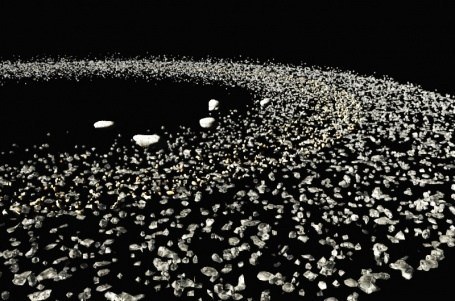
The asteroid belt can be found between which two planets?
a)
Earth and Mars
b)
Venus and Earth
c)
Saturn and Uranus
d)
Mars and Jupiter
84.

Name that phase!
a)
New Moon
b)
Full Moon
c)
Waxing Crescent
d)
Waning Gibbous
85.

Name that phase!
a)
Waxing Crescent
b)
Waning Crescent
c)
Full Moon
d)
Waxing Gibbous
86.

Name that phase!
a)
First Quarter
b)
Full Moon
c)
New Moon
d)
Waxing Crescent
87.

Name that phase!
a)
Waxing Gibbous
b)
Waning Gibbous
c)
Full Moon
d)
New Moon
88.

Name that phase!
a)
Waning Gibbous
b)
Waxing Gibbous
c)
Full Moon
d)
Waning Crescent
89.

Name that phase!
a)
Full Moon
b)
First Quarter
c)
Waning Gibbous
d)
Last Quarter
90.

Name that phase!
a)
Waning Crescent
b)
Waxing Crescent
c)
New Moon
d)
Full Moon
91.
What is illuminating the Moon?
a)
Nuclear Fusion
b)
Sunlight
c)
Mirrors
d)
Flood Lights
92.

What allows us to see the non-illuminated portion of the Moon?
a)
The Sun reflecting off the Earth
b)
The city lights from big cities
c)
Starlight
d)
The reflecting off Mars
93.
The phases of the moon, IN ORDER, are:
a)
new moon-->waxing gibbous-->1st quarter-->waxing crescent-->full moon-->waning crescent-->3rd quarter-->waning gibbous
b)
new moon-->waning crescent-->1st quarter-->waning gibbous-->full moon-->waxing gibbous-->3rd quarter-->waxing crescent
c)
new moon-->1st quarter-->waxing crescent-->waxing gibbous-->full moon-->waning gibbous-->waning crescent-->3rd quarter
d)
new moon-->waxing crescent-->first quarter-->waxing gibbous-->full moon-->waning gibbous-->3rd quarter-->waning crescent
94.

If these three bodies are lined up with each other, what would this diagram represent?
a)
full moon
b)
new moon
c)
lunar eclipse
d)
solar eclipse
95.

If the sun, moon, and Earth are lined up, what does this diagram represent?
a)
full moon
b)
new moon
c)
lunar eclipse
d)
solar eclipse
96.

Waning means to be...
a)
Going away
b)
Growing
c)
Gaining light
d)
Moving
97.
Asteroids are made out of...
a)
Stone and metals like Iron
b)
Gases like hydrogen and helium
c)
Rocks and Ice
d)
Coma, helium cloud, nucleus
98.

Asteroids and Comets orbit around...
a)
Their axis
b)
The Earth
c)
The Sun
d)
Each other
99.
Meteors are often seen as what?
a)
Particles from space
b)
Fast moving streaks of light
c)
Stars
100.
_______ is a planet whose atmosphere may contain a lot of methane gas.
a)
Uranus
b)
Earth
c)
Mars
d)
Mercury
101.
Jupiter’s Great Red Spot is a
a)
Vast Canyon
b)
Raging storm
c)
Frozen ocean
d)
Massive volcano
102.
The least dense planet in the solar system is
a)
Jupiter
b)
Saturn
c)
Neptune
d)
Earth
103.

Which planet is the hottest?
a)
Mercury
b)
Venus
c)
Earth
d)
Neptune
104.

The sun is a...
a)
planet
b)
star
c)
asteroid
d)
moon
105.

Which planet is the smallest?
a)
Mercury
b)
Venus
c)
Earth
d)
Mars
106.

Which is considered to be "Earth's Twin" because it is almost the same size?
a)
Uranus
b)
Mercury
c)
Mars
d)
Venus
100 %

