
 Worksheets
2017-2018 Biomolecules CA 1 Review
Total questions: 83
Worksheet time: 2hrs 50mins
Name
Class
Date
1.
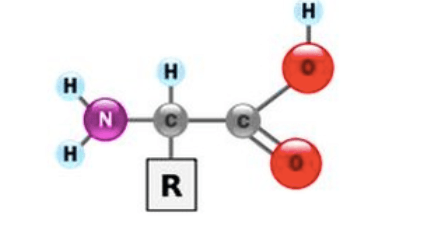
Which biomolecule is this a picture of?
a)
Protein
b)
Nucleic Acid
c)
Lipid
d)
Carbohydrate
2.
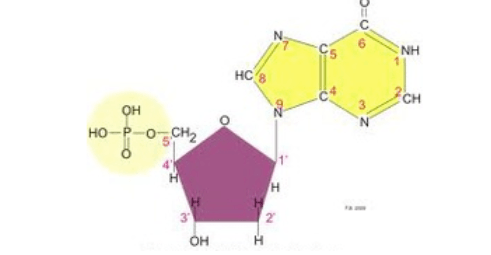
Which biomolecule is this a picture of?
a)
Protein
b)
Nucleic Acid
c)
Lipid
d)
Carbohydrate
3.
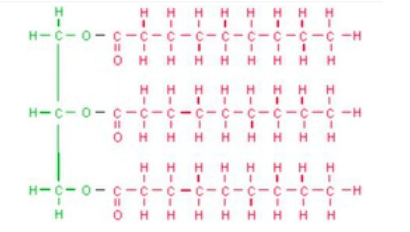
Which biomolecule is this a picture of?
a)
Protein
b)
Nucleic Acid
c)
Lipid
d)
Carbohydrate
4.
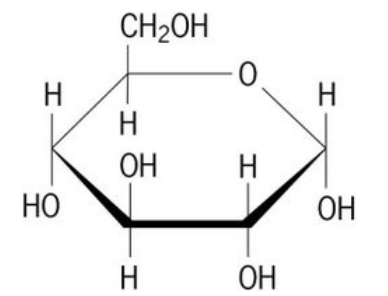
Which biomolecule is this a picture of?
a)
Protein
b)
Nucleic Acid
c)
Lipid
d)
Carbohydrate
5.
Which biomolecule is also known as enzymes?
a)
Carbohydrate
b)
Lipid
c)
Nucleic Acid
d)
Protein
6.
Which biomolecule contains pastas and breads?
a)
Lipid
b)
Protein
c)
Nucleic Acid
d)
Carbohydrate
7.
Which biomolecule is made of nucleotides and contain you DNA?
a)
Carbohydrate
b)
Lipids
c)
Protein
d)
Nucleic Acid
8.
Which biomolecule helps form muscles?
a)
Nucleic Acid
b)
Carbohydrate
c)
Protein
d)
Lipids
9.
Which biomolecule is responsible for insulation and energy storage?
a)
Protein
b)
Nucleic Acid
c)
Lipid
d)
Carbohydrate
10.
Which biomolecule has sugars and starches?
a)
Lipids
b)
Proteins
c)
Carbohydrates
d)
Nucleic Acid
11.
Which biomolecule contain your genetics?
a)
Carbohydrate
b)
Lipid
c)
Nucleic Acid
d)
Protein
12.
Which biomolecule is made of amino acids?
a)
Nucleic Acid
b)
Carbohydrate
c)
Protein
d)
Lipid
13.
Which biomolecule is your main source of energy?
a)
Nucleic Acid
b)
Protein
c)
Lipid
d)
Carbohydrate
14.
Which biomolecule contains fats, oils, and waxes?
a)
Proteins
b)
Nucleic Acid
c)
Lipids
d)
Carbohydrate
15.
Which of the following is not a carbon compound?
a)
Carbohydrates
b)
Lipids
c)
Nucleic Acids
d)
Vitamins
16.
Which biomolecule includes fats, such as triglycerides, oils, waxes, and steroids (cholesterol); insoluble in water; provides energy storage, insulation, part of cell membrane, and hormones
a)
Nucleic Acid
b)
Lipids
c)
Carbohydrate
d)
Protein
17.
Which biomolecule contains Deoxyribonucleic acid; a sequence of bases that makes hereditary code; Ribonucleic acid; translate hereditary code into proteins that determine how the cell will function under various conditions; provides storage and retrieval of information; encode genes, gene expression, helps make proteins
a)
Nucleic Acid
b)
Lipid
c)
Carbohydrate
d)
Protein
18.
Steroids are a type of ________.
a)
Nucleic Acid
b)
Lipid
c)
Cholesterol
d)
Protein
19.
What do monomers do?
a)
Bonds to make a Polymer
b)
Creates Protiens
c)
Stores energy
d)
Splits to make more cells
20.
Four most common elements that make up all living things are carbon, hydrogen,
a)
nitrogen, and iron.
b)
oxygen, and nitrogen.
c)
calcium, and phosphorus.
d)
oxygen, and iron.
21.
The chemical reaction that breaks down a molecule by adding water is
a)
Dehydration Synthesis
b)
Hydrophobia
c)
Hydrolysis
d)
Dehydration
22.
The process that builds molecules by removing water to bind them together is
a)
Hydrolysis
b)
Protein Synthesis
c)
Dehydration Synthesis
d)
Lysis
23.
Which foods are high in protein?
a)
Meats, cheeses, milk, eggs
b)
Breads, pasta, grains
c)
Butter, oil, lard
d)
Apples, Bananas, Grapes
24.
What is the functions of lipids?
a)
Quick source of energy
b)
Builds muscles, skin, enzymes
c)
Stores genetic information
d)
Stores energy, insulation, protection
25.

Identify the biomolecule
a)
Protein
b)
Lipid
c)
Carbohydrate
d)
Nucleic Acid
26.
Which foods are a quick energy source?
a)
Meats, Yogurt, Cheese
b)
Ice Cream, Candy, Cookies
c)
Fruits, Vegetables, Whole Grains
d)
Butter, Lard, Oil
27.
Lipids are made of
a)
monosaccharides
b)
amino acids
c)
glycerol and 3 fatty acids
d)
nucleotides
28.
Which examples are a sources of energy?
a)
Starch, cellulose, glycogen
b)
Valine, Histidine, Cysteine
c)
DNA, RNA
d)
Unsaturated and Saturated Fats
29.
What does the word organic mean?
a)
has nitrogen
b)
has sulfur
c)
has carbon
d)
has oxygen
30.
The more bonds a molecule has, the more....
a)
water is stored
b)
force is stored
c)
energy is stored
d)
oxygen is stored
31.
The monomer of a carbohydrate is a:
a)
Monosaccharide
b)
Amino Acid
c)
Nucleotide
d)
Glycerol+Fatty Acid
32.
The monomer of a lipid is:
a)
Monosaccharide
b)
Amino Acid
c)
Nucleotide
d)
Glycerol+Fatty Acid
33.
The function of a carbohydrate is:
a)
Genetic Material
b)
Body structures (hair, muscle, etc)
c)
1st Source of Energy
d)
2nd Source of Energy
34.
The function of a lipid is:
a)
Genetic Material
b)
Body Structures (hair, muscles, etc)
c)
1st Source of Energy
d)
2nd Source of Energy
35.
You use more calories than are eaten/readily available, your body now uses ____________ for energy.
a)
Carbohydrates
b)
Lipids
c)
Proteins
d)
Nucleic Acids
36.
An example of a polymer is:
a)
A polysaccharide
b)
A disaccharide
c)
An amino acid
d)
A nucleotide
37.
Lipids are soluble in water.
a)
True
b)
False
38.
The bonds between amino acids are called
a)
peptide bonds
b)
double bonds
c)
triple bonds
d)
carbon bonds
39.
I contain C, H, O, N.
a)
Protein
b)
Lipid
c)
Nucleic Acid
d)
Carbohydrate
40.
All 4 biomolecules -
a)
Contain C, H, O, N
b)
Contain C, H, O
c)
Are made up of Sulfur
d)
Are made up of Amino Acids
41.
Which option does not belong here?
a)
Carbohydrate
b)
Lipid
c)
Nucleotide
d)
Protein
42.
Cell membrane is an example of -
a)
Lipid
b)
Carbohydrate
c)
Protein
d)
Nucleic Acid
43.
Which statement is true about phospholipids?
a)
they repair and build muscles
b)
they store genetic information
c)
they produce quick energy
d)
they do not dissolve with water
44.
Which of the following biomolecule contains both Nitrogen & Phosphate?
a)
Carbohydrate
b)
Lipid
c)
Protein
d)
Nucleic Acid
45.
Both Carbohydrate & Lipids contain C, H, and O. How can we distinguish between these 2 biomolecules?
a)
Carbohydrate have more oxygen
b)
In lipids, the # of carbon equals the number of oxygen
c)
In carbohydrate, the # of carbon equals the number of oxygen
46.
Which biomolecules does not provide us with any energy?
a)
Carbohydrate & Lipid
b)
Protein & Lipid
c)
Protein & Nucleic Acid
d)
Nucleic Acid & Lipid
47.
What is another word for monomer?
a)
Building Blocks
b)
Polymer
c)
Protein
48.
The word "saccharide" means:
a)
sugar
b)
protein
c)
amino acids
49.

Amino acids combine to form which of the following biomolecule?
a)
Carbohydrates
b)
Lipids
c)
Proteins
d)
Nucleic Acids
50.

Glycerol and fatty acids combine to form...?
a)
Carbohydrates
b)
Lipids
c)
Proteins
d)
Nucleic Acids
51.
Oils are which type of biomolecule?
a)
carbohydrates
b)
lipids
c)
nucleic acids
d)
proteins
52.
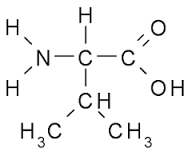
Carbon, Hydrogen, Oxygen and Nitrogen are elements in what biomolecule?
a)
Carbohydrate
b)
Lipid
c)
Protein
d)
Nucleic acid
53.

All of the following are parts of a nucleotide except?
a)
Phosphate Group
b)
Nitrogen Base
c)
Amino Group
d)
Deoxyribose/Ribose sugar
54.
Which is NOT a function for Lipids?
a)
Long term Energy Storage
b)
Chubify
c)
Insulation
d)
Cell Membrane
55.
Why is protein an important part of a healthy diet?
a)
it is needed to change glucose to energy
b)
it is needed to store nutrients
c)
it is needed to repair tissue
d)
it is needed to produce water
56.

What do disaccharides, such as sucrose, and polysaccharides, such as starch, have in common?
a)
They are lipids made of fatty acids.
b)
They are proteins made of amino acids.
c)
They are nucleic acids made of nucleotides.
d)
They are carbohydrates made of simple sugars.
57.
Many plants have waxy coatings on some surfaces. This coating reduces water loss because it's not water-permeable. What type of organicmolecule is it?
a)
carbohydrate
b)
lipid
c)
nucleic acid
d)
protein
58.
What are the main molecules that make up muscle fibers?
a)
lipids
b)
proteins
c)
carbohydrates
59.
Which best represents a long term energy storage molecule in animals?
a)
cellulose
b)
cholesterol
c)
glycogen
60.
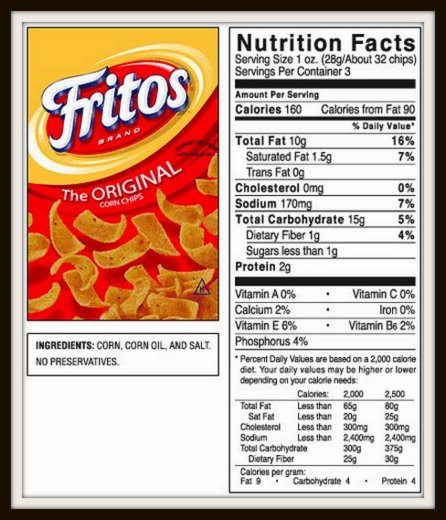
Main ingredient is?
a)
corn
b)
corn oil
c)
salt
d)
frito
61.

How many chips per serving?
a)
3
b)
32
c)
160
d)
28
62.

What % of carbs?
a)
15
b)
10
c)
160
d)
5
63.
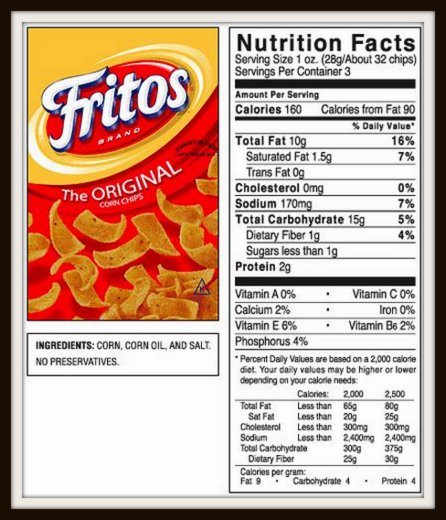
How many grams of total fat?
a)
10
b)
160
c)
15
d)
1.5
64.
How many grams of total fat?
a)
10
b)
160
c)
15
d)
1.5
65.

How many servings per bag?
a)
32
b)
96
c)
3
d)
160
66.
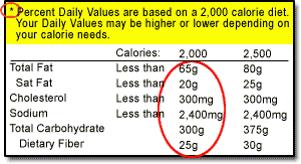
Based on a 2,000 Calorie diet, what is the total amount of fat is a person supposed to consume in a day?
a)
10g
b)
150g
c)
65g
d)
80g
67.
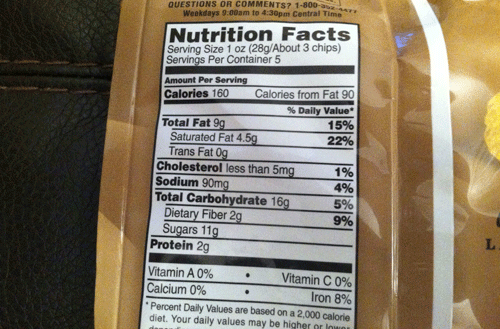
Based on the food label, if I eat 9 potato chips, how many grams of protein would I be getting?
a)
2g
b)
4g
c)
6g
d)
8g
68.
The tag on an orange says Non-GMO. What is this orange advertising?
a)
The orange is an all natural product
b)
The orange is not a genetically modified product
c)
The orange a vegan product
d)
The orange is an organic product
69.

READY-TO-SERVE
What does it mean?
What does it mean?
a)
Food you can eat without cooking
b)
Food you must cook first before you eat it
70.
Monosaccharides are what?
a)
Simple sugars
b)
30
c)
Amino acids
d)
Glucose
71.
Poly means...
a)
two
b)
one
c)
many
72.
If you change the shape of a protein, will it work the same/properly?
a)
Yes
b)
No
73.

The bond that joins amino acids are called:
a)
Peptide Bonds
b)
Ester Bonds
c)
Glycosidic Linkages
d)
Phosphodiester Bonds
74.

The diagram shows a bond forming between two amino acids. What is the name of this reaction?
a)
Dehydration Synthesis
b)
Hydrolysis
c)
Pepysis
d)
Oxidation
75.

Which macromolecule is this?
a)
carbohydrate
b)
lipid
c)
protein
d)
nucleic acid
76.

These molecules are examples of ________.
a)
monosaccharides
b)
amino acids
c)
triglycerides
d)
fatty acids
77.

Which macromolecule is this?
a)
carbohydrate
b)
lipid
c)
protein
d)
nucleic acid
78.

Which of the following molecules make up the basic structure of a cell membrane?
a)
waxes
b)
steroids
c)
fatty acids
d)
phospholipids
79.

This molecules is a
a)
amino acid
b)
nucleic acid
c)
carbohydrate
d)
lipid
80.

This molecule is...
a)
Saturated
b)
Unsaturated
81.

Which macromolecule is this?
a)
carbohydrate
b)
lipid
c)
protein
d)
nucleic acid
82.

What type of carbohydrate is this?
a)
polysaccharide
b)
disaccharide
c)
monosaccharide
d)
it isn't a carbohydrate
83.
Which is not a chemical element needed to build sugars?
a)
Carbon
b)
Oxygen
c)
Nitrogen
d)
Hydrogen
100 %

