
 Worksheets
Atoms
Total questions: 64
Worksheet time: 1hrs 3mins
Name
Class
Date
1.
How did Rutherford discover the proton?
a)
Cathode tube ray experiment
b)
Gold Foil Experiment
c)
Planetary Model
d)
Plum Pudding Model
2.
If an atom has more protons that electrons, it will have a ___ charge?
a)
Positive
b)
Negative
c)
Neutral
d)
No charge, it would just disappear
3.
If an atom has an equal amount of Protons and electrons, what will its’ charge be?
a)
Positive
b)
Negative
c)
Neutral
d)
Infinite
4.
If an atoms has more electrons that Protons, what will its’ charge be?
a)
Positive
b)
Negative
c)
Super Negative
d)
Super Positive
5.
Which determines the mass of an element?
a)
Protons
b)
Neutrons
c)
Electrons
d)
Only Protons and Neutrons
6.
Experiments with cathode rays led to the discovery of the
a)
electrons
b)
nucleons
c)
protons
d)
neutrons
7.

Rutherford’s experiment determined that the nucleus of an atom is tiny, dense and ______ charged.
a)
neutrally
b)
negatively
c)
positively
8.

The smallest particle of an element that still retains all the properties of that element.
a)
atom
b)
cathode ray
c)
electron
d)
compound
9.

What did James Chadwick discover?
a)
Neutron
b)
Proton
c)
Electron
d)
Electron Cloud
10.
Atoms of different elements are exactly alike
a)
Always true
b)
Always false
c)
Sometimes true
11.

Electrons can be found in
a)
The protons
b)
The nucleus
c)
Electron Clouds
d)
exact locations
12.

This particle is found in the nucleus and has no charge.
a)
Neutron
b)
Proton
c)
Electron
d)
quark
13.
The first person to ever talk about an atom was
a)
Democritus
b)
Rutherford
c)
Dalton
d)
Schrodinger
14.
Cations are
a)
positive
b)
negative
c)
on the right side of the periodi table.
d)
nonmetals
15.
Ions are:
a)
atoms with a positive or negative charge
b)
atoms with no charge
c)
atoms with ONLY a positive charge
d)
atoms with ONLY a negative charge
16.
Negative ions form when atoms _________ valence electrons.
a)
lose
b)
gain
c)
share
17.

How many neutrons does the isotope of lithium have?
a)
8
b)
3
c)
4
d)
5
18.

What do these isotopes of carbon all have in common?
a)
neutrons & mass number
b)
atomic number and neutrons
c)
atomic number and electrons
d)
protons, atomic number, and mass number
19.
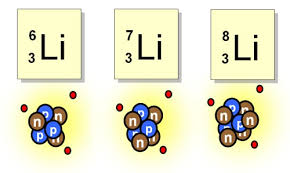
which atom has 4 neutrons?
a)
Li-6
b)
Li-7
c)
Li-8
d)
they have the same # of neutrons
20.

which explanation of this notation is correct?
a)
12 is proton #
b)
6 tells you there are 6 neutrons
c)
6 tells you there are 6 protons
d)
12 is not a mass # here
21.
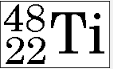
How many protons does this isotope of titanium have?
a)
48
b)
22
c)
26
d)
70
22.

How many protons does an Aluminum atom have? (use the picture to help you)
a)
27
b)
13
c)
14
d)
40
23.
He determined the mass of an electron and confirmed it’s charge in 1909 as a result of oil drop experiments.
a)
Thompson
b)
Chadwick
c)
Millikan
d)
Democritus
24.
He believed that all matter was continuous and that four basic elements existed (earth, wind, fire, water).
a)
Democritus
b)
Aristotle
c)
Chadwick
d)
Thomson
25.

The drawing above is Thomson’s ________.
a)
cathode ray tube experiment
b)
oil drop experiment
c)
gold foil experiment
26.
What would an isotope of Calcium-20 be?
a)
Calcium-22
b)
Calcium-24
c)
Calcium-26
d)
All of the Above
27.

What is this type of notation called?
a)
Scientific notation
b)
Isotope notation
c)
Ion notation
d)
Element notation
28.
What is Niels Bohr responsible for discovering?
a)
That electrons are inside the nucleus
b)
That electrons are in fixed orbits around the nucleus
c)
That electrons are small
d)
That electrons are negative
29.
Each column in the periodic table is called a
a)
period
b)
group
c)
cluster
d)
unit
30.
The atomic number tells you what?
a)
number of electrons
b)
number of protons
c)
number of neutrons
d)
both electrons and protons in an atom.
31.
Which group of the periodic table is composed of inert (not reactive) gases?
a)
alkali metals
b)
alkaline earth metals
c)
halogens
d)
noble gases
32.
Elements which are shiny, conduct electricity and heat are called
a)
metal
b)
nonmetal
c)
metalloid
d)
nonexistent
33.

The atoms along the staircase are called
a)
metals
b)
nonmetals
c)
metalloids
d)
noble gases
34.
Which is the electron configuration for an oxygen atom?
a)
1s22s22p63s23p64s2
b)
1s22s22p4
c)
1s22s22p6
d)
1s22s22p63s23p6
35.
How many d orbitals are there in a given sublevel?
a)
1
b)
3
c)
5
d)
7
36.
How many p orbitals are there in a sublevel?
a)
2
b)
1
c)
4
d)
3
37.
How many electrons can the d sublevel hold?
a)
8
b)
10
c)
2
d)
4
38.
What is the shorthand electron configuration for Sulfur atom?
a)
[Ar] 3p4
b)
[He] 3s23p4
c)
[Ne] 3s23p4
d)
[Na] 3s23p3
39.

Which element is pictured?
a)
neon
b)
fluorine
c)
magnesium
d)
argon
40.
What noble gas should be used to write the shorthand configuration for Te?
a)
Ar
b)
Kr
c)
Xe
d)
Sb
41.
Electron arrangement that uses arrows
a)
Electron configuration
b)
Shorthand configuration
c)
Lewis dot structure
d)
Orbital diagram
42.
What atom matches this electron configuration?
[Xe] 6s2 4f14 5d9
[Xe] 6s2 4f14 5d9
a)
Mercury
b)
Gold
c)
Platinum
d)
Thallium
43.
Which of the following is a p block element?
a)
Ca
b)
Ar
c)
Re
d)
Au
44.

How many neutrons are in a Gold atom?
a)
79
b)
196
c)
118
d)
275
45.
The electrons of an atom are found...
a)
in the outer "cloud" surrounding the atom.
b)
in the nucleus of the atom.
c)
in the cloud and in the nucleus.
46.
What atom matches this electron configuration?
1s2 2s2 2p6 3s2
1s2 2s2 2p6 3s2
a)
Neon
b)
Magnesium
c)
Aluminum
d)
Potassium
47.
In the modern periodic table elements are arranged by:
a)
atomic mass
b)
atomic number
c)
valence electrons
d)
number of isotopes
48.

How many electrons does Si contain? (click to see image)
a)
14
b)
28
c)
2
d)
4
49.
Which is a halogen?
a)
Helium
b)
Chlorine
c)
Oxygen
d)
Neptune
50.
There are 4 different types of subshells s,p,d,f
a)
true
b)
false
51.
Which is an alkali metal?
a)
Magnesium
b)
Iron
c)
Sodium
d)
Europium
52.
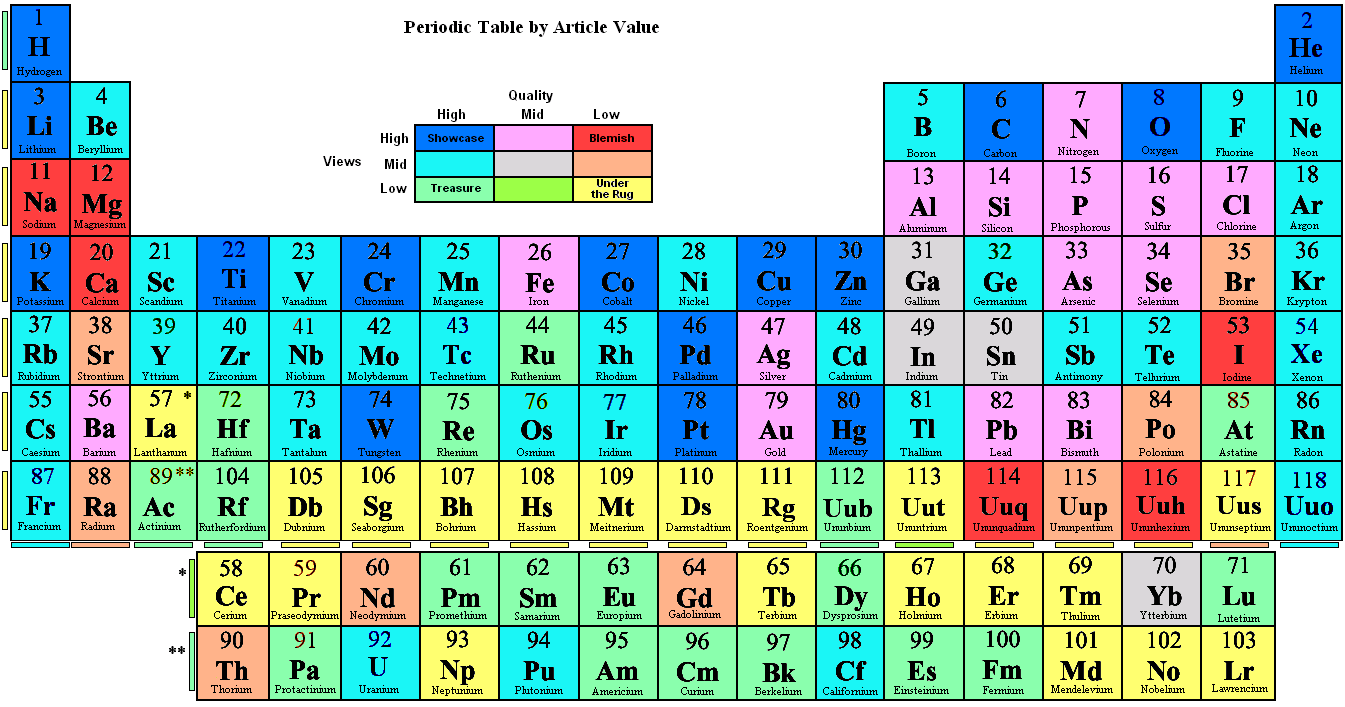
The period for Bromine is ___________.
a)
3
b)
2
c)
4
53.
Which of the following is not a property of metals?
a)
brittle
b)
malleable
c)
lustrous
d)
conductive
54.
What atom matches this electron configuration?
1s22s22p63s23p64s23d10
1s22s22p63s23p64s23d10
a)
Zinc
b)
Copper
c)
Nickel
d)
Germanium
55.
What do you start electron configuration with?
a)
1s2
b)
1d10
c)
1f14
d)
1p6
56.
What is the shape of an s orbital?
a)
sphere
b)
dumbbell
c)
double dumbbell
d)
TOO COMPLEX TO KNOW IT.
57.
What is the shape of a p orbital?
a)
sphere
b)
it's just too complex to think about it
c)
dumbbell
d)
I don't know this stuff.
58.
How many total electrons can the f orbitals in a sublevel hold?
a)
2
b)
14
c)
6
d)
10
59.
Rows on the period table are called _____ while columns are called _____.
a)
groups, families
b)
groups, periods
c)
periods, groups
d)
families, groups
60.
Why do we use the three electron configuration rules: Hund's Rule, Aufbau Principle, and Pauli Exclusion Principle?
a)
to know where electrons are located
b)
to know how electrons are oriented in space
c)
to know how electrons are used in chemical reactions
d)
all of these
61.

This image is a ___________ and is of the element __________.
a)
electron configuration, nitrogen
b)
electron configuration, potassium
c)
orbital diagram, nitrogen
d)
orbital diagram, potassium.
62.
Hydrogen is placed separately from other elements in the periodic table because it
a)
is a gas.
b)
does not exist as a free element in nature.
c)
has many unique properties.
d)
has atomic number one.
63.
The major difference between a 1s orbital and a 2s orbital is that
a)
the 2s orbital can hold more electrons.
b)
the 2s orbital is at a higher energy level.
c)
the 2s orbital has a slightly different shape.
d)
the 1s orbital can have only one electron.
64.
Both copper (atomic number 29) and chromium (atomic number 24) appear to break the pattern in the order of filling the 3d and 4s orbitals. This change in pattern is expressed by
a)
a reduction in the number of electrons in the 4s orbital and an increase in the 3d orbital.
b)
a reduction in the number of electrons in both the 3d and 4s orbitals.
c)
a reduction in the number of electrons in the 3d orbital and an increase in the 4s orbital.
d)
an increase in the number of electrons in both the 3d and 4s orbitals.
100 %

