
 Worksheets
Chapter 1 Classification
Total questions: 50
Worksheet time: 35mins
Name
Class
Date
1.
What is the internal state of balance called?
a)
Stimulus
b)
Response
c)
Homeostasis
d)
Homozygous
2.
A stimulus is ___________
a)
a change in an organisms surroundings that causes a reaction
b)
process in which organisms grow larger.
c)
a reaction to a change in surroundings
d)
the result of sexual reproduction.
3.
Which of the following is an example of an external Stimuli?
a)
Becoming dehydrated and then taking a drink of water
b)
Getting a headache and then taking Excedrin
c)
Having hunger pains and then eating a sandwich
d)
Smelling Pizza and then eating a piece
4.
There is high temperature outside. What type of response can a person's body have to regulate body temperature?
a)
Wearing a jacket
b)
Sweating
c)
Taking an ice bath
d)
Wearing a visor
5.
A stimulus type that occurs within the organisms body is
a)
external
b)
inside
c)
within
d)
internal
6.

What type of stimuli is pictured here?
a)
Internal
b)
External
c)
Response
d)
Tropism
7.
A tadpole only grows in size while changing into a frog.
a)
True
b)
False
8.
Choose which characteristic of life best represents this statement. Green plants produce their own food through the process of photosynthesis.
a)
All living things use energy
b)
All living things contain cells
c)
All living things maintain homeostasis
d)
All living things grow
9.
An amoeba is a unicellular organism. Which characteristic of life is this?
a)
All living things use energy
b)
All living things contain cells
c)
All living things respond to their environment
d)
All living things grow
10.
Over three years, Tim's height has increased from 5'4" to 5'11".
a)
All living things contain cells
b)
All living things maintain homeostasis
c)
All living things use energy
d)
All living things grow
11.
A sea worm drops its tail and the tail becomes a new worm.
a)
All living things contain cells
b)
All living things grow
c)
All living things have different levels of organization
d)
All living things reproduce
12.

Where does the grasshopper get its energy?
a)
Hawk
b)
Spider
c)
Grasshopper
d)
Plant
13.
Aristotle placed all organisms in how many groups?
a)
2
b)
3
c)
4
d)
5
14.
Which of the following is an example of binomial nomenclature?
a)
Moon Jelly
b)
Jelly fish
c)
Chrysaora fuscescens
d)
Cnidarian
15.
A wolf's scientific name is Canis rufus. Which genus does it belong to?
a)
Canis
b)
rufus
c)
wolf
d)
animal
16.

The taxon (group) with the largest amount of organisms grouped together is
a)
species
b)
phylum
c)
genus
d)
domain
17.
Which of the following is NOT true when comparing scientific names and common names?
a)
Scientific names vary from place to place.
b)
Common names vary from place to place.
c)
Scientific names are in Latin.
d)
There can be multiple common names for one organism.
18.
Which is the correct way of writing the scientific name for human?
a)
homosapien
b)
homo sapien
c)
Homo sapien
d)
Homo Sapien
19.
The method of naming organisms by using two names is known as
a)
binomial nomenclature
b)
dinomial menoclature
c)
dichotomous naming
d)
the scientific method
20.
The 8 levels of classification, from most broad to most specific, are
a)
Domain, Genus, Family, Order, Class, Phylum, Kingdom, Species
b)
Domain, Species, Kingdom, Genus, Phylum, Family, Class, Order
c)
Domain, Kingdom, Phylum, Class, Order, Family, Genus, Species
d)
Order, Kingdom, Species, Domain, Phylum, Family, Class, Genus
21.
Which of the following characteristics will most likely be helpful in identifying a butterfly using a dichotomous key?
a)
Migrates north every spring
b)
hangs on branches
c)
flutters wings fast on hot days
d)
Wings have long extensions
22.
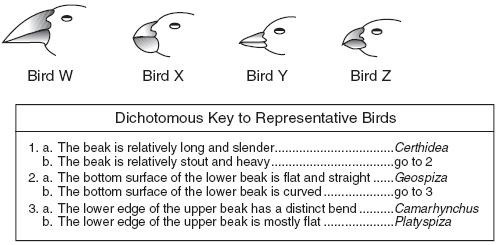
What is the name of bird W?
a)
Certhidea
b)
Geospiza
c)
Camarhynchus
d)
Platyspiza
23.
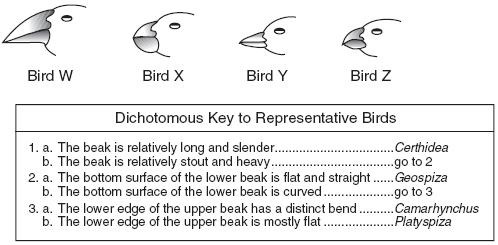
What is the name of bird Z?
a)
Certhidea
b)
Geospiza
c)
Camarhynchus
d)
Platyspiza
24.
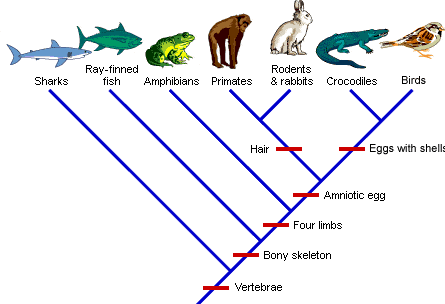
According to this cladogram, sharks are MOST closely related to which organism?
a)
Amphibians
b)
Ray finned fish
c)
Crocodiles
d)
Birds
25.
Which of the following is a cladogram most like?
a)
Family Tree
b)
A data table
c)
A model
d)
A concept map
26.
Anton Van Leeuwenhoek and __________ were credited for early microscopes.
a)
Lamarck
b)
Darwin
c)
Hooke
d)
Queen Elizabeth
27.
What types of microscope allows scientists to study extremely small things like cell structures?
a)
Light microscope
b)
Transmission electron microscope
c)
Scanning electron microscope
d)
Compound microscope
28.
Who was the person who used his microscope to observe a thin slice of cork, and concluded that the cork was made up of cells?
a)
Robert Hooke
b)
Bill Nye
c)
Matthias Schleiden
d)
Rudolf Virchow
29.
A compound light microscope will use _______ or more lenses at the same time.
a)
1
b)
2
c)
3
30.
Find total magnification for:
Eyepiece = 10X
Objective lens = 4X
Eyepiece = 10X
Objective lens = 4X
a)
4x
b)
6x
c)
14x
d)
40x
31.
What type of microscope allows scientists to see moving organisms?
a)
Light microscope
b)
Scanning electron microscope
c)
Transmission electron microscope
32.
What type of microscope allows scientists to study an object's surface?
a)
Light microscope
b)
Scanning electron microscope
c)
Transmission electron microscope
d)
Compound microscope
33.
Which of the following is not a reason people in the health care field use microscopes?
a)
Shot placement
b)
Surgeries
c)
Analyze body fluids
d)
Determine if tissues are healthy or diseased
34.
Which of the following is NOT one of the six kingdoms?
a)
Eukarya
b)
Bacteria
c)
Archaea
d)
Protista
35.
Which of the following kingdoms contains organisms that can make their own food through a process called photosynthesis?
a)
Fungi
b)
Plantae
c)
Animalia
d)
Archaea
36.
To which kingdom do humans belong?
a)
Protista
b)
Plantae
c)
Fungi
d)
Animalia
37.
What step do we always start with when using dichotomous keys?
a)
1
b)
2
c)
3
d)
4
38.
When using a dichotomous key to identify organisms, what do we look at?
a)
physical features
b)
weather patterns
c)
environment
d)
diet
39.
A baby song bird hatches from its egg with both parent songbirds watching.
a)
All living things reproduce
b)
All living things maintain homeostasis
c)
All living things use energy
d)
All living things grow
40.
A pill bug (roly poly) eats a carrot.
a)
All living things contain cells
b)
All living things use energy
c)
All living things maintain homeostasis
d)
All living things grow
41.
A camel has eyelashes that work to keep the dust and sand out of its eyes.
a)
All living things adapt to their environment
b)
All living things grow
c)
All living things have cells
d)
All living things use energy
42.
A tulip opens in the morning at sunrise and closes in the evening at sunset.
a)
All living things have cells
b)
All living things use energy
c)
All living things respond to their environment
d)
All living things grow
43.
A cat is an organism that has a respiratory system that contains lungs and a trachea.
a)
All living things contain cells
b)
All living things maintain homeostasis
c)
All living things have different levels of organization
d)
All living things grow
44.
YOU are a multi-celled organism but an amoeba is a single celled organism.
a)
All living things have cells
b)
All living things grow
c)
All living things use energy
d)
All living things respond to their environment
45.

What is number 14?
a)
stage clips
b)
stage
c)
diaphragm
d)
light source
46.

What is number 15?
a)
light source
b)
base
c)
coarse adjustment
d)
fine adjustment
47.
You should always carry the microscope by the
a)
arm and base
b)
arm and body tube
c)
arm only
d)
the objectives
48.
When looking at a specimen on your slide, you should always start with the
a)
low objective lens
b)
medium objective lens
c)
high objective lens
d)
super extra high power lens
49.
The__________ sharpens the image under high magnification.
a)
the diaphragm
b)
fine adjustment knob
c)
coarse adjustment knob
d)
the ocular
50.
The lens you look through, closest to the top of the microscope, is called the
a)
objective lens
b)
ocular lens
c)
diaphragm
d)
light source
100 %

