
 Worksheets
Skeletal System Review
Total questions: 42
Worksheet time: 30mins
Name
Class
Date
1.
AREA WHERE LENGTH OF BONE GROWTH OCCURS, FOUND IN EPIPHYSIS
a)
PERIOSTEUM
b)
HAVERSIAN CANAL
c)
EPIPHYSEAL PLATE/LINE
d)
DIAPHYSIS
2.
THE END OF THE BONE IS CALLED
a)
EPIPHYSEAL LINE
b)
DIAPHYSIS
c)
EPIPHYSIS
d)
OSTEON
3.
THE SHAFT OF THE BONE IS CALLED
a)
HAVERSIAN CANAL
b)
DIAPHYSIS
c)
EPIPHYSIS
d)
BONE MARROW
4.
SITE OF BLOOD CELL PRODUCTION
a)
PERFORATING FIBERS/SHARPEY'S FIBER
b)
VOLKMANN'S CANAL
c)
RED MARROW
d)
ARTICULAR CARTILAGE
5.
These often cover epiphysis.
a)
Fibrocartilage
b)
articular cartilage
c)
periosteum
d)
spongy bone
6.
The ribs would be classified as:
a)
long bones
b)
short bones
c)
flat bones
d)
irregular bones
7.
An example of a irregular bone would be a
a)
vertebrae
b)
sternum
c)
rib
d)
skull
8.
The connective tissue outer covering of the bones is attached to the bone by what?
a)
periosteum
b)
articular cartilage
c)
Sharpey's fibers
d)
diaphysis
9.

a)
Frontal
b)
Nasal
c)
Parietal
d)
Temporal
10.

a)
Frontal
b)
Sphenoid
c)
Zygomatic
d)
Maxilla
11.

a)
Parietal
b)
Maxilla
c)
Zygomatic
d)
Temporal
12.

a)
Maxilla
b)
Mandible
c)
Parietal
d)
Occipital
13.

a)
Occipital
b)
Temporal
c)
Sphenoid
d)
Parietal
14.

a)
Coronal
b)
Squamous
c)
Sagittal
d)
Lambdoidal
15.

a)
Occipital condyles
b)
Zygomatic arch
c)
Foramen magnum
d)
Mastoid process
16.
Inferior portion of the sternum; made of cartilage; cone shaped
a)
coracoid process
b)
acromion process
c)
xiphoid process
d)
scapula
17.
Bones of the thoracic cavity that are not attached to the sternum; 5 lower ribs
a)
small rib
b)
floating rib
c)
true rib
d)
false rib
18.
How many lumbar vertebrae are there?
a)
5
b)
7
c)
12
d)
8
19.
How many thoracic vertebrae are there?
a)
5
b)
7
c)
12
d)
6
20.
How many cervical vertebrae are there?
a)
5
b)
7
c)
12
d)
4
21.
Which of the following is the function of the STYLOID and MASTOID Processes?
a)
Allow for muscle attachment
b)
Allow nerves to pass
c)
Allow blood vessels to pass
d)
Attach to facial bones
22.
What is the name of the vertebral bone that supports the skull and allows you to nod yes?
a)
Atlas
b)
Axis
c)
Cervical vertebrae
d)
Vertebral column
23.

Bone breaks incompletely, occurs most commonly during the infantile stages of life.
a)
Greenstick Fracture
b)
Stable Fracture
c)
Bluestick Fracture
d)
Comminuted Fracture
24.
Bone breaks into many fragments.
a)
Shattered Fracture
b)
Traction Fracture
c)
Comminuted Fracture
d)
The Magic School Bus
25.
Broken bone in which the bone is twisted apart or spiraled apart.
a)
Spiral Fracture
b)
Compression Fracture
c)
Physeal Fracture
d)
Avulsion Fracture
26.

The function of yellow bone marrow is
a)
short term energy storage
b)
long term energy storage
c)
protect the bone
d)
support the bone
27.

The Five regions of the spine are:
a)
Vetebrae,Lumbar,
Thoracic
Sacrum,
Coccygeal
Thoracic
Sacrum,
Coccygeal
b)
Fascicle, Lumbar, Sacrum, Thoracic
c)
Cervical, Thoracic, Lumbar, Sacrum, Coccygeal
d)
Cervical, Thoracic, Lumbar, Sacrum,
28.

Label D
a)
Greater tubercle
b)
Lesser tubercle
c)
Deltoid tuberosity
d)
Coronoid fossa
29.
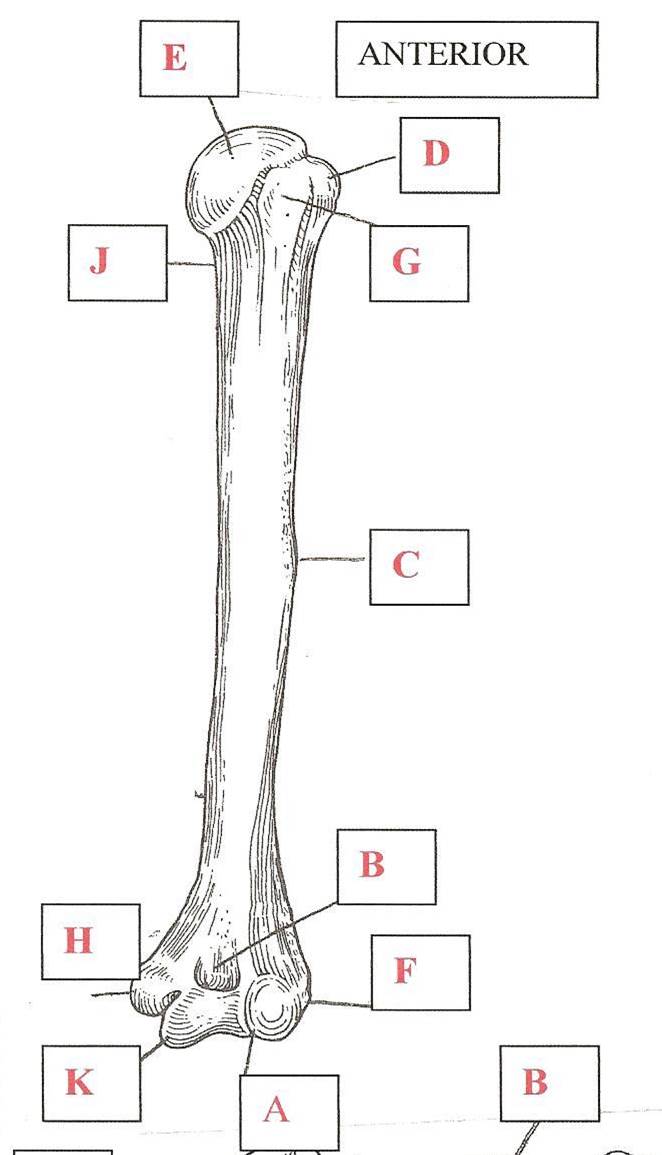
This bone is the...
a)
Femur
b)
Radius
c)
Sacrum
d)
Humerus
30.

The bone label F is indicating a marking on.
a)
Radius
b)
Ulna
c)
Humerus
d)
Fibula
31.
Bone regions united by fibrous connective tissue
a)
fibrous/suture
b)
cartilaginous/amphiarthrotic
c)
fibrous/symphysis
32.
Fibrous joints are?
a)
freely moveable
b)
partially moveable
c)
immovable
33.

Name this joint
a)
gliding
b)
saddle
c)
ball and socket
d)
condyloid
34.
Which joint allows movement in only one direction?
a)
ball and socket
b)
fiibrous
c)
hinge
d)
pivot
35.

Name this cartilaginous joint
a)
gomphosis
b)
symphysis
c)
hinge
d)
saddle
36.

Sutures, Syndesmoses, and Gomphoses are example of what type of joint?
a)
Cartilaginous
b)
Fibrous
c)
Syndesmoses
d)
Synovial
37.
________ connects bone to bone.
a)
ligament
b)
tendon
c)
muscle
d)
meniscus
38.

Name this joint
a)
gliding
b)
saddle
c)
hinge
d)
ball and socket
39.

Name this joint
a)
gliding
b)
saddle
c)
condyloid
d)
pivot
40.
What bone is also known as the clavicle?
a)
Breastbone
b)
Collarbone
c)
Shoulder Blade
d)
Hip
41.
Which structure is located on the humerus?
a)
Glenoid Fossa
b)
Trochlea
c)
Acromion
d)
Styloid Process
42.

Which marking is this?
a)
obturator foramen
b)
ischial spine
c)
ischial tuberosity
d)
acetabulum
100 %

