wayground logo

Free Printable Worksheets

Font size

S
M
L
XL
Worksheets

Chemistry Test Review Questions

Total questions: 36

Worksheet time: 6hrs 51mins

Name
Class
Date
1.

Which chemical formula best represents the molecule pictured?

a)

NH₃

b)

N₃H₃

c)

N₃H

d)

3NH

2.
What is an element? 
a)
a material that is shiny and usually hard and strong
b)
a substance made up of hydrogen and one other kind of atom
c)
a substance made of just one kind of molecule that cannot be broken down into something simpler
d)
a substance made of just one kind of atom that cannot be broken down into something simpler
3.
What does the subscript 2 show in the chemical formula H2O?
a)
There are 2 water molecules. 
b)
There are 2 oxygen atoms. 
c)
There are 2 hydrogen atoms. 
d)

all of the above

4.

When iron reacts with oxygen, it forms iron oxide, or rust. 
Fe + O2  → Fe2O3  
If 12g of iron (Fe) combines with 2g of oxygen (O2), how much rust (Fe₂O₃) is formed? 

a)

6 grams

b)

24 grams

c)

10 grams

d)

14 grams

5.
Which of the following is true about mixtures and compounds? 
a)
A mixture contains different substances that are not chemically combined with one another.
b)
Mixtures and compounds are both made of two or more different substances.
c)
A compound forms when different substances chemically combine to form a new substance.
d)
all of these 
6.
The diagram represents the reaction of methane with oxygen gas to form carbon dioxide and water.
The chemical reaction shown above takes place in a closed system. What is true about the system while the reaction occurs? 
a)
The total number of particles in the system decreases. 
b)
The total number of particles in the system increases. 
c)
The total mass of the particles in the system increases. 
d)
The total mass of the particles in the system stays the same. 
7.
Carbon dioxide is formed when two oxygen atoms chemically combine with a carbon atom. Which term best describes carbon dioxide? 
a)
compound 
b)
atom 
c)
element 
d)
mixture 
8.
What defines a mixture? 
a)
It can be described by a single chemical formula.
b)
It can be broken down into its basic substances through physical means.
c)
It can be created through a chemical reaction.
d)
It cannot be broken down into simpler substances.
9.
Over time, an iron nail reacts with water to produce iron oxide, or rust. Which of the following is a signal that rusting has taken place? 
a)
a color change on the nail from silver to reddish-brown 
b)
the release of an odor and the presence of bubbles 
c)
the release of heat and steam at the area where the mixture occurred 
d)
the appearance of sparks 
10.
Which of the following is true about pure substances? 
a)
A pure substance can always be separated by physical means.
b)
All pure substances are unable to be separated by any means.
c)
A pure substance has the same chemical properties throughout.
d)
A pure substance can only be made up of one kind of atom.
11.
Which physical property refers to the temperature at which a substance in a solid state transforms to a liquid state? 
a)
freezing point 
b)
evaporating point 
c)
melting point 
d)
boiling point 
12.
Jordan placed three blocks in a tub of water. 
What can Jordan conclude about the three blocks? 
a)
Each block is made of the same material. 
b)
Block X weighs more than block Y. 
c)
Block Z is made of a denser material than block Y. 
d)
Block Y is made of a denser material than block X. 
13.
What is oxygen's atomic number? 
a)
6A 
b)
15.994 
c)
O
d)
14.

What is one molecule of CH₄O made up of?

a)

1 carbon, 1 hydrogen, and 1 oxygen

b)

2 carbon, 2 hydrogen, and 2 oxygen

c)

1 carbon, 4 hydrogen, and 1 oxygen

d)

1 carbon, 1 hydrogen, and 4 oxygen

15.

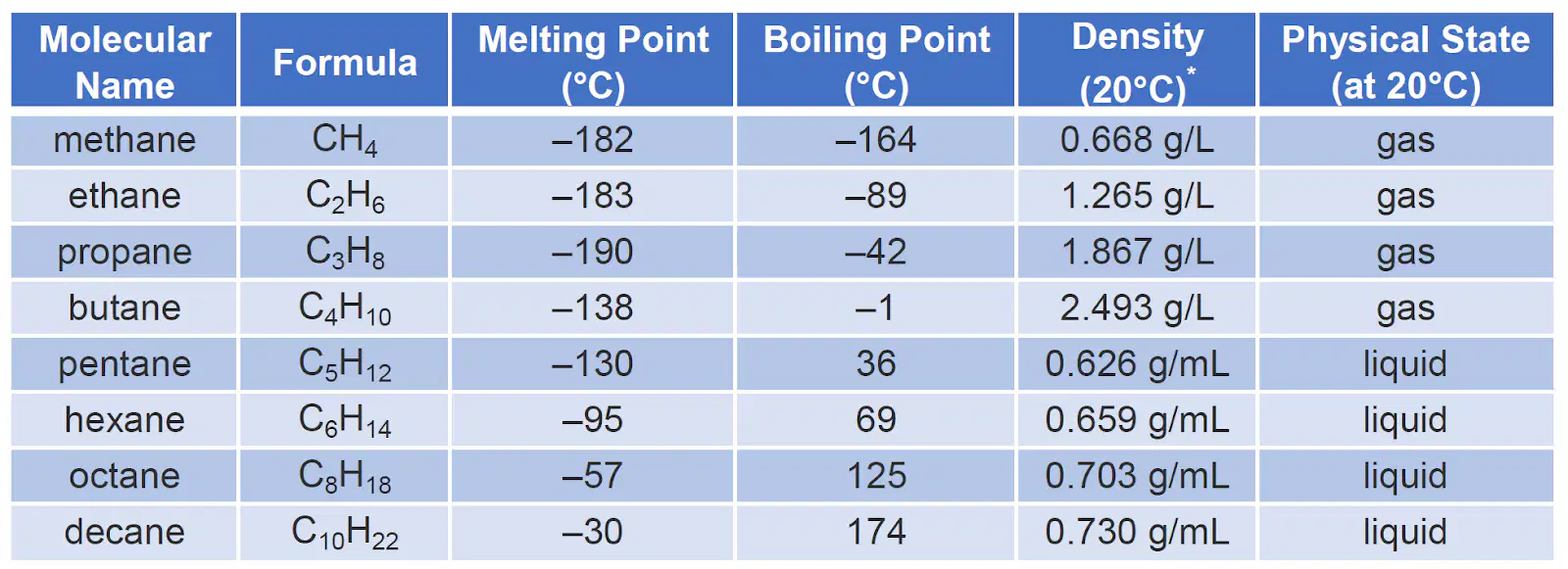
You have a gas that has a density of approximately 1.27 g/mL and boils at approximately -88.5 degrees Celisus. Which substance do you most likely have?

a)

methane

b)

ethane

c)

propane

d)

butane

16.
The chemical equation below shows the reaction of sodium (Na) and chlorine (Cl) to form sodium chloride (NaCl).
2Na + Cl2 → 2NaCl
In this equation, which of the following is a reactant?
I.  sodium
II.  chlorine
III.  sodium chloride 
a)
I, II, and III 
b)
I only 
c)
I and II only 
d)
III only 
17.
Dr. West mixes zinc (Zn) and hydrochloric acid (HCl) together in his laboratory. The two chemicals react to form hydrogen gas (H2) and zinc chloride (ZnCl2).  Which of the following are products in the chemical reaction described above? 
a)
zinc and hydrogen gas 
b)
hydrogen gas and zinc chloride 
c)
hydrochloric acid and zinc chloride 
d)
zinc and hydrochloric acid 
18.
What chemical property is present in substances that react slowly to oxygen? 
a)
melting point 
b)
the ability to rust 
c)
the ability to burn 
d)
color 
19.

How many protons are in one atom of neon (Ne)?  (hint - use the periodic table)

a)
20
b)
10
c)
20.179
d)
5
20.

Marjorie is trying to determine the identity of an unknown substance.  After running some tests, she determines that the substance is soluble in water and has a boiling point of 315 degrees celsius.  Using the data above, which of the following substances is most likely Marjorie's unknown? 

a)
SiO2
b)
NaCl 
c)
FeCl3
d)
C10H8
21.
Following a physical change:
a)
The substance always changes color.
b)
The substance always has new properties.
c)

The substance is still the same maerial as it was before the change.

d)
The substance always changes density. 
22.
An unknown material has a mass of 5.5 g and a volume of 7.75 cm3. What is the density of the material? Round to the nearest tenth. 
a)
0.7 g/cm
b)
7 g/cm
c)
1.4 g/cm
d)
1.7 g/cm3
23.
Mercury is an element. Which of the following would be the same for all atoms of mercury? 
a)
the number of electrons 
b)
the number of protons 
c)
the number of neutrons 
d)
the total number of protons and neutrons 
24.
Based on the periodic table, which of the following elements are nonmetals?
I.  cadmium (Cd)
II.  krypton (Kr)
III.  germanium (Ge)
IV.  radon (Rn) 
a)
I, II, III, and IV 
b)
IV only 
c)
II and IV only 
d)
II and III only 
25.
Which of the following is evidence of a chemical change?
a)

change in mass

b)
change in temperature
c)
change in shape
d)
change of state
26.
The chemical formula for calcium cyanamide is CCaN2. How many Carbon atoms are there in one molecule of calcium cyanamide?
a)
0
b)
1
c)
2
d)
3
27.
Your teacher tells you that in today’s science lab, you are going to make water.  If you know that water is going to be the only product, which of the following chemical equations most likely represent the chemical reaction that will occur?
a)
2H2 2H2 + O2
b)
H + Cl → HCl
c)
2H2 + O2  2H2O
d)
2N + 3H2  2NH3
28.
What elements are in the same family as Potassium?
a)
lithium (Li), sodium (Na), rubidium (Rb)
b)
iron (Fe), calcium (Ca), and copper (Cu)
c)
palladium (Pd), platinum (Pt), and darmstadtium (Ds)
d)
calcium (Ca), Sodium (Na), and magnesium (Mg)
29.
Which of the following properties is a chemical property of matter?
a)
malleability
b)
flammability
c)
conductivity
d)
color
30.
Which of the following is a physical property of matter?
a)
Melting point
b)
Malleability
c)
The ability to conduct electricity
d)
all of the above
31.

You are given an unknown substance.  Looking at the substance, you visibly distinguish different colors and different sizes of particles unevenly distributed throughout the substance.  What type of substance is this?

a)

element

b)

compound

c)

homogeneous mixture

d)

heterogeneous mixture

32.

You combine 2 liquids. They react and produce a solid product. What is this solid product?

a)

a precipitate

b)

a new substance

c)

evidence of a chemical change

d)

all of the above

33.

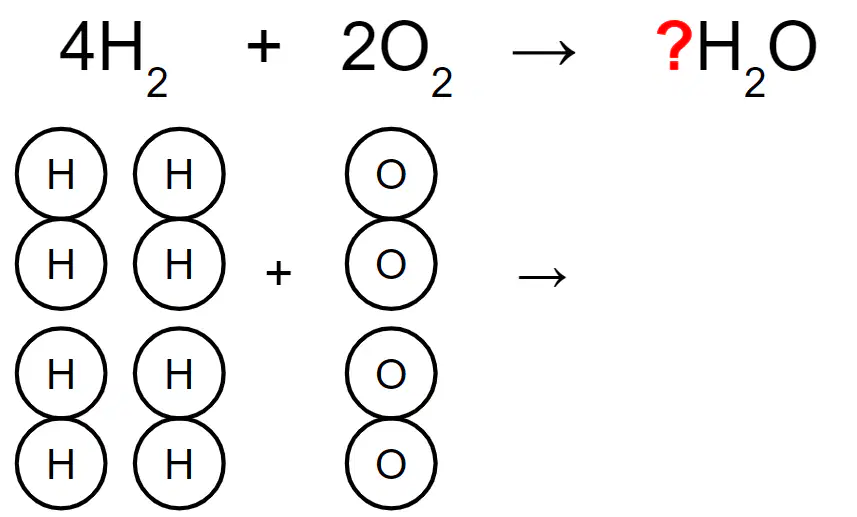
4 molecules of hydrogen (H₂) react with 2 molecule of oxygen (O₂) to produce an unknown amount of water (H₂O) molecules. How many molecules of water are produced in this reaction?

a)

2

b)

4

c)

6

d)

8

34.

What does the coeffieient mean in the formula 3H₂O?

a)

there are three atoms of hydrogen

b)

there are 3 molecules of water

c)

there are 3 molecules of hydrogen

d)

there are 6 molecules of water

35.

What physical property is calculated using mass and volume?

a)

density

b)

melting point

c)

solubility

d)

ability to react

36.

Iron reacts with oxygen to form rust.  Which chemical equation below best represents this reaction?


a)
  1. 2H₂ + O₂ ⟶ 2H₂O

b)

CO₂ + H₂O ⟶ C₆H₁₂O₆ + O₂

c)
  1. Fe + O₂ ⟶ Fe₂O₃

d)
  1. Na + Cl₂ ⟶ NaCl