
 Worksheets
BIOMOLECULES
Total questions: 71
Worksheet time: 37mins
Name
Class
Date
1.
Which biomolecule is also known as enzymes?
a)
Carbohydrate
b)
Lipid
c)
Nucleic Acid
d)
Protein
2.
Which biomolecule helps form muscles?
a)
Nucleic Acid
b)
Carbohydrate
c)
Protein
d)
Lipids
3.
Which biomolecule is responsible for insulation and energy storage?
a)
Protein
b)
Nucleic Acid
c)
Lipid
d)
Carbohydrate
4.
Which biomolecule is your main source of energy?
a)
Nucleic Acid
b)
Protein
c)
Lipid
d)
Carbohydrate
5.
Which biomolecule contains fats, oils, and waxes?
a)
Proteins
b)
Nucleic Acid
c)
Lipids
d)
Carbohydrate
6.
Which biomolecule contains Deoxyribonucleic acid; a sequence of bases that makes hereditary code; Ribonucleic acid; translate hereditary code into proteins that determine how the cell will function under various conditions; provides storage and retrieval of information; encode genes, gene expression, helps make proteins
a)
Nucleic Acid
b)
Lipid
c)
Carbohydrate
d)
Protein
7.
The monomer of a protein is called...
a)
an amino acid
b)
a monosaccharide
c)
a fatty acid
d)
a nucleotide
8.
Many monomers can be cross-linked together to form ______________.
a)
molecules
b)
plastic material
c)
polymers
d)
balloons and silly putty
9.
The chemical reaction that breaks down a molecule by adding water is
a)
Dehydration Synthesis
b)
Hydrophobia
c)
Hydrolysis
d)
Dehydration
10.
The chemical reaction that breaks down a molecule by adding water is
a)
Dehydration Synthesis
b)
Hydrophobia
c)
Hydrolysis
d)
Dehydration
11.
Identify the biomolecule
a)
Carbohydrate
b)
Lipid
c)
Protein
d)
Nucleic Acid
12.
What is the function of a nucleic acid?
a)
Stores genetic information
b)
Stores energy
c)
Quick source of energy
d)
Builds structures
13.
Nucleotides are monomer for
a)
Nucleic Acids
b)
Proteins
c)
Carbohydrates
d)
Lipids
14.
Where does the substrate bind to the enzyme?
a)
Action site
b)
Activation site
c)
Active site
d)
Inactive site
15.

What are the three parts of a nucleotide?
a)
sugar, phosphate, sugar
b)
phosphate, sugar, carb
c)
phosphate, sugar, N base
d)
phosphate, sugar, protein
16.
Proteins attach together using what bonds?
a)
Phosphorous
b)
Peptide
c)
Hydrogen
d)
Carbon
17.
Which best represents a long term energy storage molecule in animals?
a)
cellulose
b)
cholesterol
c)
glycogen
18.

What biomolecule is this a picture of?
a)
Protein
b)
Nucleic Acid
c)
Carbohydrate
d)
Lipid
19.

What are the three parts of a nucleotide that make up DNA?
a)
Disaccharide, nitrogen base, amino acid
b)
Phosphate group, protein, sugar
c)
sugar, nitrogen base, phosphate group
d)
Sugar, amino acid, nitrogen
20.
What 3 letters do enzymes typically end in?
a)
-ose
b)
-ase
c)
-ese
d)
-tic
21.

Which of the following is represented in the image?
a)
Nucleotide
b)
Carbohydrate
c)
Lipid
d)
Protein
22.
What is the shape of DNA?
a)
Double Helix
b)
Chain-link Fence
c)
Rocky Road
d)
Jamaican Twister
23.
The loss of a protein's structure is called...
a)
Denaturation
b)
Unfolding
c)
Coiling
d)
Inactivation
24.
Molecules consisting only of carbon, hydrogen, and oxygen atoms make up a large part of a plant cell wall. These molecules are classified as (4.1.1)
a)
Enzymes
b)
Proteins
c)
Cellulose
d)
Lipids
25.
Hemoglobin, insulin, albumin, and maltase, which are composed of chains of amino acids, are examples of: (4.1.1)
a)
Nucleic acids
b)
Carbohydrates
c)
Lipids
d)
Proteins
26.
The part of the enzyme that the substrate bonds to is called the _____.
a)
active site
b)
activation energy
c)
bond site
d)
peptide bond
27.
What would occur if an enzyme was placed into an acidic solution
a)
Speed up reaction
b)
remain normal
c)
Increase
d)
Denature
28.
A lock and key is sometimes used as a model to promote understanding of enzymes. Which characteristic of enzymes or their action is best illustrated by this model?
a)
The sensitivity of enzymes to changes in pH
b)
The change in activation energy the enzymes cause
c)
The specificity of fit between an enzyme and a substrate
d)
The increase in reaction rate due to the action of the enzyme
29.
What suffix is used in the names of most carbohydrates?
a)
-ase
b)
-nic
c)
-ose
d)
-yme
30.
Lipids are mostly _______________ in water.
a)
soluble
b)
insoluble
31.
Which substances are found on the surfaces and respond signals from other cells?
a)
starches and simple sugars
b)
DNA
c)
vitamins and minerals
d)
receptor molecules
32.
Examples of water soluble vitamins are ___________.
a)
Vitamin A & C
b)
Vitamin B & D
c)
Vitamin B & C
d)
VItamin E and K
33.
Vitamin D can be obtained from _______________.
a)
Carrots
b)
Wholegrain food
c)
Cereal
d)
Sunlight
34.
________ is needed to form and maintain healthy skin and for growth and development of our body.
a)
Vitamin D
b)
Vitamin A
c)
Vitamin K
d)
Vitamin E
35.
Lack of Vitamin D can lead to __________, the softening and weakening of bones, leading to bowing of legs.
a)
Osteoporosis
b)
Pellagra
c)
Spinal Bifida
d)
Rickets
36.
Found in whole-grain food, nuts and egg yolk, ___________ acts as an antioxidant.
a)
Vitamin A
b)
Vitamin D
c)
Vitamin E
d)
Vitamin K
37.
_______ and calcium are needed for normal blood clotting.
a)
Vitamin A
b)
Vitamin D
c)
Vitamin E
d)
Vitamin K
38.
Lack of vitamin B1 (thiamin) causes ___________.
a)
Beri-beri
b)
Pellagra
c)
Ariboflavinosis
d)
Spinal Bifida
39.
___________ is needed to heal cuts and wounds and to absorb iron from dark green vegetables.
a)
Vitamin A
b)
Vitamin B-group
c)
Vitamin C
d)
Vitamin D
40.
__________ can be prevented by consuming citrus food, guava and kiwi.
a)
Osteomalacia
b)
Pernicious anaemia
c)
Scurvy
d)
Dermatitis
41.
_____________ cannot be stored in the body and gets excreted through urine when not used immediately.
a)
Water-soluble vitamins
b)
Trace minerals
c)
Fat-soluble vitamins
d)
Major Minerals
42.
Beta-carotene and retinol are two types of vitamin ______.
a)
Vitamin A
b)
Vitamin B
c)
Vitamin C
d)
Vitamin D
43.
Protects against anemia and plays a role in the normal functioning of cells.
a)
Vitamin A
b)
Vitamin B-12
c)
Vitamin C
d)
Vitamin D
44.
What is a peptide bond?
a)
Bond that holds two amino acids together.
b)
A bond that holds hydrogen and oxygen molecules together.
c)
A bond that holds the phosphate group of one nucleotide and a sugar of a neighboring nucleotide.
d)
A bond that is formed by the sharing of electrons.
45.
How many different amino acids are there?
a)
15
b)
20
c)
25
d)
30
46.
Which sequence of DNA bases would pair with this partial strand
ATG TGA CAG
ATG TGA CAG
a)
ATG TGA CAG
b)
TAC ACT GTC
c)
GTA AGT GAC
d)
CAT TCA CTG
47.
Adenine bonds with ______________.
a)
Guanine
b)
Thymine
c)
Cytosine
d)
Adenine
48.
Guanine bonds with ______________.
a)
Adenine
b)
Guanine
c)
Cytosine
d)
Thymine
49.

Replicate the following strand of DNA:
AATCATGGA
AATCATGGA
a)
AATCATGGA
b)
TTAGTACCT
c)
UUAGUACCU
d)
GGATAUCUA
50.
What is the correct complimentary strand for the following DNA?ATCGAG
a)
TACGAG
b)
ATCGAG
c)
TAGCTG
d)
TAGCTC
51.
What is the difference between the sugars found in DNA and RNA?
a)
RNA contains glucose
b)
RNA contains sucrose
c)
RNA contains deoxyribose
d)
RNA contains Ribose
52.
What is the difference between DNA and RNA in terms of bases?
a)
RNA contains uracil in place of thymine
b)
RNA contains uracil in place of adenine
c)
RNA contains uracil in place of guanine
d)
RNA contains uracil in place of cytosine
53.
Which of the following statements is true?
a)
DNA is single-stranded
b)
RNA is single-stranded
c)
DNA contains uracil
d)
RNA contains deoxyribose
54.
Which type of RNA takes the instructions from the nucleus to the cytoplasm?
a)
mRNA
b)
tRNA
c)
rRNA
d)
RNA polymerase
55.
What bonds hold DNA bases together?
a)
nitrogen bonds
b)
hydrogen bonds
c)
phosphorus bonds
d)
carbon bonds
56.
Which of the following is the complementary mRNA strand for this strand of DNA? ATT-GCG-AGT
a)
UAA-CGC-TCA
b)
UAA-GCG-UCA
c)
UAA-CGC-AGT
d)
UAA-CGC-UCA
57.
Fructose is a _____________.
a)
monosaccharide
b)
disaccharide
c)
polysaccharide
d)
nonsaccharide
58.
Lactose is a ____________.
a)
monosaccharide
b)
disaccharide
c)
polysaccharide
d)
unsaccharide
59.
Maltose is a _____________.
a)
monosaccharide
b)
disaccharide
c)
polysaccharide
d)
unsaccharide
60.
Galactose is a _____________.
a)
monosaccharide
b)
disaccharide
c)
polysaccharide
d)
unsaccharide
61.
Sucrose is a _____________.
a)
monosaccharide
b)
disaccharide
c)
polysaccharide
d)
unsaccharide
62.
Glycogen is a _____________.
a)
monosaccharide
b)
disaccharide
c)
polysaccharide
d)
unsaccharide
63.
Cellulose is a _____________.
a)
monosaccharide
b)
disaccharide
c)
polysaccharide
d)
unsaccharide
64.
Fruits have a lot of __________
a)
lactose
b)
maltose
c)
fructose
d)
amylose (starch)
65.
The hydrolysis of lactose produces
a)
glucose and galactose
b)
glucose and glucose
c)
glucose and fructose
d)
maltose and fructose
66.
The hydrolysis of sucrose produces
a)
glucose and galactose
b)
glucose and glucose
c)
glucose and fructose
d)
maltose and fructose
67.
Sugar found in milk; Disaccharide composed of one glucose and one galactose molecule
a)
Sucrose
b)
Glucose
c)
Fructose
d)
Lactose
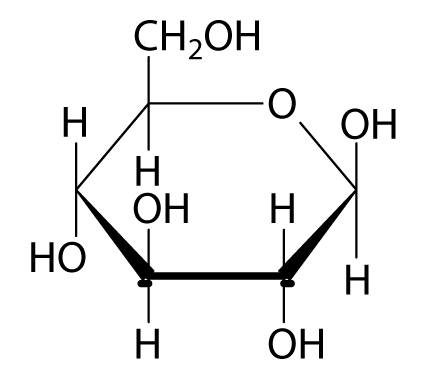
68.

What molecule is this
a)
sucrose
b)
protein
c)
glucose
d)
cellulose
69.
What types of starches are found in potatoes?
a)
Glucose
b)
Amylose and Amylopectin
c)
fructose
d)
Galactose and glucose
70.
what is the storage(s) form of carbohydrate found in mammals?
a)
Glucose and glycogen
b)
Glycogen
c)
starch
d)
Fiber and glycogen
71.
__________ are nucleic acid functions
a)
store & transfer genetic info
b)
store & create energy
c)
structure & energy for cells
d)
membrane structure and nutrient transfer
100 %

