
 Worksheets
MBC 10.3+10.4 T4 Test
Total questions: 60
Worksheet time: 1hrs 27mins
Name
Class
Date
1.

What is happening at 1?
a)
respiration: releasing CO2
b)
decomposing CO2 in the soil
c)
photosynthesis: absorbing CO2
d)
turning CO2 from the atmosphere into organic molecules
2.
How does the law of conservation of energy relates to photosynthesis?
a)
The energy from glucose is transform into light energy
b)
Light energy from the sun is converted into chemical energy in glucose
c)
Energy from carbon dioxide is converted into chemical energy in Oxygen
d)
All other answers are correct
3.

What is infiltration?
a)
When water seeps into the ground.
b)
When water vapor turns back into liquid water.
c)
Water that collects in ponds and lakes
d)
run off underground
4.

How much of the atmosphere is composed of nitrogen gas?
a)
87%
b)
38%
c)
78%
d)
21%
5.
What can excess amounts of nitrogen cause in ecosystems?
a)
Disrupts the equilibrium of ecosystem, causing number of species to decline
b)
Leads to improvement of an ecosystem due to healthy plant growth
c)
Leads to high oxygen content in aquatic ecosystems
d)
Increases the speed of decomposition of plants and animals
6.

What sphere does a volcano belong too?
a)
Atmosphere
b)
Biosphere
c)
Lithosphere
d)
Hydrosphere
7.
What is weather over a long period of time?
a)
A tropical vacation
b)
Weather
c)
Climate
d)
Science
8.
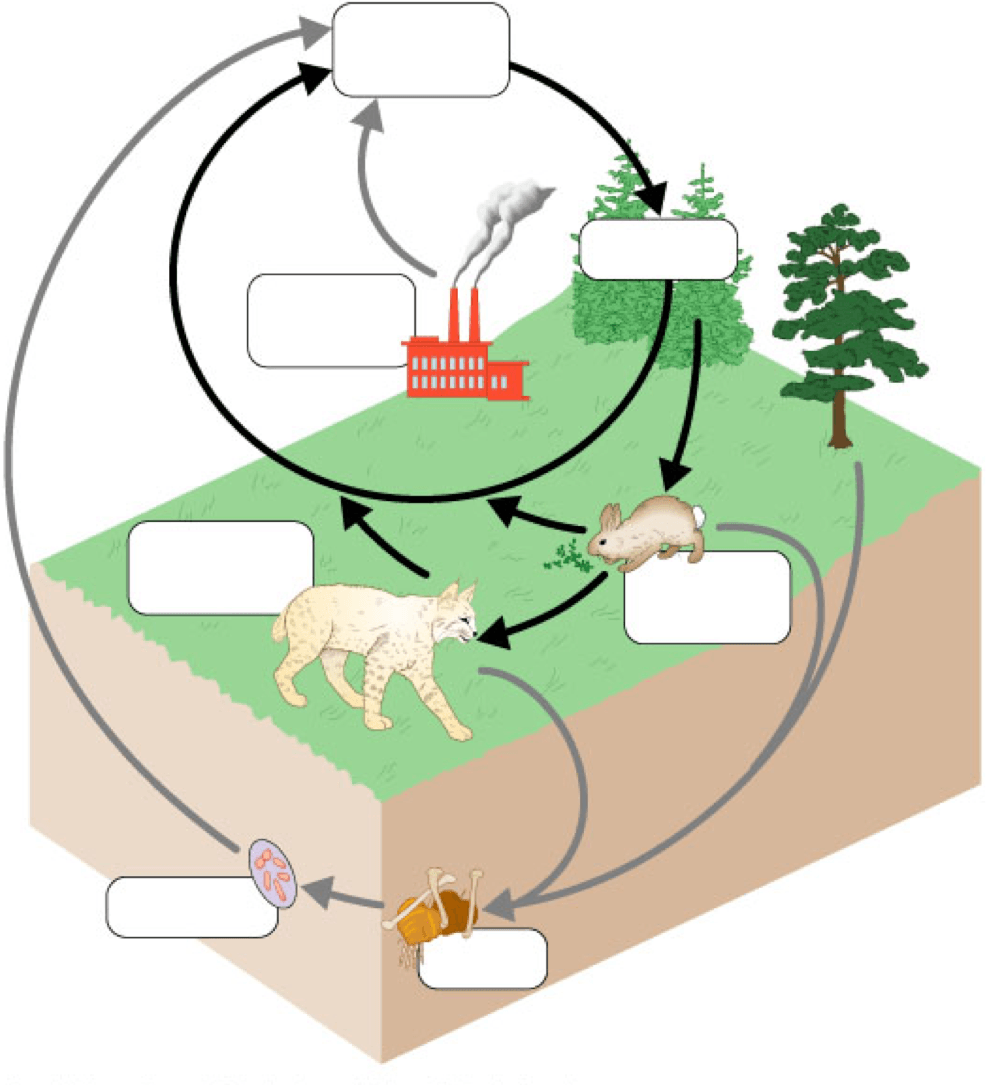
In what process is Carbon transformed into chemical energy?
a)
Photosynthesis
b)
Respiration
c)
Primary Production
d)
Secondary Production
9.
Why is the ocean important to the carbon cycle?
a)
It keeps sediment containing carbon underwater for millions of years
b)
The ocean gives out more carbon then it takes in (increases global warming)
c)
The ocean isn't important to the carbon cycle.
10.
What form is carbon in plants?
a)
CO2 gas
b)
Organic carbon compounds(carbohydrates)
c)
Carbon Solid (pure carbon)
d)
Dissolved CO2
11.
Which process moves carbon from above-ground food webs to the food web in the soil?
a)
Respiration
b)
Photosynthesis
c)
Ingestion(eating)
d)
Death and Decomposition
12.
When humans burn fossil fuels, most of the carbon quickly enters the as carbon dioxide.
a)
Water
b)
Atmosphere
c)
Sun
d)
Air
13.

When water condenses, the water vapor in the air gets ___________ and changes back into liquid.
a)
cold
b)
hot
c)
warm
d)
solid
14.

What is it called when plants give off water vapor as a waste product?
a)
condensation
b)
evaporation
c)
sublimation
d)
transpiration
15.
How do changes in the ocean affect coral reefs?
a)
Warm, acidic water causes coral to bleach and then die
b)
Coral reefs grow faster in warmer water
c)
Warmer water supports fish that like to eat coral, destroying the reefs
d)
Coral reefs aren't affected by changes in temperature and acidity
16.
Which of the following is contributing to an increase in carbon dioxide in the atmosphere?
a)
deforestation
b)
photosynthesis
c)
oceans
d)
all of the above
17.
Melting of glaciers and polar ice caps....
a)
will result in cooler temperatures in the Arctic
b)
will result in sea-levels rising
c)
Will have no effect on ecosystems
d)
None of the above
18.
What is the average weather for a particular time and region called?
a)
drought
b)
weather
c)
emissions
d)
climate
19.
What is the definition of weather?
a)
a period of abnormally dry weather that lasts at least 2 years
b)
the specific condition of the atmosphere at a particular place and time
c)
a complex community of organisms and the community's environment
d)
a release of toxic gas
20.
The warming of the atmosphere by the trapping of heat being radiated to space is called
a)
evaporation
b)
condensation
c)
the greenhouse effect
d)
radiation
21.
____________ are large streams of moving water that flow through the oceans.
a)
La Niña
b)
El Niño
c)
Currents
d)
Climate
22.
What is an enormous mass of ice moving over land?
a)
glacier
b)
iceberg
c)
ice wedging
d)
dune
23.
Energy that is transferred from one body to another as a result of a difference in temperature is called
a)
radiation
b)
kinetic energy
c)
heat
d)
chemical energy
24.

What might happen if the global conveyor stopped?
a)
Marine life would get too much oxygen
b)
Marine life would get too little oxygen
c)
There would be no effect
d)
There would be a new ice age
25.
What effect does cool temperature have on air?
a)
It causes air to sink.
b)
It causes air to blow clockwise.
c)
It causes air to rise.
d)
It causes air to blow counterclockwise.
26.
As greenhouse gases increase, oceans are becoming
a)
clearer
b)
saltier
c)
more acidic
d)
muddier
27.
The Gulf Stream ____________ nearby land areas.
a)
cools
b)
causing freezing in
c)
warms
d)
causes rain in
28.
Carbon is stored in
a)
Trees and other living things
b)
Oceans
c)
underground in soil and fossil fuels
d)
All are correct
29.
In general, surface currents that flow from the tropics toward the poles carry ______________ water.
a)
warm
b)
cold
c)
fresh
d)
oxbow lake
30.

What are the 5 main greenhouse gases?
a)
CO2, N2O, CH4, H2O, O3
b)
CO2, NO2, NH4, H2O, O2
31.

According to the Big Bang Theory, which graph best represents the relationship between time and the size of the universe from the beginning of the universe to the present?
a)
Size decreasing as time increases
b)
Size and time both increasing
c)
Size does not change as time increases
d)
Size increases, then decreases as time increases
32.
Which of the following is NOT evidence of the Big Bang Theory?
a)
Abundance of Hydrogen and Helium
b)
CMBR everywhere
c)
Stars that are blue shifted
d)
the universe is getting bigger
33.
What shape do scientists think the universe is?
a)
Sphere
b)
Triangular
c)
Saddle Shaped
d)
Flat
34.
Which statement best describes the age of our solar system and universe?
a)
Our solar system and the universe are estimated to be 5 billion years old.
b)
Our solar system and the universe are estimated to be 10 billion years old.
c)
Our solar system is at least twice as old as the universe.
d)
The universe is roughly 13.7 billion years old.
35.
Which of the following is NOT true about the Big Bang Theory?
a)
It is the scientific explanation of how life began on Earth and evolved over time.
b)
It is the scientific explanation for the origin of the universe.
c)
It states that the universe expanded from a single point and is still expanding today.
d)
It states that the universe used to be much hotter and smaller.
36.
What can we conclude from the observation that nearly all galaxies are moving away from us?
a)
Massive black holes are drawing galaxies away from Earth.
b)
The Sun and Earth are located at the center of the universe.
c)
Everything in the universe is moving the same direction.
d)
The once-smaller universe is expanding in all directions.
37.
Which of the following is not strong evidence supporting the Big Bang Theory?
a)
Presence of cosmic microwave background radiation.
b)
The frequency of the light from distant galaxies is shifted slightly towards the red
c)
The estimated age of the Earth matches the estimated age of the universe.
d)
Abundance of Hydrogen and Helium in the universe.
38.
As part of the modern theory of the origins of the elements, it is hypothesized that before the formation of the stars, most of the matter in the universe consisted of what atoms?
a)
hydrogen and helium
b)
nitrogen and carbon
c)
silicon and lithium
d)
uranium and radium
39.
Why do red-shifted light spectrums from neighboring galaxies indicate the universe is expanding?
a)
Red light has the shortest wavelength on the visible light spectrum
b)
Red light has the longest wavelength on the visible light spectrum
c)
Red light has both long and short wavelengths on the visible light spectrum
d)
Red light has neither long, not short wavelengths on the visible light spectrum
40.
Why is the abundance of H/He throughout galaxies an important piece of evidence supporting the Big Bang?
a)
H/He were two of the first elements to form following the Big Bang.
b)
H/He are highly reactive generating hot spots.
c)
H/He are high mass elements formed from supernovae.
d)
All the above
41.
Galaxies that are moving away from us are _ shifting?
a)
red
b)
blue
c)
yellow
d)
green
42.
Who first came up with the theory of the expanding universe?
a)
Hubble
b)
Newton
c)
Einstein
d)
Kepler'
43.

Where are stars the most stable?
a)
Supergiant
b)
Main sequence
c)
White dwarf
d)
black dwarf
44.

Put the stars in order from hottest to coolest.
a)
Blue, Red, White, Yellow, Orange,
b)
Red, White, Yellow, Orange, Blue
c)
Blue, White, Yellow, Red, Orange
d)
Blue, White, Yellow, Orange, Red
45.
Low-mass stars eventually collapse into what final star remnant?
a)
Black holes
b)
Neutron stars
c)
White dwarfs
d)
Nebulae
46.
The Sun makes up over 99% of the solar system's mass.
a)
True
b)
False
47.
What will the Sun become at the end of its lifecycle?
a)
red giant
b)
red dwarf
c)
white dwarf
d)
super nova
48.
What is the process that occurs in the core of a star, like the sun, that produces energy?
a)
fission
b)
fusion
c)
decay
d)
convection
49.
Which of the following stages is the earliest in the development of a star?
a)
dark nebula
b)
neutron star
c)
protostar
d)
giant
50.

What is the stage before this black hole?
a)
Supernova
b)
Neutron star
c)
white dwarf
d)
black dwarf
51.

Which star has the lowest luminosity?
a)
A
b)
B
c)
C
d)
D
52.

Which star has the lowest temperature?
a)
A
b)
B
c)
C
d)
D
53.

Which star is considered a Main Sequence Star?
a)
A
b)
B
c)
C
d)
D
54.
All stars begin as a __________?
a)
giant
b)
black hole
c)
white dwarf
d)
nebula
55.

What is the correct order for describing the stages of the life cycle of the Sun?
a)
A, B, then C
b)
A, C, then B
c)
B, C then A
d)
B, A then C
56.
______ is a force that causes dust particles to stick together in a nebula.
a)
nuclear fusion
b)
gravity
c)
hydrogen
d)
iron
57.
What is the Sun's initial (first) fuel?
a)
Iron
b)
Carbon
c)
Helium
d)
Hydrogen
58.
What is the most popular hypothesis of the formation of the moon?
a)
The moon passed very close to the earth and was caught in its gravitational pull.
b)
The moon formed the same time as the earth.
c)
The moon formed when a small planet smashed into the newly formed earth sending debris into space which formed the moon.
59.
Scientist think the Solar System is ___ years old.
a)
4,600
b)
46,000
c)
4.6 million
d)
4.6 billion
60.
How many parsecs is 10 light years?
a)
3.26
b)
307
c)
3.07
d)
326
100 %

