
NEW
Font size
S
M
L
XL
 Worksheets
populations
Total questions: 45
Worksheet time: 41mins
Name
Class
Date
1.
If the number of births in a population is the same as the number of deaths in a population, what will happen to the growth of the population?
a)
It will increase.
b)
It will decrease.
c)
It will stay the same.
d)
It will fluctuate.
2.
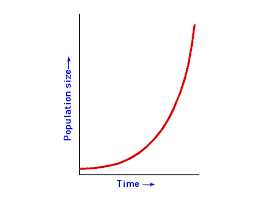
What type of growth is shown in the diagram?
a)
exponential growth
b)
logistic growth
c)
predator-prey cycle
d)
boom-bust curve
3.
What growth pattern describes a population whose growth rate slows or stops following a period of exponential growth?
a)
logistic growth
b)
population growth
c)
exponential growth
d)
predator-prey cycle
4.
If the number of births is greater than the number of deaths in a population, what will happen to the growth of the population?
a)
It will increase.
b)
It will decrease.
c)
It will stay the same.
d)
It will fluctuate.
5.
Largest number of individuals of a population that the environment can support...
a)
carrying capacity
b)
population crash
c)
lag phase
d)
mutualism
6.

Which type of growth is best illustrated by this rabbit population?
a)
exponential
b)
logistic
c)
S-shaped
d)
predator-prey
7.

When a population grows past the ecosystem's carrying capacity, what happens to the population?
a)
Continues to grow
b)
The population starts to die off to return to carrying capcity
c)
The population will go extinct due to lack of resources
d)
The population grows then finds a new carrying capacity
8.
Food, water, sunlight, shelter, and space are resources that are often __________.
a)
limiting factors
b)
wet
c)
messy
d)
found in rocks
9.
If there is more food than usual in an ecosystem, then the population will mostly likely...
a)
stay the same
b)
decrease
c)
increase
10.

Will competition increase/decrease the carrying capacity of an ecosystem for the animal in competition?
a)
Decrease
b)
Increase
11.
Natural disasters can be considered limiting factors.
a)
true
b)
false
12.
Natural disasters and weather patterns like earthquakes, floods, and tornadoes, blizzards, and heatwaves are considered ___________ ____________ limiting factors
a)
Density-dependent
b)
Density-independent
13.
Competition, disease, predation, and parasitism are considered ___________ ____________ limiting factors
a)
Density-dependent
b)
Density-independent
14.
Density-dependent limiting factors have a(n) _______________ affect on populations depending on the density of the population.
a)
similar
b)
different
15.
Exponential growth is representative of a population in an environment with ________________ resources.
a)
limited
b)
plenty of
16.

Use Figure 7-1. Population A is most likely:
a)
rapidly growing
b)
rapidly declining
c)
stable or close to stable
d)
going to decline in a few decades
17.
The total fertility rate (TFR) is an estimate of:
a)
the number of children that will survive to adulthood
b)
the number of years a typical infant will live
c)
the number of children each woman in a population will have
d)
the number of births per 1000 people per year
18.
Most demographers estimate that the human population will stabilize between ___ and ___ billion people.
a)
7.1; 8.3
b)
6.8; 10.5
c)
7.1; 12.7
d)
6.8; 8.3
19.
A species that plays a major role in determining the structure of its ecological community is
a)
a predator.
b)
a dominator species.
c)
the most abundant species in the community.
d)
a keystone species.
20.

A country with an age distribution like that shown in the figure above, is most likely a country that
a)
Is expecting rapid growth
b)
Is experiencing slow or no population growth
c)
Is experiencing a high death rate
d)
Is a less-developed country
21.
Which of the following have contributed to increased family planning worldwide?
I. women's education
II. increased income
III. advertising campaigns
I. women's education
II. increased income
III. advertising campaigns
a)
I, II, and III
b)
I and II only
c)
I and III only
d)
II and III only
22.
What is the worlds population?
a)
7 billion
b)
7 million
c)
12 billion
d)
100 billion
23.

The graph on the right best represents which country?
a)
USA
b)
Mexico
c)
Nigeria
d)
India
24.
People leaving a country
a)
Immigration
b)
Emigration
c)
Birth
d)
Death
25.
The anticipated human population by the year 2050 is about
a)
7.8 billion
b)
9 billion
c)
9 trillion
d)
78 billion
26.
Which of the following is NOT one of the factors that play a role in population growth rate?
a)
immigration
b)
death rate
c)
demography
d)
emigration
27.
Which of the following is a density-independent limiting factor?
a)
disease
b)
emigration
c)
earthquake
d)
parasitism
28.
There are 150 Saguaro cacti plants per square kilometer in a certain area of Arizona desert. To which population characteristic does this information refer?
a)
growth rate
b)
geographic distribution
c)
age structure
d)
population density
29.
The highest rate of reproduction possible
a)
population
b)
limiting factor
c)
biotic potential
d)
carrying capacity
30.
Group of organisms of one species that interbreed and live in the same place at the same time
a)
population
b)
species
c)
community
d)
biome
31.
Which of the following factors is responsible for a surge in human population growth?
a)
Famine
b)
Agriculture
c)
War
d)
Disease
32.
Temperature, sunlight, and water are examples of _______ factors.
a)
biotic
b)
abiotic
33.
Food, predators, mates are examples of _______ factors.
a)
biotic
b)
abiotic
34.
The following are examples of ___________ __________ limiting factors:
–climate, human disturbance, natural disasters
–climate, human disturbance, natural disasters
a)
density dependent
b)
density independent
35.
The following are examples of ___________ __________ limiting factors:
predation, parasitism, disease, food competition, living space, water availability
predation, parasitism, disease, food competition, living space, water availability
a)
density dependent
b)
density independent
36.
The number of wild horses per square kilometer in a prairie is the horse population's
a)
density
b)
size
c)
dispersion
37.
A flowering plant has seeds that are carried by the wind. Infer the most likely dispersion pattern of the plants that grow from these seeds.
a)
uniform
b)
clumped groups
c)
random
d)
spatial
38.
Complete:________ ________ – death rate + immigration rate – emigration rate = growth rate
a)
Growth Rate
b)
Birth Rate
c)
Capacity Rate
d)
Tax Rate
39.
Regarding population dispersion patterns, which of the following is an improper pairing
a)
random—not evenly spaced
b)
uniform—evenly spaced
c)
clumped—clustered in space
d)
random—clustered in space
40.
Even if a country has equal birthrates and death rates it can still experience
population growth due to
population growth due to
a)
Migration
b)
Doubling Time
c)
Long life expectancy
d)
High standard of living
41.

Which of the following populations has a random dispersion?
a)
flock of flamingoes
b)
herd of bison
c)
pine trees in a pine forest
d)
solitary snakes in a desert
42.

In which of the following patterns of population are organisms clustered together in groups?
a)
Random
b)
Clumped
c)
Uniform
d)
All of the above.
43.

The country with the narrowest population pyramid is:
a)
Indonesia.
b)
Brazil.
c)
Denmark.
d)
Democratic Republic of the Congo.
44.

For every 1,000 babies born in Mozambique this year, nearly 150 of them will die before they reach their 1st birthday. The rate of 150 deaths per 1,000 births is known as the:
a)
crude death rate.
b)
crude birth rate.
c)
total fertility rate.
d)
infant mortality rate.
45.

Which kind of dispersion is #1?
a)
clumped
b)
random
c)
uniform
Reset

