
 Worksheets
CCISD 5th Grade Science, 1st Semester
Total questions: 62
Worksheet time: 1hrs 7mins
Name
Class
Date
1.
A table that shows your results of an experiment, can be called our recorded...
a)
data
b)
constants
c)
control
2.
What skill are you using when you see a dark cloudy sky?
a)
Making an inference
b)
Observing
c)
Questioning
d)
Hypothesizing
3.
Which is a testable question?
a)
Do plants grow best?
b)
Will music improve plant growth?
4.
A prediction about the outcome of an experiment (how IV affects DV), is the...
a)
problem
b)
research
c)
hypothesis
5.
The amount of space an object takes up is called.
a)
mass
b)
Volume
6.
Using observations & prior knowledge to explain what or why something happened.
a)
Observation
b)
Inference
7.
When a problem is tested and observations are made to find a solution, this is the...
a)
experiment
b)
hypothesis
c)
inference
8.

By looking at the picture, which is an inference?
a)
The boy on the right is standing.
b)
The girl is wearing a dress.
c)
The boy on the left is sitting.
d)
The girl was reading a book.
9.
The amount of matter in an object is a measure of the object's ________________.
a)
volume
b)
density
c)
mass
d)
solubility
10.

Which statement is true?
a)
Oil is the most dense substance.
b)
Corn syrup is less dense than water.
c)
Oil is less dense than water.
d)
Oil and corn syrup have the same density but different masses.
11.
In which state does matter completely fill its closed container?
a)
Gas
b)
Liquid
c)
Solid
d)
Ice
12.
Which state of matter has a fixed shape and volume and its molecules move very slowly?
a)
Liquid
b)
Gas
c)
Solid
d)
Plasma
13.
The boiling point of water is ______________.
a)
0° C
b)
50° C
c)
200° C
d)
100° C
14.
When a gas turns into a liquid, it is called ___________________.
a)
Condensation
b)
Evaporation
c)
Melting
d)
Freezing
15.
Which item would be classified as magnetic?
a)
glass beaker
b)
iron nail
c)
rubber ball
d)
copper penny
16.
Two objects are placed in water. One sinks and the other floats. Which conclusion can be drawn from this data?
a)
one object is magnetic and the other is not
b)
one object is solid and the other is a liquid
c)
one object has a greater density than the other
d)
one object is much larger than the other
17.
What causes an ice cube to become a liquid?
a)
adding heat
b)
taking heat away
18.
To find the mass of an object, what tool would you use?
a)
triple beam balance
b)
beaker of water
c)
graduated cylinder
19.
What causes water to become a solid when placed in a freezer?
a)
add heat to the water
b)
take away heat from the water
c)
shine light on the water
20.
If a box of crayons was left in a hot car which would not happen?
a)
the crayons would change shape
b)
the wax would become liquid
c)
the paper wrappers would melt
21.
Why are electrical wires usually covered with plastic?
a)
to insulate the electrical wire
b)
to keep the wire warm
c)
to make the wire more conductive
22.
Which object is a conductor and not magnetic?
a)
iron nail
b)
cotton ball
c)
metal spoon
23.
A student added sugar to a cup of water and stirred with a spoon. After 10 minutes you could not see the sugar anymore. What happened to the sugar?
a)
the sugar evaporated
b)
the sugar dissolved
c)
the sugar was magnetic
24.
Boiling water was placed in containers made of three different materials. How could you tell which material was the best insulator?
a)
the one that got cold quicker
b)
the one that stayed warm longer
c)
there is no way to tell
d)
the one that conducts electricity
25.
Which object is solid, soluble, and not magnetic?
a)
salt
b)
vinegar
vinegar
vinegar
c)
iron filings
iron filings
iron filings
d)
cinnamon
26.
Approximately how long does it take the moon to go through all of its phases?
a)
365 days
b)
31 days
c)
29.5 days
d)
2 months
27.
What force does the moon and sun have on Earth's waters that causes a change in tides?
a)
Friction
b)
Inertia
c)
Air Resistance
d)
Gravity
28.
Which term describes the path the Moon travels around Earth?
a)
rotation
b)
orbit
c)
phase
d)
day
29.
Which of these cycles takes 24 hours?
a)
Earth rotating on its axis
b)
Earth revolving around the Sun
c)
the Moon rotating on its axis
d)
the Moon revolving around Earth
30.
The phases of the Moon are caused by the
a)
tilt
of the Earth
b)
tilt
of the Moon
c)
revolution
of the Earth around the Sun
d)
revolution
of the Moon around the Earth
31.

It takes 24 hours for Earth to make one full rotation. This 24-hour rotation is directly responsible for causing
a)
seasons
b)
earthquakes
c)
day and night
d)
rain and snow
32.
A summary of what you have learned from a scientific experiment is called a(n)
a)
hypothesis
b)
inquiry
c)
conclusion
d)
law
33.
The number of daylight hours changes throughout the year because Earth ________ around the sun.
a)
increases it’s speed
b)
decreases it’s speed
c)
revolves
d)
rotates
34.
How many days does it take for the Earth to complete one full revolution?
a)
365 days
b)
28 days
c)
30 days
d)
365 1/4 days
35.
In which seasons does the Earth neither tilt toward or away from the sun?
a)
summer and winter
b)
summer and fall
c)
spring and fall
d)
spring and winter
36.
When the North end of Earth’s axis is tilted toward the sun, North America will experience ______?
a)
more indirect rays and shorter days.
b)
more indirect rays and longer days.
c)
more direct rays and shorter days.
d)
more direct rays and longer days.
37.
How many Earth orbits (revolutions) around the Sun in one year?
a)
1
b)
4
c)
365
d)
12
38.
Is Earth's axis tilted or straight?
a)
Tilted 23.5 degrees
b)
Tilted 45.2 degrees
c)
Straight
d)
Tilted 60.5 degrees
39.
During Summer (and causing it) we get . . . .
a)
Direct sunlight
b)
Indirect sunlight
c)
More sunlight hours
d)
Less sunlight hours
40.
During winter (and causing it) we get . . .
a)
Direct sunlight
b)
Indirect sunlight
c)
No sunlight hours
d)
Less sunlight hours
41.

What do we call the cycle of spring, summer, fall, and winter?
a)
day and night cycle
b)
season cycle
42.

What is the imaginary line through the middle of the Earth called? It runs through the north and south poles.
a)
rotation
b)
Earth's axis
c)
revolution
43.

What do you call the earth spinning on it's axis?
a)
rotation
b)
revolution
c)
seasons
44.
Earth's rotation causes day and night
a)
True
b)
False
45.
What keeps Earth moving around the Sun?
a)
The force of gravity
b)
The pull of the moon
c)
The force of magnetism
46.

What kind of energy is represented in this picture?
a)
Thermal
b)
Potential
c)
Nuclear
d)
Mechanical
47.

What kind of energy does this device use?
a)
Chemical
b)
Electrical
c)
Thermal
d)
Chemical
48.
The ultimate source of energy is:
a)
The sky
b)
The sun
c)
Plants
d)
Movement
49.

What kind of energy?
a)
Thermal
b)
Electrical
c)
Mechanical
d)
Radiant
50.
The type of energy that allows us to hear is
a)
Mechanical
b)
Sound
c)
Light
d)
Electric
51.
What is energy?
a)
The ability to do work
b)
A force
c)
Electricity
d)
The ability to transform work
52.

rainbow
a)
light is reflected
b)
light is refracted
c)
light is absorbed
53.

sunglasses and tinted windows
a)
refraction
b)
absorption
c)
reflection
54.
Light bends when it is
a)
refracted
b)
reflected
c)
absorbed
55.
Light bounces when it is
a)
reflected
b)
absorbed
c)
refracted
56.
Light travels
a)
around corners
b)
in a straight line
57.
An object that does not vibrate cannot produce
a)
sound
b)
light
c)
heat
d)
electricity
58.

Sound is a form of?
a)
energy
b)
pitch
c)
volume
59.
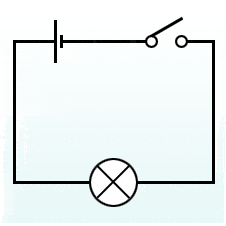
this circuit is .....?
a)
open
b)
parallel
c)
closed
d)
The cutest little circuit evah!
60.
When all parts of the circuit are connected it is a ______ circuit.
a)
open
b)
closed
61.
When you flip a light switch on and off you are closing and opening a circuit.
a)
true
b)
false
62.
What is a switch's function in a circuit?
a)
to make the current hotter or colder
b)
turn on and off the flow of current
c)
the pathway that current flows
d)
to add more power to the circuit
100 %

