
 Worksheets
Live and let live
Total questions: 73
Worksheet time: 59mins
Name
Class
Date
1.
When scientists group objects together according to their characteristics, this process is called
a)
fungi
b)
species
c)
protists
d)
classification
2.
Each living creature is grouped into one of six
a)
kingdoms
b)
invertebrates
c)
eubacteria
d)
mammals
3.
The ____________ kingdom includes decomposers , such as mushrooms.
a)
kingdoms
b)
fungi
c)
archaebacteria
d)
nonvascular
4.
Multicellular organisms that use sunlight to create food are grouped into the _____________ kingdom.
a)
plant
b)
animal
c)
fungi
d)
protist
5.
____________________ are vertebrates that are warm-blooded, have hair, and give birth to live young.
a)
mammals
b)
animals
c)
amphibians
d)
protists
6.
The ________________ kingdom can be divided into two groups; those with backbones and those without.
a)
animal
b)
mammal
c)
vertebrates
d)
invertebrates
7.
Organisms that have backbones are called
a)
animals
b)
invertebrates
c)
vertebrates
d)
mammals
8.
Organisms that do not have backbones are called
a)
animals
b)
mammals
c)
vertebrates
d)
invertebrates
9.
The smallest groups into which organisms can be classified are called
a)
species
b)
kingdoms
c)
classess
d)
orders
10.
Plants that do not have a system of tubes are called
a)
eubacteria
b)
archaebacteria
c)
nonvascular
d)
protists
11.
One group of animal vertebrates called ______________ start their lives in the water but move onto land as adults.
a)
amphibians
b)
species
c)
protists
d)
fungi
12.
A human is a member of what kingdom?
a)
Plantae
b)
Protists
c)
Fungi
d)
Animal
13.
The levels of classification in order are:
a)
Phylum, Class, Order, Kingdom, Family, Genus, Species
b)
Species, Kingdom, Phylum, Order, Class, Family, Genus.
c)
Kingdom, Phylum, Class, Order, Family, Genus, Species
d)
Kingdom, Phylum, Class, Order, Familiy, Genus, Species
14.
An organism made up of one cell
a)
Multicelluar
b)
Eukaryotic
c)
Unicellular
d)
Prokaryotic
15.
An organism made up of more than one cell is
a)
unicellular
b)
multicellular
c)
eukaryotic
d)
prokaryotic
16.

Is this an Organism?
a)
Yes, of course, all organisms have faces
b)
Sure, looks pretty lively to me
c)
Naw, you can't fool me
d)
Maybe...
17.
How many Domains are there?
Name them:
Name them:
a)
3; Archaea, Bacteria, Eukarya
b)
2; Plant, Animal
c)
1; Eukarya
d)
3; Eubacteria, Eukarya, Fungi
18.

A dichotomous key for trees is provided. Hikers found a tree that has large brown cones and single sharp needles. What species of tree have the hikers found?
a)
Juniper
b)
Pine
c)
Spruce
d)
Fir
19.

What species is bird C?
a)
Dunliin
b)
Osprey
c)
Bald Eagle
d)
Baird's Sparrow
20.
What is a dichotomous key used for in science?
a)
To provide an organisms location
b)
To identify unknown organisms
c)
To organize a "junk" drawer
d)
To decide which chemicals to mix together to get a reaction
21.

This domain includes bacteria that can live in extreme environments, such as hot springs.
a)
Archaea
b)
Bacteria
c)
Eukarya
d)
Prokarya
22.

Which kingdom contains multicellular, heterotrophic organisms whose cells have NO cell walls?
a)
Protist
b)
Fungi
c)
Plant
d)
Animal
23.
A tulip opens in the morning at sunrise and closes in the evening at sunset. This best supports the statement that
a)
All living things have cells
b)
All living things use energy
c)
All living things respond to their environment
d)
All living things grow
24.
Over three years, Tim's height has increased from 5'4" to 5'11". This best supports the statement that
a)
All living things contain cells
b)
All living things develop
c)
All living things use energy
d)
All living things grow
25.
Plants get energy from _____ while animals get energy from _____.
a)
The sun; dead stuff
b)
photosynthesis; food in their environment
c)
photosynthesis; the sun
d)
water; food around them
26.
Taxonomy is
a)
the study of living things
b)
the study of classifying and naming organisms
c)
the study of the relationships between 2 species
d)
the study of of dichotomous keys
27.

A student discovers an arachnid with a segmented abdomen, long legs, and a tail with no stinger. The student uses the dichotomous key to identify it. Which arachnid has the student found?
a)
Whip Scorpion
b)
Wind Scorpion
c)
Tick
d)
Scorpion
28.
All organisms that fit into the plant, fungi, protist, and animal kingdoms are classified into domain_____.
a)
Archaea
b)
Eubacteria
c)
Eukarya
d)
Bacteria
29.

Wastes produced by agriculture, households, industry, mining, and other human activities can end up in ______________.
a)
groundwater
b)
streams and rivers
c)
oceans
d)
All of these choices
30.

Increase in which gas is primarily responsible for increased global warming?
a)
Carbon dioxide
b)
Water vapor
c)
Methane
d)
Nitric oxides
31.

Which of the following historical events most likely triggered the largest increase in the human population?
a)
the Black Death plague, which occurred in the mid-1300s
b)
the domestication of wheat crops, which began around 8000 B.C
c)
the fall of the Roman Empire, which occurred around A.D. 800
d)
the Industrial Revolution, which began in the late 1700s
32.
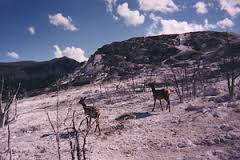
What is the most dramatic result of deforestation?
a)
land is no longer green and full of life
b)
pictures from space show deforestation
c)
loss of habitat for approximately 70% of the worlds species
d)
people can't explore rainforests
33.

What are some reasons deforestation occurs?
a)
clearing land for agriculture, ranching, and mining
b)
just wanting to destroy things
c)
Population moving from rural areas to cities
d)
to make room for infrastructure
34.

Carbon is released into the atmosphere through all of the following ways except:
a)
respiration
b)
cow flatulence
c)
photosynthesis
d)
all of the above
35.
Humans often change ecosystems as a result of population growth, consumption, and technology. Which of the following exemplifies a way in which humans modify ecosystems?
a)
factory and automotive emissions causing acid rain
b)
redirecting and storing freshwater behind dams
c)
cutting down trees to build new buildings and roads
d)
all of these
36.
What are some consequences of deforestation?
a)
increased population in cities
b)
building of more infrastructure
c)
soil erosion, loss of biodiversity, loss of ability to remove CO2
d)
more mercury and cyanide released into rivers
37.
Which parts of the environment can humans affect?
a)
air
b)
food
c)
soil and water
d)
all of the above
38.
Which of the following items does not create air pollution?
a)
motorcycle
b)
bus
c)
bicycle
d)
car
39.
How can you best reduce the amount of electricity you use in your house?
a)
Turn off the radio.
b)
Unplug everything not being used.
c)
Turn off the lights.
d)
Turn the volume down on the TV
40.
Which building will not impact the environment?
a)
home
b)
tree house
c)
apartment
d)
none of the above
41.
Not turning off the water when you are brushing your teeth wastes which resource?
a)
air
b)
water
c)
food
d)
tooth paste
42.
Using land to grow food crops is an example of
a)
desertification
b)
mining
c)
agriculture
d)
development
43.
Chemicals that kill crop-destroying organisms are called _____________.
a)
sediments
b)
fertilizers
c)
acid rain
d)
pesticides
44.
Most water pollution is the result of __________________.
a)
natural processes
b)
animal waste
c)
human activities
d)
acid rain
45.
___________________ washes agricultural wastes, including animal wastes, fertilizers, and pesticides, into bodies of water, causing algae to grow.
a)
Runoff
b)
Peak flow
c)
Groundwater
d)
Municipal sewage
46.
Water shortages can be created by ____________________.
a)
weather related issues like drought
b)
human consumption
c)
human withdrawal
d)
All of these reasons.
47.
About 97% of the water on Earth is ___________________.
a)
fresh water
b)
groundwater
c)
salt water
d)
ice
48.
The ozone layer protects us from
a)
UV rays
b)
CFCs
c)
Increased atmospheric heat
d)
Decreased atmospheric heat
49.
Global warming is due to
a)
Greenhouse gases
b)
Nitric and sulfuric acids
c)
CFCs
d)
Ozone depletion
50.
Many uses of land, including logging, mining, and farming, expose the soil, which can lead to
a)
erosion
b)
development
c)
nutrient depletion
d)
crop rotation
51.
A place where an organism gets everything it needs to survive.
a)
habitat
b)
community
c)
ecosystem
d)
population
52.
A species living together in one area is called a:
a)
species
b)
community
c)
ecosystem
d)
population
53.
Different organisms living together in the same area:
a)
community
b)
population
c)
species
d)
ecosystem
54.
All of the living AND non-living things in an particular area is called a(n):
a)
ecosystem
b)
house
c)
community
d)
mountain
55.

What level consumer is the deer?
a)
Consumer 1
b)
Consumer 2
c)
Consumer 1 & 2
d)
Producer
56.

Which of the following best describes the blue bird's (in the middle) role in this ecosystem?
a)
carnivore
b)
omnivore
c)
herbivore
d)
decomposer
57.

Which of the following best describes the deer's role in the ecosystem?
a)
herbivore
b)
omnivore
c)
carnivore
d)
decomposer
58.

Which of the following best describes the wolf's role in this ecosystem?
a)
herbivore
b)
omnivore
c)
carnivore
d)
decomposer
59.
Bacteria and fungi typically serve what role in an ecosystem?
a)
herbivore
b)
carnivore
c)
omnivore
d)
decomposer
60.

What is a producer?
a)
an organism that gets energy from eating other organisms
b)
an organisms that uses sunlight to make its own food
c)
an organism that gets energy from eating dead organisms, non-living material or waste
d)
an organism that uses chemical energy to make its own food
61.

An organism that gets energy from eating other organisms is a ______________.
a)
producer
b)
consumer
c)
decomposer
d)
prey
62.

An organism that gets energy from breaking down dead organisms, non-living material or waste is a(an) ___________.
a)
producer
b)
consumer
c)
decomposer
d)
autotroph
63.

An animal that is hunted and eaten for food is a __________.
a)
predator
b)
prey
c)
population
64.

What is a carnivore?
a)
an animal that gets energy by eating other animals
b)
An animal that gets energy by eating only plants
c)
an animal that gets energy by eating both plants and animals
d)
an animal that makes its own energy through photosynthesis
65.

An animal that gets energy from eating both plants and animals is a(an) _____________.
a)
herbivore
b)
carnivore
c)
omnivore
d)
autotroph
66.

A connection of food chains with many food energy paths in an ecosystem is a ____________.
a)
ecosystem
b)
food web
c)
environment
d)
population
67.

Which of the following is a living part of the ecosystem?
a)
Air
b)
Sunlight
c)
Mushroom
d)
Soil
68.

The shrew provides energy for the _______.
a)
cricket
b)
grasshopper
c)
frog
d)
snake
69.
Which one is NOT an example of a decomposer?
a)
mushroom
b)
leaves
c)
mold
d)
worm
70.
Frogs are considered...
a)
consumers
b)
decomposers
c)
producers
d)
composers
71.
Grass is considered a ...
a)
consumer
b)
producer
c)
decomposer
d)
composers
72.

What does a food chain represent?
a)
How all living organisms within a habitat are connected.
b)
All of the things that a particular animal eats.
c)
How plants create their own food.
d)
A single path of energy transfer within a habitat.
73.
Another word for a living thing is a:
a)
animal
b)
organism
c)
plant
d)
community
100 %

