
 Worksheets
Energetics Test Review
Total questions: 70
Worksheet time: 38mins
The outer surface of the leaf has a thin waxy covering
blade
cuticle
petiole
epidermis
____________lines the lower area of the leaf.
blade
cuticle
petiole
epidermis
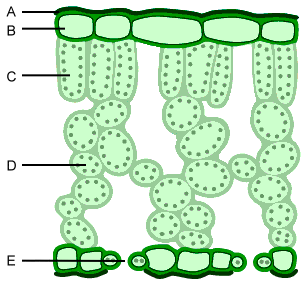
What is letter "D" pointing to?
upper epidermis
palisade mesophyll
spongy mesophyll
bundle sheath
The important gases, carbon dioxide and oxygen, enter and leave the leaf through the
upper epidermis
phloem
stomata
guard cells

In which leaf tissue does photosynthesis occur?
mesophyll
epidermis
xylem
phloem
During summer, __________ gives leaves their green color.
Chlorophyll
Anthocyanin
Xanthophyll
Carotene
When the chlorophyll (green pigment) is being broken down, ___________is produced. It gives leaves red color.
Chlorophyll
Anthocyanin
Xanthophyll
Carotene
_____________is revealed when chlorophyll (green pigment) fades. It gives leaf yellow color.
Chlorophyll
Anthocyanin
Xanthophyll
Carotene
In summer, leaves only have chlorophyll.
True
False
What is the purpose of leaf chromatogarphy experiment?
to find out what pigments do leaves have.
to prove that leaves only have green pigments.
to prove that leaves have bacteria.
What portion of the leaf is made of loosely packed cells that do some photosynthesis and have air spaces between them?
palisade layer
epidermis
guard cells
spongy layer
What portion of the leaf protects the leaf from insects, bacteria, and viruses
vein
epidermis
guard cells
cuticle

Name this part of the leaf.
stoma
guard cells
epidermis
stamen
The ____________ is the outer layer of cells covering the leaf. It is usually transparent and is waxy to prevent water loss.
pallisade layer
epidermis
spongy mesophyll
top leaf
This is the thin, waxy layer that covers the upper and lower epidermis of the leaf, preventing the loss of water.
epidermis
stoma
sepal
cuticle
These structures open and close the stomata to allow or prevent water loss from leaves.
stoma
ovaries
guard cells
pores

What part of the plant is A.
spongy mesophyll
epidermis
pistal
cuticle
What are the tiny openings on the surface of the leaf (or stem) that controls the passing of water vapor and other gases into and out of the plant.
stomata
stamen
carbon dioxide
anthers

What is A?
chlorophyll
stoma
stomata
guard cells
This process is when a plant releases any water that it
doesn't need into the air through the stomata of its leaves.
photosynthesis
transpiration
cellular respiration
breathing
Stomata control the passing of these products into and out of the plant.
water vapor
carbon dioxide
oxygen
all of the above

What is B?
stoma
guard cells
ovule
stigma
Which pigment is not seen in the leaves of trees in the fall in a temperate deciduous biome?
anthocyanin
carotene
xanthophyll
chlorophyll

Which organelle is responsible making food (Glucose) using sunlight?
Cell Membrane
Nucleus
Chloroplast
Mitochondria
Select all that are raw materials for Photosynthesis.
Water
Carbon Dioxide
Oxygen
Sunlight (Light Energy)
Glucose (Sugar/food)
Select all that are products of Photosynthesis.
Water
Carbon Dioxide
Oxygen
Sunlight (Light Energy)
Glucose (Sugar/food)
How does most of the water needed by the plant get into its leaves?
It enters through the stomata
The roots absorb it and then it travels up the stem
It's made during a chemical reaction in the leaf
The flowers capture water and deliver it to the leaves

What are the reactants in Photosynthesis?
Sun, CO2, glucose
glucose and oxygen
sun, carbon dioxide, water
water, glucose
In cellular respiration, carbon starts out in the glucose molecule, but ends up in a(n)
oxygen molecule
water molecule
CO2 molecule
C6H12O2 molecule
The REACTANTS of cellular repiration include
water and carbon dioxide
carbon dioxide and oxygen
oxygen and glucose
carbon dioxide and glucose
The products of ____________ become the reactants of cellular respiration.
ribosomes
homeostasis
mitosis
photosynthesis
Which of the following terms describes the process that allows animals to convert chemical energy to ATP to be used as energy for the animals survival?
Cellular Respiration
Photosynthesis
Krebs Cycle
Glycolysis
Which of the following is NOT a raw material needed for photosynthesis?
carbon dioxide
light
oxygen
water
What is NOT a product of cellular respiration?
carbon dioxide
energy
oxygen
water
When cells get energy from glucose without oxygen it is called _____________.
cytoplasm
fermentation
photosynthesis

What is the process through which the majority of ATP is produced?
Photosynthesis
Respiration
Exercise
Nucleotides

Which of these organisms produce ATP through cellular respiration?
Plants
Animals
Both
Neither

What is used or released when ATP becomes ADP?
phosphate released / energy used
phosphate used / energy released
phosphate released / energy released
phosphate used / energy released

What is the full name of the molecule ATP?
Adenine Diphosphate
Adenosine Diphosphate
Adenine Triphosphate
Adenosine Triphosphate

What is used / released when ADP becomes ATP?
phosphate released / energy used
phosphate used / energy used
phosphate released / energy released
phosphate used / energy released

All of the following are parts of an ATP molecule except:
Adenine
Ribose
Ribosomes
Phosphates

Where is the energy stored in an ATP molecule?
Chemical Bonds
Ionic Bonds
Atomic Bonds
James Bond

What is the full name of the molecule ADP?
Adenine Diphosphate
Adenosine Diphosphate
Adenine Triphosphate
Adenosine Triphosphate

What is ATP used for?
It is recharged to be used later.
As a backbone for DNA.
Special cell actions that require large amounts of energy.
Any cellular process requiring energy.

What does ATP become whenever energy is released?
The molecule is completely used up.
An adenine, ribose, and two phosphates attached together.
Nothing changes and it remains Adenosine Triphosphate.
ATP breaks into its three main parts.

Which enzyme helps attach a phosphate onto ADP?
ADPase
ATPase
ATPsynthase
Ace of Base

What is ADP used for?
It is recharged with a phosphate and energy.
As a backbone for DNA.
Special cell actions that require large amounts of energy.
Any cellular process requiring energy.

Exactly where is the high energy bond in ATP?
In the adenosine
In the ribose sugar (sugars contain quick energy)
In the terminal phosphate bond
Throughout the entire molecule

Which enzyme helps remove a phosphate from ATP?
ADPase
ATPase
ATPsynthase
Hydrogenase



