
 Worksheets
Mitosis and Meiosis Review
Total questions: 55
Worksheet time: 45mins
Name
Class
Date
1.

Structure (b) is a ____.
a)
chromosome
b)
chromatid
c)
centromere
2.

a)
Prophase
b)
Interphase
c)
Anaphase
d)
Telophase
3.

Fruit fly body cells have 8 chromosomes. After mitosis, you would expect a resulting fruit fly daughter cell to have ...
a)
16 chromosomes.
b)
46 chromosomes.
c)
8 chromosomes.
d)
4 chromosomes.
4.

a)
Anaphase
b)
Cytokinesis
c)
Telophase
d)
Metaphase
5.
The process by which the nuclear material is divided equally between two new cells
a)
mitosis
b)
cancer
c)
spindle
d)
centromere
6.

a)
Cytokinesis
b)
Anaphase
c)
Telophase
d)
Prophase
7.

Why would it be important to replicate DNA before a cell divides in mitosis or meiosis?
a)
In order for genetic information to be transferred into daughter cells.
b)
In order for the cell to be able to increase in size.
c)
In order for the DNA to be contained in the nucleus.
d)
In order for the cell to re-order the DNA sequencing in the new cells.
8.

a)
Cytokinesis
b)
Interphase
c)
Anaphase
d)
Metaphase
9.

How many chromosomes do humans have?
a)
46
b)
21
c)
10
10.
The time between cell divisions in the life cycle of the cell is called
a)
anaphase
b)
interphase
c)
prophase
d)
metaphase
11.

The structure labeled A is a(n)
a)
chromatid
b)
centriole
c)
centromere
d)
chromophere
12.
In the G2 stage of cell division, ______________ are made.
a)
organelles
b)
structures for cell division
c)
proteins
d)
all of the above
13.
The cell spends most of it's life in ________________.
a)
mitosis
b)
cytokinesis
c)
Interphase
d)
None of the above
14.
Chromosomes carry identical sets of what in their sister chromatids?
a)
proteins
b)
carbon molecules
c)
genetic information
d)
phospholipids
15.

a)
Anaphase
b)
Cytonkinesis
c)
Interphase
d)
Prophase
16.
What phase are cells in the longest?
a)
Interphase
b)
Metaphase
c)
Anaphase
d)
Telophase
17.
In the G1 stage of the cell cycle, the cell
a)
Grows
b)
Matures
c)
Carries on normal activities
d)
All of the above
18.
The ___________ holds the replicated sister chromatids together.
a)
centriole
b)
chromosomes
c)
centromere
d)
cycles
19.

Structure (c) is a ____.
a)
chromosome
b)
chromatid
c)
centromere
20.

Structure (a) is a ____.
a)
chromosome
b)
chromatid
c)
centromere
21.
A dog has 78 chromosomes in its body cells. What is the diploid number?
a)
78
b)
39
c)
1
d)
100
22.
A Goat has 60 chromosomes in its body cells. What is the haploid number?
a)
60
b)
30
c)
100
d)
120
23.
A human has 46 chromosomes in their body cells. What is the haploid number?
a)
46
b)
92
c)
23
d)
12
24.
During what phase of the cell cycle does cell division occur?
a)
Interphase
b)
M phase
c)
S phase
d)
G2 phase
25.
During what phase of the cell cycle does the cell prepare for mitosis?
a)
G1 phase
b)
S phase
c)
G2 phase
d)
M phase
26.
Structure (b) is a ____.
a)
chromosome
b)
chromatid
c)
centromere
27.
During what phase of the cell cycle does the cell grow?
a)
G1 phase
b)
S phase
c)
M phase
d)
Cytokinesis
28.
Put the following stages of mitosis in order: anaphase, prophase, metaphase, and telophase.
a)
prophase, metaphase, telophase, anaphase
b)
prophase, anaphase, metaphase, telophase
c)
prophase, metaphase, anaphase, telophase
d)
prophase, telophase, metaphase, anaphase
29.
Put the following stages of the cell cycle in order: G2, S, G1, M.
a)
G1, S, G2, M
b)
S, G1, G2, M
c)
G1, M, G2, S
d)
M, G1, S, G2
30.

When an area of a chromatid is exchanged with the matching area on a chromatid of its homologous chromosome, _________________ occurs
a)
crossing over
b)
mutagenesis
c)
hybridization
d)
fertilization
31.
Unlike mitosis, meiosis in male mammals results in the formation of
a)
one haploid gamete
b)
three diploid gametes
c)
four diploid gametes
d)
four haploid gametes
32.
What causes genetic variation in meiosis?
a)
chromosomes lining up
b)
crossing over of chromosomes
c)
separation of chromosomes
d)
chromosomes pulling apart
33.

Meiosis makes sperm and egg cells. In humans, sperm and egg cells each have _____ chromosomes. Therefore a fertilized human egg cell (sperm and egg cell combined) would create a cell with _____ chromosomes.
a)
23, 46
b)
46, 23
c)
2, 4
d)
50, 100
34.

What phase is shown in the picture?
a)
anaphase 1
b)
anaphase 2
c)
metaphase 1
d)
telophase 1
35.

Which process and type of resulting cells are represented?
a)
mitosis, gametes
b)
mitosis, body cells
c)
meiosis, gametes
d)
meiosis, body cells
36.
The process of crossing over occurs in what phase of meiosis?
a)
anaphase 1
b)
prophase 1
c)
prophase 2
d)
telophase 1
37.
When homologous chromosomes match up, they form a structure call a ___________.
a)
tetrad
b)
triad
c)
diploid
d)
gamete
38.
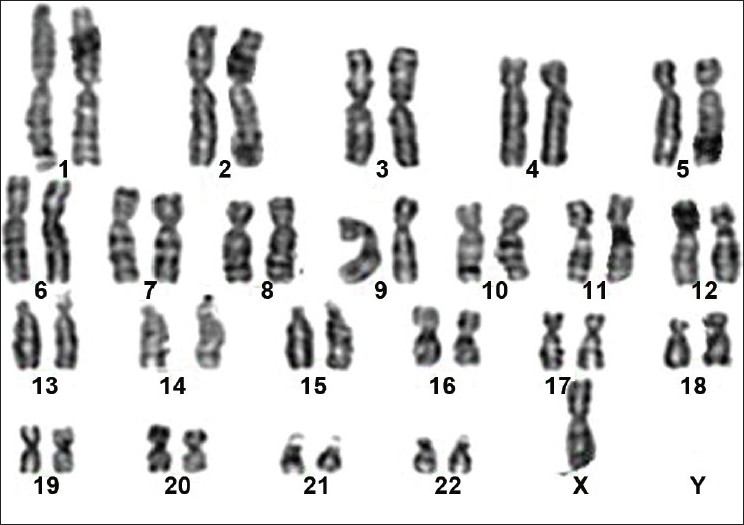
a)
This karyotype shows Trisomy 21
b)
This karyotype has no abnormality
c)
This karyotype is missing a sex chromosome (monosomy x)
d)
This karyotype is from a gamete
39.
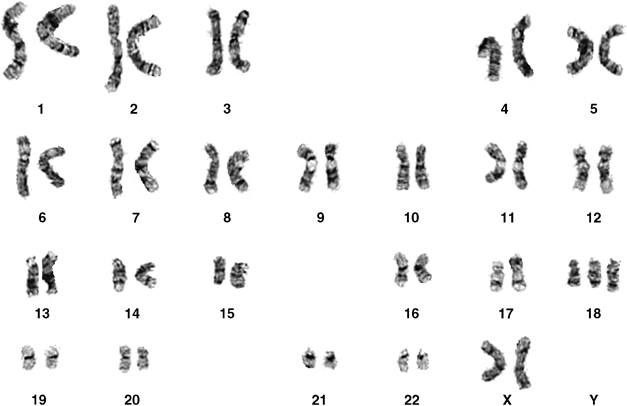
What is the chromosomal condition of the individual whose karyotype is seen in the image?
a)
Monosomy X (Turner's Syndrome)
b)
Trisomy 21 (Down's Syndrome)
c)
Trisomy 13 (Patau Syndrome)
d)
Trisomy 18 (Edwards's Syndrome)
40.
Which sex chromosomes would indicate a typical human male?
a)
XX
b)
X
c)
XY
d)
XXY
41.
Photograph of chromosomes grouped in ordered pairs
a)
pedigree
b)
Punnett Square
c)
Venn Diagram
d)
Karyotype
42.
Matt uses a microscope to look at slides of plant cells. He sees a cell with two nuclei that have visible chromosomes. In which stage of cell division is this cell?
a)
anaphase
b)
prophase
c)
telophase
d)
interphase
43.
Which of these organisms relies on mitosis for reproduction?
a)
grumpy cat
b)
angry bird
c)
unicellular paramecium
d)
squishy jellyfish
44.
During interphase, the DNA is in the form of
a)
chromatin
b)
chromosomes
c)
chromatids
d)
centromeres
45.
Which of these lists presents the stages of the cell cycle in the correct order?
a)
interphase, mitosis, cytokinesis
b)
cytokinesis, mitosis, interphase
c)
mitosis, interphase, cytokinesis
d)
interphase, cytokinesis, mitosis
46.

Which phase comes NEXT?
a)
prophase
b)
metaphase
c)
anaphase
d)
telophase
47.

These structures pull the spindle fibers and attached chromosomes to opposite ends of the cell.
a)
Spindle fiber
b)
Centriole
c)
Nucleus
d)
Centromere
48.
Form during prophase and attach to chromosomes at the centromere to pull them apart during cell division
a)
prophase
b)
nucleus
c)
spindle fibers
d)
gene
49.
A membrane that encloses the cells nucleus and separates the chromosomes from the rest of the cell is
a)
cell membrane
b)
cell wall
c)
nuclear membrane
d)
spindle fibers
50.
Phase of mitosis following metaphase during which the spindle fiber attach to centromere and the chromatids move to opposite sides of the cell.
a)
anaphase
b)
telephase
c)
metaphase
d)
prophase
51.
The sequence of stages of growth and division that a cell undergoes is called
a)
cell
b)
cytoplasm
c)
cell cycle
d)
mitosis
52.
This develops in the middle plane of a plant cell separating it into two daughter cells during cell division.
a)
cell wall
b)
cell plate
c)
cell membrane
d)
cytoplasm
53.
Two identical copies of a chromosome is
a)
centromere
b)
centrosome
c)
chromatid
d)
chromosome
54.
The division of the cytoplasm following mitosis resulting into two identical copies of the originelle cell called daughter cells
a)
cytoplasm
b)
cytokenisis
c)
telophase
d)
mitosis
55.
The structure of coiled DNA and proteins that forms in a cell's nucleus prior to mitosis is
a)
centromere
b)
centriole
c)
chromosome
d)
chromatid
100 %

