Wayground logo

Free Printable Worksheets

Font size

S
M
L
XL
Worksheets

Integrated Science 1- Midterm Review 2019

Total questions: 125

Worksheet time: 4hrs 4mins

Name
Class
Date
1.
A possible explanation to a problem that has not yet been tested. 
a)
data
b)
theory
c)
hypothesis
d)
fact
2.
Which of the following can be used to test a hypothesis?
a)
experiment
b)
theory
c)
law
d)
variable
3.
A scientific ____________ is a broad explanation for events that is widely accepted as true.
a)
law
b)
theory
c)
observation
d)
method
4.
A scientific ____________ is a statement that describes what always happens under certain conditions in nature.
a)
law
b)
theory
c)
method
d)
variable
5.
The base unit of metric length.
a)
Meter
b)
Liter 
c)
Kilogram
d)
milligram
6.
The basic unit of metric volume is called a_____.
a)
Kilogram
b)
milligram
c)
Liter
d)
milliliter
7.
The abbreviation for gram is...
a)
G
b)
gg
c)
g
8.
m stands for....
a)
millimeter
b)
meter
c)
centimeter
d)
Liter
9.

What is the volume of liquid in this graduated cylinder?

a)

40.0 mL

b)

40 mL

c)

43.0 mL

d)

43

10.
1000 grams = _____ kilograms
a)
0.0001
b)
1,000,000
c)
10
d)
1
11.
Convert 17 m to cm:
a)
0.17 cm
b)
0.017 cm
c)
1,700 cm
d)
170 cm
12.
Convert 8 kilometers to meters
a)
800 m
b)
80,000 m
c)
8,000 m
d)
.008 m
13.
Convert 5 cm to mm:
a)
5,000mm
b)
0.5 mm
c)
0.05 mm
d)
50 mm
14.
Convert 300 cm to m:
a)
3 m
b)
30 m
c)
0.3 m
d)
0.03 m
15.
5,000 mg = ____ g
a)
50
b)
5
c)
500
d)
5,000
16.
648 g = ____ mg
a)
6,480
b)
64,800
c)
648,000
d)
64.8
17.
490,000 g =____ kg
a)
490
b)
49
c)
4,900
d)
0.49
18.
How many significant figures does the following number have: 0.002040
a)
6
b)
4
c)
3
d)
2
19.
How many significant figures does the following number have: 0.998005
a)
9
b)
10
c)
6
d)
5
20.
Round 0.010229 to four sig figs
a)
1022
b)
1023
c)
0.01023
d)
0.01022
21.
Round 1047.78 to three sig figs
a)
104
b)
105
c)
1050
d)
1050.00
22.
What is the measurement 1042 Liters rounded to 2 significant figures? 
a)
1040 L
b)
1.1 x 10³ L
c)
1.0 x 10³ L
d)
1050 L
23.
How many significant figures does 1.90 × 10^8 have?
a)
3
b)
4
c)
6
d)
8
24.
Round 1009 to three sig figs
a)
100
b)
101
c)
1010
d)
1000
25.
The diameter of a carbon atom is 0.000 000 000 154 m. What is this number expressed in scientific notation?
a)
1.54 x 10¹² m
b)
1.54 x 10⁻¹² m
c)
1.54 x 10¹⁰ m
d)
1.54 x 10⁻¹⁰ m
26.
volume?
a)
48 mL
b)
48.2 mL
c)
48.25 mL
d)
4 mL
27.
Volume?
a)
63.5 mL
b)
63 mL
c)
63.55 mL
d)
6 mL
28.
What unit should be in the numerator of the conversion factor?
a)
yards
b)
leagues
c)
feet
d)
fathoms
29.

What is the total mass of the following books Pay attention to the units?

Science : 4.01 kg

Math : 3907.2 g

Foods : 4.13 x 10³ g

a)

12000 g

b)

120 g

c)

1.20 x 10⁴ g

d)

12047.2 g

30.
A rectangular fish tank measures 87 cm long, 45.3 cm wide and 41.00 cm tall.  What is the volume?
a)
16 cm3
b)
161585.1cm3
c)
160000 cm3
d)
162000 cm3
31.
Calculate 12.34 + 1.234 + 0.1234 and give your answer with the appropriate number of significant figures.
a)
13.6974
b)
13.697
c)
13.70
d)
13.7
32.
Calculate 5.50 cm + 5.50 cm and give your answer with the appropriate number of significant figures.
a)
11 cm
b)
11.0 cm
c)
11.00 cm
d)
11.000 cm
33.
Calculate 923 g ÷ 20312 cm3 and give your answer with the appropriate number of significant figures.
a)
0.04 g/cm3
b)
0.045 g/cm3
c)
0.0454 g/cm3
d)
4 x 10⁻² g/cm3
34.
Subtract 85.73g - 29.527g
a)
56g
b)
56.2g
c)
56.20g
d)
56.203g
35.
The atomic number is the number of....
a)
neutrons
b)
protons
c)
electrons
d)
mass number
36.
The mass number is equal to the sum of 
a)
protons and neutrons 
b)
neutrons and electrons
c)
protons and electrons
d)
neutrons only
37.
Protons carry what charge? 
a)
neutral 
b)
negative
c)
positive
38.
Electrons carry what charge? 
a)
neutral 
b)
negative
c)
positive
39.
In a neutral atom, the protons are always equal to the number of...
a)
electrons
b)
neutrons
40.
Locate Carbon on the periodic table, how many protons does Carbon have? 
a)
12
b)
6
c)
18
d)
0
41.
In an ion, there is a charge on the atom.  This means the number of _____ change. 
a)
protons 
b)
electrons
c)
neutrons
d)
mass 
42.
 What is the mass number of this element?
a)
5
b)
27
c)
32
d)
59
43.
Which of the following scientists added negatively-charged particles to the model of the atom?
a)
Niels Bohr
b)
John Dalton
c)
Ernest Rutherford
d)
J. J. Thomson
44.

How was the Thomson model different from the Bohr model that followed sometime later?

a)

The Bohr model did not include positive charges in the atom.

b)

The Bohr model showed electrons surrounding the positive nucleus.

c)

The Bohr model consisted of a single, solid mass with no smaller particles.

d)

The Bohr model showed neutrons in a cloud surrounding the negative nucleus.

45.
Who coined the term the atom?
a)
Democritus
b)
Dalton
c)
Bohr
d)
Thomson
46.
Who discovered the electron?
a)
Dalton
b)
Bohr
c)
Thomson
d)
Rutherford
47.
Who discovered a positively charged particle in the center of the atom?
a)
Bohr
b)
Thomson
c)
Dalton
d)
Rutherford
48.
Most of the mass in an atom is made up of _____________________?
a)
protons and electrons
b)
protons and neutrons
c)
neutrons and electrons
d)
electrons and quarks
49.
Atoms of the same element which have a different number of neutrons are called _________________.
a)
ions
b)
isotopes
c)
quarks
d)
molecules
50.
If an atom contains exactly 79 protons, then it's an atom of _____
a)
lithium
b)
gold
c)
nitrogen
d)
carbon
51.
In the Bohr model of the atom, what is the maximum number of electrons in the first shell?
a)
1
b)
2
c)
6
d)
8
52.
A horizontal row of elements in the periodic table.
a)
column
b)
group
c)
period
53.
What element is this?
a)
Helium
b)
Hydrogen
c)
Argon
d)
Silver
54.
What element is represented in this Bohr Model? 
a)
Carbon
b)
Hydrogen
c)
Aluminum
d)
Lithium
55.
How are electrons arranged in an atom?
a)
In groups of five
b)
In energy levels
c)
By color
d)
By shape
56.
An element with five valence electrons is
a)
phosphorus
b)
oxygen
c)
beryllium
d)
rubidium
57.
Rows on the period table are called _____ while columns are called _____.
a)
groups, families
b)
groups, periods
c)
periods, groups
d)
families, groups
58.
How many electrons are in the outer (valence) shell of Chlorine (Cl)?
a)
1
b)
3
c)
6
d)
7
59.
What is the name of the group that never reacts--ever ever they are stable with a full outermost ring!!!
a)
noble gases
b)
transition
c)
halogens
d)
borons
60.

What is the name of the group that has the MOST reactive METALS in it?

a)

Alkaline earth (Group 2)

b)

Alkali (Group 1)

c)

transition

d)

actinides

61.
The period for Bromine is ___________.
a)
3
b)
2
c)
4
62.
Which types of elements have intermediate properties of metals and nonmetals?
a)
metals
b)
nonmetals
c)
metalloids
d)
gases
63.
What's a valence electron?
a)
electrons in the second energy level
b)
electrons in the outermost energy level
c)
the atomic number
d)
electrons in the first level
64.
?
a)
Helium
b)
Oxygen
c)
Sodium
d)
Phosphorous
65.
Rutherford's gold foil experiment provided evidence that...
a)
negative and positive charges are spread evenly throughout the atom.
b)
alpha particles have a positive charge.
c)
gold is not a dense as previously thought.
d)
there is a dense positively charged nucleus at the center of an atom.
66.
A model of an atom that shows all of the electrons in their energy levels (shells) is called 
a)
electron dot diagram
b)
valence electrons
c)
Bohr Model
67.

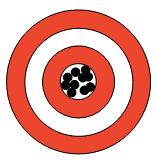
This picture demonstrates what?

a)

High Accuracy & High Precision

b)

High Accuracy & Low Precision

c)

Low Accuracy & High Precision

d)

Low Accuracy & Low Precision

68.
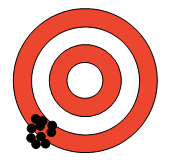
How would you describe this bullseye? 
a)
High Accuracy & High Precision
b)
High Accuracy & Low Precision
c)
Low Accuracy & High Precision
d)
Low Accuracy & Low Precision
69.

Which color has the most energy ROY G BIV?

a)

Violet

b)

Green

c)

Blue

d)

Yellow

70.

Which color has the lowest energy ROY G BIV?

a)

Green

b)

Red

c)

Blue

d)

Violet

71.
How do you write
8.317 x 10⁶
in standard form?
a)
8, 371, 000
b)
83, 170, 000
c)
837, 100
d)
8, 317, 000
72.

Express the following in standard notation:

8.025 x 10⁻⁸

a)

.00000008025

b)

.000000008025

c)

802,500,000,000

d)

80,250,000,000

73.
How many electrons should Hydrogen have around its Lewis dot model?
a)
1
b)
2
c)
7
d)
8
74.
How many electrons should Boron have around its Lewis dot model?
a)
1
b)
3
c)
5
d)
7
75.
How many electrons should Magnesium have around its Lewis dot model?
a)
1
b)
2
c)
3
d)
4
76.
As an electron falls down into its ground state it....
a)
absorbs energy
b)
releases energy
77.
For an electron to change from ground state to an excited stated it must...
a)
Absorb energy
b)
Release energy
78.
As light emitted from an element is passed through a prism, which of the following is created?
a)
light prism effect
b)
electron absorption chart
c)
quantum diagram
d)
line emission spectrum
79.
Elements in the same __________ will have similar chemical properties.
a)
Group
b)
Period
80.
Which subatomic particle is the one most responsible for chemical behavior?
a)
Electron
b)
Proton
c)
Neutron
d)
Photon
81.

The atom with the largest atomic radius in Group 8A (18) is -

a)

Ar

b)

He

c)

Kr

d)

Rn

82.
As you move down the periodic table atoms get bigger.  This is because ____________.
a)
The atoms have more mass.
b)
The atoms have more protons.
c)
The atoms have more energy levels
d)
The atoms have more nuetrons
83.
As you move across the periodic table atoms tend to get smaller because, ______________.
a)
the atoms have more mass.
b)
the atoms have less mass
c)
the atoms have more protons.
d)
the atoms have less electrons.
84.
Which one has the smallest radius?
a)
Chlorine (Cl, atomic #17)
b)
Iodine (I, atomic #53)
c)
Fluorine (F, atomic #9)
d)
Bromine (Br, atomic #35)
85.
What occurs when an atom loses an electron?
a)
The atom’s radius decreases and the atom becomes a negative ion.
b)
The atom’s radius decreases and the atom becomes a positive ion
c)
The atom’s radius increases and the atom becomes a negative ion
d)
The atom’s radius increases and the atom becomes a positive ion
86.
?
a)
Lithium
b)
Boron
c)
Carbon
d)
Neon
87.
Mendeleev predicted the order of elements that were not discovered yet. 
a)
True
b)
False
88.
Mendeleev created the order of the elements on the Periodic Table. 
a)
True
b)
False
89.
What is a Rubidium ion's symbol?
a)
Rb-
b)
Rb+
c)
Rb-2
d)
Rb+2
90.
What is the ionic symbol for a phosphorus atom?
a)
P-3
b)
P+3
c)
P-2
d)
P+2
91.
Where are the metalloids / semimetals located on the periodic table?
a)
Blue
b)
Red
c)
Green
92.
Where are metals located on the periodic table?
a)
Blue
b)
Green
c)
Red
93.
Where are the nonmetals located on the periodic table? 
a)
Blue
b)
Red
c)
Green
94.
What is the charge of an atom that has lost one electron?
a)
-1
b)
-2
c)
+1
d)
+2
95.
What is the charge of an atom that has gained one electron?
a)
-1
b)
-2
c)
+1
d)
+2
96.
Ions are: 
a)
atoms with a positive or negative charge
b)
atoms with no charge
c)
atoms with ONLY a positive charge
d)
atoms with ONLY a negative charge
97.
If an element has 3 valence electrons, what charge will likely form on its ion ?  Hint:  It will lose those electrons.  What happens to the charge when it loses 3 electrons?
a)
+3
b)
+5
c)
-3
d)
-5
98.
This is the force of attraction that holds atoms together 
a)
force of the universe
b)
gluey bond
c)
chemical bond
99.
Which is the correct lewis dot structure for calcium chloride?
a)
A
b)
B
c)
C
100.
According to the diagram below, how many bonds will this atom need to make to be stable?
a)
1
b)
2
c)
3
d)
4
101.
How many more valence electrons does Oxygen need to be stable?
a)
6
b)
2
c)
4
d)
It's already stable with 8
102.
What do atoms of metals tend to do with their valence electrons when bonding with non-metals?
a)
share them
b)
donate them
c)
keep them and accept others
d)
keep them and give others
103.

K+ and O-2 combine to form

a)

KO

b)

K2O

c)

K-2O2

d)

O2K

104.
Ca+2, O-2
a)
CaO
b)
OCa
c)
Ca-2O+2
d)
Ca2O2
105.
Ba+2, Br-1
a)
BrBa
b)
Br2Ba2
c)
BaBr2
d)
Br2Ba
106.
Ca+2P-3
a)
PCa
b)
P2Ca3
c)
CaP
d)
Ca3P2
107.
What charge is balloon A & C, if balloon B is negative (-)
a)
A (+), C (+)
b)
A (+), C (-)
c)
A (-), C (+)
d)
A (-), C (-)
108.
(8.5C) A student is studying the ways different elements are similar to one another. Diagrams of atoms from four different elements are shown below.
Which two atoms are of elements in the same group in the periodic table?

a)
Atom 1 and Atom 2
b)
Atom 1 and Atom 4
c)
Atom 2 and Atom 3
d)
Atom 3 and Atom 4
109.
Which axis is the independent variable located?
a)
y-axis
b)
i-axis
c)
d-axis
d)
x-axis
110.
Which axis is the dependent variable located?
a)
y-axis
b)
i-axis
c)
d-axis
d)
x-axis
111.
In an experiment, the dependent variable is what you:
a)
measure
b)
leave constant
c)
change
d)
quantify
112.
In an experiment, the independent variable is what you:
a)
measure
b)
leave constant
c)
change
d)
quantify
113.
Which atom has the largest atomic radius?
a)
potassium
b)
rubidium 
c)
francium
d)
cesium
114.
Which one has the smallest radius?
a)
Chlorine (Cl, atomic #17)
b)
Iodine (I, atomic #53)
c)
Fluorine (F, atomic #9)
d)
Bromine (Br, atomic #35)
115.
Which element has the greater ionization energy?
a)
Magnesium
b)
Phosphorus
116.
Put the following in order of increasing ionization energy:Neon, Lithium, Carbon
a)
Lithium, Carbon, Neon
b)
Carbon, Lithium, Neon
c)
Neon, Carbon, Lithium
d)
Lithium, Neon, Carbon
117.
Put the following in order of increasing ionization energy:Tellurium, Sulfur, Selenium
a)
Tellurium, Sulfur, Selenium
b)
Selenium, Sulfur, Tellurium
c)
Sulfur, Selenium, Tellurium
d)
Tellurium, Selenium, Sulfur
118.
Which of the following statements referring to the relative sizes of ions and atoms is correct?
a)
Na+ > Na
b)
Cl+ > Cl
c)
Na+ < Na
d)
Cl- < Cl
119.
The octet rule states that  atoms lose, gain or share electrons in order to be stable like the nearest noble gas 
a)
true
b)
false
120.
If a swimmer swam 500 meters in a race, how many kilometers did they swim? 
a)
1 km
b)
100 km
c)
1/2 km
d)
1/3 km 
121.
Convert 45 miles to meters. (Hint: 1 mile = 1.61 kilometers)
a)
0.028 m
b)
72,000 m
c)
45,000 m
d)
7 m
122.
Convert 100 kilometers/hour to miles/hour. (Hint 1 mile = 1.61 km)
a)
1.61
b)
161
c)
97
d)
62
123.
You want to go to a movie that is 126 minutes long.  How many hours is this?
a)
1.85 hours
b)
2.1 hours
c)
7560 hours
d)
2.1 minutes
124.
How many seconds are there in a year?
a)
31,000 s
b)
12,599,876 s
c)
75,676,867 s
d)
31,536,000 s
125.
Convert 30 mi/hr to m/s.
a)
13.3 m/s
b)
0.000052 m/s
c)
17280000 m/s
d)
48,000 m/s