
 Worksheets
Fall Exam Review
Total questions: 112
Worksheet time: 2hrs 37mins
Name
Class
Date
1.

What safety symbol is this?
a)
Eye Protection
b)
Clothing Protection
c)
Hand Protection
d)
Heat Protection
2.
A(n) _____________ variable depends on or is changed by another variable.
a)
dependent
b)
independent
3.
What effect does decreasing the temperature of a room have on a lifespan of a battery?
a)
independent
b)
dependent
4.
Does the type of shoe worn during a 30 meter dash affect the speed of the runner?
a)
independent
b)
dependent
5.
The part of the experiment that does not contain the independent variable. Used for comparison.
a)
Control Group
b)
Experimental Group
c)
Results
d)
Data
6.
The mass of the beaker was 122 grams.
a)
Qualitative data
b)
Quantitative data
7.
The slug was slimy.
a)
Qualitative data
b)
Quantitative data
8.
How many significant figures does the following number have: 0.002040
a)
6
b)
4
c)
3
d)
2
9.
How many significant figures does the following number have: 100.00210
a)
7
b)
5
c)
10
d)
8
10.
Round 0.010229 to four sig figs
a)
1022
b)
1023
c)
0.01023
d)
0.01022
11.
Round 1047.78 to three sig figs
a)
104
b)
105
c)
1050
d)
1050.00
12.
Calculate 12.34 + 1.234 + 0.1234 and give your answer with the appropriate number of significant figures.
a)
13.6974
b)
13.697
c)
13.70
d)
13.7
13.
Calculate 1.23 m x 0.89 m and give your answer with the appropriate number of significant figures.
a)
1.0 m2
b)
1.1 m2
c)
1.0947 m2
d)
1.09 m2
14.
What is the formula for density?
a)
density = mass x volume
b)
density = mass / volume
c)
density = mass + volume
d)
density = mass - volume
15.
A piece of copper has a mass of 89g and a volume of 10 cm3. What would be the density of the copper?
a)
0.89 g/cm3
b)
89 g/cm3
c)
8.9 g/cm3
d)
890 g/cm3
16.
Mass =10 g
Initial reading on graduated cylinder = 10 mL
Final reading on graduated cylinder = 14 mL
Density = ?
Initial reading on graduated cylinder = 10 mL
Final reading on graduated cylinder = 14 mL
Density = ?
a)
1 g/mL
b)
2.5 g/mL
c)
.71 g/mL
d)
.72 g/mL
17.
Experimental Value = 86 cm
Accepted Value = 78 cm
Percent Error?
Accepted Value = 78 cm
Percent Error?
a)
12%
b)
10 %
c)
8%
d)
6%
18.
This is a measure of the average kinetic energy of the particles in an object.
a)
temperature
b)
thermal expansion
c)
electricity
d)
sound
19.
Pouring a mixture through a paper which allows only the liquid to pass through is called
a)
filtration
b)
sifting
c)
chromatography
d)
evaporation
20.
Kim puts an ice cube in a beaker and it melts. This is a good example of:
a)
a physical change.
b)
a chemical change.
c)
an experiment.
d)
an analysis.
21.
What is an example of a Chemical change?
a)
Ripped paper
b)
boiled egg
c)
cracked egg
d)
sugar in water
22.
Which is a physical change?
a)
burning match
b)
vinegar in baking soda
c)
melting butter
d)
cooking an egg
23.

Olive Oil
a)
Heterogeneous mixture
b)
Homogeneous mixture
24.

Chicken noodle soup
a)
heterogeneous mixture
b)
homogeneous mixture
25.
Salt (NaCl)
a)
Heterogeneous
b)
Homogeneous
c)
A compound
26.
Water
a)
Heterogeneous
b)
Homogeneous
c)
A compound
27.
Air
a)
Heterogeneous
b)
Homogeneous
c)
A compound
28.
Both compounds and mixtures contain more than one type of atom, however a compound is different from a mixture because....
a)
Compounds are always different colors while mixtures are the same color
b)
Compounds are physically separated, while mixtures are chemically separated
c)
Mixtures can be physically separated, while compounds have to be chemically separated
29.
How many atoms of carbon are in 6.00g of carbon?
a)
1.20x1024atoms C
b)
6.02x10²³atoms C
c)
3.01x10²³atoms C
d)
1.50x10²³atoms C
30.
How many moles are in 3.01 x 10²² atoms of magnesium?
a)
0.05 moles
b)
1.81 x 1046 moles
c)
5.00 x 10²¹ moles
d)
5 moles
31.
What is the mass of one mole of aluminum?
a)
26.982 g
b)
13 g
c)
53.985 g
d)
14 g
32.
Determine the amount of moles in 12.15 g of magnesium.
a)
1.779 x 1026 moles
b)
295.4 moles
c)
0.4998 moles
d)
2.018 x 10⁻²³ moles
33.
Determine the number of
atoms in
2.50 moles of zinc.
atoms in
2.50 moles of zinc.
a)
1.51 x 1024 atoms
b)
4.15 x 10⁻²⁴ atoms
c)
2.71 x 10⁻²² atoms
d)
163 atoms
34.
Determine the mass of
1.4 x 10²³ atoms of Chromium.
1.4 x 10²³ atoms of Chromium.
a)
7.3 x 1024 g
b)
0.23 g
c)
4.4 x 1048g
d)
12 g
35.
Determine the mass of 2.00 mols of nitrogen.
a)
0.143 g
b)
28.0 g
c)
1.20 x 1024 g
d)
3.32 x 10⁻²⁴g
36.
Which particle has a positive charge?
a)
electron
b)
orbital
c)
proton
d)
neutron
37.
Choose the particle that has no charge.
a)
nucleus
b)
neutron
c)
proton
d)
electron
38.
This particle determines what element you have - the elements identity.
a)
electron
b)
proton
c)
neutron
d)
valence shell
39.
An electron has a _____ charge.
a)
negative
b)
positive
c)
neutral
40.
Matter that cannot be broken down into a simpler substance – building blocks of life.
a)
neutron
b)
atom
c)
electron
d)
quarks
41.
Which one is composed of the other three?
a)
proton
b)
neutron
c)
electron
d)
atom
42.
What is the mass of a proton and a neutron?
a)
1amu
b)
2grams
c)
13amu
d)
10cm
43.
What is the mass number defined as?
a)
the number of protons
b)
the number of protons and neutrons
c)
the number of neutrons
d)
the number of protons and electrons
44.
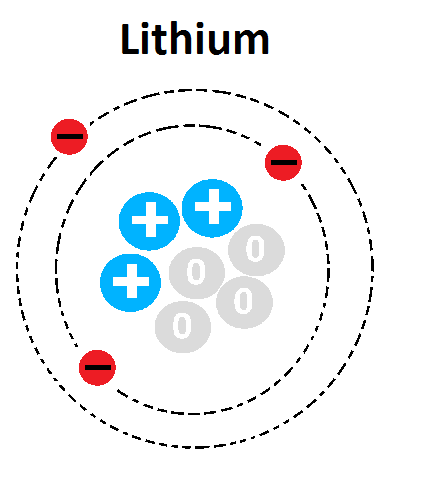
What is the atomic number of this atom?
a)
1
b)
3
c)
4
d)
7
45.
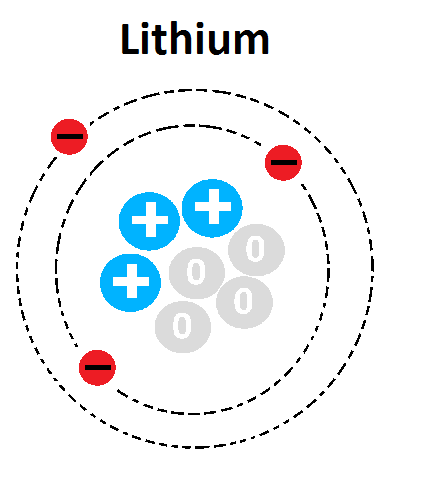
What is the mass number of this atom?
a)
1
b)
3
c)
4
d)
7
46.
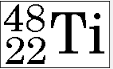
How many protons does this isotope of titanium have?
a)
48
b)
22
c)
26
d)
70
47.

How many neutrons does the isotope of lithium have?
a)
8
b)
3
c)
4
d)
5
48.
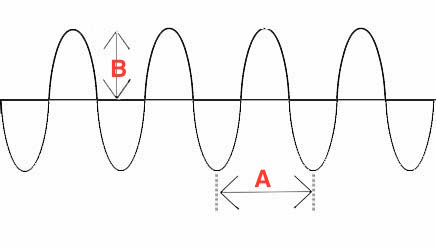
What property of this wave is represented by the letter "A"
a)
amplitude
b)
crest
c)
trough
d)
wavelength
49.
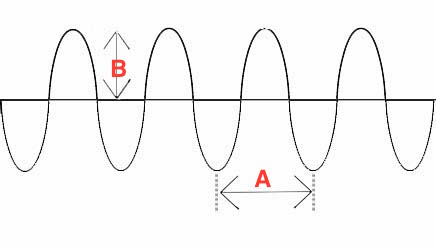
What property of the wave is represented by the letter "B"?
a)
amplitude
b)
crest
c)
trough
d)
wavelength
50.
The highest point on a wave is:
a)
the crest
b)
the trough
c)
the top
d)
the coast
51.
The lowest point on a wave is the:
a)
Amplitude
b)
Crest
c)
Trough
d)
Wavelength
52.
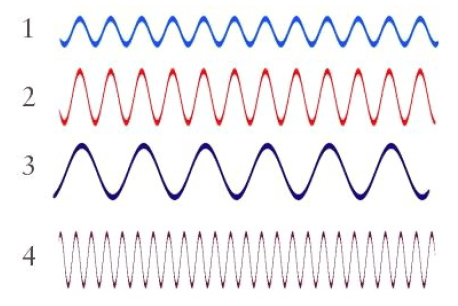
Which wave in the diagram has the greatest frequency?
a)
1
b)
2
c)
3
d)
4
53.

Which wave in the diagram has the greatest wavelength?
a)
1
b)
2
c)
3
d)
4
54.

What is the shape of a p orbital?
a)
sphere
b)
it's just too complex to thing about it
c)
dumbbell
d)
pyramidal
55.
How many valence electrons does sodium have?
a)
1
b)
2
c)
3
d)
4
56.
How many valence electrons does Phosphorus have?
a)
31
b)
5
c)
15
d)
4
57.
How many valence electrons does Krypton have?
a)
36
b)
18
c)
8
d)
4
58.
What atom matches this electron configuration?
1s22s22p63s2
1s22s22p63s2
a)
Neon
b)
Magnesium
c)
Aluminum
d)
Potassium
59.
What electron configuration matches an oxygen atom?
a)
1s22s22p63s2, 3p64s23d104p5
b)
1s22s22p4
c)
1s22s22p6
d)
1s22s22p63s23p64s23d1
60.

This could be the dot diagram of
a)
Ne
b)
H
c)
C
d)
F
61.

This could be the dot diagram of
a)
Mg
b)
Cl
c)
C
d)
O
62.
Who created the "plum pudding" model of the atom?
a)
Democritus
b)
Rutherford
c)
Dalton
d)
Thomson
63.
He conducted the cathode-ray tube experiment.
a)
Rutherford
b)
Schrödinger / Heisenberg
c)
Dalton
d)
Thomson
64.
He conducted the gold foil experiment.
a)
Democritus
b)
Dalton
c)
Thomson
d)
Rutherford
65.
Which of these is a property of metals?
a)
It's malleable
b)
It can't conduct electricity
c)
They are used in food
d)
It's very brittle
66.
If a material can easily be drawn into the shape of a wire, it is
a)
Ductile
b)
Magnetic
c)
Malleable
d)
Reactive
67.
Anytime you see the word SEMICONDUCTOR - what substance do you have?
a)
Metal
b)
Nonmetal
c)
Metalloid
68.
Helium is in which family?
a)
alkali
b)
alkaline
c)
noble gas
d)
none
69.
Orbitals include SPDF. Which orbital includes the transition metals?
a)
S (left)
b)
P (right)
c)
D (middle)
d)
F (Hanging off the bottom)
70.
What is the correct name for Group 2?
a)
Group 3
b)
Alkali Metals
c)
Alkaline Metals
d)
Chalcogens
71.
What group number are the Alkali Metals?
a)
1
b)
2
c)
17
d)
18
72.
The current periodic table is arranged by what feature?
a)
atomic mass
b)
neutrons
c)
electrons
d)
protons/atomic number
73.
The periodic table was set up by which scientist?
a)
Rutherford
b)
Thompson
c)
Mendeleev
d)
Heisenberg
74.
Which has the greater EN:
Cl or Al?
Cl or Al?
a)
Cl
b)
Al
75.
Which of the following will have a larger radius than Zinc?
a)
Gallium
b)
Aluminum
c)
Magnesium
d)
Strontium
76.
As you move down the periodic table atoms get bigger. This is because ____________.
a)
The atoms have more mass.
b)
The atoms have more protons.
c)
The atoms have more energy levels
d)
The atoms have more nuetrons
77.
As you move across the periodic table atoms tend to get smaller because, ______________.
a)
the atoms have more mass.
b)
the atoms have less mass
c)
the atoms have more protons.
d)
the atoms have less electrons.
78.
Maximum number of electrons that can be placed in an s orbital.
a)
2
b)
6
c)
10
d)
14
79.
The maximum number of electrons that can be placed in an p orbital.
a)
2
b)
6
c)
10
d)
14
80.
The maximum number of electrons that can be placed in an d orbital.
a)
2
b)
6
c)
10
d)
14
81.
The maximum number of electrons that can be placed in an f orbital.
a)
2
b)
6
c)
10
d)
14
82.
What are the sublevels that make up the n=3 energy level?
a)
s
b)
s, p
c)
s, p, d
d)
s, p, d, f
83.
What is ionization energy?
a)
Energy needed to destroy an atom
b)
Energy required to remove an electron
c)
Energy needed to split an electron
d)
Energy required to add an electron
84.
How many Aluminum are in Al2O3?
a)
3
b)
2
c)
5
d)
1
85.
According to the octet rule most elements need _______ valence electrons.
a)
2
b)
8
c)
6
d)
18
86.
When an atom loses electrons, it forms a(n)________.
a)
anion
b)
cation
c)
no ion
d)
covalent bond
87.
When an atom gains electrons, it forms a(n)
a)
anion
b)
cation
c)
no ion
d)
covalent bond
88.
When two atoms share electrons, a chemical bond is formed. This type of bond is called:
a)
covalent bond
b)
ionic bond
c)
crystal bond
d)
polyatomic bond
89.
What is a double bond?
a)
a bond between two atoms
b)
one pair of electrons shared between two atoms
c)
two pairs of electrons shared between two atoms
d)
James Bond's brother
90.
According to the VSEPR theory, the shape of CH4 molecule would be
a)
linear
b)
bent
c)
triangular
d)
tetrahedral
91.
Which of the following is a property of ionic solids
a)
low melting point
b)
low boiling point
c)
malleable
d)
good conductor when dissolved in water
92.
Which of the following is a property of covalent solids
a)
low melting point
b)
high melting point
c)
malleable
d)
good conductor when dissolved in water
93.

What is the shape?
a)
tetrahedral
b)
trigonal planar
c)
bent
d)
trigonal pyramidal
94.
What bonds are attached to the central atom in CO2?
a)
2 single bonds
b)
4 single bonds
c)
2 double bonds
d)
4 double bonds
95.
What is a double bond?
a)
a bond between two atoms
b)
one pair of electrons shared between two atoms
c)
two pairs of electrons shared between two atoms
d)
James Bond's brother
96.
Fluorine (F₂) is a(n) _________________ molecule because the valence electrons are shared equally between the two fluorine atoms.
a)
polar
b)
nonpolar
c)
ionic
d)
crystal
97.
Because the electrons in a molecule of hydrogen fluoride (HF) are more strongly pulled toward the fluorine atom, the molecule is:
a)
polar
b)
nonpolar
c)
ionic
d)
charged
98.
Na2O
a)
Sodium oxide
b)
Soidide oxide
c)
Sodium(II) oxide
d)
Disodium oxide
99.
What type of metal needs a roman numeral after its name?
a)
Group 1A
b)
Group 2A
c)
Transition
d)
Group 3A
100.
Hg2SO4
a)
Mercury sulfide
b)
Mercury sulfate
c)
Mercury(I) sulfate
d)
Mercury (II) sulfate
101.
What is the formula for iron(II) carbonate?
a)
Fe2CO3
b)
FeCO3
c)
Fe2CO2
d)
FeCO4
102.
In the compound TiO2, titanium has a charge of
a)
4+
b)
2+
c)
2-
d)
4-
103.
The chemical formula for an ionic compound of potassium and oxygen is
a)
KO.
b)
K2O.
c)
K2O2.
d)
KO2.
104.
PBr5
a)
Phosphorus Bromide
b)
Phosphorus Pentabromide
c)
Pentaphosphorus bromide
d)
Phosphorus Bromine
105.
Zinc Fluoride
a)
ZnF2
b)
ZnF
c)
Zn2F
d)
Zn2F4
106.
AB + CD →AD + CB
a)
Double Replacement
b)
Single Replacement
c)
Synthesis
d)
Decomposition
107.
Identify this type of reaction,
Cl2 + 2KI --> I2 + 2KCl
Cl2 + 2KI --> I2 + 2KCl
a)
Synthesis
b)
Single displacement
c)
Double displacement
d)
Decomposition
108.
2 C5H5 + Fe --> Fe(C5H5)2
a)
single displacement
b)
double displacement
c)
decomposition
d)
synthesis
109.
Balance this equation
_Al +_HCl --> _H2 +_AlCl3
_Al +_HCl --> _H2 +_AlCl3
a)
2, 6, 3, 2
b)
it is already balanced
c)
4, 12, 3, 4
d)
2, 1, 4, 5
110.
Balance this equation-
__P4 + __O2 --> __P2O3
__P4 + __O2 --> __P2O3
a)
it is already balanced
b)
2, 1, 3
c)
1, 2, 3
d)
1, 3, 2
111.
What type of reaction is this?
C3H6O + 4 O2 -->3 CO2 + 3 H2O
C3H6O + 4 O2 -->3 CO2 + 3 H2O
a)
single replacement
b)
synthesis
c)
combustion
d)
decombustion
112.
Balance this equation.
_CH4 + _O2 --> _CO2 + _H2O
_CH4 + _O2 --> _CO2 + _H2O
a)
1,2,1,1
b)
2,1,2,1
c)
1,2,1,2
d)
0,2,0,2
100 %

