
 Worksheets
Fall Final Exam Review
Total questions: 100
Worksheet time: 2hrs 37mins
Name
Class
Date
1.
How many significant figures are in the following number?
607000
607000
a)
1
b)
2
c)
3
d)
6
2.
Answer the following to the correct number of significant figures:
(3.24 - 1.1) ÷ 0.32
(3.24 - 1.1) ÷ 0.32
a)
6.69
b)
7
c)
6.5625
d)
6.6
3.
How many mg are in 2.3g
a)
0.023
b)
0.23
c)
23
d)
2300
4.

This bullseye demonstrates...
a)
High Accuracy & High Precision
b)
High Accuracy & Low Precision
c)
Low Accuracy & High Precision
d)
Low Accuracy & Low Precision
5.
Round 0.0010021 to three sig figs
a)
100
b)
0.00100
c)
10021
d)
already has 3 sig figs
6.

Volume?
a)
63.5 mL
b)
63 mL
c)
63.55 mL
d)
6 mL
7.
Jack has a rock. The rock has a mass of 14g and a volume of 2cm3. What is the density of the rock?
a)
7 mL
b)
7 g/cm3
c)
28 g/cm3
d)
1/7 g/cm3
8.

Put the liquids in order from most dense to least dense?
a)
4, 3, 2, 1
b)
1, 2, 3, 4
c)
3, 4, 2, 1,
d)
4, 3, 1, 2
9.
Accuracy is defined as
a)
close repeated measurements
b)
awesome measurements
c)
really good guessing
d)
measurement near the true value
10.
Measurements that are repeated and close to each other can be defined as:
a)
accurate
b)
accurate and precise
c)
precise
d)
estimated
11.

What is the volume of Object X?
a)
10.0 cm3
b)
15.0 cm3
c)
20.0 cm3
d)
25.0 cm3
12.
An object is measured to be 3.12g. The accepted value is 4.50g. What is the percentage error for this measurement?
a)
43.1%
b)
30.7%
c)
30.666%
d)
25.1%
13.
Particles (molecules) in a ______________________ have more energy than the other states of matter.
a)
gas
b)
solid
c)
liquid
14.
Define a liquid.
a)
Indefinite shape, indefinite volume
b)
Definite shape, definite volume
c)
Found in stars
d)
Definite volume, indefinite shape
15.
The state of matter that has no definite size or shape is
a)
Solid
b)
Liquid
c)
Gas
16.
Is melting butter for popcorn a chemical or physical change?
a)
chemical
b)
physical
17.

Is burning wood a chemical or physical change?
a)
chemical
b)
physical
18.
Which of the following is NOT an example of a physical change?
a)
crumpled paper
b)
pencil sharpening
c)
shrunken clothing
d)
sour milk
19.
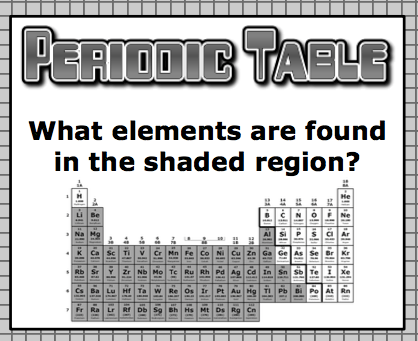
a)
Metals
b)
Nonmetals
c)
Metalloids
20.
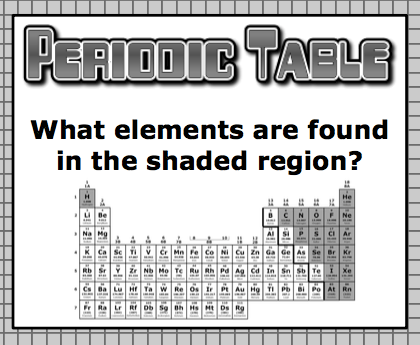
a)
Metals
b)
Nonmetals
c)
Metalloids
21.
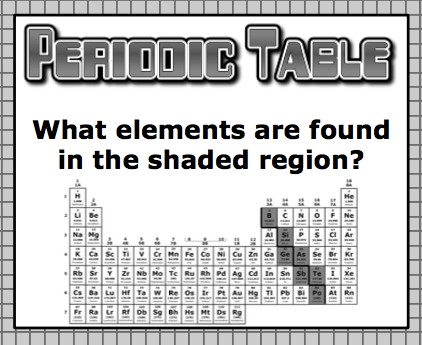
a)
Metals
b)
Nonmetals
c)
Metalloids
22.
a)
Metals
b)
Nonmetals
c)
Metalloids
23.
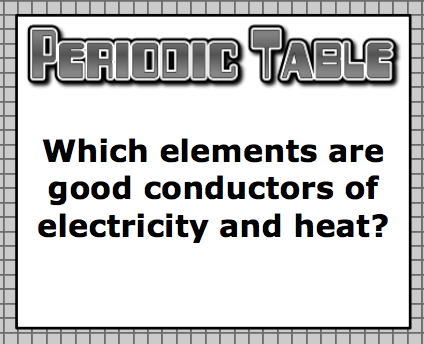
a)
Metals
b)
Nonmetals
c)
Metalloids
24.
Which is a halogen?
a)
Helium
b)
Chlorine
c)
Oxygen
d)
Neptune
25.
Elements in a ..................have similar chemical properties.
a)
period
b)
group
c)
row
26.
Which of the following will have a lower ionization energy than Scandium (Sc)?
a)
Helium (He)
b)
Titanium (Ti)
c)
Calcium (Ca)
d)
Magnesium (Mg)
27.
Which atom has the largest atomic radius?
a)
potassium
b)
rubidium
c)
francium
d)
cesium
28.
A measure of the size of an atom, and is generally defined as the distance from the nucleus to the outermost electron orbit
a)
chemical reactivity
b)
atomic radius
c)
energy levels
d)
orbit
29.
The minimum energy required to remove an electron from the ground state of an atom
a)
electron configuration
b)
energy levels
c)
ionization energy
d)
ionic bond
30.
The tendency of an atom to attract electrons and acquire a negative charge
a)
electronegativity
b)
charge
c)
bonding ability
d)
electron configuration
31.
Which of the following will have a larger radius than Zinc?
a)
Gallium
b)
Aluminum
c)
Magnesium
d)
Strontium
32.
What side of the periodic table are nonmetals on?
a)
left
b)
right
c)
top
d)
bottom
33.
Which of the following elements is a metal?
a)
calcium
b)
chlorine
c)
iodine
d)
oxygen
34.
What side of the periodic table are metals on?
a)
left
b)
right
c)
top
d)
bottom
35.
All of the following are evidence of a chemical change EXCEPT-
a)
change in state of matter
b)
formation of a gas
c)
color change
d)
precipitate forms
36.
Positive ions form when atoms _________ valence electrons.
a)
lose
b)
gain
c)
share
d)
gain or share
37.
Ions are:
a)
atoms with a positive or negative charge
b)
atoms with no charge
c)
atoms with ONLY a positive charge
d)
atoms with ONLY a negative charge
38.
Valence electrons are:
a)
Electrons farthest away from the nucleus
b)
Electrons closest to the nucleus
c)
Electrons that just come and go - they don't stay with the atom
39.

What is the number of protons?
a)
34
b)
16
c)
18
d)
S
40.

What is the number of neutrons?
a)
34
b)
79
c)
45
d)
35
41.
Negative ions are called
a)
Cations
b)
Electrons
c)
Anions
d)
Neutrons
42.
Atoms of the same element must always have the same number of _________
a)
electrons
b)
neutrons
c)
isotopes
d)
protons
43.
Two atoms of the same element but with different mass numbers are called________
a)
electrons
b)
isotopes
c)
variables
d)
electron cloud
44.

which atom has 4 neutrons?
a)
Li-6
b)
Li-7
c)
Li-8
d)
they have the same # of neutrons
45.
What quantities vary between isotopes of an element?
a)
protons, electrons, and atomic mass
b)
protons, electrons, and atomic number
c)
neutrons and electrons
d)
neutrons and atomic mass
46.
When an ionic compound forms the metal _____________ electrons and the nonmetal _______________ electrons.
a)
loses, loses
b)
loses, gains
c)
gains, loses
d)
gains, gainns
47.
What atom matches this electron configuration?
1s22s22p63s23p64s23d10
1s22s22p63s23p64s23d10
a)
Zinc
b)
Copper
c)
Nickel
d)
Germanium
48.
What electron configuration matches an oxygen atom?
a)
1s22s22p63s2, 3p64s23d104p5
b)
1s22s22p4
c)
1s22s22p6
d)
1s22s22p63s23p64s23d1
49.
How many electrons can the first energy level hold?
a)
1
b)
2
c)
8
d)
0
50.
Identify the Electron Configuration for Aluminum (Al)
a)
1s2 2s2 2p6 3s2 3p1
b)
1s2 2s2 2p6 3s2 3p3
c)
1s2 2s2 2p6 3s2 4p1
51.
Which of the following is a p block element?
a)
Ca
b)
Ar
c)
Ce
d)
Au
52.
How many electrons can the d sublevel hold?
a)
8
b)
10
c)
2
d)
4
53.
How many total electrons can the f orbitals in a sublevel hold?
a)
2
b)
14
c)
6
d)
10
54.
What is oxidation number of Fe in FeO ?
a)
+2
b)
-2
c)
0
d)
+1
55.
What is oxidation number of Mn in MnO2 ?
a)
0
b)
+2
c)
-2
d)
+4
56.
What is the oxidation number of Boron?
a)
+2
b)
+3
c)
+1
d)
-3
57.
What is the oxidation number of Sulfur?
a)
+1
b)
+2
c)
-1
d)
-2
58.
Which of these is a compound?
a)
Salt
b)
Air
c)
Charcoal
d)
Granite
59.

What atomic model is shown?
a)
Plum Pudding Model
b)
Bohr Model
c)
Nuclear Model
d)
Cloud Model
60.
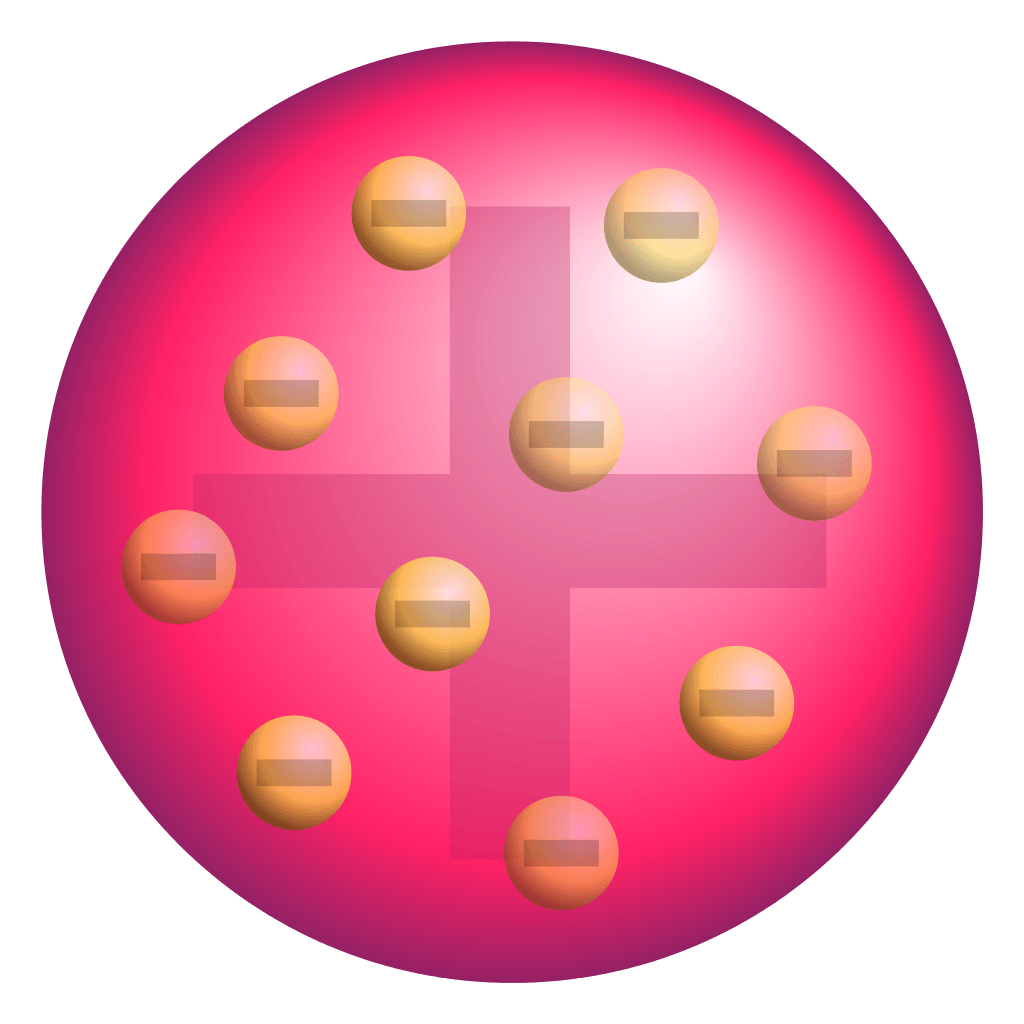
This model was developed after J.J. Thompson discovered electrons, a particle smaller than an atom. Is shows electrons floating freely in a positive space.
a)
The "Plum Pudding Model" of the atom
b)
The "Rutherford Model" of the atom
c)
Democritus's model of the atom
d)
The "Solar System Model" of the atom
61.

This was the first model of the atom ever proposed. It was simple and described atoms as tiny spheres that could not be broken down into smaller pieces.
a)
Solid Sphere Model
b)
The "Plum Pudding Model" of the atom
c)
The "Rutherford Model" of the atom
d)
The "Solar System Model" of the atom
62.
Takes two small nuclei and combines them into a larger nucleus
a)
fission
b)
fusion
63.
The splitting of a nucleus into smaller nuclei is
a)
fusion
b)
fission
c)
half-life
d)
gamma radiation
64.
A helium nucleus with two protons and two neutrons is called a(n) ____ particle
a)
alpha
b)
beta
c)
gamma
d)
lambda
65.
What happens when the number of protons in an atom changes?
a)
The number of electrons changes too
b)
Usually nothing happens, unless the atom is radioactive
c)
The atomic nucleus explodes
d)
It becomes a completely different atom, with different properties
66.
The most penetrating type of radiation is the ____.
a)
alpha particle
b)
beta particle
c)
gamma ray
d)
uranium
67.
When a nucleus emits a beta particle, its atomic number
a)
changes, and so does its mass number.
b)
changes, but its mass number remains constant.
c)
remains constant, and so does its mass number.
d)
remains constant, but its mass number changes.
68.
How many elements are represented in the compound?
Na2CO3
Na2CO3
a)
1
b)
2
c)
3
d)
4
69.

Chicken noodle soup is an example of a
a)
homogeneous mixture
b)
heterogeneous mixture
70.

Lemonade is an example of a
a)
homogeneous mixture
b)
heterogeneous mixture
71.

What is measured with a graduated cylinder?
a)
Passage of time
b)
Distance from one thing to another
c)
Weight of an object
d)
Volume of liquid
72.
This piece of equipment is used to mix liquids together.
a)
glass stirring rod
b)
scalpel
c)
probe
d)
test tube
73.
Which item measures more precisely?
a)
test tube
b)
beaker
c)
graduated cylinder
74.

Identify the equipment shown here:
a)
beaker
b)
Erlenmeyer flask
c)
Florence flask
d)
volumetric flask
75.

Name this item
a)
Balance
b)
pH Meter
c)
Digital Thermometer
d)
Spectrometer
76.
calcium phosphate
a)
CaPO4
b)
Ca2(PO4)3
c)
Ca3PO4
d)
Ca3(PO4)2
77.
hydrobromic acid
a)
HBrO3
b)
HBr
c)
HBr2
d)
HBrO
78.
copper(II) chloride
a)
CuCl2
b)
CuCl
c)
Cu2Cl
d)
Cu2Cl2
79.
Fe(NO3)2
a)
iron nitrate
b)
iron dinitrate
c)
iron(II) nitrate
d)
iron(I) nitrate
80.
K2SO3
a)
potassium sulfide
b)
potassium sulfite
c)
potassium sulfate
d)
dipotassium monosulfur trioxide
81.
P2O5
a)
Phosphorus Oxide
b)
Pentaphosphorus Dioxide
c)
Diphosphorous pentoxide
d)
Phosphoric Oxygen
82.
SeF4
a)
Tetraselenium fluoride
b)
Selenium Fluoride
c)
Selenium tetraflouride
d)
Selenium (IV) Fluoride
83.

Which of these is covalent?
a)
NaCl
b)
Pb(NO3)2
c)
CO2
d)
AlCl3
84.
Covalent compounds
a)
Share electrons
b)
transfer electrons
c)
contain a sea of electrons
d)
conduct electricity
85.
Three pairs of electrons are shared in a
a)
Single bond
b)
Double bond
c)
Triple bond
86.
How many electrons do most atoms need to be stable?
a)
1
b)
2
c)
6
d)
8
87.
The theory that is used to predict the arrangement of atoms about a central atom is called?
a)
Valence shell repulsion
b)
Valence shell electron sharing
c)
Valence shell electron pair repulsion
d)
Valence electron shell repulsion pair
88.
Atoms of H only form _________ bonds.
a)
Double
b)
Single
c)
Multiple
d)
Triple
89.

Which of the following is an acceptable Lewis structure for CH3Cl?
a)
Option A
b)
Option B
c)
Option C
d)
Option D
90.
Hydrogen needs _____ electrons in its valence shell to be stable.
a)
4
b)
6
c)
8
d)
2
91.

Which of the following is the correct Lewis structure for CH2O?
a)
Option A
b)
Option B
c)
Option C
d)
Option D
92.
A bond where electrons are NOT shared equally?
a)
polar covalent
b)
nonpolar covalent
c)
ionic
d)
ionic-covalent
93.
How many molecules are in 2.5 mol of NaCl?
a)
1.51x10²³
b)
146
c)
4.15
d)
1.51x1024
94.
What is the molar mass of table salt (NaCl)?
a)
116.886 g/mol
b)
35.453 g/mol
c)
22.990 g/mol
d)
58.443 g/mol
95.
How many moles are in 16.94g of water?
a)
16.94
b)
0.9403
c)
305.2
d)
1.063
96.
What is the law of conservation of mass?
a)
Matter changes when reacted or changed.
b)
The mass of all reactants are changed during a physical or chemical change
c)
The mass of the reactants is the same as the mass of the products
d)
The mass of the products is different than the mass of the reactants.
97.
Electronegativity is...
a)
the energy required to add an electron to a specific atom
b)
how much energy it takes to remove an electron from an atom
c)
the energy required to shield the outer electrons from the nucleus
d)
a measure of the ability of an atom to attract electrons
98.

If one-fourth of the carbon-14 is remaining then how many half-lives have passed?
a)
1
b)
2
c)
3
d)
4
99.
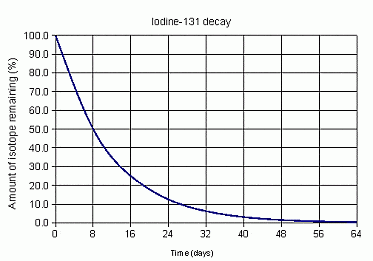
What is the half-life of iodine-131?
a)
32 days
b)
8 days
c)
16 days
d)
24 days
100.
What is Half-life?
a)
The amount of time it takes for some of the nuclei in a sample of the isotope to decay
b)
The amount of time it takes for half the electrons in a sample of the isotope to decay
c)
The amount of time it takes for half the nuclei in a sample of the isotope to decay
d)
the amount of time it takes to double the nuclei in a sample of the isotope to decay
100 %

