
 Worksheets
Environmental Science Final Exam Fall 2017-18
Total questions: 96
Worksheet time: 23hrs 53mins
Name
Class
Date
1.
Layers of rock and soil that hold groundwater are called:
a)
ponds
b)
rivers
c)
aquifers
d)
basins
2.
Water that flows over land and has not been absorbed into the ground
a)
erosion
b)
surface water
c)
runoff
d)
watershed
3.
All of the land area that supplies water to a particular river system:
a)
erosion water
b)
aquifer
c)
groundwater
d)
watershed
4.
Level reached where all soil spaces below it are saturated with water:
a)
recharge zone
b)
well
c)
littoral zone
d)
water table
5.
A hole dug deep into an aquifer to reach groundwaters is called this:
a)
underground river
b)
water basin
c)
well
d)
recharge zone
6.
This nutrient is frequently measured to check for water quality and the possibility of high levels of algal growth:
a)
oxygen
b)
nitrogen
c)
phosphorous
d)
sodium
7.
Large lake that stores water for human use:
a)
pond
b)
reservoir
c)
landfill
d)
stream
8.
Most of the earth's water is found here:
a)
Mississippi River
b)
Great Lakes
c)
Oceans
d)
Amazon River
9.
Form of pollution that comes from distinct locations:
a)
Point source pollution
b)
Nonpoint source pollution
c)
Nuclear plant run-off thermal discharge zone
d)
xeriscape
10.
Form of pollution that gets into water from many places spread over a large area from runoff:
a)
point source pollution
b)
nitrogen pollution
c)
non point source pollution
d)
eutrophication
11.
Biocontaminants in water can include all of the following except:
a)
bacteria
b)
parasites
c)
sediments
d)
viruses
12.
The name for the water can gets into groundwater as it passes through ground pollution:
a)
leachate
b)
algae
c)
erosion
d)
runoff
13.
Most of the earth's biodiversity is found here:
a)
the poles
b)
near the equator
c)
in the boreal forests
d)
in the Midwest area of the US
14.
How many mass extinctions have there been on the earth according to the fossil record:
a)
two
b)
just one
c)
three
d)
five
15.
A species in serious risk of extinction is:
a)
threatened
b)
extinct
c)
abandoned
d)
endangered
16.
Scientists are using cloning to solve the challenge of extinction in some situations.
a)
True
b)
False
17.
Biodiversity is important because:
a)
species are dependent on each other for survival
b)
The species there are, the more there are to look at
c)
biodiversity makes species become endangered
d)
what happens to one species has no effect on other species
18.
Carbon dioxide
a)
is a greenhouse gas
b)
is not produced by natural processes by organisms
c)
will not dissolve in the ocean
d)
is breathed in by humans to keep them alive
19.
Carbon dioxide:
a)
is at the center of the climate change controversy
b)
has been increasing at unnatural rates since the industrial revolution
c)
comes only from humans
d)
is the center of the climate change controversy and has been rising since industrial revolution
20.
Here in the midwest, this would not be considered an invasive species:
a)
zebra mussel
b)
burmese python
c)
common tree squirrel
d)
people from Florida
21.
Point sources are a type of water supply that is easy to locate and control. What is an example of a point source?
a)
drain pipes
b)
agricultural runoff
c)
acid rain
d)
fertilizer run off from lawns
22.
What is the relationship between the amount of available dissolved oxygen and level of water quality?
a)
There is more dissolved oxygen in the water when the water quality is high
b)
There is more dissolved oxygen in the water when the water quality is low
c)
There is little dissolved oxygen in the water when the water quality is high
d)
There is more dissolved oxygen in the water when the temperature of the water is warm.
23.
Biodegradable wastes in contaminated ground water can:
a)
clean itself in a matter of days
b)
remain contaminated permanently
c)
clean itself within hundreds to thousands of years
d)
remain contaminated for a few hours
24.
Water pollution that comes from many sources is considered...
a)
point source pollution
b)
nonpoint source pollution
c)
thermal pollution
d)
ocean pollution
25.
97% of the water on earth is _________, making it undrinkable for humans.
a)
fresh water
b)
ground water
c)
salt water
d)
surface water
26.
This type of pollution contaminates lakes, oceans, river, etc.
a)
air
b)
land
c)
water
27.
What is the % of fresh water in the world
a)
50%
b)
30%
c)
5%
d)
3%
28.
The difference between a point source and a nonpoint source of water pollution is...
a)
a nonpoint source is easily identifiable
b)
point sources can be targeted for reduction
c)
nonpoint sources tend to be factory outputs
d)
point sources tend to be agricultural in nature
29.
Which of the following gases involved in global climate change is increasing in the atmosphere at the fastest rate?
a)
H2O
b)
Methane
c)
Chlorofluorocarbons
d)
CO2
30.
What is one cause of air pollution?
a)
litter found on the side of the road
b)
water used as a coolant by power plants
c)
burning fossil fuels
31.
Which of these causes the most pollution in our world today?
a)
bikes
b)
cars
c)
skateboards
d)
computers
32.
What global effect is happening when we burn all these fossil fuels?
a)
global warming
b)
tax evasion
c)
stealing
d)
lying
33.

The Earth gains energy from the sun in the form of?
a)
Infrared Radiation (heat)
b)
X-Ray Radiation
c)
Nuclear Radiation
d)
Solar Radiation (UV)
34.
Natural processes that cause air pollution, and climate change, within the Earth's atmosphere can consist of:
a)
smokestacks and cars
b)
power plants and busses
c)
volcanoes and wildfires
d)
volcanoes and man-made-fires
35.
Unnatural processes that cause air pollution, and climate change, within the Earth's atmosphere can consist of:
a)
Oceans spraying sea water
b)
Volcanic Euruptions
c)
Industrial Smokestacks
d)
Pollinated Trees and Flowers
36.
Which BEST describes why latitudes closest to the equator have warmer climates?
a)
they are at lower elevations
b)
they receive more solar energy
c)
they are nearer to ocean currents
d)
they get more winds that carry energy in the form of heat
37.
The four main categories of __________ are air, water, land, and noise/light.
a)
Pollution
b)
Emissions
c)
Aerosols
d)
Smog
38.
Cigarette smoke, and other things that are known to cause cancer, are called
a)
CFCs
b)
carcinogens
c)
VOCs
d)
fossil fuels
39.
What is NOT a way to conserve energy?
a)
Take a short shower instead of a long one.
b)
Turn off the lights when leaving a room.
c)
Recycle old newspapers and drink cans.
d)
Driving a car instead of riding a bike.
40.
Environmental decision making requires a balance between the needs of the people and what?
a)
The location of the environment
b)
the needs of the environment
c)
the needs of the animals
d)
the wants of the people
41.
Where is water most likely to become contaminated?
a)
At the ocean bottom
b)
near a cattle farm
c)
by a dam
d)
in a forest
42.
Industrialization is a contributing factor to climate change.
a)
True
b)
False
43.
Climate change causes extreme weather conditions such as:
a)
excessive heat
b)
drought
c)
extreme storms
d)
all of these
44.
Some of the Earth's most fragile ecosystems that could be greatly impacted by climate change live in the
a)
tropical rainforest
b)
tundra
c)
oceans
d)
African Sahara desert
45.
Climate change can cause increases in asthma, allergies and heart disease.
a)
True
b)
False
46.
What are greenhouse gases?
a)
gases that cause climate change
b)
gases that emit green smoke
c)
gases that are used to make green colored glass
47.
The earth has been hotter at times in the past.
a)
True
b)
False
48.
Increasing quantities of CO2 in the atmosphere will likely cause surface air temperatures to be _____.
a)
warmer
b)
cooler
49.
How can the planting of new trees help reduce climate change?
a)
Trees help create breezes.
b)
Trees release moisture that cools the atmosphere.
c)
Trees take in carbon dioxide from the atmosphere during photosynthesis.
d)
Trees block the release of greenhouse gases from soil.
50.
What is the biggest danger posed by global warming to people living in coastal areas?
a)
increased precipitation
b)
increased acidity of sea water
c)
lack of carbon dioxide in the atmosphere
d)
rising sea level
51.
Which human activity contributes the most carbon dioxide to the atmosphere?
a)
fishing
b)
breathing
c)
burning fossil fuels
d)
farming
52.
How do fossil fuels affect the greenhouse effect?
a)
Burning fossil fuels decreases incoming solar radiation
b)
Burning fossil fuels decreases the amount of heat trapped
c)
Burning fossil fuels releases carbon dioxide into the atmosphere trapping more heat
d)
Burning fossil fuels causes less heat to be trapped
53.
Scientists can extract samples of ancient air from ice cores
a)
True
b)
False
54.

Which of the following is the best conclusion that can be made from this graph?
a)
atmospheric carbon dioxide levels have been decreasing since 1960
b)
Hawaii has a lot of carbon dioxide
c)
humans have been working hard to decrease carbon dioxide levels
d)
atmospheric carbon dioxide levels have increased steadily since 1960
55.
Global warming refers specifically to an increase in
a)
the number of storms on Earth.
b)
precipitation from Earth’s atmosphere.
c)
temperatures everywhere on Earth.
d)
Earth’s average surface temperature.
56.
All of the following are human causes of climate change except
a)
deforestation
b)
volcanoes
c)
burning fossil fuels
d)
urbanization
57.
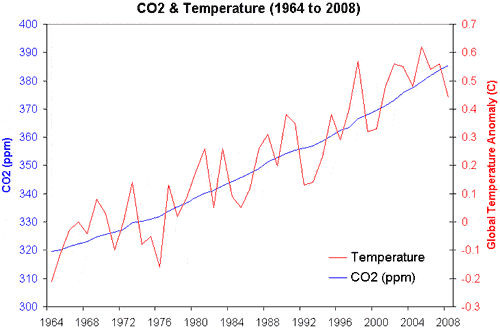
The graph below shows CO2 emissions and temperatures from 1909 to 1949.
What conclusion is best supported by the graph?
What conclusion is best supported by the graph?
a)
There is no relationship between carbon dioxide concentrations and temperatures
b)
As carbon dioxide concentrations increase, temperatures increase
c)
As carbon dioxide concentrations increase, temperatures decrease
d)
As carbon dioxide concentrations decrease, temperatures increase
58.
The sun's rays are least direct
a)
near the poles
b)
near the equator
c)
at high altitudes
d)
far from the ocean
59.
Large bodies of water affect climate because
a)
water heats up and cools more slowly than land
b)
water heats up and cools faster than land
c)
water and land cool at the same time
d)
water and land heat at the same rate
60.

Over the past 200 years, the level of carbon dioxide in the atmosphere has
a)
decreased slightly
b)
increased until recently, and then decreased
c)
increased steadily
d)
stayed about the same
61.
Which of the following is a greenhouse gas that is produced by domestic livestock?
a)
nitrogen oxide
b)
methane
c)
carbon monoxide
d)
sulfur dioxide
62.
What is an indicator that the overall climate of the Earth is getting warmer?
a)
Ice caps melting
b)
Palm trees being cut down
c)
Volcanos erupting
d)
Photosynthesis
63.
Which process does not release carbon dioxide into the environment?
a)
Combustion
b)
Respiration
c)
Decomposition
d)
Photosynthesis
64.

The greenhouse gas having the greatest role in human-caused global warming is
a)
methane
b)
carbon dioxide
c)
CFCs (chlorofluorocarbons)
d)
ozone
65.
What term best describes an organism that naturally evolved in a particular region?
a)
Native
b)
Non-Native
c)
Alien
d)
Invasive
66.
What term best describes an organism that has been transported to a new region?
a)
Native
b)
Non-Native
c)
Predator
d)
Heterotroph
67.
How can invasive species be naturally transported to a new location?
a)
Wooden Crates
b)
Plant Transportation
c)
Ships
d)
Wind Currents
68.
How can humans transport invasive species?
a)
Migratory organisms, ships, wood crates
b)
Wind, plant transport, pet trade
c)
pet trade, ships, plant transport
d)
Ships, by accident, water currents
69.

If a blue catfish is introduced and eats the large fish who eat the smaller fish, what will happen to the population of the smaller fish?
a)
Increase
b)
Decrease
c)
Stay the same
d)
No affect on smaller fish
70.
Which of the following is a key characteristic of most invasive species?
a)
Ability to breathe in the air & in the water
b)
Large, sharp teeth
c)
Produce many offspring
d)
Is a top predator
71.
What is one method for preventing invasive species?
a)
Create laws to stop and monitor imports
b)
Create a hunting program
c)
Set up boundaries
d)
Eradicate species
72.
When taken to a new habitat, non-native plants often threaten native plants of the new habitat. Why do they do this?
a)
Non-native plants are able to mutate rapidly
b)
Non-native plants cause native animals to relocate
c)
Non-native plants are able to be used for medicine
d)
Non-native plants compete with native plants for resources
73.
Without genetic diversity, a species will most likely...
a)
grow above its carrying capacity
b)
go extinct
c)
become resistant to diseases
d)
fight off an invasive species
74.
Biodiversity refers to
a)
extinct species
b)
the variety of species on Earth
c)
nonrenewable resources
d)
the rate of species decline
75.
A species that is NOT native to a particular region is called
a)
natural
b)
invasive
c)
endemic
d)
extraordinary
76.
Exotic or invasive species leads to all of these problems except
a)
increased biodiversity
b)
loss of biodiversity
c)
disease
d)
loss of native species
77.
American alligators used to be an endangered species, but not anymore. Which of the following is the best reason why there are more in Louisiana today than there were 50 years ago?
a)
they have learned how to live in new places
b)
they are bigger now than they were 50 years ago
c)
they are now protected from hunting by humans
d)
they have much more habitat now than 50 years ago
78.

Kudzu has overgrown many parts of southern Missouri and native ground plants have disappeared from the area. This is an example of:
a)
Parasitism between kudzu and the native plants
b)
A predator prey relationship between ground plants and kudzu
c)
Competition occurring between the native and invasive species
d)
Commesalism occurring between the kudzo and native plants
79.

The field mouse population in Australia has grown so fast that they eat an average of $4 billion of wheat every year. Their fast growth is caused by:
a)
A. The mice like to reproduce
b)
B. A lack of a native species to eat the field mouse
c)
C. Abundant food supply
d)
Both B and C
80.

a)
Round Goby
b)
Asian Carp
c)
Snakehead
d)
Buckthorn
81.

a)
Feral pig
b)
Snakehead
c)
Giant hogweed
d)
Red swamp crayfish
82.

a)
Snakehead
b)
Asian carp
c)
Spiny waterflea
d)
Round Goby
83.

a)
Zebra mussel
b)
Snakehead
c)
Waterhemp
d)
Sea lamprey
84.

a)
Jumping worm
b)
Red Swamp Crayfish
c)
Sea Lamprey
d)
Asian carp
85.
How do invasive plants damage the environment?
a)
Compete with native species
b)
Change plant community
c)
Alter diversity
d)
All of these
86.
Globally, the leading cause of biodiversity loss is
a)
invasive species
b)
poaching and overharvesting
c)
pollution
d)
habitat change and loss
87.
The major cause of extinction is ____________________.
a)
habitat fragmentation
b)
habitat destruction
c)
pollution
d)
poaching
88.
What is biodiversity?
a)
The variation of life found on earth + the variations within the species.
b)
Same as species diversity
c)
The variation of life.
d)
The variation of alleles.
89.
Biodiversity refers to
a)
extinct species
b)
the variety of species on Earth
c)
nonrenewable resources
d)
the rate of species decline
90.
You are a conservation biologist and have been assigned the task of conserving an endangered species. Based on your knowledge, which of the following steps would be your first priority in protecting the species?
a)
Reduce pollution in the area
b)
Captive breeding
c)
Conserve the species’ habitat
d)
Introduce a species to eat the predators of the endangered species
91.
Exotic or invasive species leads to all of these problems except
a)
increased biodiversity
b)
loss of biodiversity
c)
disease
d)
loss of native species
92.
What types of organisms are more likely to become endangered?
a)
Those with large populations
b)
Those which breed rapidly
c)
Those with one food source
d)
Those which can easily adapt to a variety of habitats
93.
True or False: Biodiversity tends to decrease nearer the equator.
a)
true
b)
false
94.
A non-native plant that causes problems to the environment that it is introduced to is called __________.
a)
Invasive
b)
Weed
c)
Indigenous
d)
Purple
95.
How do invasive plants damage the environment?
a)
Compete with native species
b)
Change plant community
c)
Alter diversity
d)
All of these
96.
How do invasive plants damage the environment?
a)
Compete with native species
b)
Change plant community
c)
Alter diversity
d)
All of these
100 %

