
 Worksheets
Genetics
Total questions: 100
Worksheet time: 1hrs 16mins
Name
Class
Date
1.
A homozygous dominant dog with brown fur is crossed with a heterozygous dog with brown fur. What are the percentages of the possible genotypes?
a)
100% BB
b)
75% BB and 25%Bb
c)
50 % BB and 50% Bb
d)
50% Bb and 50% bb
2.
The man who studied genetics and came up with genetics is
a)
Watson
b)
Crick
c)
Mendel
d)
Darwin
3.

Genotype refers to the ...
a)
physical expression of the genes
b)
the possible combination of alleles in a gene
c)
whether an allele is dominant or recessive
d)
how an organism will appear
4.

Squidward has light blue skin, and his genotype for this trait is Bb. Would Squidward be considered a purebred or hybrid for light blue skin?
a)
Purebred
b)
Hybrid
5.

An offspring will receive how many alleles from each parent to determine a specific trait?
a)
one
b)
two
c)
three
d)
five
6.
Which of the following is a phenotype?
a)
BB
b)
Bb
c)
bb
d)
Blue eyes
7.
the passing of genetic traits from parent to offspring.
a)
heredity
b)
trait
c)
gene
d)
allele
8.
having two of the same genes for the trait (sometimes called purebred).
a)
homozygous
b)
hetrozygous
c)
protein
d)
chromosome
9.
having two different genes for a trait (sometimes called hybrid).
a)
protein
b)
homozygous
c)
heterozygous
d)
genotype
10.
Magda is a tall, 11 year old drummer. She has a scar on her right cheek. She is good at swimming. Which of her traits did Magda most likely inherit?
a)
height
b)
the scar
c)
ability to swim
d)
ability to play drums
11.
Two brown eyed parents (Bb) have a baby. What is the chance the baby is blue eyed?
a)
0 %
b)
25%
c)
50%
d)
75%
12.
G = green, g = yellow
The genotype for a yellow plant is...
The genotype for a yellow plant is...
a)
GG
b)
Gg
c)
gg
d)
all of the choices result in yellow
13.
An allele whose trait only shows up when no dominant allele is present.
a)
hidden allele
b)
dominant allele
c)
recessive allele
d)
present allele
14.
Two heterozygous (Tt) tall pea plants are crossed. Which describes their offspring?
a)
50% tall and 50% short
b)
75%tall and 25% short
c)
100%short
15.
Which answer best describes codominant alleles?
a)
Both are equally dominant
b)
Both are equally recessive
c)
Neither are dominant or recessive
16.
The process by which the nuclear material is divided equally between two new cells
a)
mitosis
b)
cancer
c)
spindle
d)
centromere
17.

Structure (b) is a ____.
a)
chromosome
b)
chromatid
c)
centromere
18.

Structure (a) is a ____.
a)
chromosome
b)
chromatid
c)
centromere
19.

Structure (c) is a ____.
a)
chromosome
b)
chromatid
c)
centromere
20.

Name the phase:
a)
Anaphase
b)
Telophase
c)
Metaphase
d)
Prophase
21.

Name the phase:
a)
Anaphase
b)
Telophase
c)
Metaphase
d)
Prophase
22.

What is the next phase of mitosis?
a)
Prophase
b)
Metaphase
c)
Anaphase
d)
Telophase
23.
The cells produced via meiosis are called:
a)
sex cells
b)
somatic cells
c)
body cells
d)
skin cells
57.
Unlike mitosis, meiosis in male mammals results in the formation of
a)
one haploid gamete
b)
three diploid gametes
c)
four diploid gametes
d)
four haploid gametes
61.
If the Diploid number of Carrots is 18, the haploid number is
a)
18
b)
9
c)
27
d)
36
63.
If a body cell in a butterfly contains 24 chromosomes, a butterfly egg would contain
a)
3
b)
6
c)
12
d)
24
64.
The chromosomes that pair up during meiosis, are called __________ chromosomes.
a)
homozygous
b)
asexual
c)
homologous
d)
genes
53.

Identify the phase.
a)
Metaphase I
b)
Metaphase II
c)
Prophase I
d)
Anaphase II
52.
How many daughter cells are produced from meiosis ?
a)
10
b)
6
c)
4
d)
2
51.
Name the growth phase of the cell cycle for both Mitosis and Meiosis.
a)
metaphase
b)
telophase
c)
interphase
d)
anaophase
31.

Name this phase of meiosis.
a)
Telophase 2
b)
Telophase 1
c)
Metaphase 1
d)
Anaphase 2
34.

Name this phase of meiosis.
a)
Anaphase 2
b)
Telophase 1
c)
Anaphase 1
d)
Prophase 2
33.

Name this phase of meiosis.
a)
Prophase 1
b)
Metaphase 1
c)
Anaphase 2
d)
Prophase 2
34.
Name this phase of meiosis.
a)
Anaphase 2
b)
Telophase 1
c)
Anaphase 1
d)
Prophase 2
35.

Name this phase of meiosis.
a)
Prophase 1
b)
Prophase 2
c)
Anaphase 1
d)
Telophase 1
36.

Name this phase of meiosis.
a)
Metaphase 2
b)
Prophase 1
c)
Anaphase 1
d)
Metaphase 1
38.

Name this phase of meiosis.
a)
Prophase 1
b)
Metaphase 1
c)
Anaphase 2
d)
Telophase 1
38.
Name this phase of meiosis.
a)
Prophase 1
b)
Metaphase 1
c)
Anaphase 2
d)
Telophase 1
39.

Name this phase of meiosis.
a)
Prophase 1
b)
Metaphase 2
c)
Metaphase 1
d)
Anaphase 1
40.
The male sex cell is called
a)
egg
b)
zygote
c)
sperm
d)
mitosis
41.
The female sex cell is called
a)
zygote
b)
sperm
c)
fertilization
d)
egg
42.
How are your chromosomes inherited?
a)
most of your chromosomes from your mother
b)
most of your chromosomes from your father
c)
a random number of chromosomes from each parent
d)
half your chromosomes from your mother and half from your father.
43.
Human eggs and sperm are _____, and each has ____ chromosomes.
a)
diploid, 23
b)
diploid, 46
c)
haploid, 23
d)
haploid, 46
44.
products of meiosis are genetically
a)
different
b)
identical
46.

When an area of a chromatid is exchanged with the matching area on a chromatid of its homologous chromosome, _________________ occurs
a)
crossing over
b)
mutagenesis
c)
hybridization
d)
fertilization
46.
When an area of a chromatid is exchanged with the matching area on a chromatid of its homologous chromosome, _________________ occurs
a)
crossing over
b)
mutagenesis
c)
hybridization
d)
fertilization
47.
A human zygote should have _____ chromosomes inside.
a)
46
b)
23
c)
92
d)
64
48.
Why do we need meiosis?
a)
To double the number of chromosomes going into sex cells
b)
To halve the number of chromosomes going into sex cells
c)
To triple the number of chromosomes going into sex cells
d)
To not change the number of chromosomes going into sex cells
49.
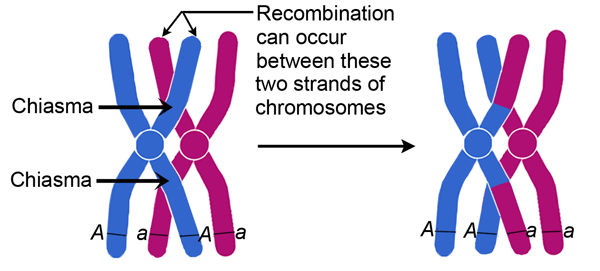
This image shows chromosomes during Prophase 1. Which of the following correctly describes the process shown?
a)
segregation of sister chromatids
b)
condensation and segregation of alleles
c)
mutationin which the DNA content of the gene is altered
d)
crossing - over in which alleles are exchanged
50.
How many cells are produced during telophase I ?
a)
4
b)
8
c)
2
d)
0
51.
Name the growth phase of the cell cycle for both Mitosis and Meiosis.
a)
metaphase
b)
telophase
c)
interphase
d)
anaophase
52.
How many daughter cells are produced from meiosis ?
a)
10
b)
6
c)
4
d)
2
53.
Identify the phase.
a)
Metaphase I
b)
Metaphase II
c)
Prophase I
d)
Anaphase II
64.
The chromosomes that pair up during meiosis, are called __________ chromosomes.
a)
homozygous
b)
asexual
c)
homologous
d)
genes
63.
If a body cell in a butterfly contains 24 chromosomes, a butterfly egg would contain
a)
3
b)
6
c)
12
d)
24
61.
If the Diploid number of Carrots is 18, the haploid number is
a)
18
b)
9
c)
27
d)
36
57.
Unlike mitosis, meiosis in male mammals results in the formation of
a)
one haploid gamete
b)
three diploid gametes
c)
four diploid gametes
d)
four haploid gametes
58.
The cells produced by meiosis are called:
a)
sex cells
b)
somatic cells
c)
body cells
d)
skin cells
59.

Meiosis makes sperm and egg cells. In humans, sperm and egg cells each have _____ chromosomes. Therefore a fertilized human egg cell (sperm and egg cell combined) would create a cell with _____ chromosomes.
a)
23, 46
b)
46, 23
c)
2, 4
d)
50, 100
60.
What kind of cells are made in MEIOSIS?
a)
Haploid gametes
b)
Diploid body cells
c)
Skin Cells
d)
Liver Cells
61.
If the Diploid number of Carrots is 18, the haploid number is
a)
18
b)
9
c)
27
d)
36
62.
Which of these cells would be produced through meiosis?
a)
skin cells
b)
liver cells
c)
brain cells
d)
sperm cells
63.
If a body cell in a butterfly contains 24 chromosomes, a butterfly egg would contain
a)
3
b)
6
c)
12
d)
24
64.
The chromosomes that pair up during meiosis, are called __________ chromosomes.
a)
homozygous
b)
asexual
c)
homologous
d)
genes
65.
In mitosis cells are genetically _______, but in meiosis cells are genetically ______.
a)
different, identical
b)
identical, different
c)
identical, identical
d)
different, different
66.
Diploid Cells are represented by
a)
2n
b)
n
c)
4n
d)
1/2 n
77.
Which of these cells would be produced through meiosis?
a)
skin cells
b)
liver cells
c)
brain cells
d)
sperm cells
68.
A male shark has 40 chromosomes in each of its sex cells. How many would be present in its body cells?
a)
20
b)
40
c)
80
d)
160
69.

What phase is represented?
a)
metaphase 1
b)
metaphase 2
c)
anaphase 1
d)
anaphase 2
70.

What phase is represented?
a)
metaphase 1
b)
metaphase 2
c)
anaphase 1
d)
anaphase 2
71.

What phase is represented?
a)
metaphase 1
b)
metaphase 2
c)
anaphase 1
d)
anaphase 2
72.
What causes genetic variation in meiosis?
a)
chromosomes lining up
b)
crossing over of chromosomes
c)
separation of chromosomes
d)
chromosomes pulling apart
73.
Unlike mitosis, meiosis in male mammals results in the formation of
a)
one haploid gamete
b)
three diploid gametes
c)
four diploid gametes
d)
four haploid gametes
74.

When an area of a chromatid is exchanged with the matching area on a chromatid of its homologous chromosome, _________________ occurs
a)
crossing over
b)
mutagenesis
c)
hybridization
d)
fertilization
75.
What kind of cells are made in MEIOSIS?
a)
Haploid Gametes
b)
Diploid Somatic Cells
c)
Skin Cells
d)
Liver Cells
76.
The process of crossing over occurs in what phase of meiosis?
a)
anaphase 1
b)
prophase 1
c)
prophase 2
d)
telophase 1
77.
Which of these cells would be produced through meiosis?
a)
skin cells
b)
liver cells
c)
brain cells
d)
sperm cells
78.
When homologous chromosomes match up, they form a structure call a ___________.
a)
tetrad
b)
triad
c)
diploid
d)
gamete
79.
Why do we need meiosis?
a)
To double the number of chromosomes going into sex cells
b)
To halve the number of chromosomes going into sex cells
c)
To triple the number of chromosomes going into sex cells
d)
To not change the number of chromosomes going into sex cells
80.
You inherited...
a)
most of your chromosomes from your mother
b)
most of your chromosomes from your father
c)
a random number of chromosomes from each parent
d)
half your chromosomes from your mother and half from your father.
81.
During meiosis I, what happens?
a)
Sister chromatids are split
b)
Homologous chromosomes are split
c)
Four cells are created
d)
None of the other choices are correct
82.
The purpose of meiosis is to form ________ cells.
a)
body
b)
sex
c)
somatic
d)
brain
83.
When homologous chromosomes match up, they form a structure call a ___________.
a)
tetrad
b)
triad
c)
diploid
d)
gamete
84.
Meiosis occurs in the testes in men and the ___________ in women.
a)
uterus
b)
cervix
c)
ovaries
d)
stomach
85.
Which of the following is NOT a gamete?
a)
egg
b)
sperm
c)
skin cell
d)
all of the above are gametes
86.
A female inherits an ____ from the egg and an ____ from the sperm.
a)
X, X
b)
Y, X
c)
X, Y
d)
X, W
87.
The chromosomes that define your sex are chromosome pair ___.
a)
1
b)
22
c)
1-22
d)
23
88.
The fertilized egg is termed a/an _____.
a)
gamete
b)
allele
c)
sperm
d)
zygote
89.
This produces sex cells.
a)
mitosis
b)
meiosis
90.
The end of meiosis results in ________ to each other.
a)
2 cells that are identical
b)
4 cells that are identical
c)
2 cells that are not identical
d)
4 cells that are not identical
91.
This produces cells for growth and repair.
a)
mitosis
b)
meiosis
92.
This is an unspecialized cell.
a)
egg cell
b)
sperm cell
c)
stem cell
d)
somatic cell
93.

Cells containing two alleles for each trait are described as
a)
haploid
b)
heredity
c)
diploid
d)
homozygous
94.
A dog's phenotype can be determined by ___________
a)
looking at the dog's parents
b)
examining the dog's chromosomes
c)
mating the dog and examining its offspring
d)
looking at the dog
95.

Mitosis is useful for the creation of new cells which is important for all of the following EXCEPT
a)
organism growth.
b)
repair of damage.
c)
replacement of worn out cells.
d)
generation of gametes.
96.

Have you ever heard of a skin graft? Skin cells can be harvested from one area and be grown in order to help burn victims or other skin injuries. Which process would result in the development of more skin cells in this treatment?
a)
Mitosis
b)
Meiosis
c)
Crossing Over
d)
Interphase
97.
Haploid Cells are represented by
a)
2n
b)
n
c)
1/2 n
d)
4n
98.
What kind of cells are made in MEIOSIS?
a)
Haploid Gametes
b)
Diploid Somatic Cells
c)
Skin Cells
d)
Liver Cells
99.
If the Diploid number of Carrots is 18, the haploid number is
a)
18
b)
9
c)
27
d)
36
100.
Goes through P.M.A.T two rounds
a)
Mitosis
b)
Meiosis
c)
Osmosis
d)
Transcription
100 %

