wayground logo

Free Printable Worksheets

Font size

S
M
L
XL
Worksheets

A&P SM FINAL REVIEW 2019

Total questions: 141

Worksheet time: 2hrs 44mins

Name
Class
Date
1.

Name the tissue

a)

Skeletal

b)

Cardiac

c)

Smooth

2.
The brain is ___ to the spinal cord
a)
superficial
b)
medial
c)
superior
d)
inferior
3.
the lungs are ____ to the heart
a)
lateral
b)
inferior
c)
superior
d)
deep
4.
the metatarsals are ____ to the phalanges
a)
proximal 
b)
distal
5.
Structure #7 is a/n 
a)
canaliculi
b)
perforating (Volkmann's canals
c)
central (Haversian) canals
d)
osteocytes
6.
An osteocyte "lives" in __.
a)
lacunae
b)
lamellae
c)
Haversian canals
d)
Volkmann's canals
7.
Structures #2 are
a)
osteons
b)
perforating (Volkmann's) canals
c)
Central (Haversian) canals
d)
canaliculi
8.
Structure #3 is a/n
a)
osteon
b)
perforating (Volkmann's) canals
c)
Central (Haversian) canals
d)
canaliculi
9.
Structure #4 is a/n
a)
osteon
b)
osteocyte
c)
lacuna
d)
osteoblast
10.
Structures #5, which are situated within structures #8, are 
a)
osteons
b)
lamellae
c)
lacunae
d)
osteocytes
11.
Structures #6 are  
a)
osteons
b)
lamellae
c)
lacunae
d)
canaliculi
12.
The bone indicated by #4 is the 
a)
frontal bone
b)
nasal bone
c)
ethmoid bone
d)
temporal bone
13.
The bone indicated by #1 is the 
a)
parietal bone
b)
temporal bone
c)
ethmoid bone
d)
occipital bone
14.
Homeostasis in the human body is often maintained by a: 
a)
neutral feedback loop 
b)
solar feedback loop
c)
positive feedback loop
d)
negative feedback loop
15.
The maintenance of an organism’s internal environment is called:
a)
compensating
b)
homeostasis
c)
balancing
d)
routine
16.
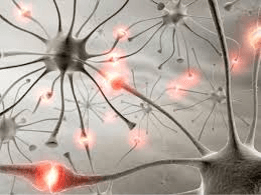
a body system that controls and coordinates all body activities through electric impulses/messages between brain, spinal cord and nerves.
a)
endocrine system 
b)
nervous system
c)
nerve
d)
neuron
17.
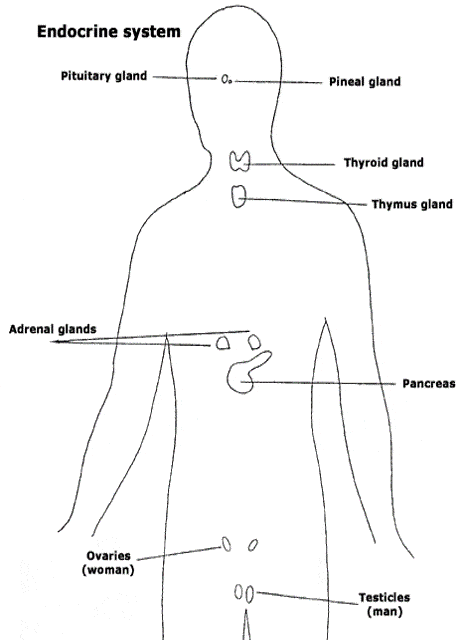
a body system that controls growth and homeostasis by secreting hormones from glands.
a)
skeletal system
b)
nervous system
c)
endocrine sytem
d)
integumentary system
18.
Which type of tissue is avascular and tightly packed?
a)
Epithelial
b)
Connective
c)
Areolar
d)
Adipose
19.
Which type of tissue would you find in the alveoli of the lungs?
a)
Simple Squamous
b)
Stratifies Cuboidal
c)
Transitional 
d)
Pseudostratified
20.
Which type of tissue would you find in the urinary bladder?
a)
Simple Squamous
b)
Stratifies Cuboidal
c)
Transitional 
d)
Pseudostratified
21.
Skin color is due to a pigment called
a)
Keratin
b)
Melanin
c)
Chromatin
d)
Epithelium
22.
The layer of the epidermis that is capable of dividing is
a)
Stratum basale
b)
Stratum corneum
c)
Stratum lucidum
d)
Stratum spinosum
23.
The protein that makes us "waterproof" is called
a)
keratin
b)
melanin
c)
carotene
d)
mucus
24.
The vascular of the skin is the:
a)
Dermis
b)
Epidermis
c)
Hypodermis
d)
Stratum basale
25.
The function of sebum is:
a)
Keeps skin soft and moist
b)
Help to regulate body temperature
c)
Produce vitamin D
d)
Protect skin from mechanical damage
26.
The ___________ is the basic unit of life
a)
organ
b)
cell
c)
atom
d)
tissue
27.
Organs and tissues that perform the same function is called _____________?
a)
cells
b)
tissues 
c)
organ system
d)
organs
28.
A group of tissues that perform a similar function is called_____. (Examples include the heart, lungs or stomach)
a)
cells
b)
tissues
c)
organs
d)
organ system
29.
When many organ systems work together it can form...
a)
organ
b)
cells
c)
organ system
d)
organism 
30.
Name this tissue
a)
Bone
b)
Cartilage
c)
Blood
d)
Adipose
31.
Name this tissue
a)
Bone
b)
Hyaline cartilage
c)
Fibrocartilage
d)
Adipose
32.
What tissue is this
a)
Bone
b)
Cartilage
c)
Blood
d)
Adipose
33.
The main purpose of the ____________ system is to break food particles into pieces that can be used.
a)
circulatory
b)
respiratory
c)
digestive
d)
skeletal
34.
What is responsible for delivering oxygen and removing carbon dioxide from the body?
a)
cell nucleus
b)
excretory system
c)
nervous tissue
d)
respiratory system
35.
Which of the following body systems work together for support, protection, and movement?
a)
respiratory and cardiovascular
b)
skeletal and muscular
c)
skeletal and integumentary
d)
digestive and respiratory
36.
a)
Lacrimial
b)
Sphenoid
c)
Maxilla
d)
Zygomatic
37.
a)
Maxilla
b)
Parietal
c)
Temporal
d)
Sphenoid
38.

Make new bone and help repair damage.

a)

Osteoblast

b)

Osteoclast

c)

Osteocytes

d)

Osetoblank

39.
how many bones are in the human body?
a)
200
b)
206
c)
205
d)
204
40.
Bone forming cells are called...
a)
osteoblasts
b)
osteocytes
c)
osteoclasts
d)
osteons
41.
What layer of the epidermis is 2 pointing to?
a)
Stratum Basale
b)
Stratum Spinosum
c)
Stratum Granulosum
d)
Stratum Corneum
42.
What layer of the epidermis is 3 pointing to?
a)
Stratum Basale
b)
Stratum Spinosum
c)
Stratum Granulosum
d)
Stratum Corneum
43.
Which step comes after a hematoma in the repair of a bone fracture?
a)
fibrocartilagenous (soft) callus
b)
hard (bony) callus
c)
bone remodeling
44.
What feature is this?
a)
Optic Canal
b)
Carotid Canal
c)
Foramen Magnum
d)
Jugular Foramen
45.
The oldest cells of the epidermis will be found here
a)
Stratum Corneum
b)
Stratum Basale
c)
Stratum Spinosum
d)
Stratum Granulosum
46.
Special bone cells, called ___, are responsible for destroying and remodeling old bone.
a)
osteoclasts
b)
osteoblasts
c)
osteocytes
d)
Haversian canals
47.
Which of the following is not one of the four tissue types? 
a)
Blood
b)
Connective
c)
Epithelial
d)
Nervous 
48.
Which type of tissue is this?
a)
Nervous
b)
Epithelial
c)
Connective
d)
Muscle 
49.
Where is epithelial tissue found?
a)
glands
b)
covering body surfaces
c)
lines organs
d)
all of the above
50.
What type of epithelium is this:
a)
Simple Columnar
b)
Simple Squamous
c)
Stratified Squamous
d)
Pseudostratified Columnar 
51.
Which type of epithelial tissue stretches and is found in the urinary bladder?
a)
Transitional
b)
Stratified Cuboidal
c)
Stratified Squamous
d)
Stratified Columnar
52.
What type of connective tissue are tendons and ligaments?
a)
Dense Connective Tissue
b)
Bone
c)
Loose Connective Tissue
d)
Cartilage
53.
What type of connective tissue is found at the ends of bones to reduce friction?
a)
Cartilage
b)
Dense Connective Tissue
c)
Adipose Tissue
d)
Loose Connective Tissue
54.
How is skin color determined?
a)
how much melanin is produced from a melanocyte regulated by DNA
b)
depends on parents
c)
its 100% random
d)
depends on area you are born in
55.

What specialized epidermal cell detects touch and sensory sensations?

a)

Keratinocytes

b)

Melanocytes

c)

Merkel (Tactile) Cells

d)

Langerhans (Dendritic) cell

56.

What specialized epidermal cell detects produces an immune response against pathogens entering the skin?

a)

Keratinocytes

b)

Melanocytes

c)

Merkel (Tactile) Cells

d)

Langerhans (Dendritic) cell

57.
What vertebral section is #6?
a)
Cervical
b)
Thoracic
c)
Lumbar
d)
Sacral
58.
What vertebral section is #5?
a)
Cervical
b)
Thoracic
c)
Lumbar
d)
Sacral
59.
Structure A 
a)
epiphysis
b)
diaphysis
c)
medullary cavity
d)
red bone marrow
60.
Structure B
a)
epiphysis
b)
diaphysis
c)
articular cartilage
d)
periosteum
61.
Covering on the end of the bones as represented in structure D. Also on the end of B.  Provides protection
a)
red bone marrow
b)
yellow bone marrow
c)
articular cartilage
d)
medullary cavity
62.
Structure E is
a)
diaphysis
b)
yellow bone marrow
c)
compact bone
d)
spongy bone
63.
Structure G is
a)
red bone marrow
b)
yellow bone marrow
c)
spongy bone
d)
articular cartilage
64.
yellow bone marrow is which macromolecule?
a)
carbohydrate
b)
protein
c)
lipid 
d)
nucleic acid
65.
Structure H
a)
articular cartilage
b)
periosteum
c)
yellow bone marrow
d)
support the bone
66.
Structure #3 is
a)
epiphysis
b)
medullary cavity
c)
red bone marrow
d)
yellow bone marrow
67.
Which of the following planes has a horizontal line through the body
a)
Transverse
b)
Coronal
c)
Lateral
d)
Frontal
68.
What does the coronal plane divide the body into?
a)
Front to back
b)
Side to side 
c)
Left to right
d)
Top to bottom
69.
Your ears are _______ to your eyes
a)
Lateral
b)
Medial
c)
Superior
d)
Inferior
70.
Your spine is ______ to your heart
a)
Anterior
b)
Posterior
c)
Medial
d)
Distal
71.

Involuntary muscle type

a)

skeletal

b)

cardiac

c)

smooth

d)

smooth and cardiac

72.
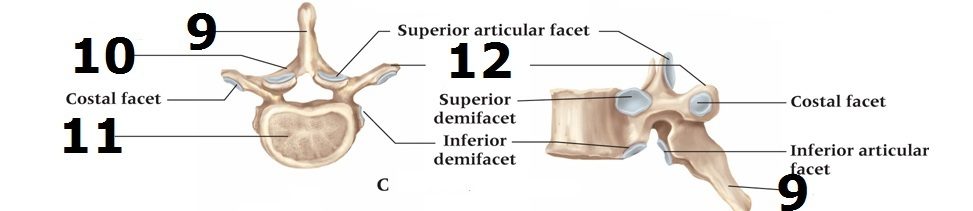
WHAT IS #9
a)
SPINOUS PROCESS
b)
BODY
c)
TRANSVERSE PROCESS
d)
LAMINA
73.
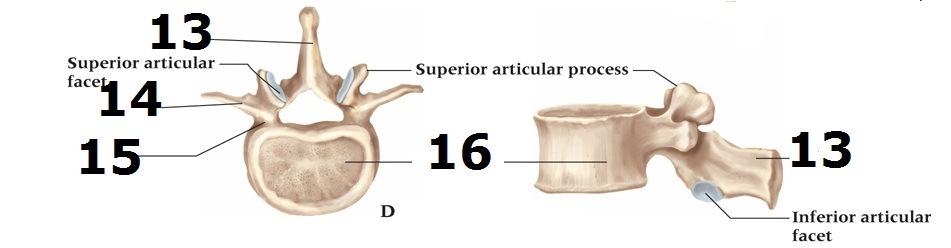
WHAT IS #16
a)
SPINOUS PROCESS
b)
BODY
c)
TRANSVERSE PROCESS
d)
PEDICLE
74.
WHAT IS #1
a)
DENS ( ODONTOID PROCESS)
b)
SPINOUS PROCESS
c)
BODY
d)
LAMINA
75.
The skin helps to produce _______________ by using UV rays from the sun.
a)
Vitamin A
b)
Vitamin C
c)
Vitamin D
d)
Vitamin K
76.
A main function of the integumentary system is ____________________.
a)
To protect the body from infection
b)
To receive pressure, pain, heat, and cold stimuli
c)
To maintain an internal body temperature
d)
All of these
77.
This gland releases oil (sebum).
a)
Sebacious gland
b)
Apocrine Gland
c)
Eccrine Gland
d)
All of the above
78.
What is letter C identifying in the diagram?
a)
Apocrine gland
b)
Eccrine gland
c)
Sebaceous gland
d)
Arrector pilli
79.
What is letter D identifying in the diagram?
a)
Apocrine gland
b)
Eccrine gland
c)
Sebaceous gland
d)
Arrector pilli
80.
What is letter E identifying in the diagram?
a)
Apocrine gland
b)
Eccrine gland
c)
Sebaceous gland
d)
Arrector pilli
81.
What is letter F identifying in the diagram?
a)
Apocrine gland
b)
Eccrine gland
c)
Sebaceous gland
d)
Arrector pilli
82.
What is #8 idenitfying in the diagram?
a)
Epidermis
b)
Dermis
c)
Hypodermis
d)
Muscle 
83.
What is #9 idenitfying in the diagram?
a)
Epidermis
b)
Dermis
c)
Hypodermis
d)
Muscle 
84.
What is #10 idenitfying in the diagram?
a)
Epidermis
b)
Dermis
c)
Hypodermis
d)
Muscle 
85.
Which of the following is NOT a plane of the body?
a)
Coronal
b)
Frontal
c)
Transverse
d)
Vertical
86.

Where would you find this type of tissue?

a)

lining hollow organs

b)

in the heart

c)

attached to your bones

d)

this is not muscle

87.
The most serious skin cancer is:
a)
Malignant Melanoma
b)
Basal Cell Carcinoma
c)
Squamous Cell Carcinoma
d)
Benign
88.
What should you consider to determine if a mole/freckle is suspicious?
a)
Does it have color?
b)
Does it have a border?
c)
Is it bigger than .6 mm?
d)
The A, B, C, D & E rule:
89.
Which is avascular?
a)
Dermis
b)
Epidermis
90.
What is the least dangerous burn?
a)
1st Degree
b)
2nd Degree
c)
3rd Degree
d)
4th Degree
91.
What type of burn blisters?
a)
1st Degree
b)
2nd Degree
c)
3rd Degree
d)
4th Degree
92.
What type of burn is "to the bone"?
a)
1st Degree
b)
2nd Degree
c)
3rd Degree
d)
4th Degree
93.
Why do we use the "rule of 9's"?
a)
To determine how deep the burn is
b)
To see what degree of burn occured
c)
To determine if it is cancerous or not
d)
To determine the % of skin burned
94.

The first vertebrae in your neck is called:

a)

atlas

b)

axis

c)

T1

d)

L1

95.
The skull, vertebral column, and thorax make up which skeleton?
a)
Axial Skeleton
b)
Appendicular Skeleton
c)
Skeleton
d)
Bones 
96.
The rounded head of a bone that makes it move easier is called?
a)
Condyle
b)
Joint
c)
Tendon
d)
Socket
97.
The occipital, temporal, parietal, sphenoid, ethmoid, & frontal bones make up our:
a)
Sutures
b)
Cranium
c)
Facial Bones
d)
Skull
98.
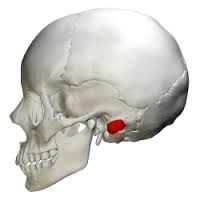
What is this?
a)
Mastoid Process
b)
Styloid Process
c)
External Acoustic Meatus
d)
Zygomatic Process
99.
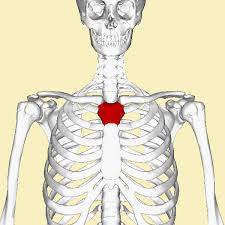
What is this?
a)
Manubrium
b)
Xiphoid Process
c)
Body
d)
Costal Cartilage
100.
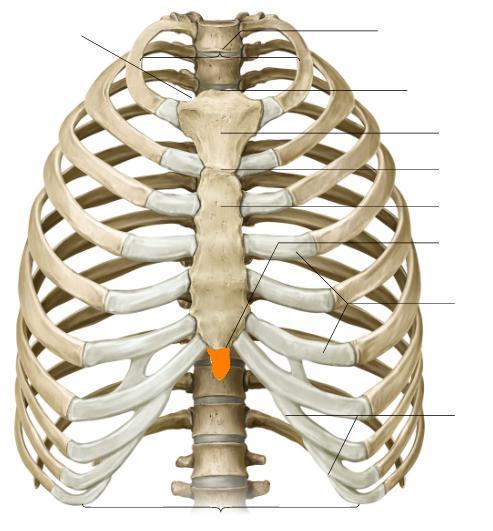
What is this?
a)
Manubrium
b)
Body
c)
Xiphoid Process
d)
Clavicle
101.
Ribs that attach directly to the sternum?
a)
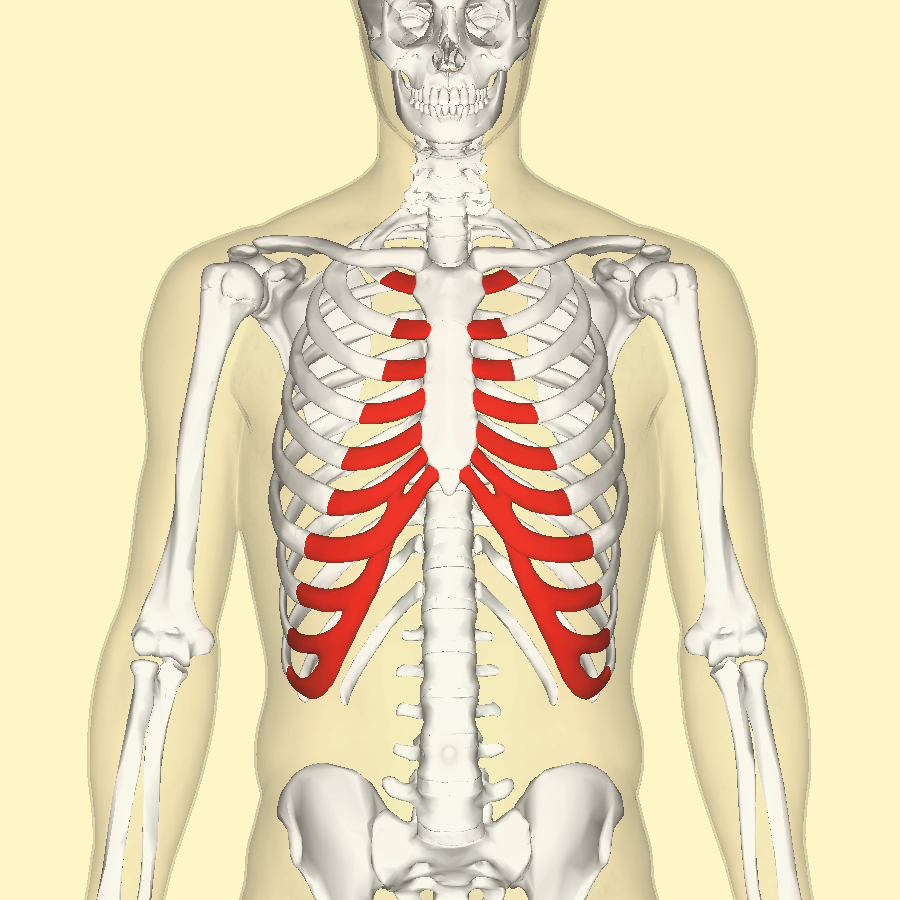
True ribs
b)
False Ribs
c)
Floating Ribs
102.
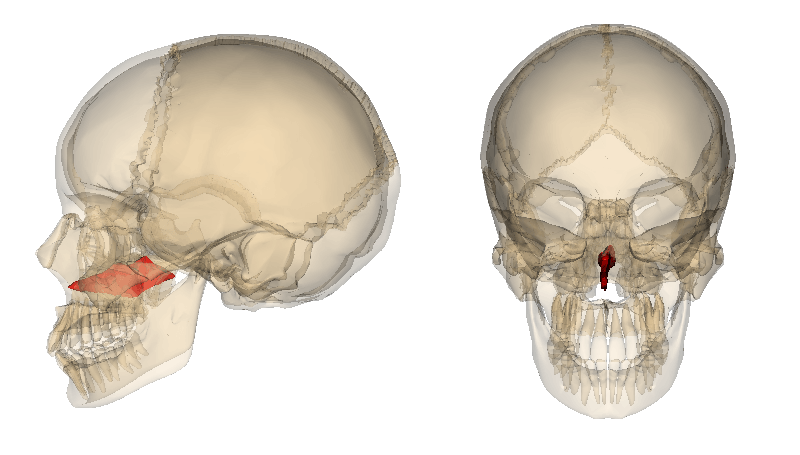
What is this?
a)
Vomer
b)
Ethmoid
c)
Palatine
d)
Sphenoid
103.
There are 12 of these and they articulate with ribs
a)
Thoracic vertebrae
b)
Cervical Vertebrae
c)
Lumbar Vertebrae
d)
Sacral vertebrae
104.
Which of the following would be found in the lower back?
a)
C4
b)
T5
c)
L3
d)
L10
105.
What is this?
a)
Costal Cartilage
b)
True Ribs
c)
False Ribs
d)
Sternum
106.
How many cervical vertebrae are in the spine? 
a)
7
b)
12
c)
5
d)
4
107.
the tailbone; bears body weight when sitting; formed by the fusion of 3 to 5 vertebrae during adolescence; 
a)
Axis
b)
Sacral 
c)
Atlas 
d)
Coccyx
108.
Curvature that forms from walking.
a)
Lumbar
b)
Cervical 
c)
Thoracic
d)
Sacral
109.
Over-curvature of the thoracic vertebrae.
a)
kyphosis
b)
lordosis
c)
scoliosis
d)
halitosis
110.
Bones of the thoracic cage that are not attached to the sternum; 5 lower ribs 
a)
small ribs
b)
floating ribs
c)
true ribs
d)
false ribs
111.
The fibrous membranes between the bones of a fetal skull are ___.
a)
osteocytes
b)
fontannels
c)
fountains
d)
chondrocytes
112.
This epithelial tissue consists of a single layer of flattened cells:
a)
simple cuboidal 
b)
stratified columnar
c)
stratified cuboidal
d)
simple squamous
113.
The outer framework of the ear is formed by:
a)
adipose (fat) tissue
b)
elastic cartilage
c)
hyaline cartilage
d)
fibrocartilage
114.
The outer framework of the ear is formed by:
a)
adipose (fat) tissue
b)
elastic cartilage
c)
hyaline cartilage
d)
fibrocartilage
115.
These types of membranes line cavities, provide lubrication, and cover organs in cavities:
a)
synovial membranes
b)
mucous membranes
c)
cartilage
d)
oil glands
116.
Epithelial tissue:
a)
conducts nerve impulses
b)
stores fat
c)
covers and lines body parts
d)
moves the body
117.
Which of the following epithelial tissues allows materials to pass through diffusion and filtration? 
a)
stratified squamous
b)
simple cuboidal
c)
simple columnar
d)
simple squamous
118.
Which of the following epithelial tissues would be found in the walls of kidney tubules?
a)
simple cuboidal
b)
stratified cuboidal
c)
simple squamous
d)
stratified columnar
119.

What type of tissue is this?

a)

Connective - Blood Tissue

b)

Connective - Loose

c)

Epithelium - Stratified Squamous

d)

Epithelial - Simple Cuboidal

e)

Nervous - Neuron

120.

What type of tissue is this?

a)

Nervous - Perjunkie

b)

Epithelial - Simple Columnar

c)

Muscle - Smooth

d)

Epithelial - Simple Cuboidal

e)

Connective - Dense

121.

What type of tissue is this?

a)

Connective - Dense

b)

Epithelial - Stratified Cuboidal

c)

Epithelium - Stratified Squamous

d)

Connective - Loose

e)

Nervous - Neuron

122.

What type of tissue is this?

a)

Connective - Hyaline Cartilage

b)

Connective - Blood Tissue

c)

Epithelial - Simple Squamous

d)

Muscle - Skeletal

e)

Nervous - Neuron

123.

What type of tissue is this?

a)

Connective - Bone tissue

b)

Epithelial - Columnar Cilliated

c)

Epithelial - Simple Squamous

d)

Muscle - Skeletal

e)

Connective - Dense

124.

What type of tissue is this?

a)

Connective - Bone tissue

b)

Epithelial - Stratified Cuboidal

c)

Muscle - Smooth

d)

Epithelial - Simple Cuboidal

e)

Nervous - Neuron

125.

What type of tissue is this?

a)

Muscle - Cardiac

b)

Connective - Blood Tissue

c)

Epithelium - Stratified Squamous

d)

Epithelial - Simple Cuboidal

e)

Connective - Dense

126.

What type of tissue is this?

a)

Muscle - Cardiac

b)

Epithelial - Columnar Cilliated

c)

Muscle - Smooth

d)

Epithelial - Glandular

e)

Epithelial - PsuedoStratified Columnar

127.

What type of tissue is this?

a)

Connective - Dense

b)

Epithelial - Columnar Cilliated

c)

Epithelial - Simple Squamous

d)

Epithelial - Glandular

e)

Nervous - Neuron

128.
The dermis layer is made up of two layers, which are the:
a)
papillary and reticular
b)
papillary and dermal
c)
dermal and tactile
d)
tactile and reticular
129.
Fatty tissue found below the dermis is:
a)
papillae
b)
papillary layer
c)
tactile 
d)
subcutaneous tissue
130.
What is the integumentary system made up of?
a)
skin, nails, and hair
b)
ribs, lungs, and heart
c)
veins and arteries
d)
muscles
131.
Which is NOT a function of the skin?
a)
Insulation
b)
Movement
c)
Excretion
d)
Vitamin D Production
132.
Simple squamous cells line the air sacs in your lungs. This allows for quick and easy gas exchange. Why are they called "simple?"
a)
they use osmosis
b)
they are one layer thick
c)
they have no brain function
133.
What gland is responsible for keeping our hair soft and is a barrier for bacteria and fungi?
a)
Sudoriferous
b)
Sebaceous
c)
Melanin
d)
Carotene
134.
What is the name of tube that our hair grows from?
a)
Follicle
b)
Root
c)
Shaft
d)
Sebaceous
135.
Goosebumps are caused by contractions of the ______ muscle
a)
Arrector pili
b)
Apocrine
c)
Eccrine
d)
Sebaceous
136.
The sweat gland that produces "stinky" sweat is the 
a)
Apocrine gland
b)
Eccrine gland
c)
Sudoriferous gland
d)
Sebaceous gland
137.

The more abundant of the two types is the

a)

axillary

b)

sebaceous

c)

eccrine

d)

apocrine

138.

What is the purpose of eccrine glands?

a)

They are part of the heat-regulating equipment of the body.

b)

Their secretions help to keep the skin soft.

c)

Their secretions prevent body odor.

d)

Their secretions promote the growth of elastin.

139.

In addition to the substances found in eccrine glands, apocrine glands also contain

a)

fatty acids and proteins

b)

proteins and nucleic acids

c)

a wider variety of vitamins and minerals

d)

carbohydrates and nucleic acids

140.
What is mean by homeostasis?
a)
Controls and coordinates body activities through chemical 
b)
controls and coordinates body activities through electrical impulses
c)
For maintenance of a steady state in the internal environment
d)
remove metabolic waste products from the cel
141.
Which of the system below not involved in body temperature?
a)
Nervous system
b)
endocrine system
c)
Excretory system
d)
muscular system