wayground logo

Free Printable Worksheets

Font size

S
M
L
XL
Worksheets

Unit 6 Genetics Review

Total questions: 138

Worksheet time: 3hrs 57mins

Name
Class
Date
1.
The cells produced via meiosis are called:
a)
sex cells
b)
somatic cells
c)
body cells
d)
skin cells
2.
This produces 2 identical cells.
a)
mitosis
b)
meiosis
3.
A human usually has xx amount of chromosomes.
a)
6
b)
22
c)
4
d)
46
4.
What is it called when a sperm and egg meet?
a)
meiosis
b)
fertilization
c)
cell division
d)
mitosis
5.
What phase is  shown in the picture?
a)
anaphase 1
b)
anaphase 2
c)
metaphase 1
d)
telophase 1
6.
Meiosis makes sperm and egg cells. In humans, sperm and egg cells each have _____ chromosomes. Therefore a fertilized human egg cell (sperm and egg cell combined) would create a cell with _____ chromosomes.
a)
23, 46
b)
46, 23
c)
2, 4
d)
50, 100
7.
What causes genetic variation in meiosis?
a)
chromosomes lining up
b)
crossing over of chromosomes
c)
separation of chromosomes
d)
chromosomes pulling apart
8.
Unlike mitosis, meiosis in male mammals results in the formation of
a)
one haploid gamete
b)
three diploid gametes
c)
four diploid gametes
d)
four haploid gametes
9.
When an area of a chromatid is exchanged with the matching area on a chromatid of its homologous chromosome, _________________ occurs
a)
crossing over
b)
mutagenesis
c)
hybridization
d)
fertilization
10.
What kind of cells are made in MEIOSIS?
a)
Haploid Gametes
b)
Diploid Somatic Cells
c)
Skin Cells
d)
Liver Cells
11.
Diploid Cells are represented by
a)
2n
b)
n
c)
4n
d)
1/2 n
12.
If the Diploid number of Carrots is 18, the haploid number is
a)
18
b)
9
c)
27
d)
36
13.
Goes through P.M.A.T two rounds 
a)
Mitosis
b)
Meiosis
c)
Osmosis
d)
Transcription
14.
Which process and type of resulting cells are represented?
a)
mitosis, gametes
b)
mitosis, body cells
c)
meiosis, gametes
d)
meiosis, body cells
15.
If a somatic cell in a butterfly contains 24 chromosomes, a butterfly egg would contain
a)
3
b)
6
c)
12
d)
24
16.
The process of crossing over occurs in what phase of meiosis?
a)
anaphase 1
b)
prophase 1
c)
prophase 2
d)
telophase 1
17.
Which of these cells would be produced through meiosis?
a)
skin cells
b)
liver cells
c)
brain cells
d)
sperm cells
18.
The chromosomes that pair up during meiosis, are called __________ chromosomes.  
a)
homozygous 
b)
asexual
c)
homologous
d)
genes
19.
When homologous chromosomes match up, they form a structure call a ___________.
a)
tetrad
b)
triad
c)
diploid
d)
gamete
20.
Crossing over helps promote 
a)
male genotype
b)
genetic variation
c)
DNA replication
d)
mitosis
21.
What is another reason we need meiosis?
a)
So the offspring has genes from both parents
b)
So the offspring has genes from one parent
c)
So the offspring has genes from neither parents
d)
So the offspring makes its own genes
22.
A male shark has 40 chromosomes in each of its sex cells. How many would be present in its body cells?
a)
20
b)
40
c)
80
d)
160
23.
Chromosomes exchange genetic material during 
a)
crossing over
b)
replication
c)
synthesis
d)
translation
24.
A human zygote should have _____ chromosomes inside.
a)
46
b)
23
c)
92
d)
64
25.
Identify the phase:
a)
Metaphase I
b)
Metaphase II
c)
Anaphase I
d)
Anaphase II
26.
Identify the phase.
a)
Metaphase I
b)
Metaphase II
c)
Anaphase I
d)
Anaphase II
27.
Identify the process.
a)
Mitosis
b)
Meiosis I
c)
Meiosis II
d)
Interphase
28.

Is the following cell diploid or haploid?

a)

Diploid

b)

Haploid

29.
Identify the phase.
a)
Telophase I
b)
Telophase II
c)
Metaphase I
d)
Metaphase II
30.

Is this karyotype for a male or female?

a)

MALE

b)

FEMALE

31.

Is this a normal human karyotype?

a)

YES

b)

NO

32.
Which individual in the first generation is a carrier?
a)
The male
b)
The female
c)
individual 1
d)
None of the above
33.
Huntington's Disease is a dominant trait.
What is the correct genotype for individual I-2?
a)
HH
b)
Hh
c)
hh
d)
H_
34.
Does this pedigree show a dominant or recessive trait?
a)
Dominant
b)
Recessive
35.
Hemophilia is a recessive sex-linked trait. If H = normal & h = has hemophilia, which genotype represents a male with hemophilia. 
a)
XHY
b)
XHXh
c)
XhXh
d)
Xh
36.
If this pedigree shows an autosomal recessive disorder, what MUST the genotype of individual II-3 be?
a)
HH
b)
Hh
c)
hh
d)
None of the above
37.
What is the gender of the individual whose karyotype is seen in the image?
a)
Male
b)
Female
38.
What is the chromosomal condition of the individual whose karyotype is seen in the image?
a)
Turner's Syndrome
b)
Trisomy 21 (Down Syndrome)
c)
Trisomy 13
d)
Trisomy 18
39.
What is the chromosomal condition of the individual whose karyotype is seen in the image?
a)
Trisomy 21 (Down Syndrome)
b)
Trisomy 13
c)
Trisomy 18
d)
Klinefelter's Syndrome
40.
Is this trait (the shaded individuals) dominant or recessive?
a)
dominant
b)
recessive
41.
Freckles (F) are dominant over nonfreckles.   What is the phenotype of individual #3
a)
Ff
b)
ff
c)
freckles 
d)
nonfreckles 
42.
What is the mode of inheritance shown here?
a)
 Recessive
b)
Sex Linked
c)
 Dominant
43.
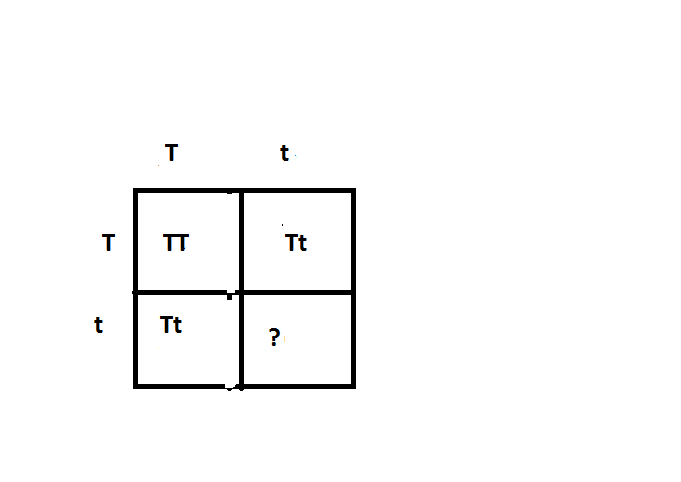
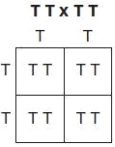
T - tall and t = short
In the punnett square below, what belongs in the missing square
a)
tt
b)
Tt
c)
Bb
d)
TT
44.
AA and Aa always show up as
a)
dominant
b)
recessive
45.
What ratio of the offspring from the cross shown will be homozygous recessive for the  trait of tallness? 
a)
0 in 4
b)
1 in 4
c)
2 in 4
d)
4 in 4
46.
How many generations are shown in this pedigree?
a)
1
b)
2
c)
3
d)
4
47.
How many people in this whole pedigree have the trait/disease?
a)
2
b)
3
c)
4
d)
6
48.
Freckles (F) are dominant over nonfreckles.   What is the phenotype of individual #3
a)
Ff
b)
ff
c)
freckles 
d)
nonfreckles 
49.
Does this pedigree show a dominant or recessive trait?
a)
Dominant
b)
Recessive
50.
Imagine the shaded individuals are those WITH a "hitchhikers thumb." What must be the genotype of individual II-1?
a)
TT
b)
tt
c)
Tt
d)
Impossible to tell
51.
What is the genotype of the father?
a)
AA
b)
aa
c)
Aa
d)
AA or aa
52.
What is the genotype of the mother?
a)
BB
b)
bb
c)
Bb
d)
BB or Bb
53.
What percentage of the offspring will have this recessive disease?
a)
0%
b)
25%
c)
50%
d)
75%
54.
Jim has type AB blood. His dad could be type O.
a)
True
b)
False
c)
Maybe
55.

What is NOT a possible genotype for someone with type B blood?

a)

IBIB

b)

IAIB

c)

IB i

d)

iIB

56.
Colorblindness is more common in males than in females because......
a)
fathers pass the allele for colorblindness to their sons only
b)
the allele for colorblindness is located on the Y chromosome
c)
the allele for colorblindness is recessive and located on the X chromosome
d)
males who are colorblind have two copies of the allele for colorblindness
57.
Colorblindness is a recessive X-linked disorder.
Which genotype represents a male with normal vision?
a)
XNYN
b)
XnYn
c)
XNY
d)
XnY
58.
Which of the following genotypes belongs in the red box in the Punnett square?
a)
XBXb
b)
XbXb
c)
XbY
d)
XBY
59.
Which of the following genotypes belongs in the red box in the Punnett square, and what would the genotype be for the trait?
a)
XBX- female heterozygous
b)
XbX- female homozygous recessive
c)
XBX - female homozygous dominant
d)
XbY - male heterozygous recessive
60.

Duchenne muscular dystrophy is a recessive X-linked disorder.

According to the Punnett square, what percentage of offspring will have the disorder?

a)

0%

b)

25%

c)

50%

d)

100%

61.

Bob is blood Type B and Hilda is Type A, their son Barry is Type O. What are the only possible genotypes of Bob and Hilda?

a)

Bob: IBi

Hilda: IAi

b)

Bob: IBi

Hilda: IAIA

c)

Bob: IBIB

Hilda: IAi

d)

Bob: IBIA

Hilda: IAi

62.
Males are more likely to suffer from a sex-linked disease or disorder because...
a)
males are the weaker sex
b)
males have less DNA
c)
males have 1 X chromosome, so the disorder is more likely to be expressed
d)
females are the stronger sex
63.

What do we use pedigrees for?

a)

To look at families

b)

To make determinations about the offspring

c)

To track traits in families

d)

To find out what type of dog we have

64.
What kind of trait is colorblindness if females can be carriers without having the disease?
a)
Regular trait
b)
Sex-linked trait
c)
Co-dominant
d)
Incomplete dominant
65.
Which gender can be carriers of colorblindness and not have it?
a)
Just males
b)
Just females
c)
Both genders
d)
Neither gender is a carrier
66.

Which best explains why individual IV-7 has colorblindness?

a)

Because her mom is a carrier and her dad has the gene

b)

Because her dad has it.

c)

Because her siblings have it.

d)

Because her uncle has it.

67.
If the affected female in Generation 3 mates with an affected male. What will be their offspring's genotype? 
a)
50% Hybrid/50% Purebred
b)
100% Homozygous Dominant 
c)
100% Homozygous Recessive 
d)
100% Heterozygous 
68.

Some dogs have erect ears; others have drooping ears. Some dogs bark when following a scent; others are silent. Erect ears and barking are due to dominant alleles located on different chromosomes. A dog homozygous for both dominant traits is mated to a droopy-eared, silent follower. The phenotypic ratio expected in the F1 generation is

a)

9:3:3:1.

b)

100 percent of one phenotype.

c)

1:1.

d)

1:2:1.

69.

Mendel’s theory of independent assortment states that

a)

one allele is always dominant to another.

b)

hereditary units from the male and female parents are blended in the offspring.

c)

the two hereditary units that influence a certain trait segregate during gamete formation.

d)

each hereditary unit is inherited separately from other hereditary units.

70.
What gamete possibilities could come from this parent's genotype?
a)
AB, AB, aB, aB
b)
Ab, AB, Ab, ab
c)
Ab, Ab, Ab, Ab
d)
AB, aB, ab, aB
71.
What gamete possibilities could come from this parent's genotype?
a)
aB, ab, AB, Ab
b)
aB, Ab, AB, AB
c)
AB, aB, AB, Ab
d)
aB, ab, aB, ab
72.
What goes in box 1
a)
AABb
b)
AABB
c)
aabb
d)
AaBb
73.
What goes in box 15
a)
abab
b)
ABAB
c)
aBaB
d)
AbAb
74.
What genotype is missing from this Punnett Square?
a)
RrYy
b)
RRYY
c)
rryy
d)
RrYY
75.
Based off this punnett square, what fraction of the offspring will have wrinkled, yellow seeds?
a)
9/16
b)
3/16
c)
1/16
d)
16/16
76.
In a dihybrid cross
a)
one trait is crossed.
b)
two traits are crossed.
c)
four boxes are needed for the punnett square.
d)
mom's alleles are dominant.
77.
parent 1: GgBB
parent 2: ggBb
Find the gametes for parent 1.
a)
GB, GB, gB, gB
b)
gB, gb, gB, gb
c)
Gg, BB, GB, GB
d)
gg, Bb, gB, gb
78.
In cacti, long arms (A) are dominant to short arms (a).  Suppose 2 heterozygous cacti are crossed.  What percentage of their offspring are expected to have short arms?
a)
0%
b)
25%
c)
75%
d)
100%
79.
Long tongues (T) are dominant to short tongues in green tree frogs.  What is the probability that two frogs that are heterozygous for long tongues could produce offspring with short tongues?
a)
100%
b)
75%
c)
50%
d)
25%
80.
If a heterozygous tall pea plant is crossed with a short pea plant, what are the possible genotypes of the future offspring?
a)
100% Tt
b)
50% Tt, 50% tt
c)
75%Tt, 25%tt
d)
25%TT, 50%Tt, 25%tt
81.
In guinea pigs, the allele for short hair is dominant over the allele for long hair.
B = short 
b = long
What would the cross be for two heterozygous guinea pigs?
a)
BB X BB
b)
BB X Bb
c)
Bb X Bb
d)
bb X bb
82.
Smooth seeds are dominant over wrinkled seeds.
What is the genotype ratio for the following cross?
Nn X NN
a)
NN = 100%, Nn = 0%, nn = 0%
b)
NN = 50%, Nn = 25%, nn = 25%
c)
NN = 50%, Nn = 50%, nn = 0%
d)
NN = 25%, Nn = 50%, nn = 25%
83.
Tomato plants usually have hairy stems. Hairless stems are present in tomato plants that are homozygous recessive for this trait. If the stem characteristics are determined by a single gene, what are the expected phenotype percentages for the offspring of a heterozygous hairy plant and a hairless plant?
a)
100% hairy, 0% hairless
b)
75% hairy, 25% hairless
c)
50% hairy, 50% hairless
d)
25% hairy, 75% hairless
84.
Cross Two Homozygous plants
(
RRYY x rryy)
R = round seeds, r  = wrinkled seeds Y = yellow seeds, y = green seeds
What percent will have Round and Yellow seeds? 
a)
0%
b)
25%
c)
50%
d)
100%
85.
Which of the following genotypes is heterozygous?
a)
Bb
b)
BB
c)
bb
d)
B
86.
Which of the following is homozygous dominant?
a)
Yy
b)
Y
c)
yy
d)
YY
87.
Which of the following is homozygous recessive?
a)
Tt
b)
tt
c)
TT
d)
T
88.
What is the genotype for a pea plant heterozygous for round seeds (R), and homozygous recessive for green seeds (y)?
a)
Ry
b)
RRyy
c)
RrYy
d)
Rryy
89.
An organism’s physical appearance, or visible traits
a)
Recessive
b)
Genotype
c)
Phenotype
d)
Heterozygous
90.
An organism’s genetic makeup, or allele combinations
a)
Recessive
b)
Genotype
c)
Phenotype
d)
Heterozygous
91.
In guinea pigs, black hair is dominant to white hair and short hair is dominant to long hair. What would be the phenotype of a guinea pig with the genotype Bbss?
a)
Black hair, long hair
b)
Black hair, short hair
c)
White hair, long hair
d)
White hair, short hair
92.
This image is an example of a _____________ cross.
a)
Monohybrid
b)
Dihybrid
c)
Purebred
d)
Heterozygous
93.
What are the possible genotypes for this cross?
a)
TT = 25% Tt= 50% tt=25%
b)
all tall
c)
TT= 75% tt = 25%
d)
Tt = 100%
94.
In pea plants tall is dominant (T) over short plants (t), and green is dominant (G) over yellow (g). Cross a tall green pea plant (TtGg) with a short yellow pea plant (ttgg). 
What is the ratio of the cross?
a)
1: 2: 2: 1
b)
9: 3: 3: 1
c)
4: 4: 4: 4
d)
3: 3: 3: 3
95.
The cells produced via meiosis are called:
a)
sex cells
b)
somatic cells
c)
body cells
d)
skin cells
96.
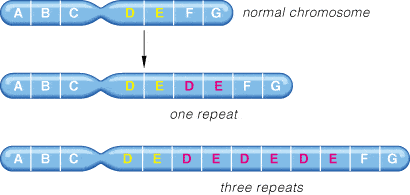
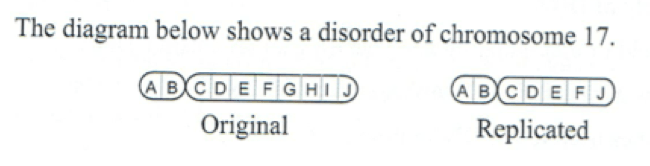
Identify the mutation in the picture.
a)
Inversion
b)
Deletion
c)
Duplication
d)
Translocation
97.
Identify the mutation in the picture.
a)
Inversion
b)
Duplication
c)
Deletion
d)
Translocation
98.
Identify the mutation in the picture.
a)
Deletion
b)
Inversion
c)
Duplication
d)
Translocation
99.
When can a mutation be passed on to offspring?
a)
only when the mutation is present during or occurs during mitosis
b)
only when the mutation is present during or occurs during meiosis
c)
when the mutation occurs during mitosis or meiosis
d)
when the mutation occurs in somatic cells
100.
What type of chromosomal mutation has occurred?
a)
substitution
b)
insertion
c)
deletion
d)
nondisjunction
101.
What process occurs during meiosis that can result in chromosomal disorders?
a)
crossing over
b)
non-disjunction
c)
anaphase I
d)
prophase II
102.
A chromosome is found to be shorter than it's homologous match.  Which type of mutation would this most likely be?
a)
insertion
b)
deletion
c)
translocation
d)
inversion
103.

Notice the abnormal 23rd chromosome. This individual has an extra X chromosome. What type of mutation is this?

a)

Translocation

b)

Nondisjunction

c)

Dublication

d)

Inversion

e)

Deletion

104.
An example of a mutation where a piece of chromosome breaks off and attaches to another chromosome is called ___.
a)
trisomy
b)
translocation
c)
inversion
d)
deletion
105.

Inversion

a)

When a segment of a chromosome breaks off.

b)

When a segment of a chromosome breaks off, flips, and reattaches.

c)

When a segment of a chromosome is copied or doubles.

d)

When a segment of a chromosome breaks and attaches to a non homologous chromosome.

e)

When entire chromosomes don't separate evenly during meiosis.

106.

Duplication

a)

When a segment of a chromosome breaks off.

b)

When a segment of a chromosome breaks off, flips, and reattaches.

c)

When a segment of a chromosome is copied or doubles.

d)

When a segment of a chromosome breaks and attaches to a non homologous chromosome.

e)

When entire chromosomes don't separate evenly during meiosis.

107.

Deletion

a)

A

b)

B

c)

C

d)

D

108.

Translocation

a)

A

b)

B

c)

C

d)

D

109.

Duplication

a)

A

b)

B

c)

C

d)

D

110.

Inversion

a)

A

b)

B

c)

C

d)

D

111.

Duplication

a)

A

b)

B

c)

C

d)

D

e)

E

112.

Inversion

a)

A

b)

B

c)

C

d)

D

e)

E

113.

Translocation

a)

A

b)

B

c)

C

d)

D

e)

E

114.

Deletion

a)

A

b)

B

c)

C

d)

D

115.

Duplication

a)

A

b)

B

c)

C

d)

D

116.

Inversion

a)

A

b)

B

c)

C

d)

D

117.

Translocation

a)

A

b)

B

c)

C

d)

D

118.

a photograph or picture of chromosomes grouped in ordered pairs is a ______________

a)

pedigree

b)

Punnett Square

c)

Venn Diagram

d)

Karyotype

119.
The results of the karyotype indicate that an individual has 3 chromosome #21. Which of the following genetic disorders do they have?
a)
Edwards Syndrome
b)
Patau's Syndrome
c)
Down's Syndrome
d)
Klinefelter's Syndrome
120.

Based on the karyotype, what is the sex of this baby?

a)

Male

b)

Female

121.
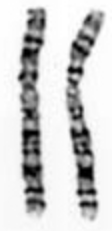
Is this Karyotype human?
a)
Yes
b)
No
c)
Impossible to Determine
122.
Which structure is labeled as A in the diagram?
a)
Centromere
b)
Chromosome
c)
Sister chromatids
123.
A pair of identical chromosomes shown in a karyotype, one inherited from mom, and one inherited from dad are called
a)
sister chromotids
b)
centromeres
c)
homologous chromosomes
d)
autosomes
124.
Which would be considered a somatic cell?
a)
Sperm cell
b)
Egg Cell
c)
Skin Cell
d)
All of these
125.
What is the haploid number for this Karyotype?
a)
26
b)
27
c)
52
d)
54
126.
The haploid number of human chromosomes is
a)
11
b)
12
c)
23
d)
46
127.
A calico cat shows both the traits for orange fur and black fur. What kind of allele expression is this?
a)
Incomplete Dominance
b)
Co dominance
c)
Independent assortment
d)
Recessive inheritance
128.
What type of inheritance do two alleles have if their traits blend together? 
a)
Incomplete Dominance
b)
Co-Dominance
c)
Mendelian Inheritance
d)
Homozygous Inheritance
129.
The different forms of a gene are called
a)
traits
b)
pollinators
c)
alleles
d)
hybrids
130.
This type of inheritance pattern is a MIXTURE of both traits.
a)
incomplete dominance
b)
co-dominance
c)
complete dominance
d)
recessive pattern
131.
This type of inheritance pattern shows BOTH traits in possible offspring
a)
complete dominance
b)
incomplete dominance
c)
co-dominance
d)
dominant pattern
132.
Snap dragon color is a incomplete dominant trait.  A red flower (RR) is crossed with white flower (rr)? What color are flowers that are Rr?
a)
Red
b)
Red and White
c)
White
d)
Pink
133.
I have 1 X chromosome and 1 Y chromosome. What am I?
a)
Male
b)
Female
134.
I have 2 X chromosomes. What am I?
a)
Male
b)
Female
135.
What you see, or the physical appearance.
a)
Genotype
b)
Phenotype
c)
Homozygous
d)
Heterozygous
136.
In which inheritance pattern are heterozygous individuals a blend of the dominant and recessive phenotypes?
a)
sex-linked inheritance
b)
complete dominance
c)
codominance
d)
incomplete dominance
137.
Which of the following is a hybrid?
a)
BB
b)
bb
c)
Bb
138.
A roan cow shows co-dominance in fur color (orange and white). What is the phenotype ratio expected if a roan cow and a roan steer mate together?
a)
4: Orange and White
b)
1: Orange : 1 White
c)
2 Orange: 2 Orange and White: 0 White
d)
1: Orange: 2 Orange and White: 1 White