wayground logo

Free Printable Worksheets

NEW

Font size

S
M
L
XL
Worksheets

Honors Semester 1 Final Review

Total questions: 80

Worksheet time: 2hrs 30mins

Name
Class
Date
1.
The Law of Conservation of Mass states
a)
that matter exists in all states and reacts the same
b)
that matter can only be changed into new substances by introducing a catalyst
c)
that matter exists in the same state throughout any chemical change
d)
that matter cannot be created or destroyed and that the mass of the products must equal the mass of the reactants
2.
How many Al atoms are in this compound?         4Al2O3
a)
2
b)
8
c)
6
d)
4
3.
An gel ice pack getting cold after you put it in the freezer for an hour.
a)
Chemical Change
b)
Physical Change
4.
Balance this reaction: ____ RbNO3 + ____ BeF2 ----> ____ Be(NO3)2 + ____ RbF
a)
1,1,1,1
b)
1,2,1,1
c)
2,1,1,2
d)
2,1,2,1
5.
Ionic or covalent?
Na  F
a)
Ionic
b)
Covalent
6.
What is the formula for calcium phosphide?
a)
CaP
b)
Ca2P3
c)
Ca3P2
d)
Ca2P
7.
Which particle has a positive charge?
a)
electron
b)
orbital
c)
proton
d)
neutron
8.
What are valence electrons?
a)
electrons on the first orbital always
b)
nucleus
c)
the outermost shell
d)
the number of electrons on the outermost orbital
9.
What is the mass number and name of an element with 8 protons and 8 neutrons?
a)
16 - Carbon
b)
16 - Oxygen
c)
24 - Oxygen
d)
8 - Neon
10.
An atom has 10 protons, 15 neutrons and 10 electrons what is its mass number.
a)
20
b)
10
c)
5
d)
25
11.
Which of the following is correct scientific notation?
a)
20.35 x 10⁴
b)
.2035 x 104
c)
2035 4
d)
2.035 x10⁴
12.
Express the following in scientific notation:
.000457
a)
457 x 106
b)
457 x 10-6
c)
4.57 x10⁴
d)
4.57 x 10⁻⁴
13.
Convert to scientific notation:
520,000,000  
a)
52 x 107
b)
5.2 x 10⁷
c)
5.2 x 10⁸
d)
0.52 x 10⁹
14.
As you move down the periodic table atoms get bigger.  This is because ____________.
a)
The atoms have more mass.
b)
The atoms have more protons.
c)
The atoms have more energy levels
d)
The atoms have more nuetrons
15.
Atoms that have a high electronegativity, _______________.
a)
give up their electrons more easily.
b)
hold on to their electrons more tightly.
c)
have more electron shells.
16.
Which has the greater EN: 
Cl or Al?
a)
Cl
b)
Al
17.
Which of these is covalent?
a)
NaCl
b)
Pb(NO3)2
c)
CO2
d)
AlCl3
18.
How many d electrons are in zirconium?
a)
2
b)
12
c)
40
d)
10
19.

What is the correct noble gas configuration for lead?

a)

[Rn] 6s2 4f14 5d10 6p2

b)

[Xe] 6s2 6d10 6p2

c)

[Xe] 6s2 5d10 6p2

d)

[Xe] 6s2 4f14 5d10 6p2

20.
What atom matches this electron configuration?
1s22s22p63s23p64s23d10
a)
Zinc
b)
Copper
c)
Nickel
d)
Germanium
21.
What electron configuration matches an oxygen atom?
a)
1s22s22p63s2, 3p64s23d104p5
b)
1s22s22p4
c)
1s22s22p6
d)
1s22s22p63s23p64s23d1
22.
What is the volume of Object X?
a)
10.0 cm3
b)
15.0 cm3
c)
20.0 cm3
d)
25.0 cm3
23.
Frank has a paper clip. It has a mass of 9g and a volume of 3cm3. What is its density?
a)
3 g/cm3
b)
1/3 g/cm3
c)
27 g/cm3
d)
39 g/cm3
24.
Naming a compound of two non-metals requires us to use..
a)
Prefixes
b)
Roman Numerals
c)
Nothing, just name it
25.
Naming a compound that starts with a transition metal requires us to use...
a)
Prefixes
b)
Roman Numeral
c)
Nothing, just name it
26.
What is the name of the compound HgCl2
a)
mercury (II) chloride
b)
mercury chlorite
c)
Monomercury dichloride
27.
Phosphorous trichloride
a)
PCl3
b)
P3Cl
c)
P3Cl3
d)
PCL
28.
How did Mendeleev arrange the elements?
a)
alphabetical 
b)
density
c)
melting point
d)
atomic mass
29.
C5H10O4 + O2 --> CO2 + H2O
a)
Decomposition
b)
Single Replacement
c)
Combustion
d)
Double Replacement
30.
2 meters = ____________ centimeters
a)
100
b)
20
c)
200
d)
2000
31.
a)
38
b)
2
c)
5
d)
40
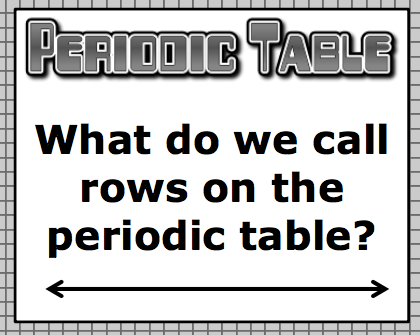
32.
a)
Periods
b)
Groups
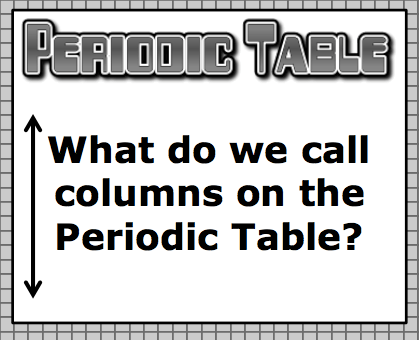
33.
a)
Periods
b)
Groups
34.
a)
Metals
b)
Nonmetals
35.
Name this formula: 
KNO3
a)
Potassium Nitrogen Oxide
b)
Potassium Nitride
c)
Potassium Nitrate
d)
Potassium (I) Nitrite
36.
What is the name for the solid formed during a reaction?
a)
Precipitate
b)
Gas
c)
Compound
d)
Aqueous 
37.
The following is what type of reaction:
PbCl2 + AgNO3 → Pb(NO3)2 + AgCl
a)
Synthesis
b)
Decomposition
c)
Single Replacement
d)
Double Replacement
38.
The following is what type of reaction:
NH3 + HCl  → NH4Cl
a)
Synthesis
b)
Decomposition
c)
Single Replacement Replacement
d)
Double Replacement Replacement
39.
Balance this equation:
 2Li + Cl2 → LiCl
a)
2Li + Cl2 → 4LiCl2
b)
2Li + Cl2 → LiCl2
c)
2Li + Cl2 → 2LiCl
d)
2Li + 2Cl2 → 2 LiCl2
40.
Shape is a ____ that helps identify an object.
a)
physical property
b)
chemical property
c)
mass
d)
matter
41.
Iron + oxygen = rust is an example of a ___________.
a)
physical property/change
b)
chemical property/change
c)
mass
d)
volume
42.
The ability of a metal to allow heat or electricity to pass through it.
a)
conductivity
b)
insulator
c)
mass
d)
density
43.
The following liquids are poured together in a beaker: alcohol (density=0.79), corn syrup (density=1.38), water (density=1.0), and cooking oil (density=0.93).  Which of these liquids will sink to the bottom of the beaker?
a)
alcohol
b)
corn syrup
c)
water
d)
cooking oil
44.
Which is a halogen?
a)
Helium
b)
Chlorine
c)
Oxygen
d)
Neptune
45.
Which is an alkali metal?
a)
Magnesium
b)
Iron
c)
Sodium
d)
Europium
46.
The proper formula for magnesium hydroxide:
a)
MgOH
b)
Mg2OH
c)
Mg(OH)2
d)
Mg2OH2
47.
The maximum number of electrons that can be placed in an p orbital.  
a)
2
b)
6
c)
10
d)
14
48.
This orbital diagram represents:  
a)
C
b)
B
c)
N
d)
O
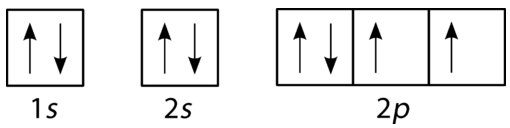
49.
What is incorrect about this orbital diagram?
a)
Both arrows in the 2p box should be pointing up
b)
There is nothing incorrect with this diagram
c)
In the there should only be 1 orbital in the first 2p box and one in the 2nd 2p box
d)
All the arrows should be pointing up.
50.
Atoms that gain electrons become...
a)
negatively charged (anions)
b)
positively charged (cations)
c)
remain neutrally charged
d)
21
51.
Who discovered the positive nucleus?
a)
Bohr
b)
Dalton
c)
Rutherford
d)
Thompson
52.
In Bohr's model electrons are....
a)
...dispersed in a positive soup
b)
...evenly spaced around the nucleus
c)
...found at different energy levels
d)
...found in clouds surrounding the nucleus
53.
Which are true about J.J. Thomson's resarch and contributions to atomic theory?
I. Discovered the nucleus
II. Use cathode ray tube
III. developed Plum Pudding Model
IV. proved atoms are indivisible
a)
I and II
b)
II and III
c)
I and IV
d)
III and IV
54.
Barium atoms want to form...
a)
an anion
b)
a cation
c)
an onion
d)
a cuddly kitten friend
55.
What is the ionic symbol for a phosphorus atom?
a)
P-3
b)
P+3
c)
P-2
d)
P+2
56.
How many electrons does Cr+3 (chromium ion) have?
a)
21
b)
24
c)
27
d)
49
57.
How do the following two elements bond together?
Cr3+  O2-         
a)
CrO
b)
Cr3O2
c)
Cr2O3
d)
CrO3
58.
Name the compound HCl
a)
hydrogen chlorite
b)
hypochlorous acid
c)
hydrogen chlorate
d)
hydrochloric acid
59.
Name the compound ClO2
a)
chlorite
b)
chlorate
c)
chlorine dioxide
d)
chlorine (II) oxide
60.
This could be the dot diagram of
a)
P
b)
Ar
c)
Na
d)
B
61.
The majority of an atom's mass exists where?
a)
In the nucleus
b)
In the electron cloud
c)
In the space between the nucleus and the electrons
d)
In the neutrons
62.
What do these isotopes of carbon all have in common?
a)
neutrons & mass number
b)
atomic number and neutrons
c)
atomic number and electrons
d)
protons, atomic number, and mass number
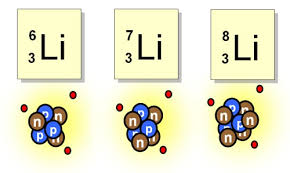
63.
which atom has 4 neutrons?
a)
Li-6
b)
Li-7
c)
Li-8
d)
they have the same # of neutrons
64.
A state of matter that has a definite volume and shape.
a)
solid
b)
liquid
c)
gas
d)
matter
65.
A measure of how much mass is contained in a given unit of volume.
a)
mass
b)
density
c)
volume
d)
matter
66.
Something that takes up space and has mass.
a)
volume
b)
matter
c)
mass
d)
density
67.
24.1% of all the isotopes of a an element have a mass of 75.23 amu, 48.7% have a mass of 74.61 amu, and 27.2% have a mass of 75.20 amu.
What is the average mass of this element?
a)
74.92 amu
b)
24.97 amu
c)
75.01 amu
d)
74.51 amu
68.
Name this formula: 
Fe3PO4
a)
Iron Phosphide
b)
Iron (III) Phosphide
c)
Iron (I) Phosphate
d)
Iron Phosphate
69.
How many significant figures does the following number have: 0.002040
a)
6
b)
4
c)
3
d)
2
70.
Round 0.010229 to four sig figs
a)
1022
b)
1023
c)
0.01023
d)
0.01022
71.

Determine the number of Significant Figures in 10.0 g

a)

5

b)

4

c)

3

d)

2

72.

What is the molar mass of fluorine gas?

(beware!)

a)

19.00g =1 mole

b)

38.00g=1 mole

c)

9.00g = 1mole

d)

18.00g= 1mole

73.

What is the molar mass of table salt (NaCl)?

a)

116.89g =1 mole

b)

35.45g =1 mole

c)

22.99g =1 mole

d)

58.44g =1 mole

74.

Calculate the molar mass of Ba(C2H3O2)2

a)

255.43g =1 mole

b)

392.76g =1 mole

c)

166.35g =1 mole

d)

196.38g =1 mole

75.

What is the percent by mass of fluorine in CaF2 (molar mass: 78.08g=1 mole, Ca is 40.08g=1mole, F= 19.00g=1 mole)?

a)

47.41%

b)

48.67%

c)

24.33%

d)

51.33%

76.

What is the percent by mass of fluorine in CaF2 (molar mass: 78.08g=1 mole, Ca is 40.08g=1mole, F= 19.00g=1 mole)?

a)

47.41%

b)

48.67%

c)

51.33%

d)

24.33%

77.

Perform the following calculation and round to the proper number of significant figures:

923 g ÷ 20312 cm3

a)

0.04 g/cm3

b)

0.045 g/cm3

c)

0.0454 g/cm3

d)

0.05 g/cm3

78.

Perform the following calculation and round to the proper number of significant figures:

7.987 m - 0.54 m

a)

7.45 m

b)

7.447 m

c)

7.4 m

d)

7.5 m

79.

Perform the following calculation and round to the proper number of significant figures:

1.23 m x 0.89 m

a)

1.0 m2

b)

1.1 m2

c)

1.0947 m2

d)

1.095 m2

80.

Solve. Round using SigFig math rules.

98.7°C - 97.25°C

a)

1°C

b)

1.5°C

c)

1.45°C

d)

1.450°C