
 Worksheets
Chemistry Fall Final
Total questions: 130
Worksheet time: 3hrs 46mins
Name
Class
Date
1.
Determine the number of sig figs in the following measurement:
0.036653 m
0.036653 m
a)
7
b)
5
c)
2
d)
0
2.
Determine the number of sig figs in the following measurement:
72,100 g
72,100 g
a)
5
b)
3
c)
6
d)
4
3.
Determine the number of sig figs in the following measurement:
3,000 mm
3,000 mm
a)
1
b)
4
c)
2
d)
3
4.
Determine the number of sig figs in the following measurement:
25.03 L
25.03 L
a)
4
b)
3
c)
2
d)
1
5.
Round the following number off to the number of sig figs shown in parentheses:
3.774499 (4)
3.774499 (4)
a)
3.774
b)
3.775
c)
3774
d)
3775
6.
Calculate the answer to the following problem and round the final answer to the correct number of sig figs:
24.567 + 0.04478 =
24.567 + 0.04478 =
a)
24.61178
b)
24.612
c)
24.611
d)
24.61
7.
Calculate the answer to the following problem and round the final answer to the correct number of sig figs:
278 x 11.70 =
278 x 11.70 =
a)
3252.6
b)
3250
c)
3252
d)
325
8.
Silver Iodide
a)
Soluble
b)
Insoluble
9.
Zinc Hydroxide
a)
Soluble
b)
Insoluble
10.
KBr
a)
Soluble
b)
Insoluble
11.
Silver acetate
a)
Soluble
b)
Insoluble
12.
KOH
a)
Soluble
b)
Insoluble
13.
NiCl2
a)
Soluble
b)
Insoluble
14.
Ions are:
a)
atoms with a positive or negative charge
b)
atoms with no charge
c)
atoms with ONLY a positive charge
d)
atoms with ONLY a negative charge
15.
Cations are
a)
positive
b)
negative
c)
neutral
d)
nonmetals
16.
If an atom gains an electron to become an ion, it is a(n)....
a)
cation
b)
anion
c)
noble gas
d)
metal
17.
What is the symbol for the Sulfide ion? (The most stable form of Sulfur)
a)
S-2
b)
S+2
c)
S-8
d)
S+6
18.
Name the ion.... Ca2+
a)
Calcium
b)
Calcide
c)
Calcium (II)
d)
Calciumide
19.
Name the ion... P3-
a)
Phosphorous
b)
Phosphide
c)
Phosphorous (III)
d)
Potassium
20.
Transition metals need _______ when naming them in a compound.
a)
roman numerals
b)
subscripts
c)
coefficient
d)
charge
21.
Which of the following is NOT an ionic compound:
a)
CaO
b)
NaOH
c)
BaCl2
d)
Br2
22.
What would be the proper chemical formula for combining Al3+ and Cl- :
a)
AlCl3
b)
Al3Cl
c)
AlCl
d)
Al3Cl3
23.
Name the following ionic compound: BeCl2
a)
beryllium chlorine
b)
beryllium(II) chloride
c)
beryllium chloride
d)
beryllium dichloride
24.
Name the following ionic compound: NaF
a)
nitrogen fluorine
b)
sodium fluoride
c)
nitrogen fluoride
d)
sodium fluorine
25.
Name the following ionic compound: Cs2S
a)
cesium sulfide
b)
cesium sulfate
c)
cesium(II) sulfate
d)
cesium(II) sulfide
26.
Is Na a metal or nonmetal
a)
metal
b)
nonmetal
27.
Is C a metal or nonmetal
a)
metal
b)
nonmetal
28.
Is O a metal or nonmetal
a)
metal
b)
nonmetal
29.
What is the formula for copper(I) sulfate?
a)
CuSO3
b)
CuSO4
c)
Cu2SO3
d)
Cu2SO4
30.
What is the formula for sodium phosphate?
a)
Na3PO4
b)
Na3PO3
c)
Na3P
d)
Na3PO
31.
What is the formula for sodium nitrate?
a)
Na3NO
b)
NaNO
c)
Na3NO3
d)
NaNO3
32.
What is the formula for iron(II) carbonate?
a)
Fe2CO3
b)
FeCO3
c)
Fe2CO2
d)
FeCO4
33.
What is the formula for magnesium phosphide?
a)
Mg3P2
b)
Mg2P3
c)
Mg2PO3
d)
Mg3(PO3)2
34.
What is the formula for copper (II) hydroxide?
a)
CuOH
b)
Cu(OH)2
c)
Cu2OH
d)
Cu2O
35.
What is a coefficient?
a)
The small number on the right of the chemical symbol.
b)
The large number to the left of a formula.
36.
Decomposition occurs when...
a)
Two formulas combine.
b)
A formula breaks apart.
c)
An atom is replaced during a reaction.
37.
A replacement occurs when...
a)
Two formulas combine.
b)
A formula breaks apart.
c)
An atom is replaced during a reaction.
38.
Is the equation balanced?: 2H2O + O2 --> 4MgO + 3Fe
a)
Yes
b)
No
39.
Balance this equation:
2Li + Cl2 -> LiCl
2Li + Cl2 -> LiCl
a)
2Li + Cl2 -> 4LiCl2
b)
2Li + Cl2 -> LiCl2
c)
2Li + Cl2 -> 2LiCl
40.
PCl5 + ___ H2O → ___ HCl + H3PO4
a)
4, 5
b)
1, 6
c)
3, 8
d)
2,2
41.
Mg + ___ HCl → MgCl2 + H2
a)
1
b)
2
c)
3
d)
4
42.
Read the following chemical formula: C6H12O6. How many hydrogen atoms are in the formula?
a)
12
b)
6
c)
4
43.
What is the part of the chemical equation in green called?
Fe + S --> FeS
Fe + S --> FeS
a)
products
b)
reactants
c)
yield
d)
chemical formula
44.
What is the little number after an element in a chemical equation called.
Example: H2
Example: H2
a)
Coefficient
b)
Subscript
c)
Atom
d)
Equation
45.

How many grams are in 3.3 mol of Potassium Sulfide?
a)
360 g
b)
454 g
c)
238 g
d)
132 g
46.
Using the balanced equation below,
CaC₂(s) + 2H₂O(l) --> C₂H₂(g) + Ca(OH)₂(aq)
how many grams of Ca(OH)₂ would be formed with 3.20 moles of CaC₂?
CaC₂(s) + 2H₂O(l) --> C₂H₂(g) + Ca(OH)₂(aq)
how many grams of Ca(OH)₂ would be formed with 3.20 moles of CaC₂?
a)
119 g
b)
21.2 g
c)
114 g
d)
237 g
47.
Given the following reaction 2NaClO3 (s) --> 2NaCl (s) + 3O2 (g). How many grams of NaCl are produced when 80.0 grams of O2 are produced?
a)
500 g Nacl
b)
96.7 g NaCl
c)
6960 g of NaCl
48.
What is the limiting reactant if 10.0 moles of NH3 react with 30.0 moles of NO?
4NH3 + 6NO → 5N2 + 6H2O
4NH3 + 6NO → 5N2 + 6H2O
a)
NH3
b)
NO
c)
N2
d)
H2O
49.
B2H6 + 3O2 -->2 HBO2 + 2 H2O
What mass of O2 will be needed to burn 36.1 g of B2H6?
What mass of O2 will be needed to burn 36.1 g of B2H6?
a)
13.8 g O2
b)
3.86 mol of O2
c)
124 g O2
50.
In the equation 2 Al2O3 --> 4 Al + 3 O2, what is the mole ratio of aluminum to oxygen?
a)
10:6
b)
3:4
c)
4:3
d)
2:3
51.
What is the molar mass of Zn(C2H3O2)2
a)
392.8g/mol
b)
142.9g/mol
c)
361g/mol
d)
183.5 g/mol
52.
phosphate
a)
PO32-
b)
PO33-
c)
PO42-
d)
PO43-
53.
acetate
a)
C2H3O21-
b)
C3H2O31-
c)
C2H2O31-
d)
C3H3O21-
54.
carbonate
a)
C4-
b)
CO42-
c)
CO32_
d)
CO31-
55.
nitrate
a)
N3-
b)
NO21-
c)
NO2-
d)
NO31-
56.
permanganate
a)
MnO41-
b)
MnO31-
c)
Mn2O1-
d)
MnO21-
57.
chromate
a)
CrO32-
b)
CrO41-
c)
CrO31-
d)
CrO42-
58.
Cr2O7-2
a)
Chromate
b)
Dichromate
c)
Carbonate
d)
Cyanide
59.
the central region of an atom where its neutrons and protons are is its
a)
nucleus
b)
electron cloud
c)
core
d)
center
60.

What does the 1.00794 stand for?
a)
Hydrogen
b)
atomic number
c)
atomic mass
d)
atomic explosion
61.
Which statement about the atomic nucleus is correct?
a)
The nucleus is made of protons and neutrons and has a negative charge
b)
The nucleus is made of protons and neutrons and has a positive charge
c)
The nucleus is made of electrons and has a positive charge
d)
The nucleus is made of electrons and has a negative charge
62.
Anything that has mass and takes up space is called
a)
heterogeneous
b)
homogeneous
c)
matter
d)
density
63.
An experiment is performed on plants to see how different liquids affect plant growth. Each plant in the experiment is given a different liquid; water, apple juice, or milk. Each plant has the same amount of soil, sunlight, and listens to the same music. In this investigation, the independent variable is ...
a)
The type of plant
b)
The amount of sunlight
c)
The type of music
d)
The type of liquid
64.
An experiment is performed on plants to see how different liquids affect plant growth. Each plant in the experiment is given a different liquid; water, apple juice, or milk. Each plant has the same amount of soil, sunlight, and listens to the same music. In this investigation, what are the controlled variables?
a)
Type of plant, amount of music, and sunlight
b)
Water, apple juice, milk
c)
Plant growth
65.

How many total people took the survey?
a)
50
b)
150
c)
100
d)
200
66.
An element plus additional element reacts to form one product is an example of which type of chemical reaction?
a)
combustion
b)
decomposition
c)
synthesis
d)
single replacement
67.
What kind of reaction is this:
4Fe + 3O2 → 2Fe2O3
4Fe + 3O2 → 2Fe2O3
a)
Synthesis
b)
Decomposition
c)
Single Replacement
d)
Double Replacement
68.
What kind of reaction is this:
2C3H7OH +9O2 -> 6CO2 + 8H2O
2C3H7OH +9O2 -> 6CO2 + 8H2O
a)
Double Replacement
b)
Combustion
c)
Single Replacement
d)
Decomposition
69.
When 12 moles of O2 reacts with 1.1 mole of C10H8 what is the limiting reactant? C10H8 + 12 O2 --> 10 CO2 + 4 H2O
a)
Oxygen
b)
C10H8
c)
Water
d)
Carbon Dioxide
70.
Theoretical yield = 73g
Actual yield = 62g
Calculate the percent yield.
Actual yield = 62g
Calculate the percent yield.
a)
1.16%
b)
116%
c)
85%
d)
76%
71.
What is the atomic number?
a)
the number of protons
b)
the number of protons and neutrons
c)
the number of neutrons
d)
the number of protons and electrons
72.
What is the mass number?
a)
the number of protons
b)
the number of protons and neutrons
c)
the number of neutrons
d)
the number of protons and electrons
73.

What is the atomic number of this nucleus?
a)
1
b)
3
c)
4
d)
7
74.

What is the mass number of this nucleus?
a)
1
b)
3
c)
4
d)
7
75.

What is the atomic number of this atom?
a)
7
b)
14
c)
21
d)
none of the above
76.
An element's atomic number is always equal to how many ______________ it has.
a)
protons
b)
neutrons
c)
electrons
d)
nuclei
77.
4822 Ti
How many neutrons are in this element?
How many neutrons are in this element?
a)
22
b)
48
c)
26
d)
44
78.
4822 Ti
Which of the following list the protons, neutrons, and electrons correctly?
Which of the following list the protons, neutrons, and electrons correctly?
a)
22, 26, 22
b)
26, 22, 22
c)
22, 48, 26
d)
26, 22, 26
79.
What is the atomic mass of an element with 40 protons, 40 electrons, and 46 neutrons?
a)
80
b)
6
c)
86
d)
Not enough information
80.
What element contains 30 electrons and 35 neutrons?
a)
B
b)
Br
c)
Tb
d)
Zn
81.
What element contains 12 neutrons and has a charge of +11?
a)
Mg
b)
Na
c)
V
d)
Sc
82.
How would you write 4.3756 x 10⁴ in standard form?
a)
437,560,000
b)
0.00043756
c)
43,756
d)
4,3756
83.
How would you write 0.0005 in scientific notation?
a)
50 x 105
b)
5 x 10⁴
c)
5 x 10³
d)
.5 x 103
84.
How do you write
1001
in scientific notation?
1001
in scientific notation?
a)
1.0001 x 10⁴
b)
1.01 x 10⁵
c)
1.001 x 10³
d)
10.1 x 10³
85.
Convert to scientific notation:
520,000,000
520,000,000
a)
52 x 107
b)
5.2 x 10⁷
c)
5.2 x 10⁸
d)
0.52 x 10⁹
86.
Express the following in scientific notation:
0.0000002203
0.0000002203
a)
.02203 x 107
b)
22.03 x 10⁻⁶
c)
2.203 x 10⁻⁷
d)
22.03 x 10⁶
87.
It is a measure of how close measurements come to each other when they are made in the same way
a)
Accuracy
b)
Precision
c)
Error
d)
Extrapolation
88.

a)
Student A
b)
Student B
c)
Student C
d)
Cannot be determined
89.

a)
Student A
b)
Student B
c)
Student C
d)
Cannot be determined
90.
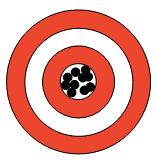
?
a)
High Accuracy & High Precision
b)
High Accuracy & Low Precision
c)
Low Accuracy & High Precision
d)
Low Accuracy & Low Precision
91.

This bullseye demonstrates...
a)
High Accuracy & High Precision
b)
High Accuracy & Low Precision
c)
Low Accuracy & High Precision
d)
Low Accuracy & Low Precision
92.
Which is the correct net ionic equation for the reaction of AgNO3 and CaCl2?
a)
Ca2+(aq) + 2Cl- (aq) → CaCl(s)
b)
Ag+(aq) + Cl- (aq) → AgCl(s)
c)
Ag + Cl → AgCl
d)
Ag+ + Ca2+ →Ag2Ca (s)
93.
What are the spectator ions in this reaction?
CuCl2(aq) + NaOH(aq) → Cu(OH)2(s) + NaCl(aq)
CuCl2(aq) + NaOH(aq) → Cu(OH)2(s) + NaCl(aq)
a)
Cu2+ and OH1-
b)
Na2+ and Cl2-
c)
Na1+ and Cl1-
d)
Na1+ and OH1-
94.
Which of the following does NOT form a precipitate?
a)
AgNO3(aq) + 2KBr(aq) →
b)
LiNO3 (aq) + NaC2H3O2(aq) →
c)
Ca(NO3)2(aq) + K2CO3(aq) →
d)
Ba(NO3)2 (aq) + Na2SO4(aq) →
95.
What precipitate forms when you mix lead (II) nitrate with sodium chloride?
a)
sodium nitrate
b)
lead (II) chloride
c)
sodium lead
d)
chloride nitrate
96.
Which is the correct net ionic equation for the reaction of AgNO3 and CaCl2?
a)
Ca2+(aq) + 2Cl1- (aq) → CaCl(s)
b)
Ag+(aq) + Cl1- (aq) → AgCl(s)
c)
Ag + Cl → AgCl
d)
Ag+ + Ca2+ →Ag2Ca (s)
97.
What precipitate forms when you mix barium nitrate with sodium sulfate?
a)
sodium nitrate
b)
barium nitrate
c)
barium sulfate
d)
sodium sulfate
98.
In this equation,
CuCl2 + NaOH → Cu(OH)2 + NaCl
Which product is insoluble?
CuCl2 + NaOH → Cu(OH)2 + NaCl
Which product is insoluble?
a)
copper(II) hydroxide
b)
sodium chloride
c)
sodium hydroxide
d)
copper(II) chloride
99.
What is the result of the reaction between potassium bromide and ammonium sulfide?
a)
potassium sulfide precipitates
b)
ammonium bromide precipitates
c)
potassium ammonium precipitates
d)
no precipitate is formed
100.
Using this chemical equation, if we burn 3 moles of Ethanol (C2H6O), how many moles of water will we make?
C2H6O+ 3 O2-> 2 CO2+ 3H2O
C2H6O+ 3 O2-> 2 CO2+ 3H2O
a)
1
b)
3
c)
9
d)
12
101.
How many moles of CO2 can I make with 6 mole of Ethanol (C2H6O)?
C2H6O+ 3 O2-> 2 CO2+ 3H2O
C2H6O+ 3 O2-> 2 CO2+ 3H2O
a)
1
b)
3
c)
6
d)
12
102.
What number should be in front of the F2 in this chemical equation?
___N2+___F2 --> ___ NF3
___N2+___F2 --> ___ NF3
a)
1
b)
2
c)
3
d)
4
103.

How many neutrons does the isotope of lithium have?
a)
8
b)
3
c)
4
d)
5
104.
How many F atoms are in this compound?
6MgF2
6MgF2
a)
2
b)
6
c)
8
d)
12
105.
The horizontal rows on the periodic table are known as
a)
periods.
b)
atoms.
c)
groups or families.
d)
valence electrons.
106.
How did Rutherford discover the proton?
a)
Cathode tube ray experiment
b)
Gold Foil Experiment
c)
Planetary Model
d)
Plum Pudding Model
107.
Experiments with cathode rays led to the discovery of the
a)
electrons
b)
nucleons
c)
protons
d)
neutrons
108.
All atoms of the same element have the same
a)
atomic mass
b)
mass number
c)
number of neutrons
d)
atomic number
109.

The smallest particle of an element that still retains all the properties of that element.
a)
atom
b)
cathode ray
c)
electron
d)
compound
110.

Which scientist saw the atom as a solid sphere?
a)
Dalton
b)
Thomson
c)
Rutherford
d)
Bohr
111.
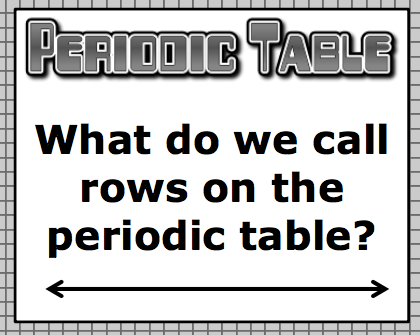
a)
Periods
b)
Groups
112.
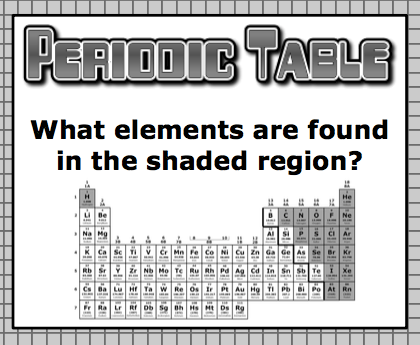
a)
Metals
b)
Nonmetals
c)
Metalloids
113.
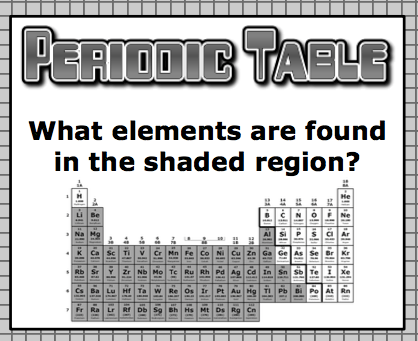
a)
Metals
b)
Nonmetals
c)
Metalloids
114.
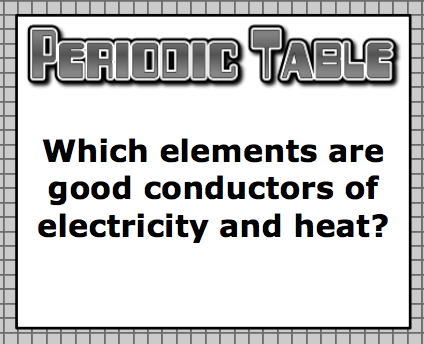
a)
Metals
b)
Nonmetals
c)
Metalloids
115.
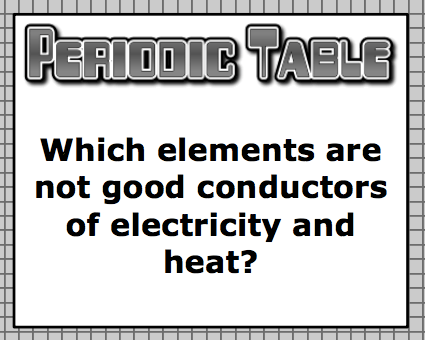
a)
Metals
b)
Nonmetals
c)
Metalloids
116.
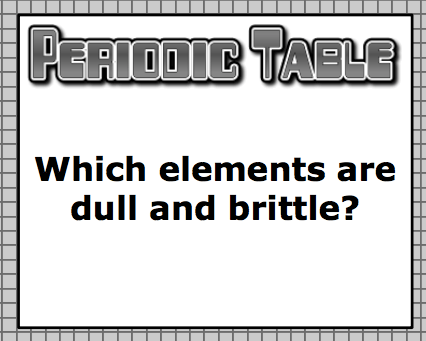
a)
Metals
b)
Nonmetals
c)
Metalloids
117.
Which of the following is not a property of metals?
a)
brittle
b)
malleable
c)
lustrous
d)
conductive
118.
The periodic table has __ groups.
a)
8
b)
7
c)
18
d)
2
119.
How many neutrons does uranium-235 have?
a)
238
b)
92
c)
146
d)
143
121.

In a correctly written symbol what would be located in the "A" position?
a)
number of neutrons
b)
atomic number
c)
number of electrons
d)
mass number
121.
In a correctly written symbol what would be located in the "A" position?
a)
number of neutrons
b)
atomic number
c)
number of electrons
d)
mass number
122.
How many electrons are in a Li+ ion?
a)
1
b)
2
c)
3
d)
4
123.
What type of ion might phosphorus form?
a)
+3
b)
+5
c)
-3
d)
all of the above
124.
Oxides ion
a)
O²⁻
b)
O³⁻
c)
O²⁺
d)
O⁻
125.
Anions are _______ that form ____________ ions and __________ electrons.
a)
nonmetals, positive, lose
b)
nonmetals, negative, gain
c)
metals, positive, gain
d)
metals, positive, lose
126.
Cations are _______ that form ____________ ions and __________ electrons.
a)
nonmetals, positive, lose
b)
nonmetals, negative, gain
c)
metals, positive, gain
d)
metals, positive, lose
127.
When the number of electrons equals the number of protons the atom has what charge?
a)
sponge bob
b)
positive charge
c)
negative charge
d)
neutral charge
128.
The gummy bear melted in the the warm water. This is an example of which type of data?
a)
Qualitative
b)
Quantitative
c)
Numerical
d)
Measured
129.
Which of the following would be an appropriate hypothesis for a lab report written in this class?
a)
I think the gummy bear is going to dissolve in the water
b)
If the gummy bear is placed in the warm water, then it will dissolve because sugar dissolves in water
c)
The warm water is going to make the gummy bear dissolve
d)
If the gummy bear is placed in warm water, it will dissolve
130.
Which of the following is an appropriate hypothesis?
a)
Light affects plant growth.
b)
More light affects plant growth
c)
A plant with more light will grow more healthy than a plant with limited light.
d)
Plants need light to grow.
100 %

