wayground logo

Free Printable Worksheets

NEW

Font size

S
M
L
XL
Worksheets

AP - Unit 1: Basic Chemistry

Total questions: 50

Worksheet time: 38mins

Name
Class
Date
1.
What makes a molecule polar?
a)
Equal sharing of valence electrons
b)
Unequal sharing of valence electrons
c)
Stealing of electrons
d)
Temporary charges that come and go
2.
All matter is made of what 
a)
energy 
b)
atoms 
c)
electrons 
d)
compounds 
3.
What type of bond is formed when a positive ion and negative ion stick together?
a)
Covalent Bond
b)
Ionic Bond
c)
Water Bond
d)
Hydrogen Bond
4.
What is an ion?
a)
 A small atom
b)
A large atom
c)
A neutral atom
d)
A charged atom
5.
Which subatomic particle is neutral?
a)
Neutron
b)
Positron
c)
Proton
d)
Electron
6.
Which subatomic particle is positive?
a)
Electron
b)
Proton
c)
Neutron
d)
Quark
7.
Which subatomic particle is negative?
a)
Proton
b)
Neutron
c)
Electron
d)
Negatron
8.
What two subatomic particles are found in the nucleus?
a)
Protons and Electrons
b)
Neutrons and Electrons
c)
Protons and Neutrons
d)
Electrons only
9.
Where are electrons located?
a)
In the electron clouds
b)
In the nucleus
c)
In the protons
d)
Paired with the neutrons
10.
If an atom has 5 protons and 4 electrons, what is its charge?
a)
Neutral
b)
Positive
c)
Negative
d)
Unknown
11.
If an atom has 8 protons and 10 electrons, what is its charge?
a)
Positive
b)
Neutral
c)
Negative
d)
It depends on its size
12.
When atoms combine, they may gain, lose, or share:
a)
protons
b)
electrons
c)
neutrons
d)
nuclei
13.
Which of the following bonds are the weakest?
a)
Ionic
b)
Hydrogen
c)
Electrovalent
d)
Covalent
14.
An atom can be described as chemically inert if its outermost electron shell contains _____ electrons.
a)
8
b)
9
c)
2
15.
Attractions between water molecules due to polarity are called:
a)
Covalent bonds
b)
Ionic bonds
c)
Polar bonds
d)
Hydrogen bonds
16.
When water molecules sticks to other water molecules.
a)
Adhesion
b)
Universal Solvent
c)
Cohesion
d)
Surface Tension
17.
When water molecules stick to other substances. 
a)
Cohesion
b)
Polarity
c)
Adhesion
d)
Capillary Action
18.
The pH scale is a range from:
a)
1-7
b)
0-14
c)
1-14
d)
1-20
19.
A(n) ______ is a substance with a pH less than 7
a)
Acid
b)
Alkaline
c)
Base
d)
Buffer
20.
A(n) _______ is a substance with a pH greater than 7.
a)
Base
b)
Acid
c)
Buffer
d)
Water
21.
A solution with a pH of 7.0 would be...
a)
Acid
b)
Base
c)
Neutral
d)
Acid and Base
22.
the starting substance in a chemical equation
a)
reactant
b)
product
23.
a substance in which another substance is dissolved.
a)
solution
b)
mixture
c)
solvent
d)
solute 
24.
the substance that is being dissolved 
a)
solution
b)
mixture
c)
solvent
d)
solute
25.
mixtures that can react with acids or bases to keep the pH within a particular range
a)
bases
b)
acids
c)
buffers 
d)
neutral 
26.
What is the number of protons that the element in this image contain?
a)
14
b)
7
c)
15
d)
18
27.
An atom has 10 protons, 15 neutrons and 10 electrons what is its mass number.
a)
20
b)
10
c)
5
d)
25
28.
The mass of one proton is greater than the mass of one...
a)
neutron
b)
electron
29.

Matter

a)

has mass.

b)

All of the choices are correct.

c)

occupies space.

d)

is what life is composed of

e)

is composed of elements.

30.

Which of the following is the strongest bond?

a)

Ionic

b)

Covalent

c)

Hydrogen

d)

Van der Waals

e)

Hydrophobic interactions

31.

This type of chemical bond happens when atoms share electrons.

a)

ionic

b)

covalent

c)

simple

d)

compound

32.

Oxygen, Nitrogen, Hydrogen, and Calcium are all examples of ______________________.

a)

molecules

b)

compounds

c)

atoms

d)

elements

33.

Which one of the following is a compound?

a)

NaCl

b)

O2

c)

Hydrogen

d)

He2

34.

What is a substance with unique physical and chemical properties that can't be reduced by chemical means.

a)

an element

b)

an atom

c)

a molecule

d)

a compound

35.

Which of these is only a molecule and not a compound?

a)

a

b)

b

c)

c

d)

d

36.

Which is the correct molecular structure for carbon dioxide?

a)
b)
c)
d)
37.
What are valence electrons?
a)
The innermost electrons
b)
The outermost electrons
c)
The bonds between two atoms
d)
When electrons are balanced
38.

Compounds that are composed of the same number and type of atoms but have them arranged in different ways are ___________.

a)

isomers

b)

isotopes

c)

polymers

d)

alkanes

39.
Attractions between water molecules are called
a)
Covalent bonds
b)
Ionic bonds
c)
Polar bonds
d)
Hydrogen bonds
40.
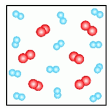
This diagram represents a _____.
a)
pure substance that is a compound
b)
mixture of elements
c)
pure substance that is an element
d)
mixture of compounds
41.
Classify the picture with the correct label.
a)
Compounds
b)
Mixture of Elements
c)
Mixture of Compounds
d)
Mixture of Elements & Compounds
42.
Classify the picture with the correct label.
a)
Element
b)
Compound
c)
Mixture of Compounds
d)
Mixture of Elements
43.

What does the diagram show?

a)

Mixture of Elements and Compounds

b)
Compound
c)

Mixture of Elements

d)

Element

44.

H2O

a)

is a compound but not a molecule

b)

is only a molecule and not a compound

c)

is a compound and also a molecule

d)

is neither a compound or molecule

45.
What is the best formula for this molecule?
a)
2H2O2
b)
6H2O2
c)
6H12O12
d)
6HO
46.
What is the total number of atoms in this molecule?
a)
2
b)
4
c)
1
d)
6
47.

How many "C" are in CO2

a)

2

b)

1

c)

0

d)

3

48.

How many hydrogens "H" are in CH4

a)

1

b)

2

c)

3

d)

4

49.

A force that holds two or more atoms.

a)

conductor

b)

simplify

c)

chemical bond

d)

brittle

50.
What is the correct formula for this molecule?
a)
NH
b)
N3H
c)
NH3
d)
NH4