
 Worksheets
Biology Final Exam
Total questions: 100
Worksheet time: 2hrs 55mins
Name
Class
Date
1.
During strenuous exercise, body temperature increases. The body responds to the increase in temperature by sweating, which helps to reduce the body temperature. Which is demonstrated in this situation?
a)
excretion
b)
metabolism
c)
homeostasis
d)
synthesis
2.
Before mitosis begins, which happens before the nucleus starts dividing?
a)
The cytoplasm separates.
b)
The DNA replicates.
c)
The sister chromatids separate.
d)
The homologous chromosomes cross over.
3.
A strand of DNA has these bases:
AGC CAT GTA TAC What is the complementary DNA strand?
AGC CAT GTA TAC What is the complementary DNA strand?
a)
ACG GAT CTA TAG
b)
TCG GTA CAT ATG
c)
TGC CTA GAT ATC
d)
UCG CUA CAU AUG
4.
Which process produces the most variation within a species?
a)
Asexual reproduction
b)
Sexual reproduction
c)
mitosis
d)
cloning
5.
Which statement best describes the relationship that exists among proteins, DNA, and cells?
a)
Proteins combine to produce cells, which produce DNA
b)
Proteins are made up of DNA, which determines the cells that are produced.
c)
DNA is made up of proteins, which tell a cell how to function.
d)
Cells contain DNA, which controls the production of proteins.
6.
Why is meiosis important for sexual reproduction?
a)
It allows the zygote formed from fertilization to have triple the chromosome number of the organism.
b)
It allows gametes to have twice the original number of chromosomes of the organism.
c)
It allows gametes to have half the original number of chromosomes of the organism.
d)
It allows the zygote formed from fertilization to have half the original number of chromosomes of the organism.
7.
Molecules diffusing with the concentration gradient through a protein channel is...
a)
Facilitated Diffusion
b)
Simple Diffusion
c)
Active Transport
d)
Osmosis
8.
What are the subunits of DNA and their function?
a)
nucleotides that store information
b)
monosaccharides that provide quick energy for the cell
c)
lipids that store energy and provide insulation
d)
proteins that provide the building blocks for the structural components of organisms
9.
What type of organic molecules are enzymes?
a)
carbohydrates
b)
lipids
c)
nucleic acids
d)
proteins
10.
A freshwater plant is placed in a container of saltwater. What will most likely happen to the cells of the plant?
a)
They will swell because water will move into them.
b)
They will swell because salt will move into them
c)
They will shrink because water will move out of them.
d)
They will shrink because salt will move out of them.
11.

This diagram shows a plant cell. Which structure is found in a plant cell but is absent in an animal cell?
a)
1
b)
2
c)
3
d)
4
12.
During which phase of the cell cycle is the cell growing and preparing for cellular division?
a)
cytokinesis
b)
anaphase
c)
prophase
d)
interphase
13.

What type of cell is shown?
a)
eukaryotic
b)
prokaryotic
c)
bacterial
d)
protist
14.
Proteins are assembled within this cell organelle.
a)
nucleus
b)
Golgi apparatus
c)
lysosome
d)
ribosome
15.
Cellular energy is produced in the membrane of this organelle.
a)
endoplasmic reticulum
b)
chloroplast
c)
mitochondria
d)
lysosome
16.
This organelle would NOT be found in animal cells.
a)
cell membrane
b)
nucleus
c)
lysosome
d)
chloroplast
17.
Which of these requires ATP?
a)
osmosis
b)
diffusion
c)
active transport
d)
stasis
18.
Which class of biomolecules include monosaccharides, disaccharides, and polysaccharides?
a)
carbohydrates
b)
lipids
c)
proteins
d)
nucleic acids
19.
Which class of biomolecules include fats, oils, and steroids?
a)
carbohydrates
b)
lipids
c)
proteins
d)
nucleic acids
20.
Which class of biomolecules is considered the main structural molecule? This same class also makes up enzymes..
a)
carbohydrates
b)
lipids
c)
proteins
d)
nucleic acids
21.
Which class of biomolecules includes DNA and RNA?
a)
carbohydrates
b)
lipids
c)
proteins
d)
nucleic acids
22.

What type of cell is shown?
a)
Eukaryotic because it has a nucleus
b)
Eukaryotic because it lacks a nucleus
c)
Prokaryotic because it has a nucleus
d)
Prokaryotic because it lacks a nucleus
23.
Which of these is most likely an enzyme? (Based on the suffix)
a)
Sucrose
b)
Galactose
c)
Fructose
d)
Amylase
24.
Which biomolecule's monomer (or building block) is glycerol and fatty acid?
a)
Lipids
b)
Proteins
c)
Carbohydrate
d)
Nucleic Acid
25.
What is a substance called if it speeds up a chemical reaction?
a)
reusable
b)
catalyst
c)
specific
d)
fragile
26.
Which biomolecule's monomer (or building block) are monosaccharides?
a)
Lipids
b)
Proteins
c)
Carbohydrate
d)
Nucleic Acid
27.

The phases of the cell cycle in correct order are _______________.
a)
Interphase, Prophase, Metaphase, Anaphase, Telophase, Cytokinesis
b)
Interphase, Prophase, Anaphase, Metaphase, Cytokinesis, Telophase
c)
Prophase, Metaphase, Anaphase, Telophase, Cytokinesis, Interphase
d)
Prophase, Metaphase, Telophase, Anaphase, Interphase, Cytokinesis
28.
Which biomolecule's monomer (or building block) is nucleotides?
a)
Lipids
b)
Proteins
c)
Carbohydrate
d)
Nucleic Acid
29.
Has membrane bound organelles
a)
Prokaryote
b)
Eukaryote
c)
both
30.

The diagram shows the base sequence of a strand of DNA.
From left to right, what is the sequence of the complementary strand of DNA in this molecule?
From left to right, what is the sequence of the complementary strand of DNA in this molecule?
a)
T G A A C
b)
A C T T G
c)
T G U U C
d)
U C T T G
31.
Which biomolecule is responsible for insulation and long-term energy storage?
a)
Protein
b)
Nucleic Acid
c)
Lipid
d)
09Carbohydrate
32.
How do enzymes work?
a)
Slow down chemical reactions
b)
Prevent chemical reactions from working
c)
increase the activation energy
d)
speed up chemical reactions
33.

Which process results in 4 haploid daughter cells?
a)
mitosis
b)
meiosis
c)
fertilization
d)
replication
34.

During meiosis, homologous chromosomes undergo ______ causing genetic variation (gene recombination).
a)
crossing over
b)
independent assortment
c)
mutations
d)
replication
35.

In meiosis four daughter cells are produced with ____ of the genetic material of the parent cell. If the parent cell has 46 chromosomes the daughter cell will have ____.
a)
the same amount, 46
b)
double, 92
c)
half, 23
36.

____ means that both alleles are the same whereas ____ indicates the alleles are different.
a)
homozygous, heterozygous
b)
heterozygous, homozygous
c)
Haploid, Diploid
d)
Diploid, Haploid
37.

Which identifies an individuals genotype?
a)
Tt
b)
tall
c)
short
d)
type A
38.

Which of these represents a heterozygous genotype?
a)
Bb
b)
BB
c)
bb
39.

What is structure D?
a)
Substrate
b)
Active site
c)
Enzyme
d)
Products
40.
Has nucleus
a)
Prokaryote
b)
Eukaryote
c)
both
41.

Chromosomes that determine if you are a male or female are called ___ chromosomes. Females have the sex chromosomes ____ and males have ____.
a)
autosomes, XX, XY
b)
sex, XY, XX
c)
autosomes, XY, XX
d)
sex, XX, XY
42.

_____ results in blending of traits.
a)
Codominance
b)
Incomplete Dominance
c)
Incomplete Recessive
d)
Polygenic Traits
43.

_____ is the expression of two traits.
a)
Codominance
b)
Incomplete Dominance
c)
Incomplete Recessive
d)
Polygenic
44.

Nucleotides include a 5-carbon ____, a phosphate group, and a _____ base.
a)
lipid, protein
b)
protein, nitrogen
c)
lipid, sugar
d)
sugar, nitrogen
45.

Which of these is the correct pairing of DNA nitrogen bases according to the base pair rule?
a)
adenine & cytosine; guanine & thymine
b)
cytosine & thymine; adenine & guanine
c)
adenine & thymine; guanine & cytosine
d)
guanine & adenine; cytosine & thymine
46.

Which process involves the copying of DNA strand to make new DNA?
a)
Transcription
b)
Translation
c)
Replication
d)
Protein Synthesis
47.

Which type of reproduction occurs with only one parent cell? What kind of offspring are produced in terms of genetics?
a)
asexual, identical
b)
asexual, unique/different
c)
sexual, identical
d)
sexual, unique/differen
48.
DNA polymerase
a)
Is an enzyme
b)
Adds new nucleotides to the template strand
c)
Proofreads DNA strands to see that they are correct
d)
All of these are functions of DNA polymerase
49.

Which process results in the production of body cells needed for repair and growth? How many chromosomes are found in cells produced by this process?
a)
mitosis, 23
b)
mitosis, 46
c)
meiosis, 23
d)
meiosis, 46
50.

Which correctly identifies the phases of mitosis?
a)
Prophase, Anaphase, Telophase, Metaphase
b)
Telophase, Prophase, Metaphase, Anaphase
c)
Anaphase, Metaphase, Prophase, Telophase
d)
Prophase, Metaphase, Anaphase, Telophase
51.
What is the main function of a selectively permeable membrane?
a)
storage of water
b)
storage of chemicals
c)
breaks down molecules within the cell
d)
regulates what enters and leaves the cell
52.
Which structure is primarily responsible for controling all processes of a plant cell?
a)
chloroplast
b)
lysosome
c)
mitochondria
d)
nucleus
53.
A cell with 24 chromosomes undergoes mitosis. How many chromosomes will each daughter cell have?
a)
6
b)
12
c)
24
d)
48
54.
Movement of materials down the concentration gradient through a protein channel is an example of
a)
facilitated diffusion
b)
active transport
c)
respiration
d)
osmosis
55.
Which list includes only structures that would be found in a prokaryotic cell?
a)
Cell wall, plasma membrane, mitochondria
b)
Central vacuole, cell wall, lysosome
c)
Cell wall, plasma membrane, cytoplasm
d)
Plasma membrane, nucleus, mitochondria
56.

What phase of mitosis is shown in the picture?
a)
Prophase
b)
Metaphase
c)
Anaphase
d)
Telophase
57.

This diagram shows an enzyme-substrate complex.
Which is represented by Structure X?
Which is represented by Structure X?
a)
Substrate
b)
Enzyme
c)
Complex
d)
Product
58.

What are the three parts of a DNA nucleotide?
a)
Amine group, R group, & carboxyl group
b)
fatty acid, glycerol, & alcohol group
c)
phosphate group, deoxyribose sugar, & nitrogen base
d)
sterol ring, six carbon sugar, & alcohol group
59.
Where do substrates bind on an enzyme?
a)
voltage-gated channels
b)
surface receptor
c)
calcium channels
d)
active site
60.
Which has a defined nucleus?
a)
prokaryote
b)
eukaryote
61.
A strand of DNA with the sequence A-C-T-T-G serves as a template to form a strand of mRNA with the sequence U-G-A-A-C. During which process would this happen?
a)
replication
b)
transcription
c)
translation
d)
meiosis
62.
Humans have ________ pairs of chromosomes.
a)
21
b)
23
c)
46
d)
None of the above
63.
Mutations are important because they bring about
a)
death of the organism in which they develop
b)
genetic variation needed for a population to evolve
c)
benefits for the individual, not for the population
d)
Hardey-Weinberg equilibrium within a population
64.
Some peeled pieces of apple were placed in distilled water and some in very salty water. The cells in the apple pieces will…
a)
Lose water in both solutions
b)
Gain water in both solutions
c)
Lose water in the distilled water and gain water in the salty water
d)
Gain water in the distilled water and lose water in the salty water
65.
A segment of DNA has this sequence:
ATA GCA CAT GTA
What is the mRNA sequence transcribed from this segment?
ATA GCA CAT GTA
What is the mRNA sequence transcribed from this segment?
a)
TAT GCT CTA GAT
b)
UAU GCU CUA CAU
c)
TAT CGT GTA CAT
d)
UAU CGU GUA CAU
66.

When is DNA replicated during the cell cycle?
a)
During the G1 phase
b)
During the G2 phase
c)
During the S phase
d)
During the M phase
67.

The intersection of the left, top, and right nitrogenous bases indicates which amino acid a mRNA codon represents. This is true for all organisms. This indicates that the ___.
a)
The genetic code is universal.
b)
We, as organisms, differ only in our sequence of bases
c)
The genetic code determines the sequence of amino acids making up a protein
d)
All of the above
68.
Which sequence depicts the correct order of protein synthesis within a cell?
a)
DNA → mRNA → amino acids → proteins
b)
DNA → amino acids → mRNA → proteins
c)
DNA → mRNA → proteins → amino acids
d)
DNA → proteins → amino acids → mRNA
69.
Osmosis is the movement of _____ across a membrane.
a)
food
b)
energy
c)
oxygen
d)
water
70.
Which is true about active transport?
a)
It requires energy
b)
it does not require energy
c)
It moves substances down the concentration gradient
d)
it moves material from high to low concentration
71.
This cell organelle helps organisms maintain homeostasis by controlling what substances may enter or leave cells.
a)
vacuole
b)
nucleus
c)
cell membrane
d)
cell wall
72.
Passive transport requires no
a)
concentration gradients
b)
osmosis
c)
motion
d)
energy
73.

In DNA, thymine is used and in RNA, ___ is used.
a)
adenine
b)
thymine
c)
cytosine
d)
uracil
74.
What does a flagellum do?
a)
It helps the cell move.
b)
It helps the cell make protein.
c)
It stores water and energy for the cell to use later.
d)
I don't know, but it looks cool.
75.
Plants, animals, fungi and protists are all examples of _______ cells
a)
Prokaryotic
b)
Eukaryotic
c)
animal
d)
plant
76.
Are prokaryotes multicellular or unicellular?
a)
Multicellular
b)
Unicellular
77.
A cell's _____ store extra food and water for later use.
a)
membrane
b)
nucleus
c)
vacuoles
d)
ribosomes
78.
Where is the DNA found in a eukaryotic cell?
a)
floating around in the cytoplasm
b)
in the nucleus
79.
What cell doesn't have a cell wall?
a)
Animal cell
b)
Plant cell
c)
IDK
d)
Prokaryote
80.
Is DNA in prokaryotes and Eukaryotes?
a)
BOTH
b)
NEITHER
c)
IDK
d)
SPONGEBOB?????
81.

Fruit fly body cells have 8 chromosomes. After mitosis, you would expect a resulting fruit fly daughter cell to have ...
a)
16 chromosomes.
b)
46 chromosomes.
c)
8 chromosomes.
d)
4 chromosomes.
82.
Asexual reproduction will result in
a)
Identical offspring to the parent
b)
Twins
c)
Meiosis
d)
Non-identical offspring to the parent
83.
What is it called when a sperm and egg meet?
a)
meiosis
b)
fertilization
c)
cell division
d)
mitosis
84.
How many cells are created at the end of Mitosis?
a)
1 diploid cell
b)
2 diploid cells
c)
3 diploid cells
d)
4 diploid cells
85.
The cells produced via meiosis are called:
a)
sex cells (gametes)
b)
somatic cells
c)
body cells
d)
skin cells
86.
Another name for a sex cell is a:
a)
gamete
b)
embryo
c)
bone cell
d)
muscle cell
87.

What is structure A?
a)
Substrate
b)
Active site
c)
Enzyme
d)
Products
88.
Why is sexual reproduction better than asexual reproduction?
a)
It gives an advantage to organisms to be different than the rest, if the environment changes.
b)
It is better for all organisms to be the same.
c)
It happens faster.
d)
It helps skin cells divide faster to heal wounds.
89.

If a cell has 12 chromosomes, how many will each daughter cell have after mitosis and cytokinesis?
a)
4
b)
6
c)
12
d)
24
90.

If a parent cell has 12 chromosomes, how many chromosomes will each gamete have after meiosis?
a)
4
b)
6
c)
12
d)
24
91.
If the Diploid number of Carrots is 18, the haploid number is
a)
18
b)
9
c)
27
d)
36
92.
Which of these cells would be produced through meiosis?
a)
skin cells
b)
liver cells
c)
brain cells
d)
sperm cells
93.
Crossing over occurs in...
a)
Prophase 1
b)
Prophase 2
c)
Metaphase 1
d)
Metaphase 2
94.
If a parent cell started with 60 chromosomes per cell, the daughter cells would each have ___ chromosomes after MITOSIS.
a)
30
b)
60
c)
120
d)
15
95.
Lipids are made of
a)
monosaccharides
b)
amino acids
c)
glycerol and 3 fatty acids
d)
nucleotides
96.
Which examples are a sources of energy?
a)
Starch, cellulose, glycogen
b)
Valine, Histidine, Cysteine
c)
DNA, RNA
d)
Unsaturated and Saturated Fats
97.
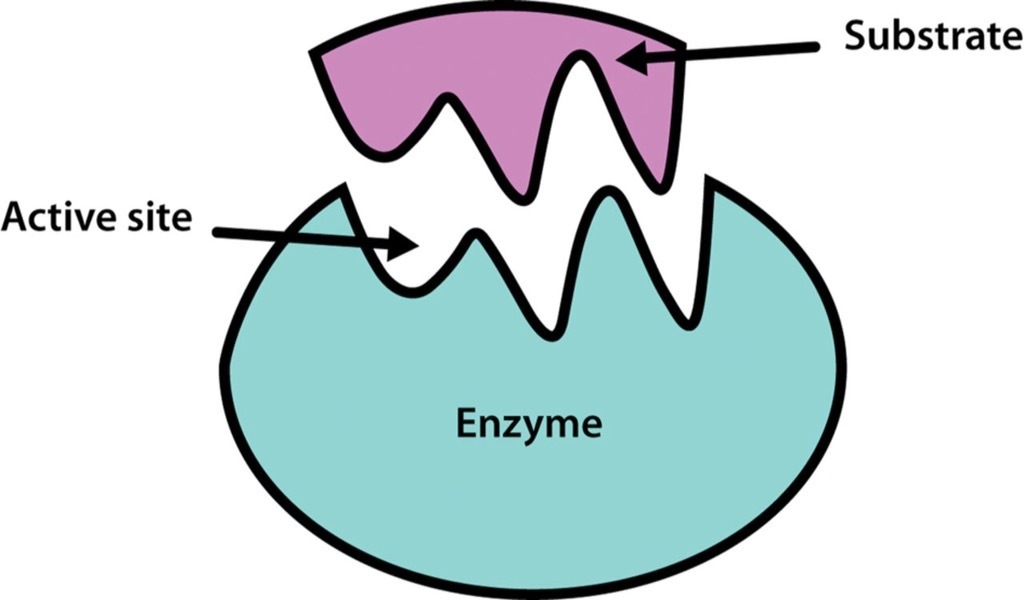
What biomolecule do enzymes belong to?
a)
Carbohydrate
b)
Lipid
c)
Nucleic Acid
d)
Protein
98.
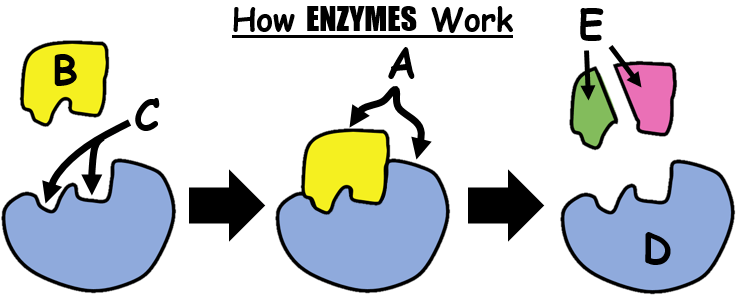
Letter D...
a)
active site
b)
enzyme
c)
substrate
d)
products
99.

What is structure C?
a)
Substrate
b)
Active site
c)
Enzyme
d)
Products
100.

The graph shows how enzymes affect reactions in cells. Which statement best summarizes the information shown in the graph?
a)
Enzymes increase the energy of the reactants.
b)
Enzymes decrease the energy level of the products.
c)
Enzyme decrease the activation energy of the reaction.
d)
Enzymes reverse the direction of the reaction.
100 %

