wayground logo

Free Printable Worksheets

Font size

S
M
L
XL
Worksheets

Biology Midterm Review

Total questions: 101

Worksheet time: 25hrs 15mins

Name
Class
Date
1.
The variable that is being tested or changed
a)
independent variable
b)
dependent variable
c)
control variable
2.
The variable that is being measured
a)
independent variable
b)
dependent variable
c)
control variable
3.
the variable that is kept the same to make sure results are caused by the thing being tested
a)
independent variable
b)
dependent variable
c)
control variable
4.
Why do scientists use the scientific method?
a)
To make sure they get credit for their discoveries.
b)
To make sure their results are valid and can be performed by other scientists.
c)
So that other scientist don't get mad at them
5.
An experiment is performed on plants to see how different liquids affect plant growth. Each plant in the experiment is given a different liquid: water, apple juice, or milk. What variables should be kept constant/controlled? 
a)
type of plant, flower pot,  soil, and amount of sunlight
b)
water, apple juice, milk
c)
only the amount of sunlight
d)
type of plant only
6.
What is being kept constant?
a)
ramp height
b)
speed of the ball rolling
c)
type of ball
7.
What is being changed in this experiment?
a)
temperature of the stove
b)
how fast the water boils
c)
amount of water
8.
What is being measured or the result/effect of this experiment?
a)
how fast the water boils
b)
amount of water
c)
temperature of stove
9.
An experiment is performed on plants to see how different liquids affect plant growth. Each plant in the experiment is given a different liquid; water, apple juice, or milk. Each plant has the same amount of soil, sunlight, and listens to the same music. In this investigation, the independent variable is ...
a)
The type of plant
b)
The amount of sunlight
c)
The type of music
d)
The type of liquid
10.
An experiment is performed on plants to see how different liquids affect plant growth. Each plant in the experiment is given a different liquid; water, apple juice, or milk. Each plant has the same amount of soil, sunlight, and listens to the same music. In this investigation, what are the controlled variables?
a)
Type of plant, amount of music, and sunlight
b)
Water, apple juice, milk
c)
Plant growth
11.
An experiment is performed on plants to see how different liquids affect plant growth. Each plant in the experiment is given a different liquid; water, apple juice, or milk. Each plant has the same amount of soil, sunlight, and listens to the same music. In this investigation, what is the dependent variable?
a)
Type of plant
b)
Water, apple juice, milk
c)
Plant growth
12.
A student is planning an experiment to find out how the height from which he drops a ball affects how high the ball bounces. The dependent variable is the _____.
a)
Diameter of the ball
b)
Force acting on the ball
c)
Height that the ball bounces
d)
Height from which the ball is dropped
13.
A student is planning an experiment to find out how the height from which he drops a ball affects how high the ball bounces. What is the control variable?
a)
The ball used
b)
The height the ball bounces
c)
Height of the ball being dropped
14.

Examine the line graph below. If the population of Centerville continues to increase at the same rate, what will the population be in the year 2010?

a)

16,000 people

b)

6500 people

c)

9500 people

d)

8000 people

15.

Which of the following is a factual conclusion that may be made from the data in the tables?

a)

As the temperature increases in both air and water the speed of sound stays the same

b)

As the temperature increases in both air and water the speed of sound decreases

c)

As the temperature decreases in both air and water the speed of sound increases

d)

As the temperature decreases in both air and water the speed of sound decreases

16.
In this graph, what is the independent variable? 
a)
Population
b)
Day
c)
Species 5
17.
In this graph, what is the dependent variable? 
a)
Walla Walla Island
b)
Time
c)
Number of Deer
18.

The scatterplot shows the amount of rainfall during six thunderstorms and the length of time that each storm lasted. Based on the scatterplot, which statement is true?

a)

During each storm that lasted longer than 1 hour, there was less than 1 inch of rain.

b)

During each storm that lasted longer than 1 hour, there was more than 1 inch of rain.

c)

No storms produced more than 2 inches of rain.

d)

No storms lasted longer than 1 hour.

19.
What type of transport requires energy? 
a)
Active Transport
b)
Facilitated Diffusion
c)
Simple Diffusion
d)
Passive Transport
20.
What type of transport does not require energy? 
a)
Active Transport
b)
Passive Transport
21.
You put a cell into a solution, the cell grows. Is the solution hypotonic or hypertonic to the cell? 
a)
hypertonic
b)
hypotonic
c)
isotonic
d)
not enough information
22.
The cell below is in a _________ solution.
a)
Hypotonic
b)
Hypertonic
c)
Isotonic
23.
The cell below is in a _____________ solution.
a)
Hypertonic
b)
Hypotonic
c)
Isotonic
24.
This egg has shrunk, what type of solution was it placed in?
a)
hypotonic solution
b)
hypertonic solution
c)
isotonic solution
d)
active transport
25.
If a cell is placed in a HYPOTONIC solution, water will move _________ of the cell, causing it to ___________.
a)
into, swell
b)
out of, shrivel
c)
in and out of the cell, stay the same
26.
What type of solution is this cell in?
a)
Isotonic
b)
Hypertonic
c)
Hypotonic
d)
diffused
27.
What type of solution is this cell in?
a)
Isotonic
b)
Hypertonic
c)
Hypotonic
d)
diffused
28.
Which of the following statements is not part of the cell theory?
a)
Cells are the basic unit of structure and function in all living things.
b)
All cells are produced from other cells.
c)
Only animal cells are composed of cells.
d)
All living things are composed of cells.
29.
Which statement reflects one of the major components of the cell theory?
a)
All living things are multi-cellular.
b)
Organs are the basic unit of structure and function for all living things.
c)
All cells come from previously existing cells.
d)
Every organism has a reproductive system to ensure survival of the species.
30.
What structures distinguish a plant cell from an animal cell?
a)
Plant cells have cell walls and ribosomes.
b)
Plant cells have cell walls and chloroplasts.
c)
Plant cells have chloroplasts and ribosomes.
d)
Plant cells have chloroplasts and mitochondria.
31.
Which statement is a part of the cell theory?
a)
all cells come from preexisting cells
b)
bacteria are prokaryotic cells
c)
eukaryotic cells are complex
d)
humans are multicellular
32.
Which of the following is NOT a cell theory.
a)
All non-living things are made of cells
b)
All cells come from pre-existing cells
c)
Cells are the basic unit of structure and function of all living things
33.
Which component of the cell membrane functions to isolate the cell from its environment?
a)
carbohydrates
b)
cholesterol
c)
phospholipids
d)
proteins
34.
Which component of the cell membrane functions to help move materials across the membrane?
a)
carbohydrates
b)
cholesterol
c)
phospholipids
d)
proteins
35.

Selective permeability allows __________ molecules to pass through plasma membrane

a)

some

b)

all

36.

The ____________ mosaic model describes the plasma membrane and its molecules

a)

solid

b)

fluid

37.
Which best describes the main job of most cells in multicellular organisms?
a)
Cells work to keep themselves alive.
b)
Cells work to keep the organism alive.
c)
Cells work to release needed materials.
d)
Cells work to store unneeded materials.
38.
Which organism performs all life processes in one cell?
a)
grass
b)
bacteria
c)
mushroom
d)
butterfly
39.
Which best explains why humans are multicellular organisms?
a)
Human cells are too small to function alone.
b)
Human cells join together to form one large cell.
c)
Humans need many cells to carry out life processes.
d)
Humans have many systems that perform the same function.
40.
How are multi-celled and single-celled organisms different?
a)
Multi-celled organisms need energy to survive, while single-celled organisms need no energy to survive.
b)
Single-celled organisms can be seen without using a microscope, while multi-celled organisms are microscopic.
c)
Multi-celled organisms have large numbers of specialized cells to perform a variety of life functions, while single-celled organisms complete life functions with one cell.
d)
Single-celled organisms have large numbers of identical cells that all perform the same function, while multi-celled organisms have cells that are all different and perform different life functions.
41.
What are the tiny structures that carry out jobs inside cells called?
a)
membranes
b)
nucleus
c)
organelles
d)
animalicules
42.
Where is the DNA found in a prokaryotic cell? 
a)
floating around in the cytoplasm 
b)
in the nucleus 
43.
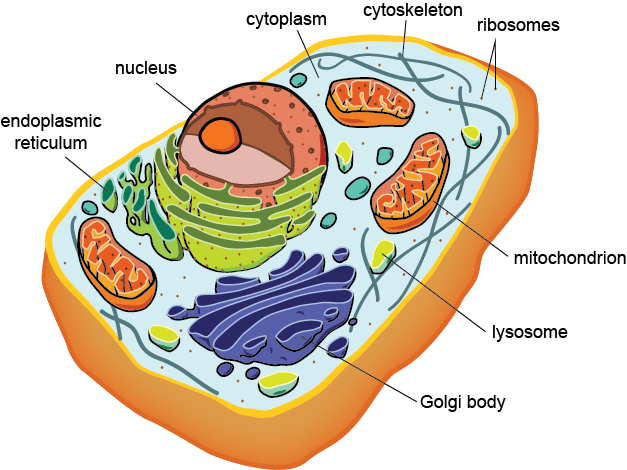
Amino acids link together to form proteins. In which organelle would this process occur?
a)
Lysosome
b)
Ribosome
c)
Centriole
d)
Mitochondria
44.
Where are proteins made?
a)
Golgi body
b)
Mitoichondrion
c)
Chromosomes
d)
Ribosomes
45.
Where are ribosomes produced?
a)
Nucleolus
b)
Endoplasmic reticulum
c)
Golgi body
d)
Vessicle
46.
In what organelle is the genetic material found inside?
 
a)
Endoplasmic Reticulum
b)
Golgi Complex
c)
Nucleolus
d)
Nucleus
47.
My main goal is to produce a lot of ATP energy. 
a)
Chloroplast
b)
Mitochondria
48.
I am only found in a plant cell. What am I?
a)
cell wall
b)
mitochondria
c)
cytoplasm
d)
chloroplast
49.
When a starfish grows a new body off a broken arm, what kind of reproduction is this?
a)
Sexual
b)
Differentiation
c)
Asexual 
d)
Specialization
50.
Where does an off spring get its traits in asexual reproduction?
a)
From both parents
b)
From only one parent
c)
From neither parent
d)
There are no traits handed down
51.
What is a substance called if it speeds up a chemical reaction?
a)
reusable
b)
catalyst
c)
specific
d)
fragile
52.
With what 3 letters do enzymes typically end?
a)
-ose
b)
-ase
c)
-ese
d)
-tic
53.
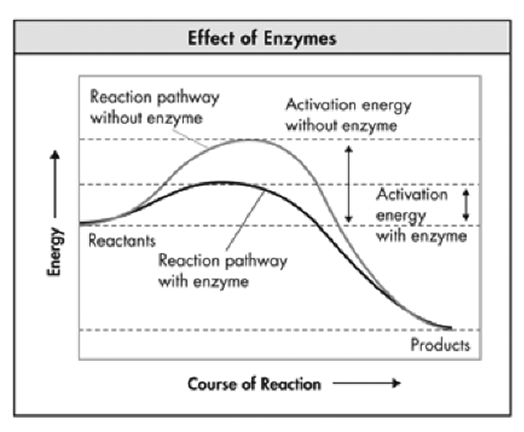
The graph shows how enzymes affect reactions in cells. Which statement best summarizes the information shown in the graph?
a)
Enzymes increase the energy of the reactants.
b)
Enzymes decrease the energy level of the products.
c)
Enzyme decrease the activation energy of the reaction.
d)
Enzymes reverse the direction of the reaction.
54.
Enzymes are...
a)
nucleic acids
b)
proteins
c)
lipids
d)
carbohydrates
55.
What is another name for enzymes?
a)
chemical catalysts
b)
microorganisms
c)
biological catalysts
d)
inorganic catalysts
56.

What body system has a lot of enzymes in it?

a)

reproductive

b)

integumentary

c)

digestive

d)

muscular

57.
What happens when enzymes are heated to a high temperature?
a)
The enzymes die.
b)
The shapes of the enzyme are altered denature
c)
The enzymes' amino acid sequence changes.
d)
The enzymes remain the same
58.
Used for short term (quick) energy.
a)
carbohydrates
b)
lipids
c)
proteins
d)
nucleic acids
59.
Provides long term energy and insulation,
a)
lipids
b)
carbohydrates
c)
nucleic acids
d)
proteins
60.
Contains DNA and RNA
a)
lipids
b)
carbohydrates
c)
proteins
d)
nucleic acids
61.
Contains a phosphate, sugar and nitrogen base
a)
nucleic acid
b)
lipid
c)
carbohydrate
d)
protein
62.
Building blocks of the body, hair , muscles etc.
a)
protein
b)
nucleic acid
c)
lipids
d)
carbohydrates
63.
Is found in the cell membrane as a bilayer. 
a)
lipids
b)
protein
c)
nucleic acid
d)
carbohydrate
64.
Identify the macromolecule in the picture
*GLUCOSE
a)
lipid
b)
protein
c)
nucleic acid
d)
carbohydrate
65.
Identify the macromolecule in the picture
* cholesterol and triglycerides
a)
carbohydrate
b)
protein
c)
lipid
d)
nucleic acid
66.
Identify the macromolecule in the picture
a)
carbohydrate
b)
lipid
c)
protein
d)
nucleic acid
67.
What type of transport is this?
a)
facilitated diffusion
b)
active transport
c)
diffusion
d)
osmosis
68.
Special proteins help move particles, but NO energy is needed. This is..
a)
facilitated diffusion
b)
exocytosis
c)
active transport
d)
equilibrium
69.
This process is known as ________ transport.
a)
passive
b)
active
c)
protein
d)
temporary
70.
This is a picture of the......
a)
cell membrane
b)
phospholipid bilayer
c)
plasma membrane
d)
all of these
71.

The majority of the cell membrane is made of which macromolecule?

a)

Phospholipids

b)

Carbs

c)

Proteins

d)

Nucleic acids

72.
What are the monomers of DNA?
a)
glycerols
b)
amino acids
c)
fatty acids
d)
nucleotides
73.
Proteins are composed of what smaller subunits?
a)
amino acids
b)
nucleic acids
c)
fatty acids
d)
nucleotides
74.
What is the monomer of a carbohydrate? 
a)
Monosaccharides
b)
Amino Acids
c)
Fatty Acids
d)
Nucleotides
75.
What are lipids composed of? 
a)
Monosaccharides
b)
Amino Acids
c)
Fatty Acids
d)
Nucleotides
76.

a single unit or molecule

a)

polymer

b)

dimer

c)

monomer

d)

macromolecule

77.

How many monomers are shown here?

a)

1

b)

3

c)

5

d)

7

78.
Which of the following properties of water enables it to move from the roots to the leaves of plants?
a)
Water expands as it freezes.
b)
Water is an excellent solvent.
c)
Water exhibits cohesive behavior.
d)
Water moderates temperature.
79.
What property of water allows it to be such a versatile solvent that it is often called the "universal solvent?"
a)
Purity
b)
Polarity and cohesion
c)
High heat capacity
d)
Expansion upon freezing
80.
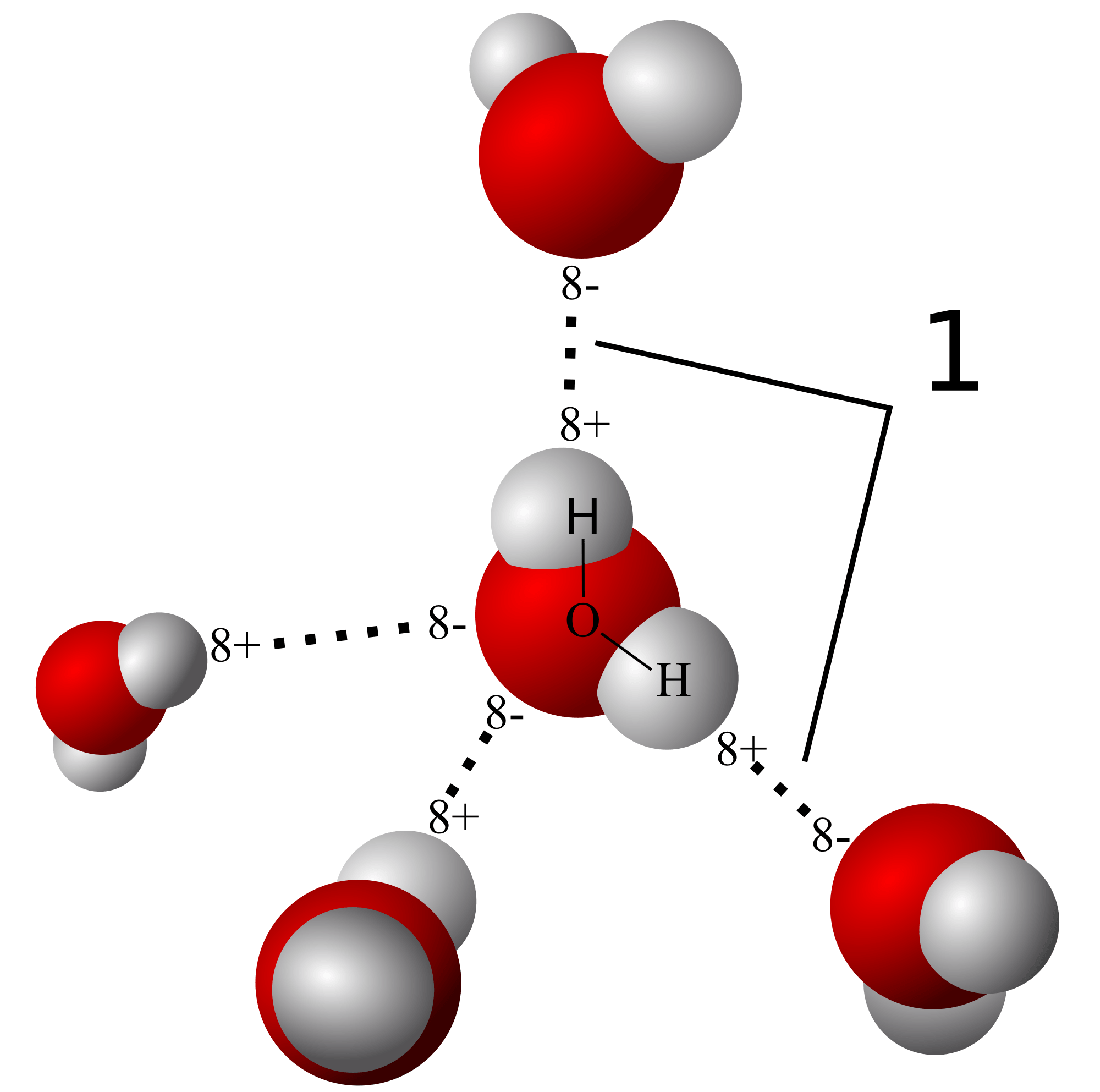
Attractions between water molecules are called
a)
Covalent bonds
b)
Ionic bonds
c)
Polar bonds
d)
Hydrogen bonds
81.
The attraction that causes water and other liquids to form drops on thin films is called ________________. This is also water’s ability to be attraction to other water molecules.
a)
adhesion
b)
capillary action
c)
cohesion
d)
surface tension
82.
What is a substance that is dissolved in another substance? 
a)
solution
b)
solute
c)
solvent
d)
compound
83.
Rainwater can dissolve chemicals that are on the ground.  This is because water ....
a)
has capillary action
b)
is the universal solvent
c)
evaporates
d)
is made of oxygen
84.
Water can dissolve many things so it is called the .....
a)
wonderful water
b)
cohesion
c)
liquid
d)
universal solvent
85.

Large bodies of water do not quickly fluctuate in temperature. Why?

a)

Water is a solvent.

b)

Water has a high heat capacity.

c)

Water acts as a buffer.

d)

Water is non-polar.

86.

This kingdom contains multicellular autotrophs.

a)

protist

b)

plant

c)

animal

d)

fungus

87.

These two kingdoms contain multicellular heterotrophs.

a)

fungus and plant

b)

plant and animal

c)

fungus and plant

d)

fungus and animals

88.

If an organism is unicellular but has a nucleus, then it belong to this kingdom.

a)

plant

b)

animal

c)

protist

d)

bacteria

89.

What is the main difference between members of the plant and fungi kingdoms?

a)

fungus are multicellular

b)

fungus are heterotrophs

c)

fungus are eukaryotic

d)

fungus have a cell wall

90.

This kingdom contains organisms that are eukaryotes. They can be both autotrophs and heterotrophs. Some have cell walls. Most are unicellular.

a)

plant

b)

animal

c)

protist

d)

bacteria

91.
A scientific name is made up of 2 parts; the first is the genus and the second is the ___
a)
family
b)
kingdom
c)
phylum
d)
species
92.
Which taxa contains the FEWEST amount of organisms, or is the most specific?
a)
genus
b)
family
c)
species
d)
order
93.
Which level of classification (taxon) comes after kingdom?
a)
order
b)
family
c)
phylum
d)
species
94.
Which domain do humans belong to?
a)
Bacteria
b)
Eukarya
c)
Archae
d)
Eubacteria
95.
The science of classifying organisms is ...
a)
biology
b)
ecology
c)
cladistics
d)
taxonomy
96.

(Taxonomy) Which level of classification is the most broad?

a)

Species

b)

Class

c)

Domain

d)

Kingdom

97.

(Taxonomy) Which level is the most specific?

a)

Domain

b)

Family

c)

Species

d)

Genus

98.

(Taxonomy) Which is the correct way to write an organisms scientific name?

a)

Ailuropoda Melanoleuca

b)

ailuropoda melanoleuca

c)

Ailuropoda melanoleuca

d)

ailuropoda Melanoleuca

99.

(Taxonomy) The scientific name for a lion is Panthera leo, what is the genus?

a)

lion

b)

Panthera

c)

leo

100.

(Taxonomy) What is hierarchy of classification from broad to most specific?

a)

Species, Genus, Family, Order, Class, Phylum, Kingdom, Domain

b)

Kingdom, Domain, Phylum, Family, Order, Class, Genus, Species

c)

Domain, Kingdom, Phylum, Class, Order, Family, Genus, Species

d)

Domain, Kingdom, Phylum, Order, Family, Class, Genus, Species

101.

(Taxonomy) How many kingdoms are there?

a)

2

b)

4

c)

6

d)

8