wayground logo

Free Printable Worksheets

Font size

S
M
L
XL
Worksheets

Unit 6: Electrostatics Review

Total questions: 83

Worksheet time: 2hrs 32mins

Name
Class
Date
1.

What happens when you touch a metal doorknob after rubbing your shoes on the carpet causing the carpet to become positively charged?

a)

The doorknob sends a burst of electric current into your body

b)

Millions of electrons go from your finger into the doorknob

c)

The doorknob sends millions of electrons into your finger

d)

our finger becomes negatively charged

2.
Which of the following is caused by static electricity?
a)
a stove getting hot when it is turned on
b)
a magnet being attracted to a refrigerator
c)
a lightning strike during a storm
d)
a light bulb coming on when a switch is turned on
3.

Why can you get a shock if you touch a metal doorknob after walking across a wool carpet(which is negatively charged now)?

a)

You have gained electrons from the doorknob

b)

You have gained neutrons from the doorknob

c)

You have lost electrons to the doorknob

d)

You have gained protons from the doorknob

4.
An atom that has more protons than electrons would have what charge?
a)
Positive
b)
Negative
c)
Neutral (Zero)
5.
An objective with a negative charge would _______ an object with a neutral charge
a)
Attract
b)
Repel
c)
Do nothing
6.

What direction are the electric field lines around a proton?

a)

towards the charge

b)

away from the charge

7.
Which of the following is not a good conductor of electricity?
a)
copper
b)
silver
c)
Glass
d)
aluminum
8.
Which of the following is not a good insulator?
a)
Copper
b)
Glass
c)
rubber
d)
wool
9.
The law of conservation of charge states that...
a)
all atoms have more protons than electrons
b)
only protons can be rubbed off of an atom
c)
charge cannot be created or destroyed
d)
charge cannot be transferred 
10.
assume a rubber rod is rubbed against a rabbit fur and gains 5 electrons.  which of the following is true?
a)
The fur lost 5 electrons
b)
the fur gained 5 electrons
c)
the fur gained 5 protons
d)
The fur lost 2 electrons
11.
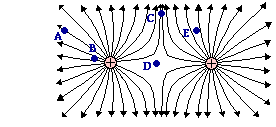
Which of the following labeled points is in the region with the strongest force of electric charge
a)
A
b)
B
c)
C
d)
D
12.
Two like charges
a)
 neutralize each other.
b)
repel each other. 
c)
must be neutrons. 
d)
attract each other.
13.
The charge of an electron is 
a)
positive. 
b)
negative. 
c)
Electrons have no charge
14.
An atom loses an electron.  What type of charge does it have now?
a)
positive
b)
negative
15.
An atom gains an electron.  What type of charge does it have now?
a)
positive
b)
negative
c)
No charge
16.
What direction are the electric field lines around an electron?
a)
towards the charge
b)
away from the charge
17.
What does it mean when the electric field lines are close together?
a)
the field is positive
b)
the field is negative
c)
The field is strong
d)
the field is weak
18.
Charged objects are not attracted to neutral objects
a)
True
b)
False
19.
When a balloon is rubbed on clothes it acquires a charge by ___________
a)
Induction
b)
reduction
c)
friction 
d)
concuction
20.
Where do electrons go when you rub a balloon on your hair?
a)
Onto the balloon
b)
Into your hair
c)
Nowhere
21.
After you rub a balloon on your hair, what charge does the balloon have?
a)
Positive
b)
Negative
c)
Neutral
22.
After you rub a balloon on your hair, what charge does your hair have?
a)
Positive
b)
Negative
c)
Neutral
23.

Sphere A carries a charge of +8 coulombs, and Sphere B carries a charge of -6 coulombs. If the two are touched together and then separated, what will the charge on sphere A be?

a)

+1

b)

-1

c)

+2

d)

-2

24.
When a rod is brought near a neutral electroscope, the leaves diverge.  Which statement best describes the charge on the rod?
a)
It must be positive.
b)
It must be negative.
c)
It may be positive or negative.
d)
It may be neutral.
25.
If an object has an excess charge of -8.0x10^-19C, how many excess electrons does the object have?
a)
2
b)
3
c)
4
d)
5
26.
If a negative rod is brought near a neutral electroscope, how will the electrons on the electroscope move?
a)
Toward the rod
b)
Away from the rod
c)
Onto the rod
d)
Away from the leaves
27.
Balloon A simultaneously touches Balloons B and C.  Balloon A started with a charge of -4e, Balloon B started with a charge of +2e, and Balloon C started with a charge of +14e.  What will be the new charge on Balloon A after they were all allowed to touch?
a)
+12e
b)
+6e
c)
+8e
d)
+4e
28.
When a plastic rod is rubbed with wool, why does the wool acquire a positive charge?
a)
Protons are transferred from the rod to the wool.
b)
Protons are transferred from the wool to the rod.
c)
Electrons are transferred from the rod to the wool.
d)
Electrons are transferred from the wool to the rod.
29.
A negatively charged rod is brought near a neutral electroscope, causing the leaves to diverge.  This is an example of....
a)
Conduction
b)
Induction
c)
Insulation
d)
Friction
30.
Charging by friction:Rubbing== Charging by contact:_____
a)
rubbing
b)
touching
c)
no contact
31.
A region around a charged object where electric force is exerted where object's electric force is exerted on other charged objects in an electric 
a)
field 
b)
outlet
c)
socket
d)
power plant
32.
Charges can redistribute themselves by friction, conduction,polarization, or........
a)
reduction 
b)
production 
c)
induction 
d)
super conduction 
33.
Lighting is an example of a static ___________.
a)
field 
b)
discharge 
c)
force
d)
polarization 
34.
Electrons do not jump from one object to another in polarization or ____________. 
a)
induction 
b)
conduction 
c)
friction 
d)
fields  
35.
What is the overall charge on this balloon? (They are the same so look at either one!)
a)
+3
b)
-6
c)
+6
d)
-3
36.
What is the name of this device that is used to detect charges?
a)
beaker
b)
electroscope
c)
van de graff generator
d)
chargometer
37.
Compared to insulators, metals are better conductors of electricity because metals contain more free
a)
protons
b)
electrons
c)
positive ions
d)
negative ions
38.
The accumulation of excess electric charge on an object is called
a)
Static electricity 
b)
Electric discharge
c)
Resistance
d)
Circuit 
39.
A material in which electrons are able to move easily
a)
Circuit
b)
Insulator 
c)
Resistance 
d)
Conductor 
40.

The process of transferring charge by touching one object to another object

a)

Induction

b)

Conduction

c)

Friction

d)

Conductor

41.
What is the unit of electric charge?
a)
Volts
b)
Amps
c)
Coulombs
d)
Ohms
42.
Protons are...
a)
positive
b)
negative
c)
neutral
43.
Protons move around and make materials more positive
a)
True 
b)
False
44.
What do you call the process of charging a conductor by bringing it near another charged object?
a)
Induction
b)
Polarization
c)
Neutralization
d)
Conduction
45.
Assume a rubber rod is rubbed against a rabbit fur and gains 5 electrons. Which of the following is true?
a)
The fur lost 5 electrons.
b)
The fur gained 5 electrons.
c)
The fur gained 5 protons.
d)
The fur lost 2 electrons.
46.
What variables affect the magnitude of the electric force between two objects with charge?
a)
charge of the first object
b)
charge of the second object
c)
distance between the charges
d)
all of the answers
47.
How is the electric force between two charges affected when both of the charges are doubled?
a)
Four times as much.
b)
Two times as much.
c)
Half as much.
d)
One-quarter as much.
48.
What materials transfer charge most easily?
a)
Conductors
b)
Insulators
49.
How is the electric force between two charges affected when the distance between the charges is halved?
a)
Four times as much.
b)
Two times as much.
c)
Half as much.
d)
One-quarter as much.
50.
How is the electric force between two charges affected when the distance between the charges is doubled?
a)
Four times as much.
b)
Two times as much.
c)
Half as much.
d)
One-quarter as much.
51.
Two point charges initially 4 cm apart are moved to a distance of 12 cm apart.  By what factor does the resulting electric force between them change?
a)
8
b)
1/3
c)
1/9
d)
9
52.
Find the magnitude of the force between two charges of 1.0 C each which are 1.0 meter apart?
a)
9E-9 N
b)
9E9 N
c)
1.1E10 N
d)
1.1E-10 N
53.
What is the unit for Electric Force?
a)
Newton
b)
Couloumb
c)
Newtons/Couloumb
d)
Nano
54.
When drawing electric field lines more lines indicates a ____________ electric field
a)
weaker
b)
stronger
c)
neutral
55.
Calculate the force exerted between two charged objects separated by a distance of 0.6 m. One object has a charge of -5 C and the other has a charge of +2.0 C.
a)
-1.5E-11 N
b)
2.5E-11 N
c)
-2.5E11 N
d)
-7.5E-10 N
56.
A 2 C charge experiences a force of 40 N when put at a certain location in space.  The electric field at that location is..
a)
2 N/C
b)
20 N/C
c)
80 N/C
d)
42 N/C
57.
The electric field in a certain region of space is 30 N/C.  What is the force on a 2 C charge in that space?
a)
32 N
b)
15 N
c)
60 N
d)
45 N
58.
When you draw the direction of the electric field you always use a ___________ test charge
a)
positive
b)
negative
c)
neutral
d)
radioactive
59.
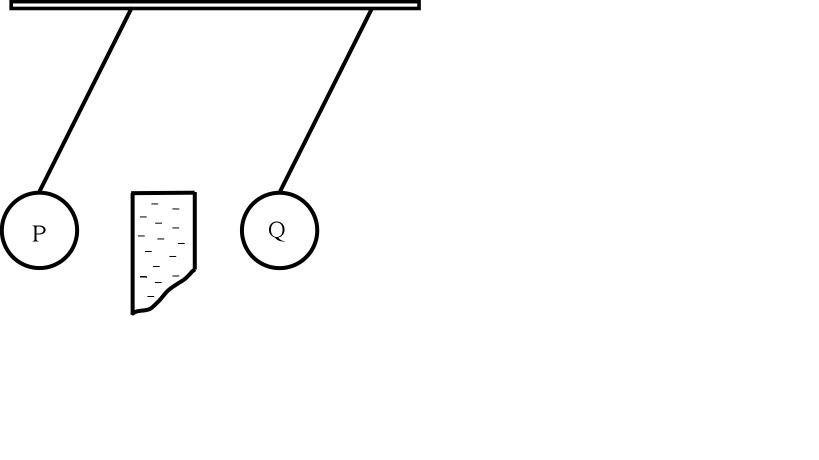
The diagram shows two metal balls, P and Q, hanging from the nylon threads. P is repelled by and Q is attracted to a negatively charged rod.
Which statement is true?

a)
P is negatively charged
b)
Q is negatively charged
c)
P is uncharged
d)
P is positively charged
60.
Lightning bolts occur between
a)
clouds and the ground
b)
clouds
c)
both of the above
61.
When a charged cloud passes overhead, the ground below is charged by
a)
deduction
b)
polarization
c)
electrification
d)
induction
62.
The atomic nuclei of almost all elements consists of
a)
protons
b)
protons and electrons
c)
protons and neutrons
d)
only neutrons
63.
When the distance between two charges is halved, the electrical force between the charges
a)
quadruples
b)
reduces to one fourth
c)
halves
d)
doubles
64.
Coulomb's law says that the force between any two charges depends
a)
directly on the size of the charges
b)
inversely on the square of the distance between the charges
c)
both A and B
d)
none of the above
65.
Two particles opposite in charge are held near each other and released.  As they move the force on each particle
a)
Increases
b)
decreases
c)
stays the same
d)
t
66.
The SI unit of charge is
a)
the ampere
b)
the newton
c)
the coulomb
d)
the joule
67.
Good insulators
a)
have electrons free to move around
b)
have tightly bound electrons
c)
have electrons do not move at all
68.
Good conductors 
a)
have electrons free to move around
b)
have electrons tightly bound
c)
do not have electrons
69.
During a lightning storm, your car is a reasonably good place to be.  Why?
a)
The rubber tires insulate your car from the ground.
b)
Lightning only hits older VW vans.
c)
You are enclosed in a conductor so charge will go around you.
d)
Actually, a car is a really bad place to be because of all of the conductors around you.
70.
What is the process of connecting an object to Earth with a conductor called?
a)
charging
b)
draining
c)
grounding
d)
induction
71.
In a neutral atom, the number of electrons is equal to the number of _______.
a)
Neutrons
b)
Orbits
c)
Protons
d)
subatomic particles
72.
When you pull a cotton sweater off your skin, electrons are transferred from the ___________________ (cotton, skin) to the __________________ (cotton, skin). As a result, your body acquires a ___________ (+ , -) charge and the cotton sweater acquires a ___________ (+ , -) charge.
a)
skin, cotton, +, -
b)
cotton, skin, +, -
c)
skin , cotton, -, +
d)
cotton, skin, -, +
73.
Which part of the atom moves to create electricity?
a)
Proton
b)
Neutron
c)
Electron
74.
A neutral electroscope is charged by bringing a negatively charged rod next to the top of the electroscope
a)
A
b)
B
c)
C
d)
D
75.
Consider the electric field lines shown in the diagram below. From the diagram, it is apparent that object A is ____ and object B is ____.
a)
+,+
b)
+,-
c)
-,+
d)
-,-
76.
A region around charged objects where the object´s electric force is exerted on other charged objects is an electric: 
a)
Field
b)
Outlet
c)
Socket
d)
Power plant 
77.
Which type of charges do these balloons have?
a)
like charges
b)
opposite charges
78.
What type of charge do these balloons have?
a)
like charges
b)
opposite charges
79.
If two balloons have the same charge, what will happen if you place them close to each other?
a)
Nothing
b)
They will be attracted
c)
They will pop
d)
They will push each other away.
80.
The process in which a charged object is brought NEAR but does not touch another object is called?
a)
Conduction
b)
Friction
c)
Induction
d)
Polarization
81.
When a glass rod is rubbed with silk and the glass rod becomes positively charged, what happens to the electrons?
a)
they are removed from the rod
b)
they are added to the rod
82.
What do you call the process of charging a conductor by bringing it near another charged object?
a)
induction
b)
polarization
c)
neutralization
d)
conduction
83.
If an object has an excess of 18 electrons, what is the charge on the object?
a)
1.28x10^-18C
b)
2.88x10^-18C
c)
14.4x10^-19C
d)
6.4x10^-19C