
 Worksheets
FINAL Physical Science FINAL Review
Total questions: 55
Worksheet time: 1hrs 22mins
Name
Class
Date
1.
How much does a 125.0kg object weigh on Earth?
a)
784.0 N
b)
12.76 N
c)
1113 N
d)
1225 N
2.
Brakes stop/slow a car, shoes/pad press against a disk/drum. What type of frictional force?
a)
Fluid
b)
Rolling
c)
Sliding
d)
Static
3.

What phase change occurs during segment IV of the graph?
a)
solid to liquid
b)
solid to gas
c)
liquid to gas
d)
liquid to solid
4.

Which element is represented by the diagram?
a)
Magnesium
b)
Sodium
c)
Titanium
d)
Vanadium
5.

Which element could have the dot diagram shown?
a)
carbon
b)
helium
c)
magnesium
d)
potassium
6.
How many valence electrons does a phosphorus atom contain?
a)
5
b)
7
c)
9
d)
15
7.
What is the correct chemical formula for magnesium phosphate?
a)
Mg3P
b)
MgPO4
c)
Mg3PO4
d)
Mg3(PO4)2
8.
Which of the following is a synthesis reaction?
a)
2H2O --> 2H2 + O2
b)
Mg + 2HCl --> MgCl2 + H2
c)
2Cu + O2 --> 2CuO
d)
HCl + NaOH --> NaCl + H2O
9.
Which pH would indicate the most acidic substance?
a)
2
b)
4
c)
10
d)
14
10.
Which of the following occurs as a pot of soup on a hot burner begins to boil?
a)
thermal energy is not transferred
b)
thermal energy is transferred from burner to air to soup
c)
thermal energy is transferred from burner to pot to soup
d)
thermal energy is transferred from soup to burner
11.
A force of 50N is applied to a rock for one hour. How much work is done if it does not move?
a)
3000J
b)
400J
c)
50J
d)
0J
12.
How much Force is used if 25J of energy is used to move a table 2.5m across a frictionless surface?
a)
0N
b)
10N
c)
25J
d)
30N
13.
How much power is required to lift a 2.00kg object 5.00m in 4.50seconds?
a)
0.45 watts
b)
2.22 watts
c)
21.8 watts
d)
45.0 watts
14.
What is the effect on frequency of a wave when the wavelength is doubled?
a)
frequency is also doubled
b)
frequency is reduced to 1/4
c)
frequency remains the same
d)
frequency is reduced to 1/2
15.
Which type of wave can travel in a vacuum?
a)
Sound
b)
Mechanical
c)
Surface
d)
Electromagnetic
16.
What is the name of Na2CO3?
a)
sodium(II) carbon oxide
b)
sodium carbonate
c)
disodium carbonate
d)
sodium carbon oxide
17.
Which combinations of elements will form an ionic bond?
a)
carbon and hydrogen
b)
chlorine and magnesium
c)
chlorine and fluorine
d)
hydrogen and oxygen
18.

High frequency waves have _________ wavelengths.
a)
varying
b)
long
c)
the same
d)
short
19.

Which type of EM wave has the highest frequency?
a)
gamma ray
b)
radio waves
c)
microwaves
d)
infrared rays
20.
Which of the following is in order from highest frequency to lowest frequency?
a)
A. Gamma Rays – Infrared – Radiowaves
b)
B. Microwave – Radiowaves – UV Light
c)
C. Visible Light – Infrared – UV Light
d)
D. X-Ray – Gamma Ray – Visible Light
21.

Warm air rises and the cool air sinks demonstrates this type of heat transfer.
a)
conduction
b)
convection
c)
radiation
d)
Insolation
22.
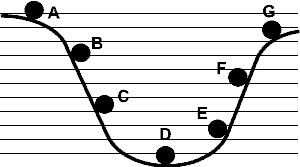
Which point has the most potential energy?
a)
G
b)
f
c)
b
d)
a
23.

When a pendulum swings, at which point is kinetic energy highest?
a)
1
b)
2
c)
3
d)
4
24.

At which point is kinetic energy greatest?
a)
W
b)
X
c)
Y
d)
Z
25.
Energy is the ability _____________.
a)
to do work
b)
to power things
c)
to move objects
d)
to turn on a light
26.
What is the unit of measurement for Power?
a)
Joules
b)
Newtons
c)
Watts
d)
Meters
27.
A person weighing 600 N gets on an elevator. The elevator lifts the person 6 m in 10 seconds. How much power was used?
a)
360 W
b)
60 W
c)
3600 W
d)
600 W
28.

Which item below is the most dense?
a)
A. Ping Pong Ball
b)
B. Lamp Oil
c)
C. Bolt
d)
D. Corn Syrup
29.
Name the type of radioactive particle that can be stopped by a sheet of paper.
a)
alpha
b)
beta
c)
gamma
d)
lambda
30.
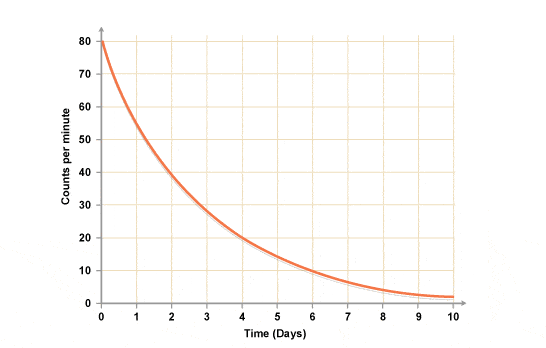
what's the half life of this substance?
a)
1 day
b)
2 days
c)
3 days
d)
4 days
31.
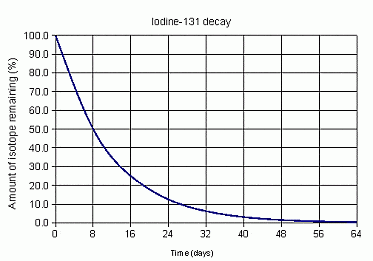
What is the half-life of iodine-131?
a)
32 days
b)
8 days
c)
16 days
d)
24 days
32.

What percent of carbon-14 would be left after 11,460 years?
a)
100%
b)
75%
c)
50%
d)
25%
33.

What percent of carbon-14 would be left after 5730 years?
a)
100%
b)
75%
c)
50%
d)
25%
34.
Higher temperature means faster moving molecules
a)
True
b)
False
35.

This is an example of a _______ circuit
a)
open
b)
series
c)
parallel
d)
square
36.

This is an example of a ______ circuit
a)
Series
b)
Parallel
c)
Open
d)
Dihexihedral
37.

In a parallel circuit if one of the light bulbs burns out the rest _________.
a)
stop the flow of electricity
b)
can still light up
c)
will go out
d)
of the light bulbs burn out also
38.

Where is a magnetic field the strongest?
a)
at both poles
b)
in the middle
c)
at the south seeking pole
d)
at the north seeking pole
39.

What will happen to the other bulbs in the circuit if one bulb goes out?
a)
The other bulbs will go out
b)
The other bulbs will get brighter
c)
The other bulbs will get dimmer
d)
They will flash on and off
40.

The charge of an electron is:
a)
Positive.
b)
Negative.
c)
Electrons have no charge
41.

This is an example of...
a)
attraction
b)
repulsion
42.
Force is ______?
a)
magnets
b)
static electricity
c)
a push or pull
d)
Star Wars
43.

The atoms along the staircase are called
a)
metals
b)
nonmetals
c)
metalloids
d)
noble gases
44.
Which of these is NOT a halogen?
a)
fluorine
b)
bromine
c)
carbon
d)
astatine
45.
Rows on the period table are called _____ while columns are called _____.
a)
groups, families
b)
groups, periods
c)
periods, groups
d)
families, groups
46.
Where on the Periodic Table are metals located?
a)
Right
b)
Left
c)
Scattered between both
d)
Metals don't exist
47.

The blue elements are called
a)
metals
b)
nonmetals
c)
metalloids
d)
noble gases
48.
How many valence electrons does Iodine have?
a)
6
b)
16
c)
7
d)
17
49.
How many valence electrons does sodium have?
a)
1
b)
2
c)
3
d)
4
50.
What is the left part of a chemical equation called?
H2 + O → H2O
H2 + O → H2O
a)
Reactants
b)
Products
c)
Yields
d)
Chemical Equation
51.
Mg + N2 →Mg3N2
a)
Synthesis (combination)
b)
Decomposition
c)
Single replacement
d)
Combustion
52.
3Ca + 2AlCl3 --> 3CaCl2 + 2Al
a)
Synthesis
b)
Decomposition
c)
Single diplacement
d)
Double displacement
53.

A subscript tells you...
a)
the # of atoms in the entire equation
b)
the # of elements in the equation
c)
the # atoms of the element it sits behind
d)
the # of compounds present
54.
How many ATOMS of Oxygen are in 3Fe2O3
a)
2
b)
3
c)
6
d)
9
55.
How many atoms of aluminum are on each side of the following equation: 4Al + 3O2 --> 2Al2 O3
a)
2
b)
6
c)
1
d)
4
100 %

