
 Worksheets
Ch 7 Evolution
Total questions: 65
Worksheet time: 3hrs 30mins
Name
Class
Date
1.

Charles Darwin came up with this theory
a)
Natural Selection
b)
Mutation
2.

To adjust to a changing environment
a)
Mutation
b)
Adapt
3.

Darwin wrote that organisms with traits that are best suited to the environment will ________________
a)
increase in number
b)
become extinct
4.

Another word for adapt is ____________.
a)
change
b)
create
5.
Which of the following is NOT an example of natural selection?
a)
People selectively breeding hamsters.
b)
Insect populations developing resistance to certain pesticides.
c)
Bacteria becoming resistant to antibiotics.
d)
Male birds of certain species developing colorful feathers to attract female mates.
6.
What characteristic did Darwin observe about the finches on the Galapagos Islands?
a)
Their feathers
b)
Genotypes
c)
Their beaks
d)
Their body sizes
7.
Which term refers to the process by which individuals that are better suited to the environment survive and reproduce therefore passing down their genes to their offspring?
a)
Evolution
b)
Variation
c)
Adaptation
d)
Natural Selection
8.

Which species’ DNA is most similar to the DNA of the toothed whale?
a)
Hippopotamus
b)
Baleen Whale
c)
Grazing Mammals
d)
Camels
9.
The environment around Manchester, England, changed during the Industrial Revolution. How did this change affect peppered moths living in the area?
a)
Natural selection favored moths with dark wings because predators could not see them on the soot-colored trees.
b)
Natural selection favored moths with white wings that were easy for predators to see.
c)
Natural selection favored moths with white wings because predators could not see them on the soot-colored trees.
d)
Natural selection caused moths with white wings to become extinct.
10.
When an organism completely dies out, it is called.....
a)
Adaption
b)
Extinction
c)
Fossilization
d)
Mutation
11.
The separation of a group of individuals from the rest of the population is referred to as
a)
genetic drift
b)
natural selection
c)
geographic isolation
d)
survival of the fittest
12.
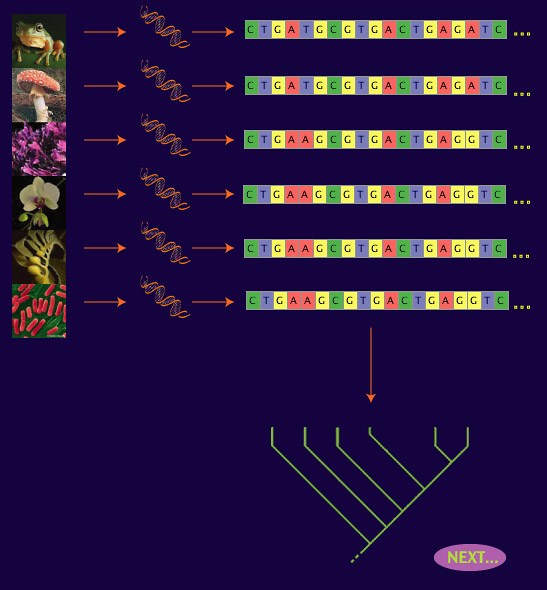
Two organisms that are closely related would have
a)
very similar DNA sequence
b)
exactly the same DNA sequences
c)
no proteins in common
d)
completely different DNA sequence
13.

Change over time...
a)
Evolution
b)
Nucleotide
14.
The white feathers of a snowy owl allow it to blend in with its environment during the winter months (snow). This is an example of ________________
a)
Species
b)
Environmental Change
c)
Adaptation
d)
Variation
15.
Darwin referred to this as survival of the fittest. Over time, it results in changes in the inherited characteristics of a population because organisms with adaptations that make them fit for their environment will survive and reproduce better than those without favorable traits.
a)
Natural Selection
b)
Genetic Variation
c)
Survival of the Fittest
16.
Genetic differences between organisms of the same species
a)
Variation
b)
Adaptation
c)
Behavior
d)
Environment
17.
What is the advantage of having different shaped beaks?
a)
To look different from other species.
b)
To be able to eat the food readily available in the environment.
c)
To protect itself against predators.
d)
To protect itself against prey.
18.
Remains of ancient organisms are called
a)
Extinctions
b)
Fossils
c)
Mutations
d)
Variations
19.
Which of the following is NOT a factor that affects the process of natural selection?
a)
Overpopulation
b)
Fossils
c)
Competition
d)
Variations
20.
A well-tested concept that explains a wide range of observations is called a(an):
a)
hypothesis
b)
experiment
c)
cause and effect
d)
scientific theory
21.
Many of the animals that live in the northernmost region of the Northern Hemisphere have white fur. How does having white fur make these animals more likely to survive in an arctic environment.
a)
White fur repels insects and parasites that live in the Arctic
b)
White fur absorbs more sunlight to help them keep warm.
c)
White fur provides less water resistance to make them swim faster
d)
White fur helps them to blend in with their environment
22.

A disease is introduced that kills off a large portion of the blueberry bushes,. Which beak size and shape will future generations of the birds most likely have?
a)
Large and round
b)
large and oval
c)
medium and round
d)
medium and oval
23.
How do scientists use layers of sediment to help them learn about fossils?
a)
They compare the soil layers to determine the relative age of the fossils?
b)
They study the soil around the fossil o determine the species
c)
the test the soil layers to learn the age of the fossilized organism when it died
24.
Sexual reproduction may lead genetic mutation. Some mutations are harmful and some mutations are helpful. If an animal develop a mutation that helped it to defend itself really well, which of the following would happen?
a)
That trait (characteristic) would be represented in more individuals in successive generations.
b)
That characteristic would be passed on the ALL of the offspring
c)
That characteristic would disappear from the species in a few generations
25.
Fisherman at a local beach often catch spotted trout. The fisherman usually keep the large fish and throw back he smaller fish. Overtime, natural selection will most likely act on the population of trout and cause the population to be dominated by
a)
small fast growing fish
b)
large slow growing fish
c)
small slow growing fish
d)
large fast growing fish
26.
Many species of organisms have similar structures.
a)
true
b)
false
27.
A remnant or trace of an organism from the past is called a _______.
a)
Ancestor
b)
Skeleton
c)
Fossil
d)
Imprints
28.

The diagram shows fossils in different rock layers. Which of these statements about the age of these fossils is most likely correct?
a)
Fossil A and C are the same age
b)
Fossil B is older than fossil C
c)
Fossils A is older than fossil B
d)
Fossil D is older than fossil C
29.
What is used to estimate age in sedimentary rock?
a)
relative dating
b)
evolution
c)
embryology
30.

What is embryology?
a)
the study of natural selection
b)
the study of fossils
c)
the study of embryos (babies before they're born)
31.
What is Natural Selection?
a)
change over time
b)
survival of the fittest
c)
a trait
32.
What is the word for differences between individuals in a species? ex. hair color
a)
Natural selection
b)
Adaptation
c)
Variation
33.
What are Homologous structures?
a)
body parts (structures) that are similar
b)
Traits that have nothing in common
c)
a body part in a whale
34.
What does the prefix "HOMO" mean?
a)
different
b)
same
c)
cell
35.
What is a group of organisms that have similar characteristics that reproduce among each other?
a)
variation
b)
population
c)
artificial selection
36.
What is the word for "CHANGE OVER TIME"?
a)
Natural Selection
b)
Adaptation
c)
Evolution
37.

What is a body part that no longer has a purpose?
a)
Vestigial structures
b)
homologous structures
c)
Heterozygous structures
38.
Similarities in the structures of two different species provide evidence that the species evolved from a common ancestor. This type of evidence includes similar structures that have different functions. Which of the following pairs of features have a similar structure but have a different function in each organism?
a)
a dolphin fin and a shark fin
b)
human fingernails and monkey fingernails
c)
the front leg of a cat and the wing of a bat
d)
the wing of a bumble bee and the wing of
a bird
a bird
39.
Anna found a bone while working on an excavation. She identified it as a dinosaur bone. What event had to happen for this fossilized bone to exist?
a)
The dinosaur’s soft tissues were replaced with stone.
b)
The dinosaur’s body was exposed to the air for a long time.
c)
The dinosaur’s body was submerged in seawater for a long time.
d)
Minerals seeped into the dinosaur’s bones before they completely decomposed.
40.

The diagram below illustrates changes over time in a population of foxes in the wild. What process is illustrated in the diagram?
a)
extinction
b)
overproduction
c)
natural selection
d)
artificial selection
41.

The figure below shows two spotted salamanders. They are the same species of salamander, but they live in different areas. Which of these terms is used to describe the difference between them?
a)
overpopulation
b)
population
c)
extinction
d)
variation
42.

Jonah’s science class is examining different rocks. Jonah finds the rock shown below. What can Jonah see on this rock?
a)
DNA
b)
fossil
c)
organism that died recently
d)
genetic evidence for evolution
43.
William discovered that two modern-day species have very similar DNA. He concludes that the two species are closely related. What type of evidence did William most likely use to reach his conclusion?
a)
fossil evidence
b)
genetic evidence
c)
structural evidence
d)
evidence from developmental patterns
44.
Tara is comparing the embryos of parrotfish and salamanders. Although the adult organisms look very different, the embryos follow similar developmental pathways. What does this suggest?
a)
that parrotfish and salamanders use their organs for different functions
b)
that parrotfish and salamanders likely share a common ancestor
c)
that parrotfish and salamanders are found in the fossil record
d)
that parrotfish and salamanders have the same genetic makeup
45.
Which of these descriptions is an example of an unused body structure called a vestigial trait?
a)
a bat’s wing that enables it to fly
b)
the tiny leg bones found in snakes that have no legs
c)
the front legs of a dog that supports its weight as it walks and runs
d)
the tentacles of an octopus that aid it in movement and catching prey
46.
Which of these answers correctly pairs a scientific discovery with the type of evidence for evolution that it represents?
a)
DNA comparison, embryological evidence
b)
fossilized bones, genetic evidence
c)
unused hind limbs, structural evidence
d)
developmental patterns, fossil evidence
47.
Which of these answers best describes the relationship between a human’s forearm and a bat’s wing?
a)
similar physical structures with similar functions
b)
similar physical structures with different functions
c)
different physical structures with similar functions
d)
different physical structures with different functions
48.
While exploring a rock formation, Hiroto finds a rock that has footprints pressed into it. A geologist tells Hiroto that the rock is millions of years old. Which of these statements is correct about
Hiroto’s find?
Hiroto’s find?
a)
It is not a fossil, because footprints are not fossils.
b)
It is not a fossil, because only whole organisms are fossils.
c)
It is a fossil only if Hiroto finds actual parts of the organism in rocks nearby.
d)
It is a fossil because footprints of organisms from million of years ago are considered to be fossils.
49.
A scientist described two modern-day species as sharing a common ancestor. What does it mean when two species share a common ancestor?
a)
It means that the two species are actually the same species.
b)
It means that one of the species evolved from other species.
c)
It means that both species evolved from one species that lived in the past.
d)
It means that the two species share all the same traits.
50.
When farmers want two desirable traits in cows, they often breed individuals that have those traits in the hopes that the offspring will have both desirable traits. What is this practice called?
a)
variation
b)
adaptation
c)
artificial selection
d)
natural selection
51.
Polar bears live in the Arctic. Ice in the Arctic is melting rapidly, reducing the range in which the polar bear can live. If polar bears do not have adaptations that allow them to survive these changes, what may happen to the polar bear?
a)
They may overpopulate.
b)
They may become extinct.
c)
They may change the environment.
d)
They may become another species.
52.

Some organisms that share a common ancestor have features that have different functions, but similar structures. These are known as
a)
vestigial structures
b)
analogous structures
c)
homologous structures
d)
fossil structures
53.
What is suggested by the similarity of early embryos of different species of vertebrates?
a)
no evolutionary relationships between the groups
b)
recent common ancestry
c)
similar environments in the past
d)
evolution from a distant common ancestor
54.

The diagram above shows an embryo of different vertebrates at different stages of development. Which field of study would support the similarities in development as evidence for evolution?
a)
comparative biochemistry
b)
paleontology
c)
comparative biogeography
d)
comparative embryology
55.
Structures similar in different organisms because they evolved in similar environments
a)
analogous structure
b)
homologous structure
c)
vestigial structure
56.
The total genes in a population
a)
gene pool
b)
taxonomy
c)
microevolution
57.
Evolution on a large scale; across several taxa of organisms
a)
macroevolution
b)
microevolution
c)
speciation
58.
Evolution on a small scale; within a species or small group
a)
macroevolution
b)
microevolution
c)
speciation
59.
What is microevolution?
a)
evolution occurring for very tiny organisms
b)
evolution occurring over very long times
c)
evolution occurring for very large animals
d)
evolution occurring in a very short amount of time
60.
Traits within a population may vary, but are the organisms still the same species
a)
Yes
b)
No
c)
I don't know
d)
All of these
61.
What is the change in the gene pool of a population?
a)
Macroevolution
b)
Microevolution
c)
Population evolution
d)
Gene pool population research-thingy
62.
Who can can contribute to the gene pool?
a)
Teddy grahams
b)
Only those that cannot reproduce
c)
Gene pool contributors
d)
Only organisms that can reproduce
63.
What does natural selection work on?
a)
Genes that are in the individual
b)
Genes that aren't expressed
c)
Genes in the population
d)
Genes that are expressed
64.
What is gene flow?
a)
Movement of genes within a population
b)
Movement of jeans from one population to another
c)
Movement of genes from one population to another
d)
Movement of genes outside a population
65.
Where are the effects of genetic drift more drastic?
a)
Large populations
b)
Small populations
c)
The United States
d)
Asia
100 %

