
 Worksheets
CA 5 review
Total questions: 88
Worksheet time: 2hrs 28mins
Name
Class
Date
1.

Which of the following best describes a DNA molecule?
a)
double helix
b)
contains ribose
c)
made of amino acids
d)
contains uracil
2.
Adenine bonds with ______________.
a)
Guanine
b)
Thymine
c)
Cytosine
d)
Adenine
3.
Guanine bonds with ______________.
a)
Adenine
b)
Guanine
c)
Cytosine
d)
Thymine
4.
Why is DNA important?
a)
It is very small and very complicated.
b)
It's in everything.
c)
It serves as the blueprint for traits of all living things.
d)
We eat it every day for energy.
5.

Name this structure
a)
double helix
b)
nucelotide
c)
amino acid
d)
protein
6.

What are the 4 nitrogen bases?
a)
adenine, thymine, cytoplasm, and guanine
b)
adenine, thymine cytosine, and guanine
c)
adenine, thymine, cytosine, and gylcerol
d)
adenine, thymine, cytosine, and glucose
7.

Which 2 molecules forms the sides (backbone) of the DNA ladder?
a)
ribose (sugar) and nitrogen bases
b)
ribose (sugar) and phosphate
c)
deoxyribose (sugar) and nitrogen bases
d)
deoxyribose (sugar) and phosphate
8.

Which organelle is DNA usually found in?
a)
mitochondrian
b)
cell membrane
c)
chloroplast
d)
nucleus
9.
Which shows the correct complementary base pairing for DNA?
a)
C-A, T-G
b)
A-G, C-T
c)
C-G, U-A
d)
T-A, G-C
10.
Which shows the correct complementary base pairing for RNA?
a)
C-A, T-G
b)
A-G, C-T
c)
C-G, U-A
d)
T-A, G-C
11.
Which of the following units are repeatedly joined together to form a strand of DNA?
a)
amino acids
b)
nucleotides
c)
chromosomes
d)
protiens
12.
What is the correct complementary strand for the following DNA?ATCGAG
a)
UAGCUC
b)
TAGCTC
13.

What determines the code, or information, of a DNA molecule?
a)
the shape (structure) of the nitrogen bases
b)
the order (sequence) of the nitrogen bases
c)
the color of the nitrogen bases
d)
the frequency (number) of nitrogen bases
14.

DNA codes for...
a)
bases
b)
proteins
c)
amino acids
d)
phosphates
15.
a change in the nucelotide-base sequence of a gene or DNA molecule
a)
nucleotide
b)
DNA
c)
RNA
d)
mutation
16.

Nucleotides are made up of a sugar, phosphate, and..?
a)
nitrogenous base
b)
amino acid base
c)
protein base
d)
hydrogen base
17.

The parts of DNA that provides the code for proteins are the _________.
a)
Sugars
b)
Phosphates
c)
Nitrogenous bases
d)
Hydrogen bonds
18.
Which RNA bases would pair with TACGAA in transcription?
a)
AUGCUU
b)
ATGCTT
19.

For what reason does DNA copy itself?
a)
to replace worn out DNA
b)
so cells can divide
c)
to export DNA to other parts of the body
d)
more DNA is better
20.

In a molecule of double-stranded DNA, the amount of Adenine present is always equal to the amount of
a)
cytosine
b)
guanine
c)
thymine
d)
uracil
21.

A segment of DNA is called a
a)
chromosome
b)
gene
c)
amino acid
d)
protien
22.

The purpose of transcription is to ____________.
a)
Stop mutations
b)
Make a new strand of DNA
c)
Create a chain of amino acids (protein)
d)
Make a strand of mRNA
23.

The purpose of translation is to ____________.
a)
Stop mutations
b)
Make a new strand of DNA
c)
Create a chain of amino acids (protein)
d)
Make a strand of mRNA
24.

Three nucleotide bases on a strand of mRNA are a(n) ____.
a)
mutation
b)
chromosome
c)
codon
d)
anticodon
25.
This type of mutation occurs when a nitrogen base is added into a sequence and drastically changes the resulting protein.
a)
Point mutation
b)
Insertion mutation
c)
Deletion mutation
d)
Substitution
26.
This type of mutations occurs when one nitrogen base is taken out of the sequence, drastically changing the resulting protein.
a)
Point Mutation
b)
Insertion Mutation
c)
Deletion Mutation
d)
Substitution
27.
Original: ATC CAT
Mutation:ATG CAT
What mutation occurred?
Mutation:ATG CAT
What mutation occurred?
a)
deletion
b)
insertion
c)
substitution
28.
How many amino acids are coded for by this sequence of nucleotides:
ATG GGA ACT CCA
ATG GGA ACT CCA
a)
1
b)
2
c)
3
d)
4
29.

This diagram can be used to -
a)
translate codon into protein.
b)
transcribe DNA into RNA.
30.
What will the matching sequence be on a strand that reads AAGCTAT?
a)
AACGATA
b)
TTCGTTA
c)
CCTGATA
d)
TTCGATA
31.
How can substitution mutation affect a person's trait?
a)
It stops DNA from replicating.
b)
It prevents ribosomes from making proteins.
c)
Causes a change in the protein that forms during translation.
d)
Changes the number of chromosomes.
32.
What is the first step in making a copy of DNA?
a)
The DNA opens up and separates into two.
b)
Neuclotides match up.
c)
Neuclotides join the open DNA strands.
d)
Two identical strands are formed.
33.
What is the sequence for building proteins?
a)
DNA-rRNA-tRNA-mRNA
b)
DNA-mRNA-tRNA-rRNA
c)
mRNA-rRNA-tRNA-DNA
d)
DNA-mRNA-rRNA-tRNA
34.
What is responsible for holding the two strands of the DNA double helix together?
a)
hydrogen bonds
b)
alleles
c)
London dispersion forces
d)
deoxyribose sugars
35.
DNA is copied during
a)
Translation
b)
Transcription
c)
Reproduction
d)
Replication
36.
The enzyme that adds more nucleotides (monomers into a polymer) is called
a)
helicase
b)
primase
c)
polymerase
d)
nuclease
37.
DNA polymerase is a(n)
a)
lipid
b)
enzyme
c)
sugar
d)
starch
38.

Which correctly identifies the parts labelled I and II?
a)
I-base II-phosphate
b)
I- ribose II- uracil
c)
I- deoxyribose II- base
d)
I- ribose II-adenine
39.
What provides evidence for the universal nature of the genetic code?
a)
mRNA codons are assigned to the same amino acids in different species
b)
The amount of A is equal to the amount of T and the amount of G is equal to the amount ofC
c)
Nucleic acids contain the same bases in all species
d)
Uracil replaces thymine in RNAB.
40.

Which model represents transcription?
a)
A
b)
B
c)
C
d)
D
41.
The enzyme that unzips the DNA to prepare for replication
a)
helicase
b)
replicase
c)
polymerase
d)
synthase
42.

Which structure in the image is a codon?
a)
E
b)
B
c)
A
d)
F
43.

Which of the following is true about structure D in the figure shown?
a)
it carries amino acids
b)
it's a tRNA
c)
it has an anticodon
d)
all of these
44.

What is the portion of the protein molecule coded for by the piece of mRNA given?
a)
Ser-Lys-arg-Gly
b)
Leu-Lys-Cys-Phe
c)
Leu-Lys-Pro-His
d)
Pro-Glu-Leu-Val
45.
In order for translation to occur, mRNA must migrate to the
a)
lac operon
b)
enhancer
c)
ribosomes
d)
RNA polymerase
46.
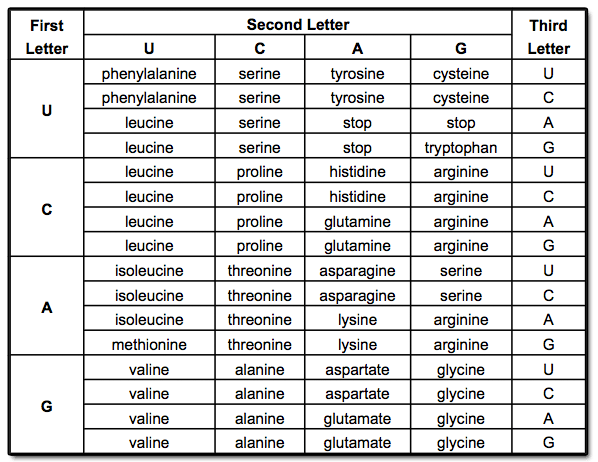
What is the correct amino acid sequence for the mRNA code AUGCCAGUAUGA
a)
Met-Pro-Ala-Val
b)
Met-Pro-Val
c)
Tyr-Gly-His
d)
Tyr-Gly-Arg-His
47.

The pictures here show the steps of DNA replication, but they are all mixed up! What order should the pictures be in?
a)
3, 2, 1, 4
b)
2, 1, 4, 3
c)
2, 3, 1, 4
d)
3, 4, 1, 2
48.
This Y shaped region where DNA is unwound to start replication is called...
a)
replication fork
b)
Leading strand
c)
Lagging strands
d)
replication splicing
49.

The enzyme that comes first temporarily gets the single strand ready to add new nucleotides is called "The Initializer" or
a)
Helicase
b)
Primase
c)
Polymerase
d)
Nuclease
50.

Which enzyme is responsible for adding nucleotides ("The Builder")?
a)
Topoisomerase
b)
DNA Polymerase
c)
Ligase
d)
Primase
51.
What is the end result of replication?
a)
Two new identical strands of DNA
b)
One parent strand and one daughter strand of DNA
c)
Two new and different strands of DNA
d)
One new strand of DNA
52.

Which enzyme is responsible for gluing and connecting parts of newly created DNA fragments together ("The Gluer")?
a)
Topoisomerase
b)
DNA Polymerase
c)
Ligase
d)
Primase
53.

The enzyme that unzips the DNA to prepare for replication ("The Unzipper")
a)
helicase
b)
replicase
c)
polymerase
d)
synthase
54.
Are all mutations bad?
a)
Yes
b)
No
55.
Original: ATC CAT
Mutation: ATC GCAT
What mutation occurred?
Mutation: ATC GCAT
What mutation occurred?
a)
deletion
b)
insertion
c)
silent
d)
transverse
56.
What happens in Inversion?
a)
Its repeated
b)
They all get deleted
c)
A section of the chromosome gets flipped
d)
they start to cross-over
57.
What happens in Translocation?
a)
They all live normaly
b)
They all repeat each other
c)
Different chromosomes cross-over with each other
d)
Something happens
58.
What are the building blocks of proteins call?
a)
DNA
b)
RNA
c)
Ribosomes
d)
Amino Acids
59.
Why are insertion and deletion mutations so harmful?
a)
They change all of the codons from the mutation on down the line, which changes the amino acid sequence
b)
They insert things that an organism doesn't need.
c)
They often delete things that organisms need.
d)
Insertion and deletions are not any more harmful than substitution mutations.
60.
ATTTGAGCC- Original
ATTGAGCC - Mutated
The example above is an example of a
ATTGAGCC - Mutated
The example above is an example of a
a)
Insertion- Frameshift
b)
Deletion- Substitution
c)
Deletion -Frameshift
d)
All of the above
61.
Which genetic abnormality can be identified through karyotyping?
a)
point mutation
b)
recessive allele
c)
extra chromosomes
d)
sex-linked allele
62.
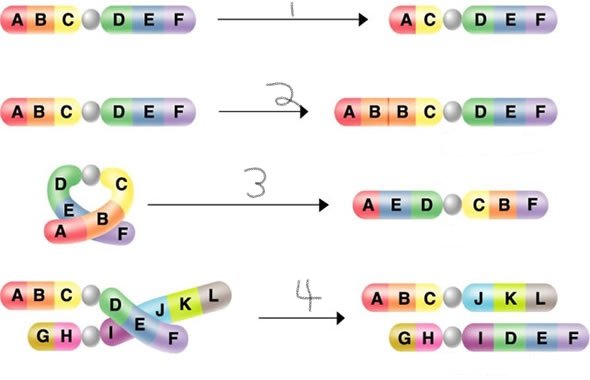
Which of these is the correct order for the chromosome mutations in the image (from top to bottom)?
a)
(1) duplication, (2) inversion, (3) substitution, (4) translocation
b)
(1) deletion, (2) duplication, (3) inversion, (4) translocation
c)
(1) deletion, (2) insertion, (3) translocation, (4) inversio
d)
(1) substitution, (2) duplication, (3) translocation, (4) inversion
63.
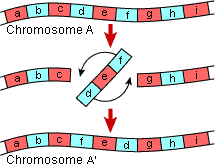
Which type of chromosome mutation is this (use image) and why?
a)
Inversion, because the genes are switching places with those of another chromosome
b)
Translocation, because the genes are switching places with those of another chromosome
c)
Inversion, because the genes of the same chromosome are switched to opposite orders
d)
Translocation, because the genes of the same chromosome are switched to opposite orders
64.
A male shark has 40 chromosomes in each of its sex cells. How many would be present in its body cells?
a)
20
b)
40
c)
80
d)
160
65.
If a cell has an abnormal number of chromosomes, usually from meiosis, what is this considered? Choose the best answer.
a)
Chromosome mutation
b)
Nondisjunction
c)
Sex-linked mutation
d)
Inversion
66.
What is the central dogma of biology?
a)
Proteins are made from RNA that assembles amino acids through DNA ribosomes.
b)
RNA copies all information for an organism onto DNA which assembles ribosomes, and creates amino acids from proteins
c)
DNA is the blueprint for an organism. RNA copies specific sections that need to be built and transfers that information to a ribosome which assembles proteins out of amino acids.
d)
RNA is the blueprint for an organism. It copies its information onto DNA, which takes amino acids (like lego building blocks) and assembles those acids into proteins.
67.
How are mutations passed on to offspring?
a)
Any mutation that an organism acquires in its life can be passed on to the offspring through its gametes (sex cells)
b)
Only mutations that occur *in the gametes* are passed on to the offspring
c)
Mutations are not usually passed on to the offspring. A mutation stays within the original organism.
d)
Mutations are not passed to offspring. They only occur within developing embryos.
68.
A scientist cloned a goat. Which of these is a true statement about the cloned goat?
a)
It has new genes and traits
b)
It lacks the genes for reproduction
c)
It has the genes that are identical to the original goat
d)
It looks the same but has different genes.
69.

Which change below would result in a different Amino Acid?
3'-GCT-5'
3'-GCT-5'
a)
GTT
b)
TCT
c)
TCC
d)
GCA
70.
Would a mutation in the DNA of a skin cell be passed on to an organism's offspring?
a)
Yes, because any change to the DNA is passed on to the offspring
b)
Maybe. Sex cells only use half of the body's genetic code. It might get the copy of a gene that wasn't mutated.
c)
No. Only mutations that occur in the gametes (sex cells) are passed on to the offspring
d)
Without knowing the animal, it would be hard to tell whether or not the mutation would be passed on.
71.
a change in one nucleotide to another is known as a/n
a)
frameshift mutation
b)
missense mutation
c)
somatic mutation
d)
point mutation
72.
A type of substitution in which one amino acid changes is called
a)
Nonsense
b)
Missense
c)
Silent
d)
all of the above
73.
A type of substitution in which no amino acids change is called
a)
Missense
b)
Nonsense
c)
Silent
d)
Deletion
74.
This type of substitution codes for a stop codon
a)
Missense
b)
Nonsense
c)
Silent
d)
Deletion
75.

Mr. Jones was killed in a car accident. Afterwards, a former girlfriend filed a paternity suit claiming that Mr. Jones was the father of her child, and thus she was entitled to the man’s estate. Which sample of DNA would have to be from Mr. Jones if he were the child’s father?
a)
2
b)
3
c)
4
d)
5
76.

Bob was found dead in his home. Crime scene analysis showed signs of a struggle. Blood was collected from the crime scene, the victim, and three suspects. Which suspect likely committed the crime?
a)
Sue
b)
Lisa
c)
John
d)
None of these
77.

Which male is the father of this child?
a)
Male 1
b)
Male 2
c)
Neither could be the father
d)
Either could be the father
78.

Which man is the father of this baby?
a)
Father 1
b)
Father 2
c)
Father 3
d)
None of them
79.

Whose blood was found at the crime scene?
a)
John
b)
Lisa
c)
Bob
d)
Sure
80.

Which two bear species are most closely related?
a)
Bear 1 and Bear 2
b)
Bear 1 and Bear 3
c)
Bear 2 and Bear 3
d)
There’s no way to tell
81.

Which suspect is likely guilty?
a)
Suspect #1
b)
Suspect #2
c)
Suspect #3
82.

Which man is the father of child #2 (5th Column)?
a)
Male #1
b)
Male #2
c)
Neither Is likely
83.

DNA is recovered from a suspected dead soldier. Which Parents are the likely parents of the soldier?
a)
Parents C and D
b)
Parents E and F
c)
Parents A and B
d)
Parents G and H
84.
Which DNA fragment bands move faster and farther in a gel electrophoresis?
a)
there is no way to tell
b)
the largest ones
c)
the smallest ones
d)
none of these
85.
What is the purpose of gel electrophoresis?
a)
helps cut DNA
b)
count the genes in DNA
c)
separates DNA based on size
d)
allows for an exact replicated organism
86.

During gel electrophoresis, DNA moves from the ___ end to the ___ end.
a)
positive, negative
b)
negative, positive
87.

DNA cutting "scissors" are
a)
Bacteriophages
b)
Restriction Enzymes
c)
DNA Enzymes
d)
Plasmids
88.
DNA fingerprinting works because
a)
Most genes are dominant
b)
All organisms contain RNA
c)
The most important genes are different among most people
d)
No two people, except identical twins, have exactly the same DNA
100 %

