
NEW
Font size
S
M
L
XL
 Worksheets
Skeletal system
Total questions: 68
Worksheet time: 52mins
Name
Class
Date
1.
What is the functional unit of spongy bone?
a)
Trabeculae
b)
Canaliculi
c)
Osteoclasts
d)
Spongiculicon
2.
Osteo means?
a)
Bone
b)
Bone tissue
c)
skin
d)
tissue
3.
Make new bone and help repair damage.
a)
Osteoblast
b)
Osteoclast
c)
Osteocytes
d)
Osetoblank
4.
Osteocytes
a)
Make new bone and help repair damage
b)
–Carry nutrients and waste products to and
from blood vessels in the bone.
c)
They grow within the bone to aid in
flexibility.
d)
Break down bone and help to sculpt and
shape it.
5.
many bones form from what?
a)
bones
b)
bone tissue
c)
Cartilage
d)
skin tissue
6.
long, short, irregular are all ?
a)
types of bone
b)
functions of the bone
c)
bones
d)
types of bone tissue
7.
which one of these IS a function of the skeletal system
a)
vitamin D production
b)
fat storage
c)
movement
8.

what type of bone in the femur
a)
Long bone
b)
Short bone
c)
Flat bone
d)
Irregular bone
9.

What type of bone is the scapula
a)
long bone
b)
short bone
c)
flat bone
d)
sesamoid bone
10.

Which one of the following is an irregular bone
a)
humerus
b)
tibia
c)
patella
d)
vertebrae
11.
The Skeletal System does what?
a)
Support your body
b)
Help your body move with muscles
c)
all of the above
d)
protect your organs
12.
A mature bone cell is called a _________.
a)
osteon
b)
osteocyte
c)
osteoclast
d)
osteoblast
13.
The cells that turn into mature bone cells are called _______________.
a)
osteon
b)
osteocyte
c)
osteoclast
d)
osteoblast
14.
The cells that break down old bone tissue are called ________.
a)
osteon
b)
osteocyte
c)
osteoclast
d)
osteoblast
15.
The central and perforating canals in compact bone are where you would find ____________.
a)
blood vessels
b)
neurons
c)
bone marrow
d)
cartilage
16.
Is a thin vascular membrane of connective tissue that lines the inner surface of the bony tissue that forms the medullary cavity of long bones.
a)
periosteum
b)
endosteum
c)
medullary cavity
d)
Diaphysis
17.
Is the central cavity of bone shafts where red bone marrow and/or yellow bone marrow (adipose tissue) is stored
a)
periosteum
b)
endosteum
c)
medullary cavity
d)
Diaphysis
18.
A very thin membrane that covers many of the bones in your body. It serves as protection as well as a channel for the blood supply and nutrients for bone tissue.
a)
periosteum
b)
endosteum
c)
medullary cavity
d)
Diaphysis
19.
What is the main structural unit of compact bone?
a)
Osteon
b)
Trabecula
c)
Lacuna
d)
Lamella
20.
Where is the periosteum?
a)
Covering the outside of the bone
b)
Lining the medullary cavity inside the bone
c)
At the ends where the bone forms a joint
d)
In the metaphysis as a site of growth
21.
What is the lining of the medullary cavity called?
a)
Periosteum
b)
Endosteum
c)
Articular Cartilage
d)
Epiphyseal Plate
22.
Canaliculi are for
a)
providing protection
b)
housing osteocytes
c)
providing nourishment
d)
holding bone together
23.
Perforating canals
a)
supply blood to the skin.
b)
supply blood to the Haversian systems.
c)
are artifacts.
d)
are filled with bone marrow.
24.
An osteocyte "lives" in __.
a)
lacunae
b)
lamellae
c)
Haversian canals
d)
Volkmann's canals
25.

Bone breaks incompletely, occurs most commonly during the infantile stages of life.
a)
Greenstick Fracture
b)
Stable Fracture
c)
Bluestick Fracture
d)
Comminuted Fracture
26.

Which fracture is where the bone is visible through the skin?
a)
Compound Fracture
b)
Stable Fracture
c)
Kevin Ware
d)
Horse
27.
Bone breaks into many fragments.
a)
Shattered Fracture
b)
Traction Fracture
c)
Comminuted Fracture
d)
The Magic School Bus
28.
Broken bone in which the bone is twisted apart or spiraled apart.
a)
Spiral Fracture
b)
Compression Fracture
c)
Physeal Fracture
d)
Avulsion Fracture
29.
Broken bone that is broken at right angles to its axis or straight across the bone.
a)
Transverse Fracture
b)
Manipulation
c)
Closed Fracture
d)
Greenstick Fracture
30.
The vitamins that are specifically required for normal bone growth are:
a)
vitamins A, I, E, and K
b)
vitamins B1, B2, and B3
c)
vitamins C and B complex
d)
vitamins A, C, and D
31.
What type of connective tissue is found at the ends of bones to reduce friction?
a)
Cartilage
b)
Dense Connective Tissue
c)
Adipose Tissue
d)
Loose Connective Tissue
32.
The epiphysis is
a)
The shaft of a bone
b)
a bone cell
c)
the end of a long bone
d)
the covering of a bone
33.
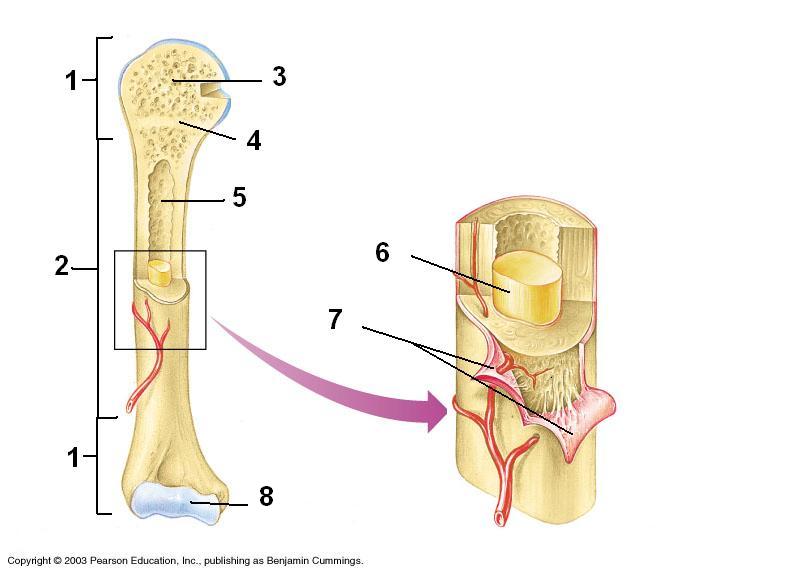
In adults, the substance at #6 would be
a)
red marrow
b)
yellow marrow
c)
spongy bone
d)
clotted blood
34.
Where are blood cells made?
a)
Yellow marrow
b)
Red marrow
c)
Spongy Bone
d)
Periosteum
35.
Bones elongate at the
a)
endosteum
b)
epiphyseal plate
c)
compact bone
d)
medullary cavity
36.

Osteon is...
a)
A microscopic cylindrical-shaped unit of compact bone.
b)
Knobby end of a long bone
c)
Strong, tough, fibrous connective tissue covering the bone.
d)
porous units pf spongy bone
37.
Type of dense bone tissue found on the outer surfaces and shafts of bones.
a)
coxal bones
b)
osteons
c)
compact bone
d)
spongy bone
38.

Structure #2 is_______ & mainly made of this type of bone ___________
a)
epiphysis, compact bone
b)
epiphysis, spongy bone
c)
diaphysis, compact bone
d)
diaphysis, spongy bone
39.
The production of blood cells is called
a)
homeostasis
b)
hematopoiesis
c)
hemostasis
d)
homologous
40.

Spongy bone would primarily be found where in a bone?
a)
diaphysis
b)
epiphysis
c)
periosteum
d)
endosteum
41.
What type of bone makes up the diaphysis?
a)
spongy bone
b)
compact bone
c)
rigid bone
d)
soft bone
42.
The bone building process is called?
a)
collagen
b)
ossification
c)
hypertrophy
d)
getting stronger
43.
Flat bones of the skull are made by a process called
a)
intramembranous ossification
b)
endochondral ossification
c)
hematoma
d)
epiphyseal plates
44.
Woven bone is found in
a)
intramembranous ossification
b)
endochondral ossification
c)
fracture repair
d)
cartilage
45.
A break in bone that does not penetrate the skin
a)
stress fracture
b)
simple fracture
c)
compound fracture
46.
What category do the skull bones fall in?
a)
floating
b)
flat
c)
irregular
d)
Long
47.
Bony expansion on a narrow neck
a)
Head
b)
Trochanter
c)
Line
d)
Process
48.
A furrow, usually to surround and support veins, capilaries or nerves
a)
fissure
b)
groove
c)
tubercle
d)
trochanter
49.
A narrow slit-like opening
a)
fissure
b)
foramen
c)
meatus
d)
ovale
50.
A very large, blunt, irregularly shaped surface
a)
tubercle
b)
trochanter
c)
tuberosity
d)
meatus
51.
A round or oval opening through a bone
a)
meatus
b)
foramen
c)
fissure
d)
trochanter
52.
sinus
a)
A cavity within a bone, filled with air and lined with mucus membrane
b)
a slit like opening
c)
a cavity within a bone lined with connective tissue
53.
Epiphysis
a)
The shaft of a bone
b)
a bone cell
c)
the end of the bone
d)
the cavity filled with bone marrow
54.
Rounded process
a)
fontanel
b)
condyle
c)
facet
d)
fossa
55.
small, nearly flat articular surface
a)
condyle
b)
fossa
c)
facet
d)
fontanel
56.
tube-like passageway
a)
tubercle
b)
trochanter
c)
spine
d)
meatus
57.
A small, rounded projection
a)
trochanter
b)
tubercle
c)
meatus
d)
fissure
58.
Armlike bar of bone
a)
Crest
b)
Fossa
c)
Groove
d)
Ramus
59.
Raised area above a condyle
a)
Epicondyle
b)
Notch
c)
Spine
d)
Tubercle
60.
Sharp, slender projection
a)
Notch
b)
Line
c)
Spine
d)
Groove
61.
Any bony prominance
a)
Process
b)
Facet
c)
Fissure
d)
Meatus
62.
Narrow ridge of bone (on interior of a bone)
a)
Head
b)
Line
c)
Foramen
d)
Groove
63.
Rounded projection
a)
Trochanter
b)
Tubercle
c)
Tuberosity
d)
Notch
64.
Rounded articular projection
a)
Crest
b)
Condyle
c)
Spine
d)
Sinus
65.
Shallow, basinlike depression
a)
Fissure
b)
Facet
c)
Foramen
d)
Fossa
66.

Letter A represents...
a)
Yellow Marrow
b)
Red Marrow
c)
Endosteum
d)
Periosteum
67.

Letter D represents...
a)
Compact bone
b)
Spongy Bone
c)
Endosteum
d)
Periosteum
68.
Letter D represents...
a)
Compact bone
b)
Spongy Bone
c)
Endosteum
d)
Periosteum
Reset

