
 Worksheets
Cumulative Ocean Review
Total questions: 82
Worksheet time: 2hrs 51mins
Name
Class
Date
1.
When rust forms on a metal object, it is caused by what process?
a)
carbon dioxide (carbonic acid)
b)
acid rain
c)
oxidation
d)
lichens
2.
How does freezing water cause the weathering of rocks? The freezing water—
a)
keeps the rocks in place
b)
makes the rocks last longer
c)
expands in the cracks and breaks rocks
d)
causes rocks to fall in landslides
3.
What is sediment?
a)
the process of rocks being broken down and carried away
b)
bits of rock and sand caused by the weathering of rocks
c)
the top layer of the soil
d)
decaying plant or animal material
4.

How do plants weather rocks?
a)
during photosynthesis
b)
when roots grow into cracks of rocks and expand the rock
c)
when the plant moves water from the roots to the leaves
d)
Plants don't weather rocks
5.

What type of weathering is it when acid rain breaks down and changes the rock?
a)
chemical weathering
b)
physical or mechanical weathering
c)
erosion
6.
The agent of mechanical weathering in which rock is worn away by the grinding action of other rock particles is called -
a)
erosion
b)
cracking and peeling
c)
abrasion
d)
ice wedging
7.
What is the movement of soil from one place to another?
a)
weathering
b)
deposition
c)
discharge
d)
erosion
8.

What happens when weathering and erosion work together?
a)
New Mountains are formed
b)
The climate changes overtime
c)
Metal pieces become rusty
d)
They change the Earth's surface
9.
The process that breaks down rocks and other materials on Earth's surface is called
a)
weathering
b)
erosion
c)
soil conservation
d)
decomposition
10.

During chemical weathering, what can happen to the type of rock that has undergone chemical weathering?
a)
a new rock is produced that is larger than the original rock
b)
a new rock is produced that is the same as the original rock
c)
a new rock is produced that is different from the original rock
d)
no new rock is created - it is just smaller in size
11.

The outside layer of the earth is called ______________________.
a)
core
b)
crust
c)
mantle
d)
outer core
12.

Where 2 plates are moving together
a)
Divergent Boundary
b)
Convergent Boundary
c)
Transform Boundary
13.

Stress that squeezes together
a)
Compression
b)
Tension
c)
Shearing
14.
Earth's interior consists of 3 major zones. Which zone makes up over 80% of Earth's interior?
a)
crust
b)
mantle
c)
core
d)
lithosphere
15.

What is a break in the Earth's crust?
a)
Fault
b)
Focus
c)
Fold
d)
Mineral
16.

What is a fault where rock squeezes together from COMPRESSION?
a)
Normal Fault
b)
Reverse Fault
c)
Strike Slip Fault
d)
Bekken Fault
17.
What is a fault where rock squeezes together from COMPRESSION?
a)
Normal Fault
b)
Reverse Fault
c)
Strike Slip Fault
d)
Bekken Fault
18.

Which kind of plate boundary is this?
a)
divergent boundary
b)
transform boundary
c)
convergent boundary (ocean to continent)
d)
convergent boundary (continent to continent)
19.

Which kind of plate boundary is this?
a)
divergent boundary
b)
transform boundary
c)
convergent boundary (ocean to continent)
d)
convergent boundary (continent to continent)
20.

What is the approximate location of letter B?
a)
80oN, 0o
b)
0o, 80oW
c)
80oS, 0o
d)
0o, 80oE
21.

Determine the contour interval
a)
10 m
b)
20 m
c)
50 m
d)
100 m
22.

Determine the contour interval:
a)
5 m
b)
10 m
c)
15 m
d)
20 m
23.

Where is the epicenter located?
a)
A
b)
B
c)
C
d)
There is no epicenter
24.
P waves and S waves are both types of ___ waves.
a)
Body
b)
Surface
c)
Hand
25.
This is what happens after an earthquake:
a)
aftershocks
b)
post-shocks
c)
microshocks
d)
pre-shocks
26.
How much bigger is a magnitude 8 earthquake compared to magnitude 7 one on the Richter Scale?
a)
1 time bigger
b)
10 times bigger
c)
100 times bigger
d)
1000 times bigger
27.
What type of seismic wave travels compressionally?
a)
P wave
b)
S wave
c)
Surface
d)
None
28.
A line of volcanic activity that surrounds the Pacific Ocean basin is the
a)
Ring of Fire
b)
Aleutian Islands
c)
Hawaiian Islands
d)
Caribbean Islands
29.
The process in which dissolved minerals crystallize and glue particles of sediment together is
a)
compaction.
b)
cementation.
c)
deposition.
d)
erosion.
30.
Which part of the water cycle is occuring when warm, moist air cools and begins forming clouds?
a)
condensation
b)
evaporation
c)
precipitation
d)
transpiration
31.
Which best explains why runoff is important?
a)
It returns water to other locations on Earth
b)
It increases the chance of flooding
c)
It makes evaporation occur faster
d)
It increases condensation
32.
How much of the water on Earth is considered fresh water?
a)
97%
b)
10%
c)
3%
d)
5%
33.
What is the process where a liquid changes to a gas?
a)
condensation
b)
evaporation
c)
precipitation
d)
transpiration
34.
What happens over time when nutrients and other chemicals build up in a lake and form a layer of algae on top of the lake?
a)
pollution
b)
photosynthesis
c)
contamination
d)
eutrophication
35.
What caused tributaries to flow downward toward a main river?
a)
friction
b)
surface tension
c)
gravity
d)
silt and sand
36.
One of these is NOT runoff. Which one?
a)
a stream
b)
a lake
c)
a river
d)
a water table
37.
Groundwater is found...
a)
on Earth's surface
b)
in the Earth
38.
The paths that rivers and streams take are called...
a)
aquifers
b)
channels
c)
water tables
39.

What is B?
a)
Evaporation
b)
Condensation
c)
Precipitation
d)
Runoff
40.

What is A?
a)
Evaporation
b)
Condensation
c)
Precipitation
d)
Runoff
41.

What is C?
a)
Evaporation
b)
Condensation
c)
Precipitation
d)
Runoff
42.
Two types of water currents are
a)
local and global
b)
sea and land
c)
surface and deep
d)
warm and cold
43.
Which of the following uses the most water worldwide?
a)
Agriculture
b)
Domestic Use
c)
Industry
d)
Water Parks
44.

Compared with surface currents, deep currents are
a)
colder and less dense.
b)
warmer and less dense.
c)
warmer and denser.
d)
colder and denser.
45.

Which of the following causes water from deep currents to rise to the surface to replace warm currents?
a)
evaporation
b)
freezing of the surface of the water
c)
upwelling
d)
squeezing solids out of the ice down into the water below
46.
What is the cause of rising surface temperatures of the Pacific Ocean, drought in the western United States, and flooding on the Pacific coast of South America?
a)
the Gulf Stream
b)
the Jet Stream
c)
La Nina
d)
El Nino
47.

The curving of air to the right in the Northern hemisphere is caused by ___________ and is called the _________ effect.
a)
Earth's rotation...Coriolis
b)
Earth's revolution...Coriolis
c)
Earth's rotation...Doppler
d)
Earth's revolution...Doppler
48.
Water that has greater density ______ .
a)
sinks
b)
rises
c)
spins clockwise
d)
is warmer
49.
The basic ocean motions are
a)
waves, tides, and rivers
b)
waves, tides, and currents
c)
tides, currents, and springs
d)
tides, currents, depth
50.
The highest part of a wave is the
a)
trough
b)
wave length
c)
crest
d)
wave height
51.
The lowest point of a wave
a)
wave length
b)
wave height
c)
crest
d)
trough
52.
This is the distance from crest to crest
a)
crest
b)
trough
c)
wave length
d)
wave height
53.
Animal-like plankton are known as
a)
phytoplankton
b)
zooplankton
c)
photosynthesis
d)
ocean food web
54.
This type of ocean motion is caused by differences in salinity and temperature
a)
surface currents
b)
waves
c)
deep ocean currents
d)
tsunami
55.
The ocean floor -------
a)
is always a flat bed of sand
b)
is covered by the same amount of water everywhere
c)
has mountains, plains, and ridges like land surfaces
d)
covers less area than the land
56.
At which location are oceans the deepest?
a)
Mid-ocean ridge
b)
Abyssal plain
c)
Ocean trench
d)
Volcanic island
57.
The main difference between ocean water and lake water is that ocean water contains —
a)
oxygem
b)
plants
c)
algae
d)
salt
58.
A person who studies the ocean
a)
geologist
b)
oceanographer
c)
biologist
d)
audiologist
59.
a long, high sea wave caused by an earthquake
a)
trench
b)
tide pool
c)
tsunami
d)
plankton
60.
Why are ocean currents so important to Earth's overall climate?
a)
they redistribute the heat from the equator
b)
the redistribute cold from the poles
c)
they move salty water to mix with freshwater
d)
all of these
61.
Warm ocean currents generally come from
a)
The North Pole
b)
The South Pole
c)
The Equator
d)
Both A and B
62.
What process brings the deep cold ocean currents up to the surface?
a)
Conduction
b)
Global Wind Patterns
c)
Convection Currents
d)
Temperature and salinity
63.

Wha type of tide would this arrangement of earth-moon-sun create?
a)
full moon tide
b)
new moon tide
c)
neap tide
d)
spring tide
64.

What type of tides would this arrangement of earth-moon-sun create?
a)
neap tide
b)
spring tide
c)
new moon tide
d)
full moon tide
65.
How do warm-water currents affect the coastal areas along which they flow?
a)
Cool the coast
b)
Warm the coast
c)
Cause snow to fall
d)
Cause higher tides
66.
Upwelling is associated with
a)
a decrease in access to nutrients for phytoplankton
b)
cooler, nutrient-rich waters being pushed up from deeper ocean waters
c)
temperature gradients moving water from the equator to the poles
d)
an increase in human fatalities
67.
What is sonar
a)
Ice Cream
b)
Sound navigating and ranging
c)
Korean Pop
d)
Cellphones measuring distance
68.
Scientists use ______ to determine the oceans depth.
a)
Submarine
b)
Sonar
c)
Helicopter
d)
Light
69.
The _________ is the gradually sloping end of a continent that extends under the ocean to 350 m deep.
a)
continental shelf
b)
trench
c)
seamount
d)
abbysal plain
70.
What is a deep, steep-sided canyon in the ocean floor?
a)
seamount
b)
trench
c)
continental rise
d)
continental slope
71.
What is a gently sloping, shallow area of the ocean floor that extends outward from the edge of the continent?
a)
continental shelf
b)
continental rise
c)
continental slope
d)
seamount
72.

What letter is B?
a)
Cont. Shelf
b)
Cont. Slope
c)
Cont. Rise
d)
Abyssal Plain
73.

What is letter A?
a)
Cont. Shelf
b)
Cont. Slope
c)
Abyssal Plain
d)
Abyssal Plain
74.
The _____ extends from the edge of the continental shelf down to the ocean floor.
a)
abyssal plain
b)
continental slope
c)
mid-ocean ridge
d)
trench
75.
______ are flat areas of sea floor formed when valleys are filled in with sediment.
a)
mid ocean ridges
b)
continental shelves
c)
abyssal plains
d)
continental slopes
76.
Active continental margins
a)
are located near a trench
b)
are found on the west coast
c)
Have narrow beaches and sharp cliffs
d)
All of the above
77.
Thermohaline currents are a result of different
a)
temperatures
b)
salinity*
c)
density
d)
All of the above
78.
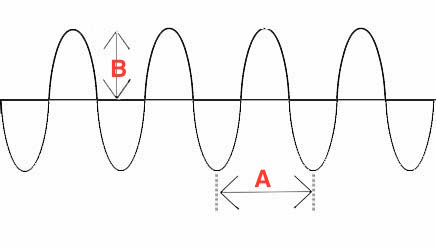
What property of this wave is represented by the letter "A"
a)
amplitude
b)
crest
c)
trough
d)
wavelength
79.
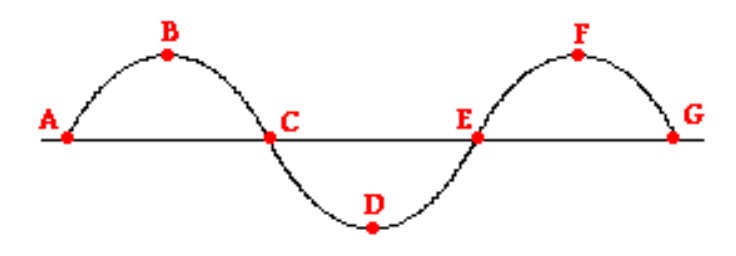
Which letter(s) represent the trough of the wave?
a)
A
b)
B & D
c)
D
d)
C & G
80.
Valleys cut deep into the ocean floor
a)
abyssal plain
b)
trench
c)
seamounts
d)
mid-ocean ridges
81.
An underwater mountain range
a)
trench
b)
seamount
c)
mid ocean ridge
d)
abyssal range
82.
An isolated flat-topped mountain is known as
a)
guyot
b)
trench
c)
abyssal plain
d)
mid-ocean ridge
100 %

