
 Worksheets
Classification Review
Total questions: 100
Worksheet time: 1hrs 29mins
Name
Class
Date
1.
Tigers, Jellyfish, Gorillas and Sponges are all part of kingdom _______.
a)
Animalia
b)
Plantae
c)
Fungi
d)
Bacteria
2.

You would find mushrooms in which kingdom?
a)
Plantae
b)
Protists
c)
Fungi
d)
Animalia
3.

Which kingdom do humans belong to?
a)
Plantae
b)
Fungi
c)
Animalia
d)
Protista
4.
The scientific name for an organism is made from the:
a)
class and family name
b)
genus and species name
c)
domain and kingdom name
d)
kingdom and phylum name
5.

An illustration and a dichotomous key are given. What is the correct classification for this organism?
a)
Class Insecta
b)
Order Amblygygi
c)
Order Araneae
d)
Order Scorpiones
6.

A dichotomous key for trees is provided. Hikers found a tree that has large brown cones and single sharp needles. What species of tree have the hikers found?
a)
Juniper
b)
Pine
c)
Spruce
d)
Fir
7.
Which of the following organisms are MOST closely related?
a)
organisms that share a domain
b)
organisms that share a family
c)
organisms that share a genus
d)
organisms that share an order
8.
What step do we always start with when using dichotomous keys?
a)
1
b)
2
c)
3
d)
4
9.
What is the study of classification called?
a)
Taxonomy
b)
Geology
c)
Anatomy
d)
Geometry
10.

Which domain is capable of living in extreme environments like hot springs, geysers, or very salty waters?
a)
Bacteria
b)
Archaea
c)
Eukarya
11.

Almost all bacteria are...
a)
Unicellular
b)
Multicellular
12.

Which two kingdoms are entirely multicellular?
a)
Animalia and Plantae
b)
Animalia and Protista
c)
Protista and Plantae
13.
Organisms whose cells have NO nucleus are classified as...
a)
Eukaryotic
b)
Prokaryotic
c)
Dead
14.
What is the genus name here:
Canis lupus
Canis lupus
a)
Canis
b)
lupus
15.

Mold, yeast, and mushrooms all belong to the Kingdom _______.
a)
Archaebacteria
b)
Fungi
c)
Eubacteria
d)
Protista
16.

A student discovers an organism with a segmented abdomen, long legs, and a tail with no stinger. The student uses the dichotomous key below to identify it. Which arachnid has the student found?
a)
Whip Scorpion
b)
Wind Scorpion
c)
Daddy long legs
d)
Scorpion
17.
Which is NOT one of the 5 kingdoms?
a)
Protist
b)
Animal
c)
Family
d)
Plant
18.
The more classification levels organisms share, the more ------.
a)
characteristics they have in common.
b)
specific groups are based.
c)
characteristics they don’t have in common.
d)
different they are.
19.
Identify the correct order of the taxonomy from largest grouping to most specific grouping.
a)
Species, genus, family, order, class, phylum, kingdom
b)
Kingdom, phylum, class, order, family, genus, species
c)
Kingdom, species, genus, family, class, order, phylum
d)
Phylum, family, genus, species, order, kingdom, class
20.
What is an organism?
a)
a source of energy
b)
a organ-like structure
c)
a living thing
d)
a source of heat
21.
Which of the following is the smallest group in the taxonomy?
a)
Genus
b)
Species
c)
Family
d)
Kingdom
22.
Which is the largest grouping in the taxonomy?
a)
family
b)
kingdom
c)
species
d)
phylum
23.
All organisms that do not fit into plant, fungi, and animal kingdoms but have a nucleus are:
a)
archaebacteria
b)
eubacteria
c)
protists
d)
fungus
24.
This kingdom is unicellular and prokaryotic.
a)
Bacteria
b)
Protista
c)
Fungi
d)
Animalia
25.
All of the following have a nucleus except...
a)
Bacteria
b)
Animalia
c)
Plantae
d)
Protista
26.
Which kingdom is autotrophic AND has a cell wall?
a)
Bacteria
b)
Fungi
c)
Plantae
d)
Protista
27.
What is the difference between Archaebacteria and Eubacteria?
a)
Bacteria is eukaryotic
b)
Archaebacteria is multicellular
c)
Archaebacteria can live in extreme environments
d)
They are the same
28.
This kingdom contains heterotrophic organisms that can be unicellular or multicellular. Organisms from this kingdom can sometimes cause athlete's foot or ringworm.
a)
Fungi
b)
Animalia
c)
Protista
d)
Archaebacteria
29.

This domain is characterized by ancient bacteria that can live in extreme environments, such as hot springs.
a)
Archaea
b)
Bacteria
c)
Eukarya
d)
Prokarya
30.

Which kingdom would this organism belong to?
a)
Plantae
b)
Archaebacteria
c)
Protista
d)
Animalia
31.

Which kingdom do humans belong to?
a)
Plantae
b)
Fungi
c)
Animalia
d)
Protista
32.
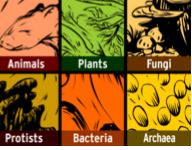
Which kingdoms are prokaryotic?
a)
Archaebacteria and Animalia
b)
Eubacteria and Archaebacteria
c)
Fungi and Protista
d)
Plantae and Eubacteria
33.
Organisms that are classified as unicellular are --
a)
seen with the naked eye
b)
many celled organisms
c)
single celled organisms
d)
able to make their own food
34.

This kingdom contains organisms such as trees, plants and shrubs.
a)
Fungi
b)
Plantae
c)
Animalia
d)
Protista
35.
Sexual Reproduction requires ______ parents
a)
0
b)
1
c)
2
d)
3
36.
Which of the following scientists developed the system for classification?
a)
Darwin
b)
Aristotle
c)
Einstein
d)
Linnaeus
37.

The scientific name for water bear is Hypsibius dujardini. What is its genus?
a)
Hypsibius
b)
dujardini
c)
water
d)
tardigrade
38.

The scientific name for water bear is Hypsibius dujardini. What is its species?
a)
Hypsibius
b)
dujardini
c)
water
d)
tardigrade
39.
How do scientists organize living things?
a)
by looks
b)
by shared characteristics
c)
by size
d)
by differences
40.
In a properly written scientific name, which part is lowercase?
a)
species
b)
genus
41.
Grouping based on similar characteristics.
a)
classification
b)
domains
c)
kingdoms
d)
prokaryote
42.
An organism that is made up of only one cell.
a)
moss
b)
mushroom
c)
unicellular
d)
aristotle
43.
An identification aid or tool that uses sequential, descriptive, paired statements.
a)
branching diagram
b)
dichotomous key
c)
binomial nomenclature
d)
taxonomy
44.
Archaebacteria and Eubacteria are the only living organisms that do NOT have ___
a)
a cell wall
b)
a nucleus
c)
cytoplasm
d)
flagella
45.
What process do most bacteria use to reproduce?
a)
Meiosis
b)
Cytokinesis
c)
Binary Fission
d)
Sexual reproduction
46.
The correctly written scientific name is -
a)
Felis domesticus
b)
mus domesticus
c)
quercus Alba
d)
Canis Lupus
47.

What is the name of bird Z?
a)
Certhidea
b)
Geospiza
c)
Camarhynchus
d)
Platyspiza
48.
what are the 6 kingdoms???
a)
Protista, Animalia, Fungi, Plantae, Archaebacteria, Eubacteria
b)
Protista, Animalia, Lizards, Plantae, Archaebacteria, Eubacteria
c)
Animalia, fungi, plantae, Archaebacteria, Eubacteria
d)
mammals, birds, insects, crocodile.
49.

One characteristic used to place organisms into kingdoms is..
a)
Body shape
b)
How they move
c)
How many cells
d)
How they reproduce
50.
In the levels of classification, what comes after phylum?
a)
class
b)
family
c)
genus
d)
order
51.
Which of the following is NOT a rule to writing scientific names?
a)
The genus is the first word and capitalized.
b)
Both the genus and the species are capitalized.
c)
The second word is the species and is lower case.
d)
The scientific name is either italicized or underlined.
52.
The correct way to write the scientific name for a red maple tree is....
a)
ACER RUBRUM
b)
Red maple
c)
acer rubrum
d)
Acer rubrum
53.
made of two or more cells
a)
multicellular
b)
unicellular
c)
kingsom
d)
prokaryotic
54.
made of one cell
a)
multicellular
b)
unicellular
c)
taxonomic Key
d)
homeostasis
55.
classification category that ranks above phylum and below domain
a)
kingdom
b)
genus
c)
eukaryotic
d)
prokaryotic
56.
An organism that is able to make its own food.
a)
autotrophic
b)
heterotrophic
c)
bacteria
d)
animal
57.
An organism that cannot make its own food.
a)
heterotrophic
b)
autotrophic
c)
cell
d)
plant
58.
A method of reproduction that requires only one parent.
a)
sexual reproduction
b)
asexual reproduction
c)
cell
d)
organelle
59.
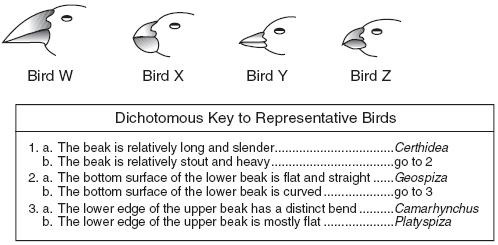
What is the name of bird W?
a)
Certhidea
b)
Geospiza
c)
Camarhynchus
d)
Platyspiza
60.
An early classification system had two groups: Plants and Animals. What is wrong with that system?
a)
It is too specific
b)
It is too narrow minded
c)
It is too broad
d)
It is too fancy
61.
Which kingdom contains only multicellular autotrophs?
a)
fungi
b)
plant
c)
animal
d)
protist
62.
What do plants and fungi have in common?
a)
They are both autotrophic
b)
They are both unicellular
c)
They both have cell walls
d)
They both are prokaryotes
63.
What statement would NOT be good for a dichotomous key?
a)
The organism has 1 dorsal fin
b)
The organism is ugly
c)
The organism has leaves in groups of three
d)
The organism has 6 legs
64.
Which organisms can you find living in extreme places such as salt lakes, hot springs and deep sea trenches
a)
Eubacteria
b)
Plantae
c)
Archea
d)
Protists
65.
Organisms in the Kingdom Animalia are mostly unicellular Eukaryotes.
a)
True
b)
False
66.
How many kingdoms are there?
a)
3
b)
4
c)
6
d)
9
67.
I am made of many cells. My cells have an organized nucleus. I mostly have two parents, but sometimes one. I make my own food.
a)
Fungi
b)
Bacteria
c)
Plantae
d)
Animalia
68.
Mushrooms are members of the kingdom
a)
Protista
b)
Animalia
c)
Plantae
d)
Fungi
69.
Animalia, Protista, Fungi, and Archaea are the
a)
scientists who organized taxonomy
b)
names of kingdoms
c)
levels of classification
d)
scientific names of different organisms
70.
This kingdom includes complex, multicellular organisms that are usually green, have cell walls, and make sugar by photosynthesis
a)
fungi
b)
bacteria
c)
plantae
d)
archaea
71.
This kingdom includes mostly single-celled or simple multicellular organisms.
a)
Protista
b)
Eubacteria
c)
Archaebacteria
d)
Fungi
72.
Which of the following is an example of a heterotroph?
a)
Sunflower
b)
Tree
c)
Mushroom
d)
Carrot
73.
How many cells do eubacteria have?
a)
1
b)
2
c)
3
d)
millions
74.
What is the scientific name for a dog?
a)
Dog
b)
familiarius
c)
Canis familiarius
d)
Canis
75.
Scientific names of organisms always have ___ parts.
a)
1
b)
2
c)
3
d)
4
76.
What is the proper way to spell the second largest level of classification?
a)
Fylum
b)
Phylem
c)
Phlegm
d)
Phylum
77.
What is the proper way to spell the largest grouping of living things?
a)
Kingdom
b)
Kingdem
c)
Class
d)
Cingdamm
78.
Examples are mushrooms and yeast
a)
Fungi
b)
Protista
c)
Plantae
d)
Animalia
79.
Examples are daisies and oak trees
a)
Fungi
b)
Plantae
c)
Protista
d)
Animalia
80.
Examples are amoebas and parameciums
a)
Fungi
b)
Protista
c)
Plantae
d)
Animalia
81.
Examples are kangaroos, owls and cats
a)
Fungi
b)
Protista
c)
Plantae
d)
Animalia
82.
In the levels of classification, what comes after phylum?
a)
class
b)
family
c)
genus
d)
order
83.

Which characteristics best describes the Plant Kingdom?
a)
unicellular; eukaryote; autotroph
b)
multicellular, prokaryote, autotroph
c)
multicellular, eukaryote, autotroph
d)
unicellular, prokaryote, heterotroph
84.

Which characteristics best describes the Animal Kingdom?
a)
unicellular, eukaryote, autotroph
b)
multicellular, prokaryote, heterotroph
c)
multicellular, eukaryote, autotroph
d)
multicellular, eukaryote, heterotroph
85.

Which characteristics best describe the Kingdom Fungi?
a)
multicellular and unicellular, eukaryote, autotroph
b)
multicellular and unicellular, prokaryote, heterotroph
c)
multicellular, eukaryote, heterotoph
d)
multicellular and unicellular, eukaryote, heterotroph
86.

Which characteristics best describes the Kingdoms Eubacteria and Archaebacteria?
a)
unicellular, prokaryote, heterotroph
b)
unicellular, prokaryote, heterotroph and autotroph
c)
multicellular, eukaryote, autotroph
d)
multicellular, prokaryote, heterotroph and autotroph
87.

Use the dichotomous key above to classify the unknown organism in the picture
a)
Kentuckyus
b)
Californius
c)
WalaWala
d)
Beverlus
88.
What must a plant be exposed to for photosynthesis to occur?
a)
food
b)
cold water
c)
sunlight
d)
energy
89.
A group of organisms that look alike and can reproduce among themselves is known as a:
a)
Genus
b)
Phylum
c)
Species
d)
Animal Family
90.
All organisms that do not fit into plant, fungi, and animal kingdoms but have a nucleus are:
a)
archaebacteria
b)
eubacteria
c)
protists
d)
fungus
91.
What characteristics place plants in a different kingdom than animals?
a)
They are multicellular because plants need specialized cells to perform different functions
b)
many plants are single celled organisms, an animals need specialized cells to perform functions of their bodies
c)
animal cells contain chloroplasts to make their own food, whereas plant cells do not contain chloroplast to make their own food
d)
plant cells contain chloroplasts to make their own food, whereas animal cells do not contain chloroplasts to make their own food
92.
In a dichotomous key, each question contains four choices.
a)
TRUE
b)
FALSE
93.
This kingdom includes complex, multicellular organisms that are usually green, have cell walls, and make sugar by photosynthesis
a)
fungi
b)
bacteria
c)
plantae
d)
archaea
94.
What is a dichotomous key?
a)
A series of statements that only response to each other
b)
A series of paired statements that have multiple response
c)
A series of paired statements that only have one response
d)
A series of paired statements that only have two responses
95.
Taxonomy is the ________of how animals are classified.
a)
Process
b)
Study
c)
Order
d)
Mechanics
96.
Which of the following is NOT true about Bacteria?
a)
They are unicellular
b)
They are Eukaryotes
c)
They are Everywhere
d)
The are both Autotrophic and Hetrotrophic.
97.
The seahorse found along the Atlantic Coast of the United States has the scientific name Hippocampus hudsonius. What is the seahorse’s species name?
a)
fish
b)
horse
c)
Hippocampus
d)
hudsonius
98.
For hundreds of years, people thought all living things belonged to one of two groups. What were the two groups?
a)
living and nonliving
b)
animals and flowers
c)
animals and plants
d)
microscopic and nonmicroscopic
99.
As you move down the classification pyramid, the variety of organisms:
a)
Increases
b)
Stays the same
c)
Decreases
d)
Doubles
100.
Highest level of classification
a)
Kingdom
b)
Phylum
c)
Species
100 %

