
 Worksheets
The Atmosphere, Weather, and Climate
Total questions: 104
Worksheet time: 1hrs 6mins
Name
Class
Date
1.
Which gas in our atmosphere is most abundant?
a)
Argon
b)
Oxygen
c)
Nitrogen
d)
Carbon Dioxide
2.
The air in the troposphere has a greater density than the air in any other layer of the atmosphere,
a)
True
b)
False
3.
Temperature decreases as altitude increases in the Thermosphere.
a)
True
b)
False
4.
In which layer of the atmosphere does weather occur?
a)
Mesosphere
b)
Thermosphere
c)
Stratosphere
d)
Troposphere
5.
What decreases as you go up in the atmosphere?
a)
Altitude
b)
Atmosphere
c)
Meteors
d)
Air Pressure
6.
What is the lowest main layer of Earth's atmosphere?
a)
Thermosphere
b)
Troposphere
c)
Stratosphere
d)
Mesosphere
7.
What is the outer most main layer of Earth's atmosphere?
a)
Thermosphere
b)
Troposphere
c)
Stratosphere
d)
Mesosphere
8.
What are the 2 most abundant gases in Earth's atmosphere?
a)
carbon dioxide and oxygen
b)
carbon dioxide and nitrogen
c)
nitrogen and oxygen
d)
nitrogen and hydrogen
9.
James plans to climb to the top of Mount Everest. Which of the following statements about his climb will be the most accurate?
a)
Air pressure will rise and the temperature on a thermometer will increase.
b)
Air pressure will fall and the temperature on a thermometer will decrease.
c)
Air pressure will rise and the temperature on a thermometer will decrease.
d)
Air pressure and thermometer will not change.
10.
Which of the following is NOT a reason why the atmosphere is important?
a)
It is made of many layers.
b)
It provides gases living things need.
c)
It provides warm temperatures.
d)
It protects us from UV rays and meteors.
11.
Which of the following is the correct order of the atmosphere layers from Earth to space?
a)
troposphere, stratosphere, mesosphere, thermosphere, exosphere
b)
troposphere, mesosphere, thermosphere, exosphere, stratosphere
c)
thermosphere, stratosphere, mesosphere, troposphere, exosphere
d)
troposphere, stratosphere, mesosphere, exosphere, thermosphere
12.
This type of cloud is thick and puffy on top, and generally flat on the bottom. It has well-defined edges and can change shape rapidly.
a)
cumulus cloud
b)
stratus cloud
c)
cirrus cloud
d)
cloud 9
13.
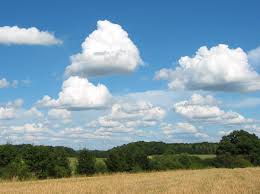
what type of cloud is shown?
a)
cumulus
b)
cirrus
c)
stratus
14.
Rain, snow, sleet, and hail are all examples of what?
a)
evaporation
b)
condenstation
c)
precipitation
d)
infiltration
15.
What is the process during which water cools and turns from a gas to a liquid?
a)
Codensation
b)
Runoff
c)
Precipitation
d)
Evaporation
16.

Warm air rises and the cool air sinks demonstrates this type of heat transfer.
a)
conduction
b)
convection
c)
radiation
d)
Insolation
17.
In convection, WARM air
a)
Rises
b)
Sinks
18.
In convection, COOL air
a)
Rises
b)
Sinks
19.
Warm air is __________ dense than cold air and rises creating convection currents.
a)
more
b)
less
20.
Which is true about the way air flows?
a)
from high pressure to low pressure
b)
from cold air to hot air
c)
from low pressure to high pressure
d)
from top to bottom only
21.
Which term best describes how the earth's atmosphere is heated?
a)
Spirally
b)
Unevenly
c)
Circularly
d)
Kinetically
22.
When Earth's rotation causes the wind to curve
a)
cloudy
b)
Coriolis effect
c)
high pressure
d)
low pressure
23.
This storm forms over a warm, tropical oceans close to the equator.
a)
Hurricane
b)
Earthquake
c)
Tornado
d)
Windstorm
24.
This storm is a funnel-shaped windstorm that extends down from a cumulonimbus cloud.
a)
Hurricane
b)
Tornado
c)
Thunderstorm
d)
Windbreak
25.
Layer that has most weather and life?
a)
Mesosphere
b)
troposphere
c)
stratosphere
d)
exosphere
26.
This layer is where satellites are found
a)
thermosphere
b)
exosphere
c)
stratosphere
d)
mesosphere
27.
Air pressure is greatest:
a)
closer to Earth
b)
farther from Earth
28.
The global wind which we live in is the
a)
Westerlies
b)
Jet Stream
c)
Trade winds
d)
Polar easterlies
29.
Layers of air around earth?
a)
climate
b)
Atmosphere
c)
ozone
d)
clouds
30.
Scientists who study weather and try to predict it are called
a)
astronomers
b)
volcanologists
c)
meteorologists
d)
weatherologists
31.
A severe storm which involves a funnel cloud forming over land is:
a)
hurricane
b)
tornado
c)
thunderstorm
d)
blizzard
32.
The mass of water vapor contained in a given volume of air is
a)
radiation
b)
dew point
c)
condensation nuclei
d)
humidity
33.
How does the burning of fossil fuels change the atmosphere?
a)
Major increase in carbon dioxide
b)
Decrease of ozone in the upper atmosphere
c)
Increase in oxygen
d)
Large quantities of dust, ash, and gases into the atmosphere
34.
If I said that Indianapolis is sunny and 85 degrees, am I describing its weather or climate?
a)
Weather
b)
Climate
35.
What does the word "anthropogenic" mean?
a)
Created naturally
b)
Created by humans
c)
Created by greenhouse gases
d)
Created by climate change
36.
If I said that it is always cold in Antarctica, am I describing its weather or its climate?
a)
Weather
b)
Climate
37.
what weather do you expect in a high pressure system
a)
Clear skies, sinking air
b)
Clear skies, rising air
c)
Rain, sinking air
d)
Rain, rising air
38.

Which Climograph is from a tropical location?
a)
A
b)
B
c)
C
39.
The burning of coal, gas, and oil which are all fossil fuels releases __________.
a)
Oxygen
b)
Methane
c)
Carbon Dioxide
d)
Nitrogen
40.
We help reduce global warming when we ________.
a)
conserve energy
b)
remove trees
c)
burn coal
d)
produce methane
41.
The level of CO2 in our atmosphere has ______________ in recent decades.
a)
risen
b)
decreased slightly
c)
stayed the same
d)
decreased significantly
42.
changing climate zones can lead to a shift in ____________.
a)
weather patterns
b)
gases
c)
temperature patterns
d)
environmental hazards
43.
What is currently happening to polar regions?
a)
nothing
b)
freezing
c)
moving
d)
melting
44.
_______ pressure systems usually signal fair weather with winds moving clockwise.
a)
low
b)
medium
c)
high
d)
none of the answers are correct
45.
______ pressure systems usually signal stormy weather with winds moving counter clockwise.
a)
low
b)
medium
c)
high
d)
none of the answers are correct
46.
________ is a condition of Earth’s atmosphere at any time.
a)
weather
b)
air pressure
c)
ozone
d)
rain
47.
The source for heating the Earth and circulating Earth’s atmosphere comes from the______________.
a)
sun
b)
moon
c)
earth
d)
ocean
48.

This form of precipitation forms as ice crystals in clouds that are below freezing.
a)
rain
b)
sleet
c)
snow
d)
hail
49.
What should you do if a severe weather warning is issued for your area?
a)
seek safe shelter
b)
have a party
c)
go out and look for the severe weather
d)
ignore the warning
50.
Climate is
a)
the further you get from the equator
b)
the higher you go, the colder it gets
c)
the conditions of the atmosphere at a certain place and time.
d)
the average weather conditions of an area over a long period of time.
51.

The tendency for objects to move to the right in the Northern Hemisphere and the to the left in the Southern Hemisphere is due to the:
a)
Eckman's spiral
b)
Coriolis effect
c)
Westerlies
d)
Gyres
52.

Which atmospheric circulation cell is between 0-30 degrees latitude lines?
a)
Hadley cell
b)
Polar cell
c)
Doldrums
d)
Ferrel cell
53.

The winds created in the Ferrel cells are called:
a)
Trade winds
b)
Polar winds
c)
Westerlies
d)
Hurricanes
54.

How do hurricanes start?
a)
After an earthquake occurrence
b)
Evaporation of warm sea water
c)
Hot air rising from a land mass
d)
Burning of greenhouse gases
55.

Which weather cell is between 60 degrees latitude and the poles?
a)
Hadley cell
b)
Polar cell
c)
Ferrel cell
d)
ITCZ
56.
________________ are forests in which plenty of rain falls all year.
a)
Polars
b)
Savanas
c)
Rain forests
d)
Tropics
57.
How has global warming made it more difficult for polar bears to hunt the seals they feed on?
a)
The population of seals has declined.
b)
Polar bears are forced to swim longer distances between ice sheets.
c)
Seals now have more places to hide.
d)
Polar bears are now being hunted more by other predators.
58.
What is the largest source of U.S. greenhouse gases?
a)
agriculture
b)
electricity generation
c)
transportation
d)
deforestation
59.
What is the 2nd largest source of U.S. greenhouse gases?
a)
agriculture
b)
electricity generation
c)
transportation
d)
deforestation
60.
Generally, the farther a place is from the equator, the warmer its climate will be.
a)
True
b)
False
61.

Which season is taking place in the Northern Hemisphere in Position 3?
a)
Winter
b)
Spring
c)
Summer
d)
Fall
62.

Which season is taking place in the Northern Hemisphere in Position 3?
a)
Winter
b)
Spring
c)
Summer
d)
Fall
63.

Which season is taking place in the Northern Hemisphere in Position 4?
a)
Winter
b)
Spring
c)
Summer
d)
Fall
64.
The Earth's axis is tilted _____ degrees.
a)
23.5
b)
25.3
c)
30.2
d)
24
65.
Objects in the sky appear to move from _______ to _______.
a)
East to West
b)
West to East
c)
North to South
d)
South to North
66.
If Earth rotated slower, we would have...
a)
shorter days.
b)
longer days.
c)
shorter years.
d)
longer years.
67.
Which angle of sunlight produces the most heat?
a)
90 degrees
b)
60 degrees
c)
30 degrees
d)
0 degrees
68.
Which season has the least amount of daylight in the Northern Hemisphere?
a)
Winter
b)
Spring
c)
Summer
d)
Fall
69.
Where is the equator?
a)
at the North Pole
b)
halfway between the North and South Poles
c)
at the South Pole
d)
in the Western hemisphere
70.
What causes more heat, indirect sunlight or direct sunlight?
a)
indirect
b)
direct
71.

Why is the Equator warmest?
a)
Because it is closest to the sun.
b)
Because it receives the most direct sunlight
c)
Because no clouds form here.
d)
Because it is far from the sun
72.

The hemisphere where you live
a)
equator
b)
southern
c)
northern
d)
eastern
73.
The general term for harmful chemicals in the gaseous sphere
a)
aquatic pollution
b)
terrestrial pollution
c)
atmospheric pollution
d)
noise pollution
74.
How do jet streams influence the weather?
a)
by creating clouds
b)
by increasing the moisture in the atmosphere
c)
by moving weather from one area to another very quickly
d)
by drying out the atmosphere
75.
Where is the ozone layer located?
a)
Mesosphere
b)
Thermosphere
c)
Stratosphere
d)
Troposphere
76.
Why are air temperatures above land higher than the air above the water during the day?
a)
Land heats quicker than water.
b)
Water heats quicker than land.
c)
There are more people on land.
d)
There is more pollution on land.
77.
What contributed to the development of the hole in the ozone?
a)
Electricity use.
b)
The use of CFC's (chlorofluorocarbons.)
c)
Human breathing.
d)
New factories.
78.

Using the diagram, which layers of the atmosphere are temperatures increasing?
a)
Troposphere and stratosphere
b)
Troposphere and mesosphere
c)
Stratosphere and thermosphere
d)
Mesosphere and thermosphere
79.

Which layer is 0 -12 km?
a)
troposphere
b)
stratosphere
c)
mesosphere
d)
thermosphere
80.
What are the percentages of the main gases on Earth?
a)
78% oxygen, 21% nitrogen and 1% other
b)
78% other, 21% oxygen and 1% nitrogen
c)
78% nitrogen, 21% oxygen and 1% other
d)
95% carbon dioxide and 5% oxygen
81.
Why is it harder to breath at higher altitudes?
a)
The air is more dense. Heavy air is hard to breath.
b)
The air is less dense. Less pressure means that the air is thin.
c)
Less percentage of oxygen at higher levels.
d)
It is not harder to breath at higher altitudes,
82.
Which climate zone has colder temperatures?
a)
temperate
b)
tropical
c)
polar
83.
What climate zone has warm temperatures?
a)
temperate
b)
polar
c)
tropical
84.
What climate zone changes with the seasons?
a)
temperate
b)
tropical
c)
polar
85.
What type of weather could be expected when there are white puffy cumulus clouds in the sky?
a)
cold
b)
rain
c)
storms
d)
fair
86.
What process forms the clouds?
a)
evaporation
b)
transpiration
c)
precipitation
d)
condensation
87.
What do thunderstorms, tornados and hurricanes have in common?
a)
high pressure and strong winds
b)
low pressure and no wind
c)
low pressure and strong winds
d)
high pressure and no winds
88.
In addition to colder temperatures what type of weather could be expected when a cold front moves in?
a)
fair weather
b)
hotter temperature
c)
no change
d)
thunderstorms
89.
What helps regulate the temperature of the earth and its atmosphere?
a)
wind
b)
sun
c)
water
90.
What do we call when gases trap heat in the atmosphere?
a)
global warming
b)
climate changes
c)
greenhouse effect
d)
coriolis effect
91.

Which of the following is the best conclusion that can be made from this graph?
a)
atmospheric carbon dioxide levels have been decreasing since 1960
b)
Hawaii has a lot of carbon dioxide
c)
humans have been working hard to decrease carbon dioxide levels
d)
atmospheric carbon dioxide levels have increased steadily since 1960
92.
Compared to other greenhouse gases, carbon dioxide is very effective in trapping heat near the surface of the Earth.
a)
true
b)
false
93.
Which of the following have been linked to climate change?
a)
droughts
b)
flooding
c)
melting of polar ice caps
d)
all of the above
94.
Some greenhouse gases are naturally present in the Earth's atmosphere
a)
True
b)
False
95.
Things you can do to help decrease global warming include:
a)
Eat more ice cream.
b)
Keep your freezer door open.
c)
Keep your air conditioner on high.
d)
Turn off your lights when you’re not using them.
96.
Carbon is stored in
a)
Trees and other living things
b)
Oceans
c)
underground in soil and fossil fuels
d)
All are correct
97.
What is the average weather for a particular time and region called?
a)
drought
b)
weather
c)
emissions
d)
climate
98.

What happens if a hurricane moves over land or cold ocean water?
a)
it will get stronger
b)
it will get weaker
c)
it will upgrade its category
d)
it will morph into a typhoon
99.
How do the conditions for a tornado differ from the conditions for a hurricane?
a)
Tornadoes never form when there is rain, while hurricanes always form with rain.
b)
Tornadoes form under low pressure, while hurricanes form under high pressure
c)
Tornadoes form in a stable atmosphere, while hurricanes form in an unstable atmosphere
d)
Tornadoes form over land, while hurricanes form over bodies of water
100.
During a _________ you should lay low in a ditch if you can't seek shelter inside.
a)
tornado
b)
hurricane
c)
thunderstorm
101.
What should you do if a hurricane is heading your way?
a)
pack up and prepare to leave if you live on the coast
b)
go to a room with windows
c)
lay low in a ditch if you are stuck outside
102.

Most of the damage done by a hurricane is the result of _____
a)
water
b)
wind
c)
tornadoes
d)
lightning
103.
What are thunderstorms?
a)
a storm with thunder and lighting and typically also heavy rain or hail
b)
a storm that can be the same as thunderstorms, but even more dangerous
c)
a mobile, destructive vortex of violently rotating winds having the appearance of a funnel shaped cloud and advancing beneath a large storm system.
d)
a huge storm with strong winds and storm surges
104.
Where is Tornado Alley located?
a)
Near the equator of the Earth
b)
Near the North Pole
c)
South Central Los Angeles
d)
Middle states of United States
100 %

