
 Worksheets
ecology2
Total questions: 81
Worksheet time: 54mins
Name
Class
Date
1.
What is the original source of almost all energy in most ecosystems?
a)
carbohydrates
b)
sunlight
c)
water
d)
carbon
2.
Autotrophs make up the _______ level in all ecosystems.
a)
First
b)
Second
c)
Third
d)
Fourth
3.

which symbiosis is this
a)
parasitism
b)
mutualism
c)
commensalism
d)
nonalism
4.

symbiotic relationship in which both organisms benefit
a)
competition
b)
Mutualism
c)
nitrogen fixation
d)
energy pyramid
5.

What does a food web represent?
a)
All connections of energy flow throughout all organisms in a habitat.
b)
The specific ways that mutualism is carried out.
c)
A single pathway or energy flow between organisms.
d)
How carnivores get their food.
6.

The image provided is an example of a(n):
a)
Carnivore
b)
Herbivore
c)
Producer
d)
Autotroph
7.

The image provided is an example of a(n):
a)
Producer
b)
Autotroph
c)
Consumer
d)
Insect
8.
The amount of energy that usually transfers from one trophic level to the next...
a)
10%
b)
20%
c)
80%
d)
50%
9.
Which of the following would be the definition of a detritivore?
a)
Animals that eat insects.
b)
Organisms that feed on rocks, recycling the nutrients back into the ground.
c)
Organisms that eat only pants
d)
Things that feed on dead organisms, recycling the nutrients back into the ground.
10.
An illustration that uses arrows to show the many possible directions in which matter and energy can pass through the organisms in an ecosystem.
a)
Food chain
b)
Food web
c)
Energy Pyramid
d)
Succession Map
11.
The nonliving aspects of an ecosystem.
a)
Abiotic factors
b)
Biotic factors
12.
The living portions of the ecosystem.
a)
Biotic factors
b)
Abiotic factors
13.
Water temperature would be an example of ...
a)
A biotic factor
b)
An abiotic factor
14.
A collection of organisms that belong to different populations but all live in the same area and interact with one another.
a)
Population
b)
Ecosystem
c)
Community
d)
Ecosphere
15.
A place where an organism lives.
a)
Terrain
b)
Habitat
c)
Community
d)
Population
16.
A collection of organisms that make up a community as well as all of the nonliving aspects of the environment.
a)
Population
b)
Community
c)
Habitat
d)
Ecosystem
17.
Organisms that can capture energy from inorganic, nonliving sources.
a)
Producers
b)
Consumers
c)
Detritivores
d)
Carnivores
18.
Organisms that feed on both living producers and other consumers.
a)
Carnivores
b)
Omnivores
c)
Herbivores
d)
Detritivores
19.
The general name for organisms like animals and fungi that get their energy from eating other organisms.
a)
Producers
b)
Consumers
c)
Detritivores
d)
Carnivores
20.
An organism at the second trophic level would be considered a...
a)
Top carnivore
b)
Producer
c)
Herbivore
d)
Carnivore
21.
A graphic illustration that shows each trophic level and the amount of useable energy contained within.
a)
Food chain
b)
Food web
c)
Energy Pyramid
d)
All of these
22.
True or False: It is possible for a carnivore to be a producer.
a)
False
b)
True
23.

Organisms that look similar and can produce fertile offspring
a)
Species
b)
Fish
c)
Community
d)
Trees
24.
Two or more members of a particular species living and interacting in the same area
a)
Community
b)
Population
c)
Organisms
d)
Biosphere
25.

The area between the highest mountain and the deepest ocean where life can be found
a)
Biosphere
b)
Biome
c)
Farm
d)
Ecosystem
26.

What does a food web represent?
a)
All connections of energy flow throughout all organisms in a habitat.
b)
The specific ways that mutualism is carried out.
c)
A single pathway or energy flow between organisms.
d)
How carnivores get their food.
27.

relationship in which two species live closely together
a)
resource
b)
mutualism
c)
succession
d)
symbiosis
28.

The rabbit in this food web would be considered a:
a)
Decomposer
b)
Producer
c)
Secondary Consumer
d)
Primary Consumer
29.

In this Food Web Pyramid Which type of consumer gets only 10% of the energy stored in plants?
a)
Herbivore
b)
Carnivore
c)
Omnivore
d)
Secondary Consumer
30.
As you move upward, from level to level, in an energy pyramid, energy _____.
a)
increases
b)
decreases
c)
stays the same
d)
increases exponentially
31.

What are the Abiotic factors in this image?
a)
water, sunlight, dirt, air
b)
birds and plants
c)
birds, water, dirt
d)
plants, water
32.
plants that convert energy from the sun
a)
decomposer
b)
primary consumer
c)
secondary consumer
d)
producer
33.
A local company dumped sewage into the wetlands. As a result, most fish in the wetlands died. This decrease in the number of fish will probably result in
a)
fewer mice
b)
fewer birds
c)
fewer spiders
d)
fewer insects
34.
Which order of these shows the food chain in the correct order?
a)
Zooplankton--->Bear--->Salmon
b)
Salmon--->Zooplankton--->Bear
c)
Zooplankton-->Salmon--->Bear
d)
Bear--->Zooplankton--->Salmon
35.
What is the symbiotic relationship called which one organism is helped and the other organism is unharmed?
a)
mutualism
b)
parasitism
c)
commensalism
d)
consumer
36.
Antelope and zebras interacting is an example of a (n)
a)
community
b)
population
c)
ecosystem
d)
biome
37.
Which of the following organisms are typical decomposers?
a)
grasses and ferns
b)
bacteria and mushrooms
c)
mice and deer
d)
lions and snakes
38.
An organism's specific role in its habitat is called its
a)
consumer
b)
niche
c)
birth right
d)
mutalism
39.

How would the removal of the earth worms affect the other organisms.
a)
The number of bass will increase
b)
The number of crayfish will decrease
c)
The crayfish will get their energy directly from the sun
d)
The number of bass and ospreys will increase
40.

The sun's energy is most directly available to people through
a)
Path A
b)
Path B
c)
Path C
d)
Path D
41.
Autotrophs make up the _______ level in all ecosystems.
a)
First
b)
Second
c)
Third
d)
Fourth
42.
What is the major difference between a community and an ecosystem?
a)
A community involves only the biotic, not the abiotic
b)
An ecosystem only includes herbivores and carnivores-- no decomposers
c)
An ecosystem involves only the biotic, AND THE abiotic
d)
An ecosystem is just a larger community
43.
What are the major differences between a species and a population?
a)
Populations consist of ALL of the individual organisms within a species in a given area/ecosystem that are fertile
b)
Populations are a collection of many different types of species that are not related to each other
c)
Populations are just a larger amount of individuals
d)
Populations are the number of individuals within a species that are identical
44.

What makes Fungi so unique when it comes to trophic levels?
a)
They are producers so they can be high or low
b)
They are consumers of only plants
c)
They are consumers of all types of organisms because they decompose
d)
They are consumers of only the primary trophic level
45.

What are the plants in this picture?
a)
Heterotrophs
b)
Autotrophs
c)
Carnivores
d)
Herbivores
46.

In this food web, what is the grasshopper?
a)
producer
b)
tertiary consumer
c)
secondary consumer
d)
primary consumer
47.

In the energy pyramid here, which organisms have the most energy available?
a)
Producers
b)
Carnivores
c)
Herbivores
d)
Top Predator
48.
An animal that is hunted and eaten for food is a
a)
predator
b)
prey
49.

a relationship between two in which one species, the predator, feeds on the other species, the prey
a)
chemosynthesis
b)
predation
c)
cellular respiration
d)
commensalism
50.

The diagram below shows the cycling of nutrients in an ecosystem.
The removal of which of the following groups would cause an immediate decrease in the amount of energy flowing through the system?
The removal of which of the following groups would cause an immediate decrease in the amount of energy flowing through the system?
a)
Producers
b)
Consumers
c)
Decomposers
d)
Inorganic nutrients
51.

If a disease destroying barley plants in a field swept through an ecosystem, what would happen to the barley eating bird population in the the field ?
a)
The bird population would stay the same
b)
The bird population would infinitely increase
c)
The bird population would decrease
52.

What is the carrying capacity of the graph?
a)
around 500
b)
more than 500
c)
less than 500
d)
around 600
53.

What is the order of succession shown in this figure?
a)
A, B, C, D
b)
B, A, D, C
c)
C, D, A, B
d)
D, A, B, C
54.

The mouse in this food web would be considered a:
a)
Primary Consumer
b)
Producer
c)
Tertiary Consumer
d)
Secondary Consumer
55.
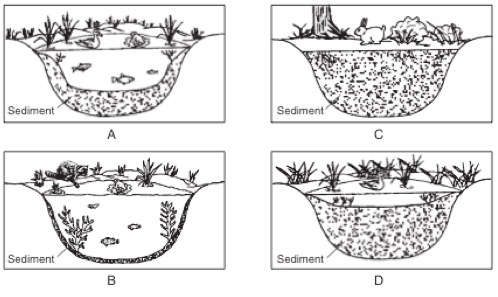
What is the correct order from oldest (happened first) to youngest (happened last) in this pond succession?
a)
A, B, C, D
b)
D, C, B, A
c)
B, A, D, C
d)
C, D, A, B
56.

If the grasshopper were to be removed completely from the food web, what organism would be most effected?
a)
The squirrel
b)
The shrew
c)
The deer
d)
The rabbit
57.

Which organism recieves the least amount of energy from the producer?
a)
Owl
b)
Grasshopper
c)
Lilypad
d)
Mouse
58.

A drought has hit this grassland biome. How will this effect the rabbit population?
a)
The rabbits will increase in number.
b)
The rabbit population will stay the same.
c)
The rabbit population will decrease.
d)
The rabbit population will become extinct immediately.
59.
Which best explains why producers are at the beginning of all food chains?
a)
They turn dead animals into nutrients
b)
They provide shelter for smaller animals
c)
The transfer energy from the sun into food
60.
What might happen if you remove a primary consumer from the ecosystem?
a)
There would be more food for secondary consumers.
b)
The number of primary consumers would increase.
c)
The number of plants would increase.
d)
The number of secondary consumers would increase.
61.
Which of the following best describes the niche of a frog?
a)
its color
b)
a lily pad in a pond
c)
jumping
d)
maintains insect population
62.
Which of the following lists the levels of organization in the enviroment from complex to simple?
a)
Biosphere, ecosystem, biome, community
b)
Organism, population, community, ecosystem, biome, biospere
c)
biosphere, biome, ecosystem,community, population, organism
d)
organ system, organ, tissue, cell
63.
What do the arrows in a food web represent?
a)
equals
b)
it points towards the organism that is being eaten
c)
yeilds or makes
d)
it points towards the organism that is receiving energy from what it has eaten
64.
Use the food chain below to answer the following question:
Grass--> Grasshopper--> Bird
What word best describes the grasshopper?
Grass--> Grasshopper--> Bird
What word best describes the grasshopper?
a)
producer
b)
secondary consumer
c)
herbivore
d)
omnivore
65.
Use the following food chain to answer this question
Grass--> Insects--> Shrews-->Owl
What would happen if all the insects were to be eliminated?
Grass--> Insects--> Shrews-->Owl
What would happen if all the insects were to be eliminated?
a)
The grass would decrease and the shrews would increase
b)
the grass would decrease and the shrews would decrease
c)
the grass would increase and the shrews would decrease
d)
the grass would increase and the shrews would increase
66.
grass->rabbit -> fox
a)
food chain
b)
food web
c)
energy pyramid
67.
Which of the following is the correct equation for PHOTOSYNTHESIS?
a)
CO2 + light + H2O --> O2 + Sugar
b)
CO2 + sugar + H2O --> O2 + light
c)
O2 + light + H2O --> CO2 + Sugar
d)
CO2 + O2 + H2O --> Light+ Sugar
68.
Which organelle performs PHOTOSYNTHESIS?
a)
Chloroplast
b)
Mitochondria
69.

Shallow coastal waters provide an essential habitat to a variety of plants and animals. A small part of a coastal food web is shown. Which organism is a primary consumer?
a)
algae
b)
horseshoe crab
c)
striped bass
d)
soft-shell clam
70.

The diagram represents a food chain. The arrows in the diagram indicate the
a)
return of chemical substances to the environment
return of chemical substances to the environment
b)
order of importance of the various organisms.
c)
direction of energy flow through a series of organisms
d)
direction in which organisms move in the environment.
71.
Hummingbirds need large amounts of energy to flap their wings between 60 and 200 times per second. Their wings beat so rapidly that it is difficult to see them move. They often appear suspended in air for extended periods of time without changing their location. Hummingbirds have long bills and grooved tongues to reach into flowers to feed on flower nectar. They also feed on insects. Which term best describes the ecological relationship between hummingbirds and insects?
a)
mutualism
b)
parasite-host
c)
predator-prey
d)
commensalism
72.
Striped fish are affected by abiotic and biotic factors in the environment. Which of these factors is biotic?
a)
water temperature
b)
mineral nutrients
c)
algae
d)
sediment
73.

The energy pyramid below shows a possible amount of energy, in kilocalories, available in the organisms at each trophic level in an ecosystem. According to the law of conservation of energy, energy can neither be created nor destroyed. If this is true, why is there less energy in the top of the energy pyramid than there is in the bottom of the energy pyramid?
a)
Energy is lost between each trophic level as heat.
b)
The law of conservation of energy does not apply to ecosystems.
c)
Organisms in the top of the energy pyramid use up energy the fastest.
d)
The extra energy in the bottom is slower to reach the top.
75.
A farmer plants two species of grass with similar nutrient needs on the same small plot of land. What kind of interaction will most likely occur between the two species?
a)
parasitism
b)
competition
c)
commensalism
d)
mutualism
75.
A farmer plants two species of grass with similar nutrient needs on the same small plot of land. What kind of interaction will most likely occur between the two species?
a)
parasitism
b)
competition
c)
commensalism
d)
mutualism
76.

The diagram below depicts the water cycle. Which process is represented by the number 2?
a)
precipitation
b)
evaporation
c)
surface runoff
d)
condensation
77.
An increase in the atmospheric levels of carbon dioxide (CO2) is the biggest contributor to which of the following?
a)
El Nino
b)
global warming
c)
wind storms
d)
ozone depletion
78.

The graph below shows population data for two species. What can be said about the relationship between species 1 and species 2?
a)
When the population of species 1 increases, the population of species 2 decreases.
b)
The population of species 1 and species 2 stay the same over the time period shown.
c)
The population of species 1 is not influenced by the population of species 2.
d)
When the population of species 1 increases, the population of species 2 increases.
79.
Overpopulation occurs when a population exceeds its carrying capacity. White-tailed deer are considered to be an overpopulated species in the central United States. What is one consequence of white-tailed deer exceeding their carrying capacity?
a)
People don't see deer as often in urban areas.
b)
The deer are less healthy and more prone to disease.
c)
There are more predators to eat the deer.
d)
The deer have stopped breeding.
80.

78% of Earth's atmosphere is nitrogen gas. All living things need nitrogen as a part of DNA and RNA. Yet you and I, and other living things, cannot use the nitrogen in our atmosphere directly. One type of organism is responsible for "fixing" nitrogen or helping to put it in a form so other living things can use it. That organism is
a)
bacteria.
b)
fungi.
c)
plants.
d)
viruses.
81.

In the freshwater food chain below, which would most likely happen if the Bluegill population decreased significantly?
a)
The Minnows population would decrease in number.
b)
The Crayfish population would compete with the Minnows for food.
c)
The Zooplankton population would start being consumed by the Kingfisher population.
d)
The Kingfisher population would decrease in number.
100 %

