
 Worksheets
Lab 1 and 2 (orientation and microscope) review
Total questions: 75
Worksheet time: 53mins
Name
Class
Date
1.
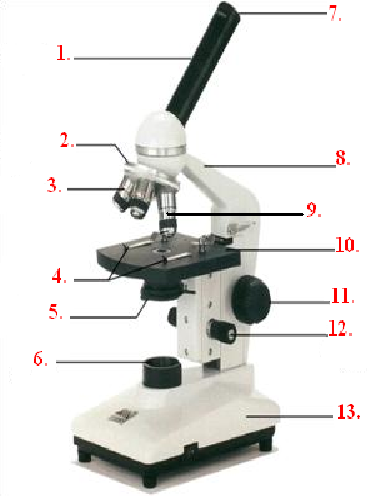
Piece 7
a)
Ocular Lens
b)
Objective Lens
c)
Base
d)
Arm
2.

Number 3
a)
Ocular Lens
b)
Objective Lens
c)
Diaphragm
d)
Base
3.

Number 8
a)
Base
b)
Stage
c)
Tube
d)
Arm
4.

Number 4
a)
Stages
b)
Arms
c)
Stage Clips
d)
Ocular Lens
5.
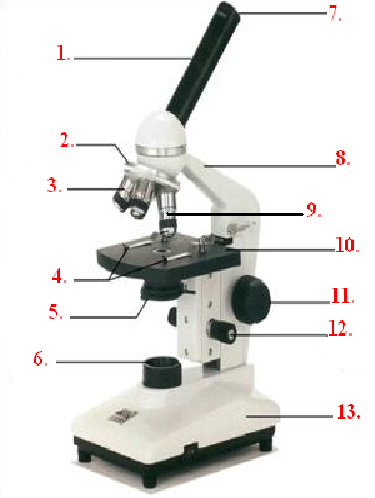
Number 10
a)
Stage
b)
Stage Clips
c)
Diaphragm
d)
Base
6.
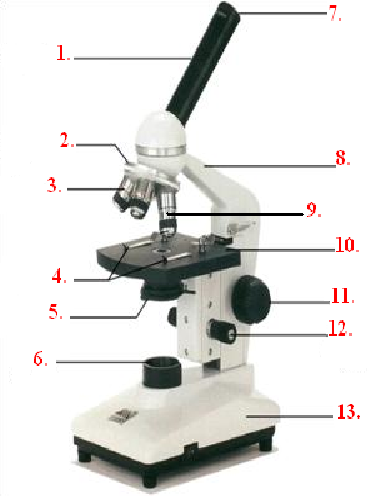
Number 12
a)
Course Adjustment
b)
Fine Adjustment
c)
Small Adjuster
d)
Large Adjuster
7.

Number 11
a)
Course Adjustment
b)
Fine Adjustment
c)
Small Adjuster
d)
Large Adjuster
8.

Number 5
a)
Knob
b)
Ocular Lens
c)
Diaphragm
d)
Objective Lens
9.

Number 6
a)
Insulator
b)
Objective Lens
c)
Ocular Lens
d)
Light
10.

Number 13
a)
Arm
b)
Light
c)
Base
d)
Stand
11.
Cells are the base unit and function of living things.
a)
True
b)
False
12.
The cell theory states
a)
All living things are composed of cells
b)
All cells are produced from other cells
c)
Dead cells help to reproduce new cells
d)
Both A and B
13.
Find the total magnification:
Eyepiece = 10X
Objective lens = 55X
Eyepiece = 10X
Objective lens = 55X
a)
10x
b)
55x
c)
65x
d)
550x
14.
You can find total magnification by which of the following methods?
a)
ocular PLUS objective
b)
ocular TIMES objective
c)
ocular MINUS objective
d)
ocular DIVIDED BY objective
15.
When would you use the diaphragm?
a)
When you wanted to move the stage
b)
When you wanted to adjust the light
c)
When you wanted to put the microscope away
d)
When you sneeze
16.
You should always carry the microscope by the
a)
arm and base
b)
arm and body tube
c)
arm only
d)
the objectives
17.
When looking at a specimen on your slide, you should always start with the
a)
low objective lens
b)
medium objective lens
c)
high objective lens
d)
super extra high power lens
18.
When looking through your microscope, you move your slide to the right- It appears
a)
to move to the right
b)
to stay the same
c)
to move to the left
d)
vanish
19.
The _______focuses the image under low power.
a)
revolving nosepiece
b)
fine adjustment knob
c)
coarse adjustment knob
d)
arm/neck
20.
The__________ sharpens the image under high magnification.
a)
the diaphragm
b)
fine adjustment knob
c)
coarse adjustment knob
d)
the ocular
21.
The lens you look through, closest to the top of the microscope, is called the
a)
objective lens
b)
ocular lens
c)
diaphragm
d)
light source
22.
The ________ of the microscope would show you the MOST zoomed in image, or the SMALLEST field of view.
a)
low power objective
b)
medium power objective
c)
high power objective
d)
stage
23.
Never use this when on high power.
a)
Fine adjustment
b)
Diaphragm
c)
Course adjustment
d)
Stage clips
24.
Who was the person who used his microscope to observe a thin slice of cork, and concluded that the cork was made up of cells?
a)
Robert Hooke
b)
Bill Nye
c)
Matthias Schleiden
d)
Rudolf Virchow
25.
Which scientist came up with the first IDEA for a microscope?
a)
Janssen
b)
Leewenhoek
c)
Hooke
d)
Bill Nye
(BILL BILL BILL)
(BILL BILL BILL)
26.
What is the function of stage clips?
a)
To move the objectives
b)
To keep the slide secure
c)
To adjust the focus
d)
To look through
27.
What will be the total magnification if the ocular lens is 10X and the objective lens is 10X?
a)
10X
b)
100X
c)
1000X
d)
1X
28.
The higher the magnification, the ________ you see of the specimen.
a)
more
b)
less
c)
higher
d)
lower
29.
Lenses consist of low 4X, medium 10X, and high 40X. These are called----
a)
Eyepiece
b)
Ocular Lens
c)
Objective Lenses
d)
Illuminators
30.
Where do you place the slide to view it?
a)
Base
b)
Stage Clips
c)
Diaphragm
d)
Stage
31.
Projects and provides light upward to view specimen; illuminator
a)
Aperature
b)
Light Source
c)
Stage
d)
Stage Clips
32.

What is the name of this scientific tool?
a)
Compound Light Microscope
b)
Scanning Electron Microscope
c)
Transmission Electron Microscope
d)
Teloscope
33.
What scientific tool bounces electrons off the surface of a specimen to create a 3D image?
a)
Compound Light Microscope
b)
Scanning Electron Microscope
c)
Transmission Electron Microscope
d)
Teloscope
34.

What scientific tool created this detailed, highly magnified image of a cell's mitochondria?
a)
Compound Light Microscope
b)
Scanning Electron Microscope
c)
Transmission Electron Microscope
d)
Teloscope
35.

What scientific tool created this image of plant cells, magnified 400x?
a)
Compound Light Microscope
b)
Scanning Electron Microscope
c)
Transmission Electron Microscope
d)
Teloscope
36.

What scientific tool was used to create this 3D image?
a)
Compound Light Microscope
b)
Scanning Electron Microscope
c)
Transmission Electron Microscope
d)
Ultrasound
37.
What scientific tool uses a series of lenses and light to magnify specimens?
a)
Compound Light Microscope
b)
Scanning Electron Microscope
c)
Transmission Electron Microscope
d)
Teloscope
38.
What scientific tool shoots electrons through a thin specimen to produce highly detailed, highly magnified images?
a)
Compound Light Microscope
b)
Scanning Electron Microscope
c)
Transmission Electron Microscope
d)
MRI
39.
What unit is used to measure mass?
a)
Celsius
b)
Grams
c)
Liters
d)
Meters
40.

What unit would you use when measuring with this instrument?
a)
Celsius
b)
Grams
c)
Liters
d)
Meters
41.

What is the name of this scientific tool?
a)
Beaker
b)
Graduated Cylinder
c)
Thermometer
d)
Triple Beam Balance
42.
When measuring the length of a pencil, what unit would you use?
a)
Kilometers
b)
Meters
c)
Centimeters
d)
Millimeters
43.
What unit is used to measure the volume of water in a swimming pool?
a)
Kiloliters
b)
Liters
c)
Centiliters
d)
Milliliters
44.

What is this scientific tool used for measuring?
a)
Length
b)
Mass
c)
Temperature
d)
Volume
45.

What metric unit accompanies measurements from this equipment?
a)
Celsius
b)
Centimeters
c)
Fahrenheit
d)
Grams
46.
What unit would be used to measure your mass?
a)
Grams
b)
Kilograms
c)
Milligrams
d)
Pounds
47.
What is the correct SI unit for mass?
a)
Kilograms
b)
newtons
c)
pounds
d)
grams
48.

The distance between New York City and Miami, Florida would be measured in __?__.
a)
kilometers (km)
b)
meters (m)
c)
centimeters (cm)
d)
millimeters (mm)
49.

The SI unit for time is the __?__.
a)
meter (m)
b)
liter (L)
c)
gram (g)
d)
second (s)
50.

The metric prefix "kilo" means __?__.
a)
one tenth (0.1)
b)
one thousandth (0.001)
c)
one hundred (100)
d)
one thousand (1,000)
51.

Which of the following is NOT correct?
a)
kilo means 1000
b)
hecto means 100
c)
milli means one-thousandth
d)
centi means one tenth (0.1)
52.

28 °C = __?__ K
a)
301
b)
245
c)
401
d)
345
53.
What is the metric prefix for milli?
a)
h
b)
he
c)
k
d)
m
54.
Which lists metric units, in order, from smallest to largest?
a)
milligram, centigram, gram
b)
kilogram, gram, centigram
c)
decagram, hectogram, milligram
d)
kilogram, hectogram, decagram
55.
Give the correct abbreviation: micrometer
a)
mm
b)
micm
c)
μm
d)
Mm
56.
Controls the amount of light allowed to pass through the specimen
a)
diaphragm
b)
light source
c)
stage clips
d)
fine adjustment
57.
Cells are often called "the ____ of life."
a)
bread
b)
road map
c)
building blocks
d)
meaning
58.
All organisms are made of:
a)
organelles
b)
cytoplasm
c)
DNA
d)
cells
59.
All existing cells are produced by other
a)
living cells
b)
dead cells
c)
atom cells
d)
animal cells
60.
The characteristics of life include all of the following except
a)
must be able to move
b)
must have at least one cell
c)
must be able to combust
d)
must be able to reproduce
61.
Rocks are not living because
a)
they never move
b)
they aren't needed for humans
c)
they are not made of cells
d)
they don't break down
62.
Holds objective lenses; Rotatates to change objectives
a)
Arm
b)
Base
c)
Revolving Nosepiece
d)
Diaphragm
63.
What happens to the view of the image as the power of magnification is increased?
a)
By increasing the power of magnification, the image becomes more detailed.
b)
By increasing the power of magnification, the image is reversed.
c)
By increasing the power of magnification, you are able to see more of what surrounds the specimen.
d)
By increasing the power of magnification, the specimen magically becomes alive!
64.

What is the length of the eraser?
a)
3 cm
b)
2 cm
c)
5 cm
d)
7 cm
65.

What is the volume of liquid in this graduated cylinder?
a)
40.0 mL
b)
40.3 mL
c)
43.0 mL
d)
44.0 mL
66.

At which point should your eyes be when you read a graduated cylinder? (Hint: see the letter next to the eye)
a)
A
b)
B
c)
C
67.

What is the volume of the fish?
a)
18.0 cm3
b)
6.0 cm3
c)
38.0 cm3
68.

How much water should be added to raise the volume to 20mL?
a)
1.0 mL
b)
2.0 mL
c)
3.0 mL
d)
4.0 mL
69.
Using your senses to gather information.
a)
hypothesis
b)
observation
c)
seeing
d)
guessing
70.
How many cm's is in a meter?
a)
1000
b)
10
c)
100
d)
1
71.
If a lab fire erupts, immediately:
a)
A. Notify (or tell) your teacher
b)
B. Run and scream
c)
C. Throw water at the fire
d)
D. Open the windows
72.
Why are approved eye protection devices (such as goggles) are worn in the lab?
a)
A. To improve your vision
b)
B. To make you look like a bug
c)
C. To give you headaches
d)
D. To protect eyes around chemicals, heat, or glassware
73.
If you have been injured in the lab, what should you do first?
a)
A. Apply the first aid yourself
b)
B. Go to doctor after school in a few hours
c)
C Tell your science teacher immediately
d)
D. Not tell anyone
74.

You may eat or drink in the science laboratory...
a)
after you have washed your hands.
b)
on the days you are not doing a lab.
c)
only from the beakers.
d)
at no time unless given teacher approval.
75.
Labs are individual activities and you should ignore your group members or be the only one working.
a)
True
b)
False
100 %

