
 Worksheets
Ecology Unit Review
Total questions: 65
Worksheet time: 3600secs
Name
Class
Date
1.

symbiotic relationship in which both organisms benefit
a)
competition
b)
Mutualism
c)
nitrogen fixation
d)
energy pyramid
2.

which symbiosis is this
a)
parasitism
b)
mutualism
c)
commensalism
d)
nonalism
3.
Autotrophs make up the _______ level in all ecosystems.
a)
First
b)
Second
c)
Third
d)
Fourth
4.
What is the term for each step in the transfer of energy and matter within a biological community?
a)
energy path
b)
food web
c)
trophic level
d)
food pyramid
5.
What is the original source of almost all energy in most ecosystems?
a)
carbohydrates
b)
sunlight
c)
water
d)
carbon
6.

A living relationship between two species in which one organism is harmed is called...
a)
mutualism
b)
commensalism
c)
parasitism
d)
niche
7.
A group of organisms of the same species that live in the same area
a)
community
b)
population
c)
biome
d)
ecosystem
8.

The process of plants losing water through their leaves is called ____.
a)
condensation
b)
evaporation
c)
transpiration
d)
exhaling
9.
What is the most abundant gas in the atmosphere?
a)
hydrogen
b)
oxygen
c)
helium
d)
nitrogen
10.

What is this a picture of?
a)
Nitrogen cycle
b)
carbon cycle
c)
water cycle
d)
plant cycle
11.
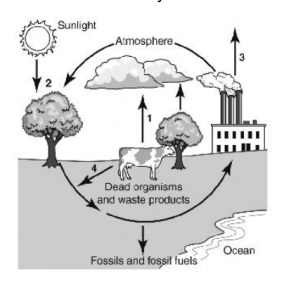
What cycle is in the image?
a)
carbon cycle
b)
water cycle
c)
nitrogen cycle
12.

Organisms that break down dead plants & animals and release nitrogen back into atmosphere...
a)
bacteria
b)
plants
c)
animals
d)
producers
13.
Abiotic
a)
living
b)
nonliving
14.
organisms that make their own food
a)
consumer
b)
omnivore
c)
decomposers
d)
producer
15.
an organism that breaks down dead organisms and waste to live and grow
a)
producers
b)
consumers
c)
decomposers
16.
omnivore means
a)
an organism that eats meat
b)
an organism that eats plants
c)
an organism that eats plants and animals
d)
an organism that decomposes
17.
fungi, bacteria, and worms are examples of
a)
decomposers
b)
producers
c)
omnivores
d)
consumers
18.

Look at the picture...is it a consumer, decomposer, or a producer?
a)
consumer
b)
decomposers
c)
producer
19.

Look at the picture...is it a consumer, decomposer, or a producer?
a)
consumer
b)
decomposer
c)
producer
20.

Look at the picture... is it a consumer, producer, or decomposer?
a)
consumer
b)
producer
c)
decomposer
21.

Look at the picture... is a consumer, producer, or decomposer?
a)
consumer
b)
producer
c)
decomposer
22.
a diagram that shows many connected food chains and feeding relationships in an ecosystem
a)
food web
b)
food chain
c)
food pyramid
d)
nitrogen cycle
23.
If a deer eats leaves and berries, what type of consumer is the deer?
a)
omnivore
b)
carnivore
c)
herbivore
d)
producer
24.
A biotic part of a desert is a
a)
cactus
b)
sand
c)
the sun
25.
Animals that hunt and kill other animals for food are known as
a)
herbivores
b)
omnivores
c)
prey
d)
predators
26.
A large, relatively distinct region with a similar climate, soil, plants, and animals
a)
ecozones
b)
biotopes
c)
biomes
d)
biodomes
27.
Earth’s biomes are divided into _________ biomes, and __________biomes
a)
terrestrial, aquatic
b)
hot, cold
c)
north, south
d)
east, west
28.
Which biome is a treeless biome in the far north with harsh, cold winters and extremely short summers
a)
tundra
b)
desert
c)
temperate deciduous forest
d)
tropical rain forest
29.
Which type of trees characterizes our biome, here in SC?
a)
deciduous
b)
cacti
c)
ginko
d)
palm
30.
Which biome is also called the "taiga"
a)
temperate deciduous forest
b)
boreal forest
c)
temperate rainforest
d)
tropical rainforest
31.
Which major biome's lack of precipitation limits plant grow and is home to cacti, mesquite, white thorn, pack rats, small reptiles, and coyotes?
a)
desert
b)
taiga
c)
tundra
d)
grassland
32.
This biome is just south of the tundra. It contains mostly spruce trees and Douglas firs, which are both evergreen. The winters are long and cold and the summers are short and rainy. The soil is very rich. Moose and elk live here.
a)
boreal forest
b)
chaparral
c)
temperate deciduous forest
d)
temperate rainforest
33.

The biome known for trees with broad leaves that fall off the trees in the winter.
a)
Coniferous Forests
b)
Temperate Deciduous Forests
c)
Deserts
d)
Tundra
34.
An organism that is killed and eaten by another organism
a)
Predator
b)
Prey
c)
Competition
d)
Adaptation
35.
What does symbiosis mean?
a)
A.living separately, no relationship between 2 species
b)
A.living together, close relationship between 2 species
c)
A.Living separately, long distance relationship between 2 species
d)
When one species kills and eats another
36.
What type of symbiosis?
* Hummingbirds feed on nectar from flowers.
* Flowers are pollinated by hummingbirds as they move from flower to flower.
* Hummingbirds feed on nectar from flowers.
* Flowers are pollinated by hummingbirds as they move from flower to flower.
a)
commensalism
b)
mutualism
c)
parasitism
d)
predation
37.
What type of symbiosis?
*Snapping Shrimp have poor and depend on their goby fish roommate to give the danger signal when predators come and guide them
back home if they wander too far.
* Goby fish who don't have a place to hide are quickly eaten. They find a Snapping Shrimp roommate who digs a hole for both to live in.
*Snapping Shrimp have poor and depend on their goby fish roommate to give the danger signal when predators come and guide them
back home if they wander too far.
* Goby fish who don't have a place to hide are quickly eaten. They find a Snapping Shrimp roommate who digs a hole for both to live in.
a)
commensalism
b)
mutualism
c)
parasitism
d)
predation
38.
What type of symbiosis?
*The tick lives on dog and feeds on its blood and tissue.
* The dog gets skin irritation and can pick up diseases carried by tick.
*The tick lives on dog and feeds on its blood and tissue.
* The dog gets skin irritation and can pick up diseases carried by tick.
a)
commensalism
b)
mutualism
c)
parasitism
d)
predfation
39.
What type of Interaction?
* The Red-Chested cuckoo birds find an unattended robin nest, push out the robin eggs, and lay their eggs in the robin’s nest, and leave.
* Robin babies die and robin parents feed and take care of the cuckoo babies.
* The Red-Chested cuckoo birds find an unattended robin nest, push out the robin eggs, and lay their eggs in the robin’s nest, and leave.
* Robin babies die and robin parents feed and take care of the cuckoo babies.
a)
commensalism
b)
mutualism
c)
parasitism
d)
predation
40.
What type of symbiosis?
*Remora use suckers to attach temporarily to large marine animals such as sharks, manta rays, whales, turtles, or large fish.
*The shark provides free transportation, protection, and dropped food and feces which the remora feeds on. The host is not injured.
*Remora use suckers to attach temporarily to large marine animals such as sharks, manta rays, whales, turtles, or large fish.
*The shark provides free transportation, protection, and dropped food and feces which the remora feeds on. The host is not injured.
a)
commensalism
b)
mutualism
c)
parasitism
d)
predation
41.
The struggle between organisms to survive as they attempt to use the same resource
a)
Predator
b)
Prey
c)
Competition
d)
Adaptation
42.
What type of symbiosis?
*Hookworms can enter the body, live off of the host’s blood.
*The host can suffer from blood loss, anemia and iron deficiency.
*Hookworms can enter the body, live off of the host’s blood.
*The host can suffer from blood loss, anemia and iron deficiency.
a)
commensalism
b)
mutualism
c)
parasitism
d)
predation
43.
Which of the following population growth patterns would occur if a species of rabbits was introduced to an island on which they had a plentiful supply of food and no natural predators?
a)
Logistic growth
b)
Exponential growth
c)
Boom and bust growth
d)
Lagging growth
44.
Which of the following organisms serves as a pioneer species during primary succession?
a)
Small plants
b)
Earthworms
c)
Lichens
d)
Birds
45.
Which of the following terms refers to the maximum number of individual an environment can support for an extended period of time?
a)
Carrying capacity
b)
Climax community
c)
Logistic growth maximum
d)
Density dependent capacity
46.
If an ecosystem is destroyed by a tornado, by what process would it be rebuilt?
a)
Primary succession
b)
Secondary succession
c)
Climatic restoration
d)
Ecological restoration
47.
Which of the following terms refers to the mature plant and animals characteristic of an ecosystem?
a)
Climax community
b)
Carrying capacity
c)
Pioneer species
d)
Abiotic factors
48.
Which level of ecology brings in non-living factors?
a)
Community
b)
Ecosystem
c)
Biome
d)
Population
49.

What does the graph represent?
a)
Emigration
b)
Exponential growth
c)
Immigration
d)
Logistic Growth
50.
Which limiting factor would increase due to the number of individuals in a population?
a)
Unusual weather
b)
Natural disaster
c)
Births
d)
Disease
51.
Which limiting factor is independent of the number of individuals in a population?
a)
competition
b)
parasitism/disease
c)
stress
d)
natural disasters
52.
Organisms move away from an area
a)
Competition
b)
Predation
c)
Emigration
d)
Immigration
53.
What kind of factor: flood?
a)
density-independent
b)
density-dependent
54.
What kind of factor: predation?
a)
density-independent
b)
density-dependent
55.

Which kind of distribution is #1?
a)
clumped
b)
random
c)
uniform
56.

Refer to the diagram of the survivorship curve.
Which curve best describes an organism that invests a lot of energy in parenting?
Which curve best describes an organism that invests a lot of energy in parenting?
a)
A
b)
B
c)
C
d)
this is not a survivorship curve
57.

Which survivorship curve represents a species where most of the individuals live through their lives and die of old age?
a)
Type 1
b)
Type 2
c)
Type 3
58.

The average number of people per square mile
a)
population distribution
b)
population density
c)
urbanization
d)
population rate
59.

A aquatic biome classified as marine would have...
a)
Fresh Water
b)
Salt Water
c)
Either Fresh Water or Salt Water
d)
Neither Fresh Water or Salt Water
60.
An estuary is where
a)
fresh water meets ponds
b)
fresh water meets lakes
c)
fresh water meets streams
d)
fresh water meets salt water
61.
These include all lakes/streams/rivers and all surrounding land which drains toward it.
a)
Marsh
b)
Swamp
c)
Watershed
d)
Basin
62.
This Wetland is dominated by trees and the top layer of soil is organic with mineral soil beneath.
a)
Swamp
b)
Bog
c)
Marsh
d)
Seep
63.
An ecosystem where water covers the soil or water is near the surface of the soil is called
a)
a desert
b)
an ocean
c)
an estuary
d)
a wetland
64.
This area is a very harsh environment in the ocean due to tides crashing and receding.
a)
Coral Reef
b)
Aphotic Zone
c)
Abyss
d)
Intertidal Zone
65.
When a lake fills with Nitrogen and Phosphorus this process occurs.
a)
Photosynthesis
b)
Digestion
c)
Decomposition
d)
Eutrophication
100 %

