
 Worksheets
tectonic plates
Total questions: 80
Worksheet time: 1hrs 18mins
Name
Class
Date
1.

Name this boundary
a)
Convergent
b)
Divergent
c)
Transform
d)
Sergent
2.

Name the boundary
a)
divergent
b)
convergent
c)
transform
d)
sergent
3.

Name the boundary
a)
convergent
b)
transform
c)
divergent
d)
sergent
4.
Which of the following is where one plate slides under another plate?
a)
submarine zone
b)
divergence zone
c)
subduction zone
d)
lower zone
5.
Which of the following is associated with transform boundary?
a)
volcanoes
b)
mountains
c)
trenches
d)
earthquakes and fault line
6.
Mountains form from....
a)
Plates sliding past one another
b)
collision of plates
c)
plates moving away from each other
d)
none of these
7.
Oceanic crust is.....
a)
Younger and less dense than continental crust
b)
Thinner, younger, and more dense than continental crust
c)
older, thicker, and less dense than continental crust
d)
Bigger and younger than continental crust
8.
Earth's plates are....
a)
Constantly moving and changing the face of the Earth
b)
Never moved
c)
Move seldom and very fast
d)
move when they feel like it
9.
What was the name given to all the continents when they were joined as one super continent?
a)
Supreme Continent
b)
Eurasia
c)
Plate tectonics
d)
Pangea
10.
Whenever a subduction zone is formed a ____ is formed.
a)
mountains
b)
Island arc
c)
rift valley
d)
volcanoes
11.
Which of the following land formation occurs at a divergent continental/continental boundary?
a)
mid-ocean ridge
b)
deep ocean trench
c)
Pacific hot spot
d)
rift valley
12.
What are mid-ocean ridges?
a)
A chain of underwater falls
b)
A chain of underwater volcanoes
c)
A chain of underwater mountains
d)
A chain of underwater rocks
13.
Created by a divergent boundary
a)
rocky mountain
b)
Mariana's Trench
c)
mid-Atlantic ridge
d)
volano
14.
Plates moving apart would be...
a)
convergent
b)
divergent
c)
transform
15.

Which is subducted in an ocean-continental convergent boundary?
a)
continental plate
b)
oceanic plate
16.
What type of boundary creates a new seafloor?
a)
convergent continental to continental
b)
convergent ocean to continental
c)
convergent ocean to ocean
d)
divergent
17.
A subduction zone is formed....
a)
when one tectonic plate sinks below another
b)
at all plate boundaries
c)
when plates diverge
d)
at transform boundaries
18.
Which of the following is the softer moving area of the mantle that contains convection current?
a)
asthenosphere
b)
lithosphere
c)
outer core
d)
oceanic crust
19.
This area contains over 70 percent of volcanoes and 90 percent of earthquakes in the world.
a)
North American plate
b)
Ring of Fire
c)
Fiery rings
d)
African plate
20.
Which of the following did not support the Continental Drift Theory?
a)
Magnetic striping in the ocean floor
b)
identical fossils found in different continents
c)
Mountains that extend over continents
d)
Coastlines of continents such as South America and Africa fit like a puzzle
21.

This is the theory that states that all the continents started as a single massive continent and have been MOVING apart for over 200 million years and the man that proposed it.
a)
The Big Bang Theory, Einstein
b)
The Pangea Theory, Hutton
c)
The Tectonic Plate Theory, Darwin
d)
The Continental Drift Theory, Wegner
22.

This is the driving force behind the movement of tectonic plates.
a)
Mantle convection currents
b)
Oceanic convection currents
c)
Atmospheric convection currents
d)
Solar convection currents
23.

Which is older oceanic or continental crust?
a)
Oceanic
b)
Continental
24.

The rocks closer to the mid-oceanic ridge are younger than the rocks further away from the mid-oceanic ridge.
a)
True
b)
False
25.

The movement of plates at a divergent boundary
a)
move towards each other
b)
slide past each other
c)
move up and down
d)
move away from each other
26.

A land feature that is produced at a convergent boundary is
a)
a valley
b)
an ocean
c)
a canyon
d)
a volcano
27.

This image represents this type of boundary
a)
divergent
b)
transform
c)
convergent
d)
tectonic
28.
Same rocks in Texas as those in Antarctica, this is proof of-
a)
coastal erosion
b)
plate tectonics
c)
ocean currents
d)
glacial melting
29.

Mid Ocean Ridge forms at type of boundary-
a)
Transform Boundary
b)
Convergent Boundary
c)
Divergent Boundary
d)
Hot Spot
30.
Volcanoes form with at type of boundary-
a)
convergent continent to continent
b)
divergent continental
c)
convergent continent to ocean
d)
transform
31.

This is an example of -
a)
convergent
b)
divergent
c)
transform
32.

This is an example of -
a)
convergent
b)
divergent
c)
transform
33.

This is an example of -
a)
convergent
b)
divergent
c)
transform
34.

This is an example of -
a)
convergent
b)
divergent
c)
transform
35.

This is an example of -
a)
convergent
b)
divergent
c)
transform
36.
Come together
a)
convergent
b)
divergent
c)
transform
37.
divide
a)
convergent
b)
divergent
c)
transform
38.
divergent
a)
come together
b)
divide
c)
touch
39.
convergent
a)
come together
b)
divide
c)
touch
40.
transform
a)
come together
b)
divide
c)
touch
41.
Fossils, landforms, glaciers, and puzzle were all evidence of-
a)
big bang theory
b)
tectonic plate theory
c)
sea floor spreading theory
d)
volcanic theory
42.
This image represents this type of boundary
a)
divergent
b)
transform
c)
convergent
d)
tectonic
43.
This is the theory that states that all the continents started as a single massive continent and have been MOVING apart for over 200 million years and the man that proposed it.
a)
The Big Bang Theory, Einstein
b)
The Pangea Theory, Hutton
c)
The Tectonic Plate Theory, Darwin
d)
The Continental Drift Theory, Wegner
44.
The movement of plates at a divergent boundary
a)
move towards each other
b)
slide past each other
c)
move up and down
d)
move away from each other
45.
A land feature that is produced at a convergent boundary is
a)
a valley
b)
an ocean
c)
a canyon
d)
a volcano
46.
What is a tectonic plate?
a)
A peice of the earths crust
b)
A peice of the mantle
c)
A peice of the core
d)
A peice of the whole world
47.
Which type of plate boundary would cause mountains to form
a)
Transform
b)
Convergent
c)
Divergent
d)
Reform
48.
What is the name of the layer that contains the uppermost mantle and crust
a)
Asthenosphere
b)
Mesosphere
c)
Lithosphere
d)
Transosphere
49.
This layer of Earth is the thickest part
a)
crust
b)
outer core
c)
mantle
d)
inner core
50.
What is the name of the area where one crust slides underneath another
a)
no flex zone
b)
subduction zone
c)
transverse zone
d)
school zone
51.
What was the name given to all the continents when they were joined as one super continent
a)
Supreme Continent
b)
N.A.S.E.A.A.A
c)
Wegner World
d)
Pangea
52.

The outside layer of the earth is called ______________________.
a)
core
b)
crust
c)
mantle
d)
outer core
53.

The huge pieces of the earth's crust are called ____________________________.
a)
crust
b)
plates
c)
directions
d)
seismos
54.

This famous transform fault is located in the western United States creates significant earthquake activity for California
a)
New Madrid
b)
Denali Fault
c)
Ramapo Seismic Zone
d)
San Andreas
55.

This famous transform fault is located in the western United States creates significant earthquake activity for California
a)
Sierra Nevada Seismic Zone
b)
Denali Fault
c)
San Fransisco
d)
San Andreas
56.
Earthquakes under the water can cause _________________________________.
a)
tornadoes
b)
tsunamis
c)
lightening
d)
hailstorms
57.
A break in the lithosphere along which movement has occurred is a(n)
a)
fault
b)
earthquake
c)
epicenter
d)
volcano
58.

Earthquakes happen every day. Most are too small for humans to notice.
a)
True
b)
False
59.
Who lives in a pineapple under the sea?
a)
Crazy uncle philip
b)
Spongebob Squarepants
c)
Old Greg
d)
Cthulhu
60.
What is a large ocean wave that results from an underwater earthquake, landslide, or volcanic eruption?
a)
Aftershock
b)
Liquefaction
c)
Seismic Gap
d)
Tsunami
61.

The red lines show the Earth's ________________.
a)
Volcanoes
b)
Plates
c)
Shaking
d)
Fossils
62.
During an earthquake, the ground will _________________.
a)
lava
b)
magnitude
c)
shake
d)
run
63.

The picture is an example of a __________.
a)
fossil
b)
theory
c)
magnitude
d)
evidence
64.
The Earth's plates are _____________.
a)
staying in position
b)
moving
c)
getting smaller
d)
destroyed
65.
What is the shaking of the Earth’s crust caused by a release of energy?
a)
Earthquake
b)
Epicenter
c)
Fault
d)
Plate
66.
Which of the following is NOT a cause of an earthquake?
a)
Collapse of Cavern
b)
Eruption of Volcano
c)
Lightning Strikes
d)
Moving Tectonic Plates
67.

The outside layer of the earth is called ______________________.
a)
core
b)
crust
c)
mantle
d)
outer core
68.

The huge pieces of the earth's crust are called ____________________________.
a)
crust
b)
plates
c)
directions
d)
seismos
69.
The Richter scale measures:
a)
the amount of radon gas released
b)
the movement of plates
c)
the strength of an earthquake
d)
the weight of tectonic plates
70.
Scientists think that convection currents flow in Earth's
a)
continents
b)
mantle
c)
lithosphere
d)
inner core.
71.
Which layer of Earth is the thinnest?
a)
crust
b)
mantle
c)
outer core
d)
inner core
72.

Part of mantle where lithosphere floats
a)
Crust
b)
Core
c)
Asthenosphere
d)
Atmosphere
73.

One large landmass
a)
North America
b)
Pangea
c)
South America
d)
PanAmerica
74.

Heat transfers within the Earth
a)
Conduction
b)
Convection Current
c)
Ocean Current
d)
Radiation
75.

Addition of new sea floor
a)
Subduction
b)
Sea Floor Spreading
c)
Sea Floor subduction
d)
Convergent
76.
To make new crust, ____ is pushed up from the mantle.
a)
Lava
b)
Iron
c)
Magma
d)
Nickel
77.

Plates sliding past each other in opposite directions
a)
Convergent
b)
Divergent
c)
Subduction
d)
Transform
78.
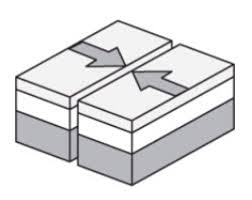
Name the boundary
a)
convergent boundary
b)
divergent boundary
c)
transform boundary
d)
sergent boundary
79.
A subduction zone is formed...
a)
when one tectonic plate sinks below another
b)
at every type of convergent plate boundary
c)
at every type of divergent plate boundary
d)
at transform boundaries
80.
What are mid-ocean ridges?
a)
A chain of underwater waterfalls
b)
A chain of underwater volcanos
c)
A chain of underwater mountains
d)
A chain of underwater rocks
100 %

