wayground logo

Free Printable Worksheets

NEW

Font size

S
M
L
XL
Worksheets

Weathering, Soil, and Erosion Test Practice Questions

Total questions: 67

Worksheet time: 2hrs 35mins
Name
Class
Date
1.
The natural chemical or physical processes that breaks down rock on Earth's surface.
a)
weathering
b)
erosion
c)
deposition
d)
jackhammering
2.
This type of weathering occurs when rock is physically broken down into smaller pieces of rock.
a)
mechanical weathering
b)
chemical weathering
c)
erosion weathering
d)
deposition
3.
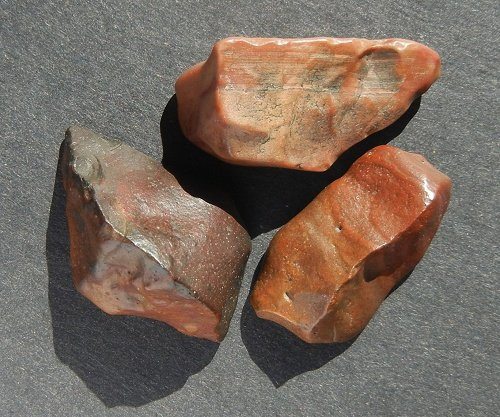
These rocks were made smooth by wind blowing smaller rock particles across their surface.  This is an example of:
a)
ice wedging
b)
chemical weathering
c)
acid rain
d)
abrasion
4.
These rocks were broken apart from the continuous freeze/thaw of water in the cracks of the rocks. This is an example of:
a)
ice wedging
b)
acid rain
c)
permeability
d)
abrasion
5.
How is mechanical weathering different from chemical weathering?
a)
Chemical weathering happens over much shorter time frame than mechanical weathering.
b)
Chemical weathering changes the chemical composition of rocks; mechanical weathering does not.
c)
Chemical weathering occurs only in tropical climates; mechanical weathering occurs only in cool climates.
d)
Chemical weathering occurs only in the mountains; mechanical weathering occurs only on flat land.
6.
Weeds growing into the cracks in a sidewalk and the sidewalk begins to crumble is an example of:
a)
mechanical weathering
b)
chemical weathering
7.
Potholes forming in the road after a cold winter is an example of:
a)
mechanical weathering
b)
chemical weathering
8.
A metal statue slowly turning green after years of being outside is an example of:
a)
mechanical weathering
b)
chemical weathering
9.
Rust that forms on rocks or metal because of extended exposure to oxygen is what example of chemical weathering?
a)
carbon dioxide (carbonic acid)
b)
acid rain
c)
oxidation
d)
lichens
10.
Which type of climate would cause the greatest rate of weathering?
a)
Cold and dry
b)
Cold and humid (wet)
c)
Warm and humid (wet)
d)
Warm and dry
11.

The surfaces of old marble statues are often covered with small holes or pits. Which of these MOST LIKELY causes these holes or pits?

a)

The concrete becomes pitted as water freezes in small cracks in the statue.

b)

The concrete is chipped away by sand particles blown by strong winds

c)

The concrete is chemically weathered by acid rain.

d)

Long exposure to sunlight causes the pits to form.

12.
All of the following are causes of physical weathering except...
a)
plant growth
b)
wind
c)
acid rain
d)
running water
13.
How does freezing water cause the weathering of rocks?  The freezing water—
a)
keeps the rocks in place
b)
makes the rocks last longer
c)
expands cracks and breaks rocks
d)
causes rocks to fall in landslides
14.
Soil is made of
a)
weathered rocks and minerals
b)
dead plants and animals
c)
air and water
d)
all of the above
15.
Humus is.....
a)
the dead parts of plants and animals in soil.
b)
A food we eat with pretzels.
c)
The tiny particles inside of soil
d)
The roots that come off of a plant and live in soil.
16.
Layers of soil are also known as:
a)
Soil Profiles
b)
Soil Horizons
c)
Soil sheets
d)
Soil cores
17.
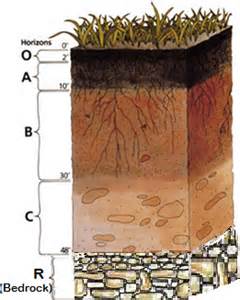
What is the layer of soil that contains leaf litter and organic matter?
a)
O - Organic
b)
A - Topsoil
c)
B - Subsoil
d)
R - Bedrock
18.
Why are Layer O (located above topsoil)  and Layer A (topsoil) darker than all other levels of soil?
a)
It contains all the darker colored minerals
b)
It contains volcanic rock
c)
It contains more organic matter
d)
It contains bits of burned trees
19.
Soil formation begins with the weathering of_______.
a)
Humas
b)
Subsoil
c)
Litter
d)
Rock
20.
Decayed organic material in soil is called______.
a)
Litter
b)
Silt
c)
Humus
d)
Clay
21.
Why is soil not the same everywhere?
a)
different climates
b)
different amount of rain
c)
different organic matter
d)
all of the above
22.
The two main factors that determine the rate of weathering are the TYPE of rock and_____.
a)
Music
b)
Climate
c)
Size of rock
d)
Weight of rock
23.
Organic matter is made of materials that….
a)
Were once living
b)
Were once nonliving
c)
Were once living and nonliving
24.
What do we call the layers of soil?
a)
Deposits
b)
Horizons
c)
Minerals
d)
Rocks
25.
_______ is the type of soil used most often with plants. It is a mixture of clay, sand, and silt.
a)
loam
b)
humus
c)
mud
d)
dirt
26.
Layers of soil are also known as:
a)
Soil Profiles
b)
Soil Horizons
c)
Soil sheets
d)
Soil cores
27.
Topsoil; almost all living things inhabit this layer which contains humus and other organic materials
a)
Horizon A
b)
Horizon B
c)
Horizon C
28.
Subsoil; contains minerals leached from topsoil, clay, and sometimes humus
a)
Horizon A
b)
Horizon B
c)
Horizon C
29.
Partially weathered bedrock
a)
Horizon A
b)
Horizon B
c)
Horizon C
30.
What is the layer of soil that contains humus, leaf litter, and other organic matter?
a)
O - Organic
b)
A - Topsoil
c)
B - Subsoil
d)
R - Bedrock
31.
Which horizon is made up of partially weathered rocks?
a)
Horizon A
b)
Horizon B
c)
Horizon C
d)
Horizon R
32.
What is groundwater?
a)
any form of liquid water
b)
water that is not moving
c)
water on Earth's surface
d)
water below Earth's surface
33.
What force is responsible for erosion and deposition in landslides?
a)
gravity
b)
ice
c)
wind
d)
temperature
34.
Which erosion agent is used to develop a creep?
a)
gravity
b)
glaciers
c)
oxidation
d)
wind
35.
Which type of sediment will be dropped first as the wind slows?
a)
biggest
b)
smallest
c)
heaviest
d)
lightest
36.
Which of these is an example of erosion
a)
Light Shinning onto a mountain
b)
Rain breaking down rock 
c)
Wind blowing away sediment
d)
All of the above
37.
The movement that occurs during mass wasting is caused by what? 
a)
Wind
b)
Gravity 
c)
Ice 
d)
Water 
38.
Which of the following is not an example of mass wasting? 
a)
Landslide
b)
Slump
c)
Flood
d)
Creep 
39.
Trees, walls, and fence posts leaning downhill are a sign of ______. 
a)
Rockfalls
b)
Mud Flow
Mud Flows
c)
Creep
d)
Slump
40.
What glacial features are indicated by the labels C and D on the figure?
a)
moraines
b)
outwash plains
c)
kettle lakes
d)
ice sheets
41.
When mass wasting occurs at a slow pace, which term is applied?
a)
rock fall
b)
creep
c)
landslide
d)
glaciation
42.
Big chunks of land falling down a curved slope all at once would be an example of
a)
Slump
b)
Creep
c)
Rockfall
d)
Lahar
43.
Which of the following statements best describes a slump?
a)
slippage of a block of material moving along a curved surface
b)
blocks of rock sliding down a slope
c)
rapid flow of water-saturated debris, most common in mountainous areas
d)
slow downhill movement of soil and regolith
44.
What process(es) might result in the peaks of mountains becoming smooth and rounded?
a)
deposition
b)
weathering and erosion
c)
tectonic plates spreading apart
d)
tectonic plates sliding past
45.
What is an enormous mass of ice moving over land?
a)
Ice wedging
b)
Glacier
c)
Iceberg
d)
Dune
46.

Weathering caused by glaciers is mostly by

a)

ice wedging and oxidation

b)

abrasion and ice wedging

c)

root wedging and abrasion

d)

mass wasting and abrasion

47.
a large rock transported from a distant source by a glacier
a)
erratic
b)
moraine
c)
horne
d)
kettle
48.

Deep grooves left by glacial abrasion are called what?

a)

horns

b)

striations

c)

slumps

d)

avalanches

49.

Which of these is not one of the 5 factors of soil formation?

a)

Climate

b)

Country of origin

c)

Slop/topography

d)

Time

e)

Biological Activity

50.

How do plants get the nitrogen they need?

a)

from the air

b)

from the soil or water in which they live

c)

from the Sun

d)

from broken-down rocks

51.

Plants and animals cannot use nitrogen directly from the air.

a)

True

b)

False

52.

Process in which bacteria convert nitrogen gas into a form that can be used by other living things is called

a)

nitrogen fixation

b)

ammonificaiton

c)

nitrification

d)

denitrification

53.
Plants need Nitrogen because...
a)
it helps build strong roots
b)
it helps in the production of seeds and fruit
c)
it builds chorophyll for green leaves
d)
its important for cell division.
54.
Plants need Phosporus because...
a)
it helps build strong roots
b)
it helps in the production of seeds
c)
it builds chorophyll for green leaves
55.
Plants need Potassium because...
a)
it helps build strong roots
b)
it helps in the production of seeds and fruits
c)
it builds chorophyll for green leaves
d)
its important for cell division.
56.
Any material, natural or synthetic that is applied to soil to supply nutrients essential to plant growth.
a)
Fungicide
b)
Fertilizer
c)
Herbicide
d)
Manure
57.
This is what forms when a stream with a low gradient develops a series of gradual bends which may become oxbow lakes.
a)
meandering stream
b)
braided stream
c)
straight stream
d)
first order stream
58.
This forms due to erosion at a meander.
a)
oxbow lake
b)
braided stream
c)
straight stream
d)
floodplain
59.
What river feature does this picture show?
a)
Oxbow Lake
b)
Meander
c)
Estuary
d)
Tributary
60.
What river feature does this image show?
a)
Meander
b)
Oxbow Lake
c)
Tributary
d)
Headwaters
61.
What is the source of a river called?
a)
Point source pollution
b)
Estuary
c)
Headwaters
d)
Flood plain
62.
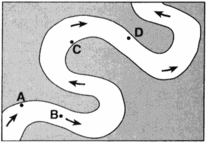
At which location is the greatest amount of sediment most likely being deposited?
a)
A
b)
B
c)
C
d)
D
63.
______________ is the volume (amount) of water that flowing past a certain point in a given amount of time
a)
Capacity
b)
Competence
c)
Discharge
d)
Gradient
64.
The ability of a stream to erode and transport materials depends largely on its ________.
a)
velocity
b)
volume
c)
gradient
d)
length
65.
Which is a factor that decreases downstream?
a)
volume
b)
length
c)
gradient
d)
velocity
66.
If the gradient of a stream is decreased, the velocity will
a)
not be affected
b)
be disrupted
c)
decrease
d)
increase
67.
Over time, a meander of a stream will tend to:
a)
get more exaggerated
b)
reduce discharge
c)
erode a deeper channel
d)
fill in with cobbles