
NEW
Font size
S
M
L
XL
 Worksheets
Q3 Benchamark
Total questions: 80
Worksheet time: 3hrs 48mins
Name
Class
Date
1.
What is a major difference between prokaryotic and eukaryotic cells?
a)
Eukaryotic cells are multicellular and Prokaryotic cells are unicellular.
b)
Eukaryotic cells have been on earth longer than Prokaryotic cells.
c)
Prokaryotic cells do not have a nucleus or membrane bound organelles
d)
Prokaryotic cells are bacteria and viruses that make you sick.
2.
Which of the following is not a kind of pathogen?
a)
Bacteria
b)
Protists
c)
Mosquitoes
d)
Fungi
3.
Disease causing organism.
a)
Phagocyte
b)
Pathogen
c)
Pandemic
4.
Ten people became sick with the flu after attending a school dance.What likely happened?
a)
Contact with environmental sources
b)
contact with an infected animal
c)
contact with a contaminated object
d)
contact with an infected person
5.
Which is the BEST way to prevent the flu from becoming a pandemic?
a)
getting a vaccination
b)
taking antibiotics
c)
eating fruits and vegetables
d)
washing hands often
6.
Which is a reactant of photosynthesis?
a)
Oxygen
b)
Carbon Dioxide
c)
Nitrogen
d)
Glucose
7.
Which is a product of photosynthesis?
a)
Oxygen
b)
Carbon Dioxide
c)
Water
d)
Nitrogen
8.
Which is a reactant of cellular respiration?
a)
Carbon Dioxide
b)
Nitrogen
c)
Water
d)
Oxygen
9.
What do plants get from animals?
a)
carbon dioxide
b)
oxygen
c)
sugar
d)
emotional support
10.
How does carbon get from plants to animals?
a)
through food in the form of glucose
b)
in the air
c)
through water
d)
Fedex
11.

In the carbon cycle, what is the role of green plants?
a)
release carbon dioxide into the air
b)
decomposing matter
c)
absorbing carbon dioxide
d)
combustion
12.

What role do animals play in the carbon cycle?
a)
absorb carbon dioxide from the atmosphere
b)
give off carbon dioxide
c)
combustion
d)
decomposing matter
13.
Which best explains how a nonliving virus is able to reproduce?
a)
A virus becomes living when in contact with a host organism.
b)
A virus infects a host organism by injecting its DNA into the cells of the host organism.
c)
A virus infects a host organism by pulling the DNA from the cells of the host organism into itself.
d)
A virus becomes living when a sufficient number of viruses invade a host organism and cause an infection.
14.
Which pathogen can be cured by antibiotics?
a)
Virus
b)
Bacteria
c)
Protist
d)
Fungi
15.
What is another name for natural selection?
a)
survival of the smartest
b)
survival of the fastest
c)
survival of the biggest
d)
survival of the fittest
16.
What is a change in an organism that allows for it to survive in its environment?
a)
homologous
b)
vestigial
c)
variation
d)
adaptation
17.

What is this an example of?
a)
diversity of species
b)
variation
c)
vestigial structures
d)
DNA studies
18.

Darwin wrote that organisms with traits that are best suited to the environment will ________________
a)
increase in number
b)
become extinct
19.
The environment around Manchester, England, changed during the Industrial Revolution because of the increase of smoke being released onto the surrounding trees. How did this change affect peppered moths living in the area?
a)
Natural selection favored moths with dark wings because predators could not see them on the soot-colored trees.
b)
Natural selection favored moths with white wings that were easy for predators to see.
c)
Natural selection favored moths with white wings because predators could not see them on the soot-colored trees.
d)
Natural selection caused moths with white wings to become extinct.
20.

A species of bird ate many types of seeds. The individuals vary in beak size. If a drought were to kill off the trees that produce small seeds and leave only large seeds, how would the population change?
a)
The birds with larger beaks were better at eating the large seeds than those with smaller beaks, so only the birds with larger beaks got enough food to survive, reproduce, and pass the trait of large beaks to the next generation.
b)
The birds with smaller beaks had to work harder than those with larger beaks to crack open the large seeds. The more they used their beaks, the larger their beaks became, so they were able to get enough food to survive, reproduce, and pass the traits of large beaks to the next generation.
c)
The birds with smaller beaks grew their beaks so that they would be better able to eat the large seeds and get enough food to survive, reproduce, and pass the trait of larger beaks to the next generation.
d)
Beak size is random and will not be determined by the types of seeds available.
21.
Since we have our immune system to protect us from disease, why do we still need a vaccine?
a)
Because some diseases are too severe for our immune system.
b)
Because adaptive immunity takes days to weeks to initiate a response and sometimes it is too late.
c)
Because some people are immune deficient or have weak immune systems.
d)
All of the above
22.

Vaccines stimulate the body to produce...
a)
autoimmune diseases
b)
helper t-cells
c)
fever
d)
antibodies
23.
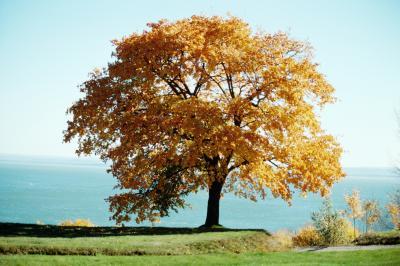
The biome known for trees with broad leaves that fall off the trees in the winter.
a)
Coniferous Forests
b)
Deciduous Forests
c)
Deserts
d)
Tropical Rain Forests
24.
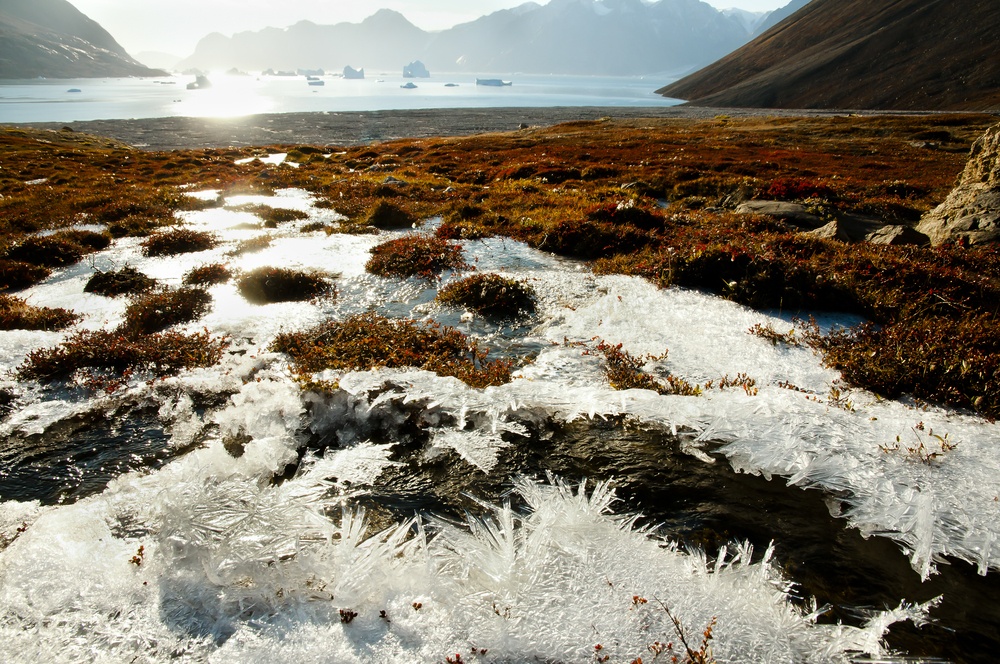
Which Biome has permafrost?
a)
Temperate Forest
b)
Rainforest
c)
Taiga
d)
Tundra
25.
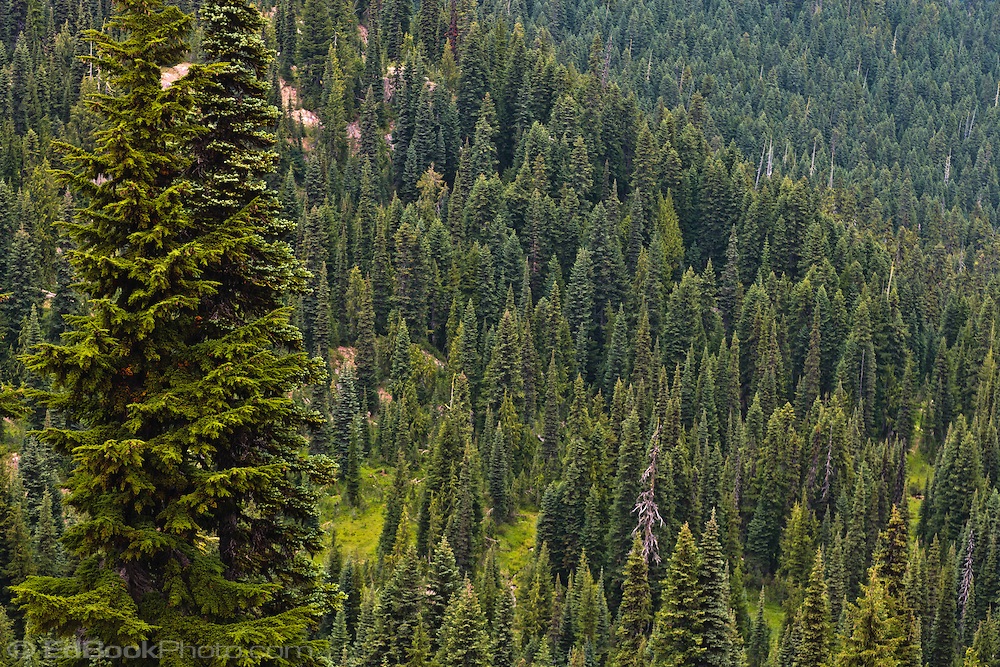
Which biome has coniferous trees (which don't lose their leaves)?
a)
Taiga
b)
Temperate Forest
c)
Tundra
d)
Grasslands
26.
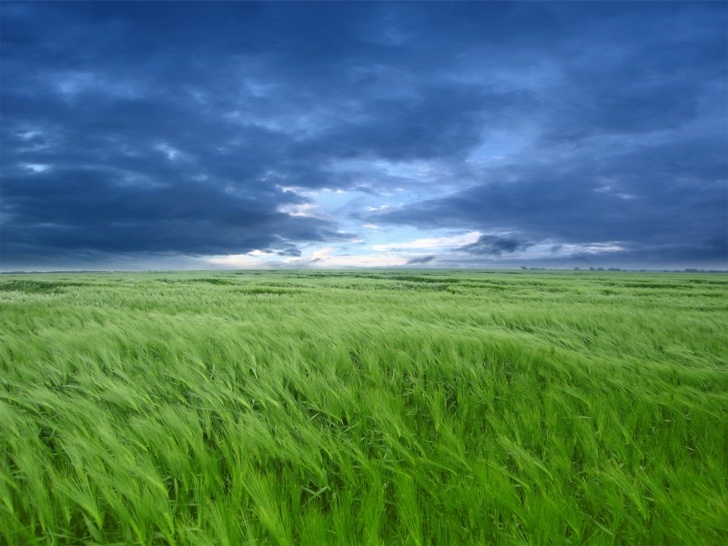
Which biome has wide-open fields of grass?
a)
Taiga
b)
Grasslands
c)
Temperate Forest
d)
Rainforest
27.
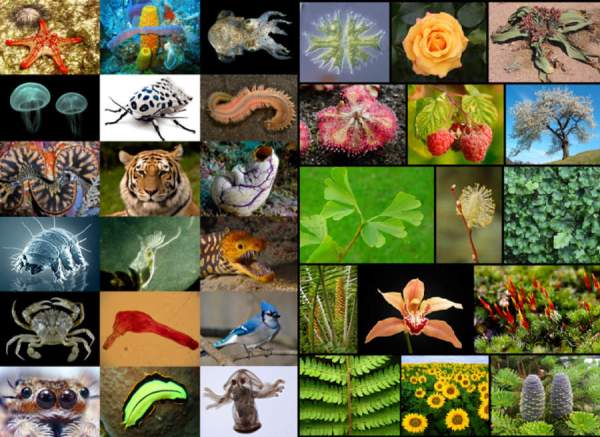
Which biome has the most variety of plants and animals?
a)
Temperate Forest
b)
Rainforest
c)
Tundra
d)
Grasslands
28.
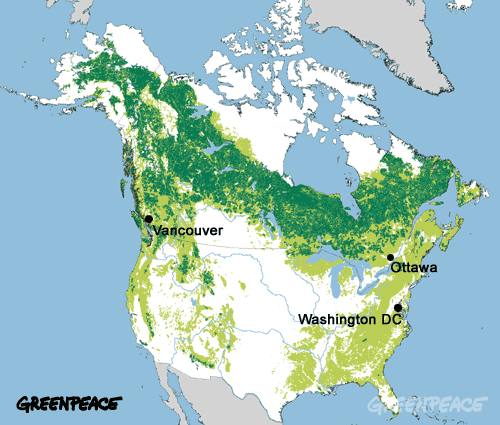
Which biome is Canada in?
a)
Tundra
b)
Taiga
c)
Temperate Forest
d)
Desert
29.

a)
budding
b)
binary fission
c)
sporulation
d)
regeneration
30.
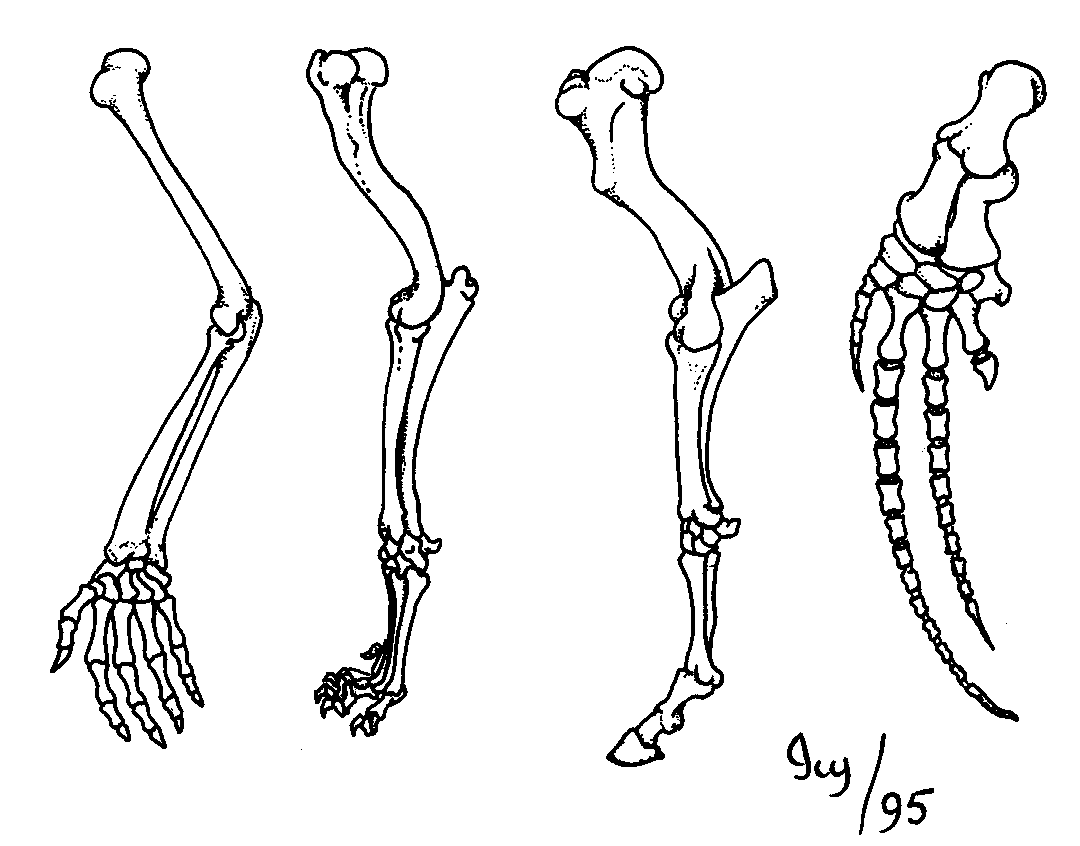
Structures with the same parts have different functions; suggests that organisms share a common ancestry
a)
vestigial structures
b)
homologous structures
c)
adaptive radiation
d)
fossil
31.
If two organisms have similar traits of DNA they are probably
a)
share a common ancestor
b)
share a common environment
c)
share a common population
d)
speciation
32.

Study of embryos of various organisms to show a common ancestor because of similarities in development
a)
natural selection
b)
embryology
c)
speciation
d)
evolution
33.

A dichotomous key for trees is provided. Hikers found a tree that has large brown cones and single sharp needles. What species of tree have the hikers found?
a)
Juniper
b)
Pine
c)
Spruce
d)
Fir
34.

What is the name of bird Z?
a)
Certhidea
b)
Geospiza
c)
Camarhynchus
d)
Platyspiza
35.
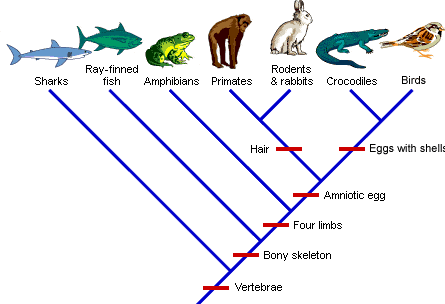
According to this cladogram, sharks are MOST closely related to which organism?
a)
Amphibians
b)
Ray finned fish
c)
Crocodiles
d)
Birds
36.

According to this cladogram, birds are LEAST related to:
a)
Amphibians
b)
Sharks
c)
Ray Finned Fish
d)
Crocodiles
37.

Which trait do only humans have, according to the cladogram?
a)
jaws
b)
mammary glands & hair
c)
terrestrial during all life stages
d)
bipedal & opposable thumbs
38.

According to the data, the unknown bacterial species is most closely related to
a)
Species I
b)
Species II
c)
Species III
d)
Species IV
39.
Which sequence of DNA bases would pair with this partial strand
ATG TGA CAG
ATG TGA CAG
a)
ATG TGA CAG
b)
TAC ACT GTC
c)
GTA AGT GAC
d)
CAT TCA CTG
40.

The process on the left is:
The process on the right is:
The process on the right is:
a)
Left: meiosis
Right: meiosis
Right: meiosis
b)
Left: meiosis
Right: cloning
Right: cloning
c)
Left: mitosis
Right: meiosis
Right: meiosis
d)
Left: mitosis
Right: mitosis
Right: mitosis
41.

A calico cat shows both the traits for orange fur and black fur. What kind of allele expression is this?
a)
Incomplete Dominance
b)
Co dominance
42.

This shows...
a)
Incomplete dominance
b)
Codominance
c)
Sex linked traits
d)
Dominant inheritance
43.

This bacteria is
a)
Streptococcus pyogenes
b)
Staphylococcus aureus
c)
Bacillus cereus
d)
Vibrio cholerae
44.

The bacteria pictured here are
a)
Streptococcus
b)
Staphylococcus
c)
Spirilla
d)
Bacilli
45.

The bacteria pictured here is
a)
Spirilla
b)
Staphylococcus
c)
Streptococcus
d)
Baccilli
46.

The bacteria pictured here is
a)
Spirilla
b)
Staphylococcus
c)
Streptococcus
d)
Bacilli
47.
A man, who has red-green colorblindness, and his wife, who is a carrier for colorblindness, have a colorblind son. What is the probability that their next son will also be colorblind?
a)
0%
b)
25%
c)
50%
d)
100%
48.
In certain species of plants, purple flowers (P) are dominant to white flowers (p). If two heterozygous plants are crossed, what will be the phenotype of the offspring?
a)
100% purple flowers
b)
100% white flowers
c)
75% white flowers, 25% purple flowers
d)
25% white flowers, 75% purple flowers
49.

In fruit flies, red eye color (R) is a sex-linked trait that is dominant over white eye color (r).
According to the Punnett square, what percentage of female offspring will have red eyes?
According to the Punnett square, what percentage of female offspring will have red eyes?
a)
0%
b)
25%
c)
50%
d)
100%
50.
If a woman is a carrier for a sex linked recessive trait of hemophilia and her husband has hemophilia, which of the following is true? Make a punnett square!
a)
All sons will have hemophilia
b)
all daughters will have hemophilia
c)
50% of daughters and 50% of sons have hemophilia
d)
100% of sons have hemophilia and 100% of daughters are carriers
51.

Organisms require nitrogen to make which of the following?
a)
glucose and starch
b)
lipids and nucleic acids
c)
proteins, chlorophyll, and nucleic acids
d)
carbohydrates and proteins
52.

How much of the atmosphere is composed of nitrogen gas?
a)
87%
b)
38%
c)
78%
d)
21%
53.
Which of the following describes the role of nitrogen-fixing bacteria in the nitrogen cycle? Nitrogen-fixing bacteria convert
a)
nitrates intro nitrogen gas
b)
ammonia into proteins
c)
nitrogen gas into ammonia
d)
proteins into nitrates
54.
What forms of nitrogen and carbon can be used by plants?
a)
ammonia and carbon monoxide
b)
ammonia, nitrates, and carbon dioxide
c)
nitrites and carbohydrates
d)
nitrate and carbon monoxide
55.
Which process moves carbon stored in fossil fuel into another carbon reservoir?
a)
When fossil fuels are burned, carbon enters the atmosphere as carbon dioxide.
b)
The denitrifying bacteria turns the fossil fuel into carbon dioxide gas.
c)
Decomposers convert the fossil fuels into greenhouse gases like carbon dioxide.
d)
The fossil fuels react with the soil to produce carbonates and carbon dioxide.
56.
Which of the following is a consequence of excess carbon building up in Earth’s atmosphere?
a)
The amount of breathable oxygen available to living things decreases
b)
Global temperatures change, affecting normal weather patterns.
c)
The amount of solar energy reaching the earth’s surface decreases.
d)
Global air pressure increases making it more difficult for plants and animals to breathe.
57.
Scientists have detected a dramatic decrease in usable nitrogen levels in the soil of a local ecosystem. Which of the following is a likely theory to explain this problem?
a)
A decrease in the amount of lightning strikes.
b)
An increase in fertilizer usage at local farms.
c)
An increase in the biomass forming plants.
d)
A decrease in bacterial colonies within the soil.
58.

The grizzly bear is most related to the
a)
black bear
b)
panda bear
c)
fox
d)
sea star
59.

If layer 3 was estimated to be 5720 years old then what type of dating was used
a)
rock layer
b)
relative
c)
evolutionary
d)
absolute
60.
Which layer is the oldest?
a)
1
b)
2
c)
3
d)
4
61.

The diagram shows fossils in different rock layers. Which of these statements about the age of these fossils is most likely correct?
a)
Fossil A and C are the same age
b)
Fossil B is older than fossil C
c)
Fossils A is older than fossil B
d)
Fossil D is older than fossil C
62.
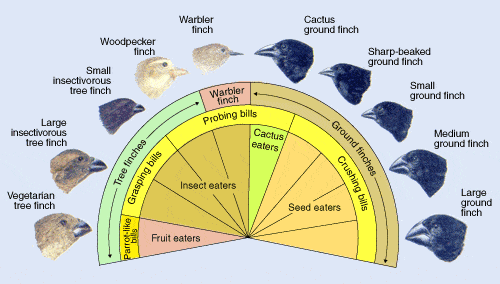
All of these finches have different shaped beaks, they are an adaptation to gain access of
a)
Water
b)
Food
c)
Shelter
63.

The cell below is in a _________ solution.
a)
Hypotonic
b)
Hypertonic
c)
Isotonic
64.

The cell below is in a _____________ solution.
a)
Hypertonic
b)
Hypotonic
c)
Isotonic
65.
An animal cell placed in a hypertonic (salty) solution will
a)
Shrink
b)
Swell
c)
Stay the same
66.
Why can't you drink salt water?
a)
It's hypertonic to your cells
b)
It's hypotonic to your cells
c)
It's isotonic to your cells
d)
It's paratonic to your cells
67.

The figures show four process involving DNA and RNA. Which figure shows the process of transcription?
a)
Figure A
b)
Figure B
c)
Figure C
d)
Figure D
68.
The figures show four process involving DNA and RNA. Which figure shows the process of translation?
a)
Figure A
b)
Figure B
c)
Figure C
d)
Figure D
69.
Which sequence depicts the correct order of protein synthesis within a cell?
a)
DNA → mRNA → amino acids → proteins
b)
DNA → amino acids → mRNA → proteins
c)
DNA → mRNA → proteins → amino acids
d)
DNA → proteins → amino acids → mRNA
70.

What are tiny organelles that convert glucose into ATP?
a)
Ribosomes
b)
Vesicles
c)
Cytoskeleton
d)
Mitochondria
71.

What is a producer?
a)
an organism that gets energy from eating other organisms
b)
an organisms that uses sunlight to make its own food
c)
an organism that gets energy from eating dead organisms, non-living material or waste
d)
an organism that uses chemical energy to make its own food
72.

Which of the following is a herbivore?
a)
cricket
b)
frog
c)
hawk
d)
shrew
73.

Which of the following would be the most likely effect, if there were a sudden increase in the cricket population?
a)
There would be a decrease in the small bird population.
b)
There would be a decrease in the grass/flowers population.
c)
There would be a decrease in the mice population.
d)
There would be an increase in the grass/flowers population.
74.
What might happen if you remove a primary consumer from the ecosystem?
a)
There would be more food for secondary consumers.
b)
The number of primary consumers would increase.
c)
The number of plants would increase.
d)
The number of secondary consumers would increase.
75.
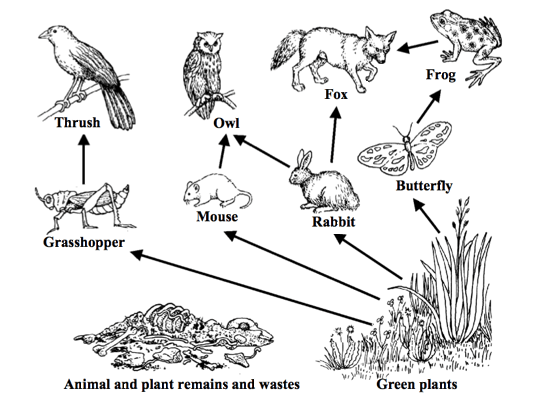
The owl receives energy from which organisms?
a)
grasshopper and mouse
b)
mouse and rabbit
c)
rabbit and butterfly
d)
butterfly and frog
76.

Which consumer receives energy from the leopard seal?
a)
blue whale
b)
penguin
c)
killer whale
d)
elephant seal
77.
What is the total percentage of energy that is transferred through the levels in an energy cycle?
a)
10%
b)
15%
c)
26%
d)
42%
78.
what percent of energy is lost when it transfer from on animal to another.
a)
80%
b)
85%
c)
95%
d)
90%
79.

Identify the process shown in this diagram.
a)
Extinction
b)
Toxin Accumulation
c)
Pollution
d)
Biomagnification
80.

Which organism in this diagram has the highest DDT concentration?
a)
Zooplanktons
b)
small fish
c)
large fish
d)
Fish-eating birds
Reset

