wayground logo

Free Printable Worksheets

NEW

Font size

S
M
L
XL
Worksheets

Plants, Photosynthesis & Respiration

Total questions: 65

Worksheet time: 2hrs 46mins

Name
Class
Date
1.

The part of the plant that holds the plant in place, stores food and absorbs water and minerals from the soil.

a)

stem

b)

roots

c)

leaves

d)

flowers

2.

Which of the following statements best describes phloem's function in the plant?

a)

transports water and minerals up from the roots to the rest of the plant

b)

transports food down from the leaves to the rest of the plant

c)

transports water and minerals down from the roots to the rest of the plant

d)

transports food up from the leaves to the rest of the plant

3.
What is the male part of the flower?
a)
Petals
b)
Stamen
c)
Pistil
d)
Sepals
4.
What is the female part of the flower?
a)
Petals
b)
Stamen
c)
Pistil
d)
Sepals
5.
What is the male reproductive material of plants?
a)
Seeds
b)
Pollen
c)
Fruit
d)
Sepals
6.
What part of the flower turns into the fruit?
a)
Seeds
b)
Ovary
c)
Stamen
d)
Sepals
7.
What is the waxy layer on leaves?
a)
Chloroplasts
b)
Plastic
c)
Wax
d)
Cuticle
8.

What is the function of the cuticle on a leaf?

a)

to keep water from entering the leaf

b)

to keep water from leaving the leaf

c)

to keep bacteria out of the leaf

d)

to keep oxygen in the leaf

9.
A plant is a ?
a)
Heterotrophic, multicellular, eukaryote
b)
Autotrophic, unicellular, eukaryote
c)
Autotrophic, multicellular, eukaryote
d)
Heterotrophic, unicellular, prokaryote
10.
Seedless plants reproduce by
a)
spores
b)
seeds
c)
binary fission
d)
mitosis
11.
A seed can move by wind, water, and ________.
a)
clouds
b)
singing
c)
cars
d)
animals
12.

The movement of water vapor out of plant and into the air.

a)

evaporation

b)

sweating

c)

transpiration

d)

photosynthesis

13.

A series of chemical reactions that capture light energy from the sun and convert it into chemical energy the plant uses.

a)

cellular respiration

b)

photosynthesis

c)

angiosperm

d)

pollination

14.

The organ of a plant that produces sugars; where most of photosynthesis occurs.

a)

leaf

b)

stem

c)

roots

d)

xylem

15.
Where do plants get the energy to carry out photosynthesis?
a)
Air
b)
Sugar
c)
Oxygen
d)
Sunlight
16.
What is true of all plants?
a)
They are unicellular
b)
They have cell walls
c)
They are heterotrophic
d)
They are prokaryotes
17.
What is this?
a)
Xylem
b)
Phloem
18.
Both the xylem and phloem are considered-
a)
Stomata
b)
Leaves
c)
Roots
d)
Vascular tissue
19.
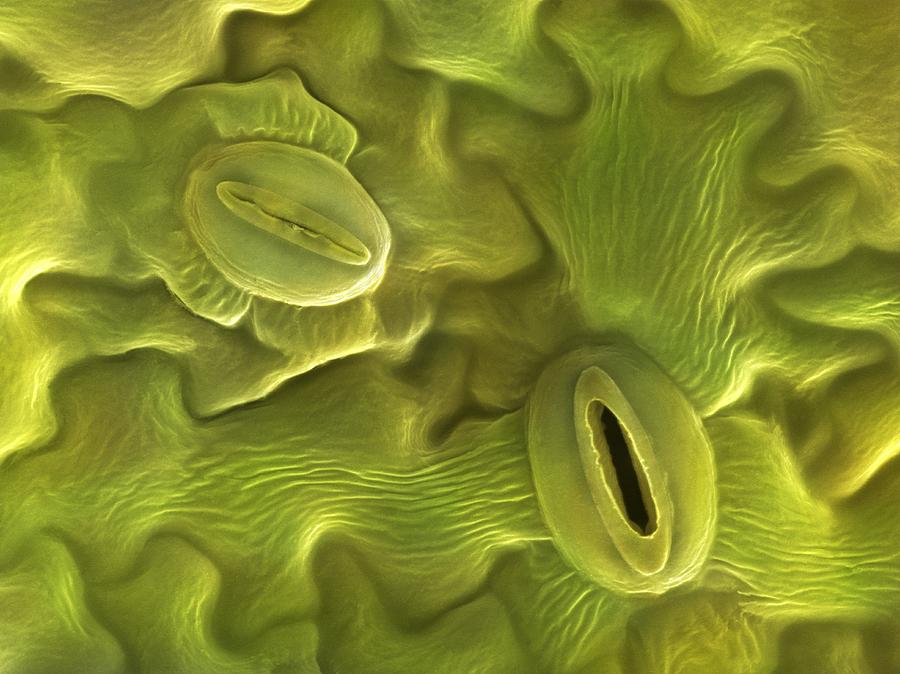
Opening that allows gas exchange
a)
Stomata
b)
Leaves
c)
Roots
d)
Vascular tissue
20.
___ opens and closes the stomata.
a)
Guard cells
b)
Xylem
c)
Roots
d)
Phloem
21.

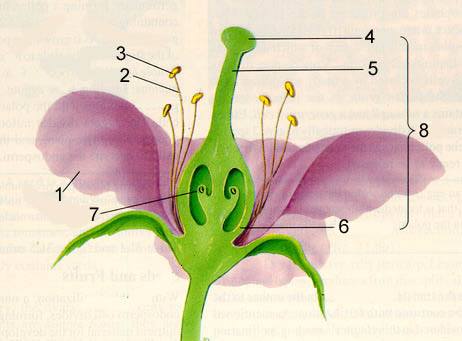
What is #3 pointing to?

a)

stigma

b)

filament

c)

ovary

d)

anther

22.

What is #4 pointing to?

a)

anther

b)

style

c)

stigma

d)

ovary

23.

What is #6 pointing to?

a)

stigma

b)

style

c)

ovary

d)

petal

24.
What are the reactants for cellular respiration?
a)
H2O and O2
b)
glucose and O2
c)
glucose and CO2
d)
H2O and CO2
25.
Plants carry out both photosynthesis and respiration. Which is a reactant in photosynthesis and a product in respiration?
a)
glucose
b)
oxygen
c)
light energy
d)
water
26.
Plants respond to stimuli such as light and gravity. What are these responses called?
a)
Tropisms
b)
Homeostasis
c)
Mutualism
d)
Decomposition
27.
This type of process requires oxygen.
a)
Aerobic
b)
Anaerobic
c)
Cell transport
d)
None of the above
28.
This type of process does not require oxygen.
a)
Aerobic
b)
Anaerobic
c)
Cell transport
d)
None of the above
29.
What are some things we use plants for?
a)
food
b)
medicine
c)
building
d)
all of the above
30.
The living things in a food web that makes food are called ________.
a)
producers
b)
consumers
31.
Flowering plants, such as rose bushes and cherry trees-
a)
are classified as angiosperms
b)
have cones to protect their seeds
c)
lack xylem and phloem
d)
reproduce only by spores
32.
Seedless vascular plants include-
a)
mosses, ferns, and algae
b)
ferns, horsetails, and club mosses
c)
angiosperms, gymnosperms, and club mosses
d)
algae, flagellates, and sporozoans
33.

How are angiosperms and gymnosperms alike?

a)

They both produce flowers and seeds

b)

They both have vascular tissue

c)

They both have leaves called needles

d)

They both produce pine cones

34.
In which organelle (part of the cell) does photosynthesis take place?
a)
mitochondria
b)
chloroplast
c)
nucleus
d)
cell membrane
35.
What is the pigment in chloroplasts that performs photosynthesis?
a)
Chlorosynthesis
b)
Chlorophyll
c)
ADP
d)
Electron Transport
36.
Which of the following is the correct equation for PHOTOSYNTHESIS?
a)
CO+ light + H2O --> O+ Sugar
b)
CO+ sugar + H2O --> O+ light
c)
O2 + light + H2O --> CO+ Sugar
d)
CO+ O2 + H2O --> Light+ Sugar
37.
What is the purpose of photosynthesis?
a)
make glucose
b)
make ATP
c)
make light
d)
release carbon dioxide
38.
Autotroph or heterotroph?
a)
Autotroph
b)
Heterotroph
39.
What are the products of photosynthesis?
a)
Carbon dioxide and water
b)
Carbon dioxide and oxygen
c)
Glucose and oxygen
d)
Glucose and water
40.
Cellular Respiration's goal is to
a)
make water
b)
make ATP
c)
make glucose
d)
make  oxygen
41.
Cellular respiration occurs in both plants and animals.
a)
true
b)
false
42.

A potted plant is placed inside a clear, sealed vacuum container that has water pumped into it on a regular basis. The container is placed in the sun and the plant’s growth is monitored. Which statement best describes what will most likely happen to the plant over time?

a)

The plant will grow faster because it is sheltered from the wind.

b)

The plant will die because it does not have oxygen for photosynthesis.

c)

The plant will die because it does not have carbon dioxide for photosynthesis

d)

The plant will grow at a slower rate because it requires more water.

43.

In which of the following structures does cellular respiration occur in the cell?

a)

nucleus

b)

cytoplasm

c)

mitochondria

d)

vacuoles

44.
Which process do the animals in the food web use to convert energy from food into ATP?
a)
cellular respiration
b)
osmosis
c)
photosynthesis
d)
transcription
45.
In which way are photosynthesis and cellular respiration different?
a)
Cellular respiration stores ATP, while photosynthesis releases ATP.
b)
Cellular respiration produces oxygen, while photosynthesis uses oxygen.
c)
Photosynthesis releases energy, while cellular respiration stores energy.
d)
Photosynthesis used carbon dioxide, while cellular respiration produces carbon dioxide.
46.

A diagram representing the relationship between photosynthesis and cellular respiration is shown.

The numbered boxes in the diagram represent which of the following?

a)

1 - water; 2 - nitrogen

b)

1 - nitrogen; 2 - oxygen

c)

1 - oxygen; 2 - carbon dioxide

d)

1 - carbon dioxide; 2 – water

47.
Two test tubes were filled with a solution of bromthymol blue. A student exhaled through a straw into each tube, and the bromthymol blue turned yellow. An aquatic green plant was placed into each tube, and the tubes were corked. One tube was placed in the dark, and one was placed in direct sunlight. The yellow solution in the tube in sunlight turned blue, while the one in the dark remained yellow. Which statement best explains why the solution in the tube placed in sunlight returned to a blue color?
a)
Oxygen was produced by photosynthesis.
b)
Carbon dioxide was removed by photosynthesis.
c)
Carbon dioxide was produced by respiration.
d)
Oxygen was removed by respiration.
48.
Which gas is removed from the atmosphere during photosynthesis?
a)
hydrogen
b)
oxygen
c)
nitrogen
d)
carbon dioxide
49.

Why are there less air bubbles as the plant is placed further away from the light source

a)

because cellular respiration decreases when there is less light

b)

because the light independent reaction decreases when there is less light

c)

because photosynthesis decreases as a plant is moved further away from a light source

d)

the wavelength increases as a plant is placed further away from a light source

50.
One of the principal compounds that living things use to store energy is
a)
DNA
b)
ATP
c)
H20
d)
CO2
51.
What are the reactants in the equation for cellular respiration?
a)
oxygen and lactic acid
b)
carbon dioxide and water
c)
glucose and oxygen
d)
water and glucose
52.
What is the correct equation for cellular respiration?
a)
6O2 + C6H12O6 -> 6CO2 + 6H2O + Energy
b)
6O2 + C6H12O6 + Energy -> 6CO2 + 6H2O
c)
6CO2 + 6H2O -> 6O2 + C6H12O6 + Energy
d)
6CO2 + 6H2O + Energy -> 6O2 + C6H12O6
53.
Organisms that cannot make their own food and must obtain energy from external sources are called
a)
autotrophs
b)
heterotrophs
c)
thylakoids
d)
plants
54.

This is a group of vascular plants where their seeds are not surrounded by a fruit?

a)

dicots

b)

monocots

c)

angiosperms

d)

gymnosperms

55.

Vascular plants with seeds are split into what two groups?

a)

angiosperms & bryosperms

b)

gymnosperms & angiosperms

c)

gametophytes & sporophytes

d)

sporophytes & gymnosperms

56.

Which tissue type does a majority of the photosynthesis?

a)

Dermal

b)

Ground

c)

Mersitematic

d)

Vascular

57.

Which type of plant tissue covers the outer surface of the plant and acts as a protective layer?

a)

Dermal

b)

Vascular

c)

Ground

d)

Connective

58.

Tissue that contain rapidly growing cells in a plant is called

a)

Ground tissue

b)

Dermal tissue

c)

Vascular tissue

d)

Meristematic tissue

59.

Vascular plants with seeds are split into what two groups?

a)

angiosperms & bryosperms

b)

gymnosperms & angiosperms

c)

gametophytes & sporophytes

d)

sporophytes & gymnosperms

60.
Which gas is removed from the atmosphere during photosynthesis?
a)
hydrogen
b)
oxygen
c)
nitrogen
d)
carbon dioxide
61.
Flowers ____________.
a)
look nice so we can use them
b)
smell nice so we can use them
c)
look and smell nice to attract insects and birds (pollinators)
62.

How are ADP and ATP related to each other?

a)

ADP is a high energy molecule and when it loses a phosphate it released energy becoming low energy ATP.

b)

ATP loses energy when it gains a phosphate group, becoming low energy ADP.

c)

ATP is a high energy molecule and when it loses a phosphate it released energy becoming low energy ADP.

63.
What may happen if the snowshoe hare was removed from the food web pictured?
a)
The insects in the habitat would increase.
b)
The shrew population would decrease due to being only hawk food source.
c)
The willow tree population would decrease.
d)
Foxes would dies due to no food source. 
64.
In this Food Web Pyramid Which type of consumer gets only 10% of the energy stored in plants?
a)
Herbivore
b)
Carnivore
c)
Omnivore
d)
Secondary Consumer
65.
If the plant population decreased, the amount of carbon would _________.
a)
Stay the same
b)
Increase
c)
Decrease