
NEW
Font size
S
M
L
XL
 Worksheets
RRE exam honors
Total questions: 75
Worksheet time: 1hrs 11mins
Name
Class
Date
1.
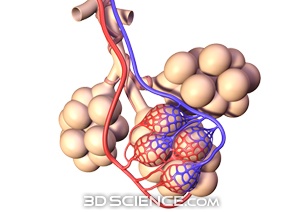
The air sacs that are covered with capillaries where gas exchange takes place
a)
bronchi
b)
lungs
c)
oxygen
d)
alveoli
2.
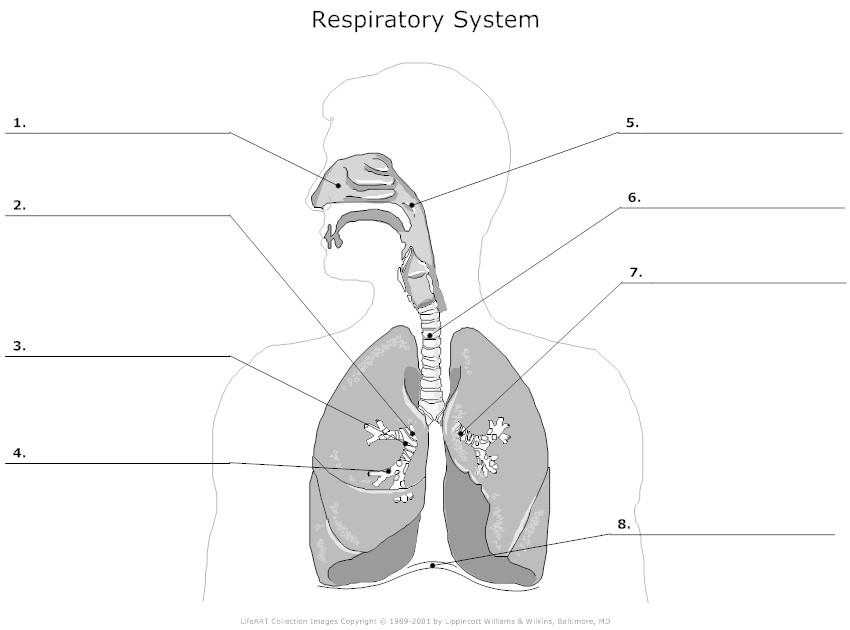
Name the structure labeled 8
a)
lungs
b)
trachea
c)
diaphragm
d)
alveoli
3.
tiny hairlike structures that filter inhaled air to trap dust and other particles; push trapped particles toward the esophagus
a)
sinuses
b)
cilia
c)
mucus
d)
pharynx
4.
this lung condition is an inflammation of the mucus membrane that lines the bronchial tubes.
a)
bronchitis
b)
pneumonia
c)
cystic fibrosis
d)
cancer
5.
Tiny air sacs in the lungs that are the site of gas exchange between the lungs and blood.
a)
alveoli
b)
relax
c)
diaphragm
d)
nose
6.
Which of the following is true?
a)
Oxygen diffuses along the concentration gradient from the alveoli into the capillaries
b)
Oxygen diffuses against the concentration gradient from the alveoli into the capillaries
c)
Oxygen diffuses along a concentration gradient from the capillaries to the alveoli
d)
Oxygen diffuses against the concentration gradient from the capillaries to the alveoli
7.
What is the respiratory system ?
a)
The respiratory system is the system that helps circulate our blood .
b)
The respiratory system is the system that takes in oxygen and takes the unneeded particles and creates carbon dioxide.
c)
The respiratory system is a system that is similar to the circulatory system.
d)
The respiratory system is a system that holds the heart as an internal organ.
8.
A wide muscle that separates the chest cavity from the abdominal cavity and aids in the inflation of the lungs.
a)
diaphragm
b)
heart
c)
nose
d)
trachea
9.
Where is urine stored?
a)
kidneys
b)
urinary bladder
c)
urethra
d)
ureters
10.
Which are the tubes that carry urine from the kidney to the bladder?
a)
Adrenal tubes
b)
Kidneys
c)
Ureters
d)
Urethras
11.
What word describes the function of the nephrons?
a)
Tube
b)
Passageway
c)
Filter
d)
Reservoir
12.
Which are the tubes that carry urine from the kidney to the bladder?
a)
Adrenal tubes
b)
Kidneys
c)
Ureters
d)
Urethras
13.
Place the following events in sequence:
A) Urine passes through the ureters
B) Urea enters the kidneys
C) Urine enters the urethra
A) Urine passes through the ureters
B) Urea enters the kidneys
C) Urine enters the urethra
a)
B, A, C
b)
C, B, A
c)
B, C, A
d)
A, C, B
14.
Tiny filtering structures where urine is produced in the kidneys are called
a)
ureters.
b)
alveoli.
c)
nephrons.
d)
bronchi.
15.
What is the main function of the excretory system?
a)
to collect and remove wastes from the body
b)
to strengthen skeletal muscles
c)
to protect the nervous system
d)
to bring oxygen to body cells
16.
Which excretory organ eliminates water and some chemical wastes in perspiration?
a)
lungs
b)
skin
c)
liver
d)
kidneys
17.

Identify Letter D
a)
Bowman's Capsule
b)
Proximal Tubule
c)
Distal Tubule
d)
Glomerulus
18.
What is another word that can be used to describe "homeostasis"?
a)
STABLE
b)
EQUAL
c)
COMPLETE
d)
CORRECT
19.
Homeostasis
a)
allows for a wildly fluctuating internal environment
b)
is impossible in vertebrates
c)
is the maintenance of a relatively stable internal environment and often incorporates a form of feedback regulation
d)
is the maintenance of a relatively stable external environment and often incorporates a form of feedback regulation
20.
An increase in hormone A causes an increase in hormone B, which then causes a decrease in A.
a)
failure to maintain homeostasis
b)
feedback mechanism
c)
disruption in cellular communication
d)
breakdown of chemicals
21.
The failure of a cell to react normally to insulin (a hormone) is most likely
a)
vacuoles
b)
receptors
c)
mitochondria
d)
sugars
22.
Which statement best describes the chemical substances secreted by endocrine glands?
a)
They are secreted in one place and most often act at another
b)
they are distributed by the nervous system
c)
They are secreted into specialized ducts for transport.
d)
They are found only in vertebrates
23.

The diagram shows the interaction between blood sugar and pancreas activity. This is
a)
an example of a feedback mechanism maintaining homeostasis
b)
an example of an immune system responding to prevent disease
c)
an example of the hormonal regulation of gamete production
d)
an example of the digestion of sugar by insulin
24.

The following image is an example of
a)
dynamic equilibrium
b)
loss of homeostasis
c)
carrying capacity
d)
excretion
25.

What is your body's purpose in having negative feedback loops?
a)
To keep your nervous system engaged
b)
To keep your body away from homeostasis
c)
To maintain homeostasis
d)
To fight off any approaching threats such as disease and viruses
26.
What is homeostasis?
a)
An organism's job or role in an ecosystem
b)
Your body's production mechanism for gametes
c)
The sum of all chemical reactions in an organism
d)
Maintenance of stable internal conditions regardless of external factors
27.
What two things are found in the central nervous system?
a)
brain/spinal cord
b)
spinal cord/motor neurons
c)
motor/sensory neurons
d)
only brain
28.
Which part of a neuron RECIEVES information?
a)
axon
b)
dendrite
c)
cell body
d)
axon terminal
29.
What are specialized nerve endings that detect change inside and outside the body?
a)
interneurons
b)
receptors
c)
motor neurons
d)
reflex arc
30.
Which part of your brain controls memory?
a)
cerebrum
b)
cerebellum
c)
medulla
d)
neurons
31.
Which part of the brain controls breathing?
a)
neurons
b)
medulla
c)
cerebellum
d)
cerebrum
32.
Which part of the brain controls balance and body position?
a)
cerebrum
b)
medulla
c)
cerebellum
d)
impluses
33.
If I step on a nail...what type of neurons take the response to my muscles?
a)
motor
b)
interneurons
c)
sensory
d)
not neurons, muscle tissue sends the response
34.

What does the cerebrum control?
a)
controls thoughts and voluntary actions
b)
controls vital and involuntary actions
c)
controls balance
d)
controls the uvula
35.
These type of neurons transmit signals from your senses to the spinal cord and brain.
a)
motor
b)
sensory
c)
interneurons
d)
synapse
36.

4. What part of the brain is this?
a)
Cerebellum
b)
Medulla
c)
Cerebrum
37.
The division of the autonomic nervous system that acts in times of emergency is the?
a)
parasympathetic
b)
somatic
c)
peripheral
d)
sympathetic
38.
What does the autonomic nervous system control?
a)
Voluntary movement
b)
Cardiac muscles only
c)
Involuntary responses
d)
The spinal cord
39.
What are the two parts of the nervous system?
a)
The brain and spinal cord
b)
The central nervous and peripheral nervous system
c)
The neurons and the dendrites
d)
The cerebrum and the medulla
40.
Amy has an itch on her nose and would like to scratch it. What part of her nervous system will control the movement of her arm to scratch her nose?
a)
Somatic
b)
Sympathetic
c)
Parasympathetic
d)
Autonomic
41.

Z
a)
Dendrite
b)
Axon Terminal
c)
Neurotransmitters
d)
Synapse
42.

The gland labeled 4 in the diagram is?
a)
the thymus gland
b)
the thyroid gland
c)
the parathyroid glands
d)
the adrenal glands
43.
Endocrine glands produce __________ which maintain the body in homeostasis
a)
oils
b)
neurotransmitters
c)
tears
d)
hormones
44.
Which of the following IS correctly paired
a)
Thyroid- promotes metabolism
b)
Parathyroid-promotes childbirth
c)
Pineal-promotes storage of calcium in bones
d)
Prolactin-promotes growth and development
45.
this hormone causes an increase in bone density, deepening of the voice, and increased production of body and facial hair
a)
estrogen
b)
insulin
c)
testosterone
d)
progesterone
46.
targets bone and muscle to promote growth and development
a)
growth hormone
b)
prolactin
c)
oxytocin
d)
ADH (antidiuretic hormone)
47.
targets mammary glands which promotes the production of milk in mammals
a)
growth hormone
b)
prolactin
c)
progesterone
d)
parathyroid hormone
48.
targets osteoclasts (bone destroying cells) so that they release calcium from bones when calcium levels are low
a)
calcitonin
b)
parathyroid hormone
c)
osteoclast hormone
d)
ADH
49.
produces epinephrine and nor-epinephrine which promote the fight or flight response
a)
pancreas
b)
testes
c)
adrenal glands
d)
pineal gland
50.
together these two hormones produced by the pancreas control blood sugar levels
a)
epinephrine and nor-epinephrine
b)
T3 and T4
c)
estrogen and progesterone
d)
insulin and glucagon
51.
a disease by which people cannot control sugar levels in the blood
a)
hypertension
b)
sleep apnea
c)
diabetes
d)
hyperthyroidism
52.
these hormones promote secondary sex characteristics in females
a)
testosterone and GH
b)
epinephrine and nor-epinephrine
c)
estrogen and progesterone
d)
prolactin and oxytocin
53.

name the organ labeled 4
a)
pituitary gland
b)
thyroid gland
c)
pancreas
d)
thymus
54.
regulates blood-sugar levels.
a)
Endocrine System
b)
Pancreas
c)
Flight or Fight Response
d)
Glands
55.
The gland that stimulates body metabolism
a)
Thyroid
b)
testes
c)
ovary
d)
adrenal
56.
The process by which an organism’s internal environment is kept stable in spite of changes in the external environment.
a)
Positive Feedback
b)
Negative Feedback
c)
Homeostasis
d)
Targeted Cells
57.

What is the pituitary gland?
a)
the master gland
b)
helps you go to sleep
c)
influence metabolic rate
d)
decrease
blood calcium
58.

What is the target cell?
a)
A cell
that a hormone is specifically directed towards
b)
produces
a large number of different hormones
c)
secretes
digestive juices including enzymes
d)
secretes
molecular messengers
59.
The gland that stimulates body metabolism
a)
Thyroid
b)
testes
c)
ovary
d)
adrenal
60.
What gland produces prolactin?
a)
Pancreas
b)
Thyroid
c)
Pituitary Gland
d)
Adrenal Glands
61.
The reason that the steroid hormone aldosterone affects only a small number of cells in the body is that ___.
a)
only its target cells get exposed to aldosterone.
b)
only its target cells contain aldosterone receptors.
c)
it is able to enter nontarget cells.
d)
nontarget cells destroy aldosterone before it can produce any effect.
62.

The pituitary gland is represented by letter ___.
a)
A
b)
B
c)
C
d)
D
63.

Letter D is pointing to the ___.
a)
thyroid
b)
parathyroid
c)
thymus
d)
pituitary gland
64.
Which of the following gland does NOT belong to the endocrine system?
a)
pituitary
b)
testes
c)
salivary
d)
thyroid
65.
What element is needed to prevent a goiter of the thyroid gland?
a)
Iodine
b)
Iron
c)
Calcium
d)
Zinc
66.
Where are the adrenal glands located?
a)
On each side of the larynx
b)
On top of the kidneys
c)
On top of the heart
d)
In the inner ears
67.
The hormone that lowers blood sugar is ___.
a)
Insulin
b)
Glucagon
c)
Cortisol
d)
Epinephrine
68.
What is the main function of the nervous system?
a)
Responsible for control of the body and communication among body parts
b)
Responsible for production of offspring
c)
Helps to rid the body of toxins, water, and other unwanted materials and transports lymph, a fluid containing infection-fighting white blood cells, throughout the body
d)
Provides oxygen to the body's cells, while moving carbon dioxide
69.
Major organs of the nervous system
a)
Kidneys, nephrons
b)
Stomach, intestines, mouth
c)
Heart, blood vessels, blood
d)
Brain, spinal cord, nerve
70.
Nose, trachea, lungs, alveoli
a)
Respiratory system
b)
Endocrine system
c)
Muscular system
d)
Skeletal system
71.
Kidneys, lungs, skin, nephrons
a)
Digestive system
b)
Excretory system
c)
Integumentary system
d)
Respiratory system
72.
Pituitary gland, pancreas, thyroid, adrenal gland
a)
Digestive system
b)
Integumentary system
c)
Endocrine system
d)
Immune system
73.

Which statement correctly describes an interaction between the hormones and the cells?
a)
Hormone A is synthesized by cell 2 and targets cell 1
b)
Hormone B bonds with both cell 1 and cell 2
c)
specialized receptor molecules on cell 1 secrete hormone B
d)
reactions carried out by cell 1 are regulated by hormone C
74.
Where is urine stored?
a)
kidneys
b)
urinary bladder
c)
urethra
d)
ureters
75.
A noninfectious, chronic respiratory condition that occurs when the walls of their elasticity is _____.
a)
asthma
b)
chronic obstructive pulmonary disease
c)
emphysema
d)
pleurisy
Reset

