
NEW
Font size
S
M
L
XL
 Worksheets
Wood-2nd Semester Midterm Review
Total questions: 61
Worksheet time: 49mins
Name
Class
Date
1.
Why do hurricanes have to have low pressure?
a)
because low pressure causes air to rise
b)
because low pressure causes air to sink
c)
because low pressure makes sea breezes used by the hurricane
d)
because high pressure causes air to rise
2.
When do hurricanes usually develop?
a)
January through April
b)
September through October
c)
June through November
d)
January through June
3.
The region(s) that have a frequent occurrence of tornadoes are called
a)
sub-tropics
b)
low pressure
c)
high pressure
d)
tornado alley
4.
A tornado that forms or travels over water is called a_____________.
a)
water spout
b)
dust devil
c)
dust storm
d)
geyser
5.
Why does cold water or land cause a hurricane to weaken?
a)
because the high pressure of the hurricane can't handle the cold water from a low pressure system
b)
because the land always cools faster than the ocean
c)
because the land breeze shreds the hurricane
d)
because they cut off the energy supply to the hurricane
6.
Name the three necessary ingredients for thunderstorm formation.
a)
Lifting Mechanism, Fronts, Moisture
b)
Moisture, Lifting Mechanism, Instability
c)
Lifting Mechanism, Mountains, Oceans
d)
Stability, Moisture, Heat
7.
Why does the air mass of the hurricane rotate counterclockwise in the Northern Hemisphere?
a)
because of the uneven heating from the sun
b)
because of the upwelling of warm water in the ocean where it forms
c)
because the Northern Hemisphere is moving faster than the Southern Hemisphere causing spinning
d)
because the spinning of the earth causes the Coriolis effect
8.

what`s difference between watch and warning
a)
watch is to get you prepared while warning is to warn you
b)
watch is to warn you while warning is to prepare you
9.
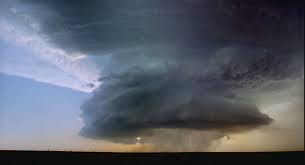
Where do tornadoes start?
a)
Over the ocean near the equator
b)
In the clouds that create blizzards
c)
In the clouds of severe thunderstorms
d)
Any time that it rains
10.
What happens in Tornado Alley to create so many tornadoes?
a)
The rate of condensation is higher than the rate of precipitation
b)
Warm air from Canada meets cold air from Virginia
c)
Cold, dry air from Canada meets warm dry air from Gulf of Mexico
d)
Warm air in Texas clashes with even warmer air in Texas
11.
The pressure inside a hurricane is _______.
a)
High
b)
Low
12.
In what areas of the world do hurricanes form?
a)
Warm ocean waters
b)
Polar ocean waters
c)
On lakes and rivers
d)
Over the central plains of the U.S
13.
What is condensation?
a)
The part of the water cycle when the sun heats up water, turning it from a liquid into water vapor or steam. It rises from the ground into the air.
b)
The part of the water cycle when the water vapor in the air gets cold. The water turns back into a liquid and forms clouds.
c)
The part of the water cycle when clouds get heavy and can no longer hold the liquid water. This causes the water to fall from the sky to the earth as rain, snow, sleet, or hail.
14.
Which of the following is a good way to conserve water at home?
a)
taking long showers
b)
washing the car on a sunny afternoon
c)
running the dishwasher for your favorite bowl
d)
washing the car on a cloudy day
15.
What ocean floor feature may eventually turn into a volcanic island, like Hawaii?
a)
Trench
b)
Mid-ocean ridge
c)
Rift Valley
d)
Seamount
16.
How are deep currents created?
a)
Density differences
b)
Wind
c)
From runoff and rain
d)
Continental deflections
17.
As you descend deeper into the ocean, the water gets
a)
warmer and pressure increases
b)
warmer and pressure decreases
c)
colder and pressure decreases
d)
colder and pressure increases
18.
Seawater is typically denser than freshwater due to seawaters-
a)
greater depth
b)
smaller mass
c)
higher salinity
d)
lower freezing point
19.
What part of the ocean floor would be the most difficult to explore due to pressure?
a)
continental slope
b)
sea mount
c)
trench
d)
abyssal plain
20.
The oceans absorb much of the sunlight reaching Earth. When water in the oceans absorb sunlight and heat up, what process can happen to the water?
a)
accumulation
b)
condensation
c)
evaporation
d)
precipitation
21.
Some of the water that precipitates does not runoff into the rivers and is absorbed by the plants or gets evaporated. It moves deep into the soil. What is this process called?
a)
Sublimation
b)
Transpiration
c)
Runoff
d)
Infiltration
22.
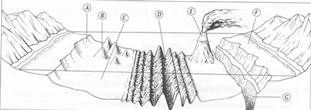
What is letter C?
a)
Mid-Ocean Ridge
b)
Cont. Shelf
c)
Cont. Slope
d)
Abyssal Plain
23.
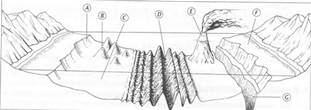
What is letter D?
a)
Cont. Shelf
b)
Mid-Ocean Ridge
c)
Volcanic Island
d)
Seamount
24.
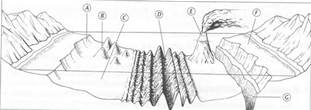
What is letter A?
a)
Cont. Shelf
b)
Cont. Slope
c)
Seamount
d)
Abyssal Plain
25.
Rift is similiar to ...
a)
A hole
b)
A divide
c)
A valley
d)
A trench
26.
What is the difference between a volcanic island & a seamount?
a)
A volcanic island rises above the water & a seamount does not
b)
A seamount rises above the water & a volcanic island does not
c)
Both the seamount & volcanic island are underwater
d)
Both the seamount & the volcanic island rise above the water
27.

Water in the ocean is always
a)
Moving
b)
Still
c)
Warming up
d)
Cooling down
28.

Air moves from _______ pressure to _______ pressure.
a)
Low, High
b)
High, Low
c)
Warm, Cold
d)
Cold, Warm
29.

Air travels in patterns around the Earth called
a)
Global Winds
b)
Local Winds
c)
Ocean Winds
d)
Blowing Winds
30.

Water travels in definite paths around the ocean called
a)
Highways
b)
Currents
c)
Rivers
d)
Streams
31.

Currents that occur at or near the surface of the ocean are called
a)
Deep Currents
b)
Convection Currents
c)
Surface Currents
d)
Wave Currents
32.

Surface currents are mainly caused by
a)
The Coriolis Effect
b)
Cold and Warm Water
c)
Convection
d)
Wind
33.

When a current bounces off a continent and changes direction, this is called
a)
Global Winds
b)
Deflection
c)
The Coriolis Effect
d)
Redirection
34.

Winds cause surface currents and winds are created by the
a)
Sun
b)
Moon
c)
Tides
d)
Coriolis Effect
35.

Warm water is ________ dense and _________ than cold water
a)
More, Heavier
b)
Less, Heavier
c)
Less, Lighter
d)
More, Lighter
36.

Surface currents and deep currents join together to make a
a)
Deep Sea Current
b)
Warm Current
c)
Cold Current
d)
Convection Current
37.

Ocean currents bring warm water from the equator towards Earth's
a)
Southern Hemisphere
b)
Continents
c)
Equator
d)
Poles
38.
What are the TWO most abundant gases in Earth's atmosphere?
a)
Carbon dioxide and oxyen
b)
Nitrogen and oxygen
c)
Oxygen and ozone
d)
Oxygen and hydrogen
39.
In which layer of the atmosphere would you find the majority of water vapor?
a)
Troposphere
b)
Thermosphere
c)
Mesosphere
d)
Stratosphere
40.
As altitude increases, the air pressure -
a)
increases
b)
decreases
c)
stays the same
d)
doubles
41.
The force that air exerts on all objects is called ...
a)
air pressure
b)
density
c)
infrared radiation
d)
altitude
42.
In which layer of the atmosphere do satellites orbit earth?
a)
Exosphere
b)
Ionosphere
c)
Stratosphere
d)
Mesosphere
43.
In which layer of the atmosphere does most weather occur?
a)
Troposphere
b)
Thermosphere
c)
Mesosphere
d)
Ionosphere
44.
The ozone layer protects people from which of the following
a)
effects of radon
b)
too much UV radiation
c)
carbon monoxide poisoning
d)
allergies
45.
The layers of atmosphere are classified according to changes -
a)
humidity
b)
air pressure
c)
altitude
d)
temperature
46.
What causes wind to blow?
a)
Differences in longitude
b)
Shock waves from clouds
c)
Differences in air temperature and pressure
d)
The rotation of the earth
47.
What is a rapidly spinning column of air that has high winds, low pressure, and touches the ground?
a)
Thunderstorm
b)
Hurricane
c)
Tornado
d)
Cyclone
48.
What creates the air pressure difference between the equator and the poles?
a)
The length of the seasons
b)
The shape of the earth
c)
the duration of the solar year
d)
The amount of direct sunlight each area receives
49.
When heat rises cools then sinks
a)
high pressure
b)
convection current
c)
low pressure
d)
stratospheric pressure
50.
If you wanted to visit an area with very little wind, where might you go?
a)
The doldrums around the equator
b)
the jet streams in the northern and southern hemisphere
c)
the North or South Pole
d)
the area around the Mediterranean Sea
51.
At the poles, air is usually ________.
a)
rising
b)
sinking
52.
At the equator the air is usually ________.
a)
rising
b)
sinking
53.

What does symbol # 1 mean?
a)
Occluded Front
b)
Stationary Front
c)
Warm Front
d)
Cold Front
54.

What does symbol # 4 mean?
a)
Stationary Front
b)
Occluded Front
c)
Warm Front
d)
Cold Front
55.

What does symbol # 3 mean?
a)
Cold Front
b)
Warm Front
c)
Stationary Front
d)
Occluded Front
56.
What type of of air mass is dry and warm?
a)
cP
b)
cT
c)
mP
d)
mT
57.
What type of of air mass is wet and warm?
a)
mP
b)
mT
c)
cT
d)
cP
58.

Which type of front is displayed?
a)
Cold
b)
Warm
c)
Stationary
d)
Occluded
59.
_________ fronts are associated with more violent weather
a)
cold
b)
warm
c)
stationary
d)
occluded
60.
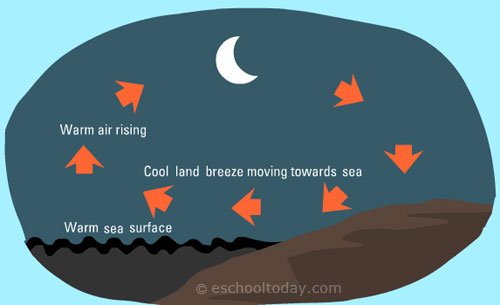
Is this a land or a sea breeze?
a)
land breeze
b)
sea breeze
61.
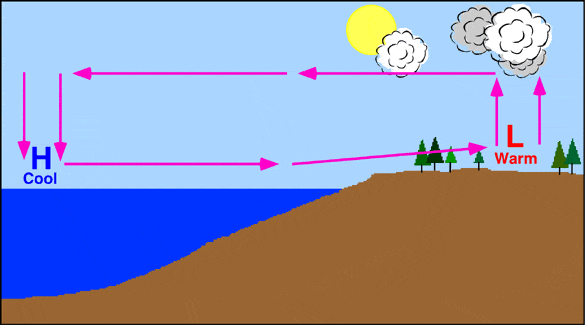
Is this a land or a sea breeze?
a)
land breeze
b)
sea breeze
Reset

