
 Worksheets
7.E. Weather Review
Total questions: 73
Worksheet time: 1hrs 5mins
Name
Class
Date
1.
The symbol on a weather map for a warm front is what?
a)
a line with triangles on it
b)
a line with circles on it
c)
a line with semi-circles on it
d)
a line with circles on it
2.
A front is
a)
where warm air is cooling at earth's surface
b)
a line where hot and cold air are separating
c)
a line where two different air masses meet
d)
where cold air is rising and forming rain clouds
3.
When a cold front or a warm front stays in place for several days without invading another front, it is called a ______.
a)
stationary front
b)
cold front
c)
occluded front
d)
warm front
4.
What type of cloud produces most thunderstorms?
a)
cumulonimbus
b)
Altostratus
c)
Stratus
d)
Cirrus
5.
What types of weather is associated with a maritime tropical?
a)
dry and warm
b)
dry and cold
c)
wet and cold
d)
wet and warm
6.
What type of air mass is created when neither air mass is stronger than another?
a)
Occluded
b)
cold
c)
Stationary
d)
Warm
7.
How do we name air masses?
a)
Water and temperature
b)
Air pressure
c)
moisture and temperature
d)
Cold and warm
8.
6. Air masses develop because the Earth is heated unevenly.
a)
True
b)
False
9.
What type of weather does a low pressure system bring?
a)
stormy, cloudy weather
b)
clear skies
10.
What type of weather does a high pressure system bring?
a)
Stormy weather
b)
Clear skies, little rain
11.
4. An air mass is...
a)
A body of air with the same temperature and moisture throughout.
b)
a body of air that produces rain
c)
A body of evaporated water
d)
the weight of air
12.

This is the symbol for which type of front?
a)
cold front
b)
warm front
c)
stationary front
d)
occluded front
13.

This is the symbol for which type of front?
a)
cold front
b)
warm front
c)
occluded front
d)
stationary front
14.

What does this symbol on a weather map indicate?
a)
High pressure system
b)
Low pressure system
c)
Cold front
d)
Warm front
15.

What does this symbol on a weather map indicate?
a)
High pressure system
b)
Low pressure system
c)
Cold Front
d)
Warm Front
16.
Winds are caused by differences in
a)
precipitation
b)
humidity
c)
air pressure
d)
turbulance
17.
When two air masses meet and weather occurs, what is created?
a)
Fronts
b)
Weather
c)
Climate
d)
Seasons
18.

This weather instrument measures air pressure.
a)
anemometer
b)
barometer
c)
rain gauge
d)
wind vane
19.

Identify the type of front that is shown in the image.
a)
Occluded Front
b)
Cold Front
c)
Stationary Front
d)
Warm Front
20.

Identify the type of front that is shown in the image.
a)
Occluded Front
b)
Cold Front
c)
Stationary Front
d)
Warm Front
21.

Identify the type of front that is shown in the image.
a)
Occluded Front
b)
Cold Front
c)
Stationary Front
d)
Warm Front
22.

Identify the type of front that is shown in the image.
a)
Occluded Front
b)
Cold Front
c)
Stationary Front
d)
Warm Front
23.
In _________ pressure systems, air sinks:
a)
high
b)
low
c)
medium
d)
none
24.
In _______ pressure systems, air rises
a)
high
b)
low
c)
medium
d)
none
25.
Low Pressure is associated with this type of weather...
a)
Cloudy/Overcast Weather
b)
Cold Weather
c)
Warm Weather
d)
Fair Weather
26.
Where does the initial source of energy come from that creates winds?
a)
the moon
b)
the sun
c)
the Earth's surface
d)
the rotation of the Earth
27.

The Coriolis Effect is caused by
a)
Earth rotating around the sun
b)
Earth rotating on its axis
c)
The tides
d)
Gravity
28.
What is the initial source for global winds and convection in the atmosphere?
a)
Unequal heating of the Earth by the sun.
b)
The rotation of the Earth
c)
Moon's gravity
d)
continental deflection
29.
What kind of weather is usually associated with a high pressure system?
a)
Sunny weather
b)
Precipitation (rain, snow, etc.)
30.
Which of these brings thunder, lightning, and heavy rain?
a)
High Pressure System
b)
Low Pressure System
31.
Which of these brings light rainfall?
a)
High Pressure System
b)
Low Pressure System
32.
The air pressure outside is dropping. What kind of weather will likely pass through our area in the coming days?
a)
clear, fair weather
b)
cloudy, rainy weather
33.
The words "maritime" and "continental" both describe the _____ of an air mass.
a)
temperature
b)
moisture
34.
The words "polar" and "tropical" both describe the _____ of an air mass.
a)
temperature
b)
moisture
35.
Which of these best describes a continental tropical air mass?
a)
dry and cold
b)
dry and warm
c)
humid and warm
d)
humid and cold
36.
Which of these best describes a maritime polar air mass?
a)
dry and cold
b)
dry and warm
c)
humid and cold
d)
humid and warm
37.
How do we name air masses?
a)
Water and temperature
b)
Air pressure
c)
Humidity and temperature
d)
Cold and warm
38.
How do we characterize an air mass that forms over the ocean?
a)
Dry
b)
Wet
39.
How do we characterize an air mass that forms over land?
a)
Dry
b)
Wet
40.
How do we characterize an air mass that forms over near the equator?
a)
Cold
b)
Warm
41.
How do we characterize an air mass that forms near the poles?
a)
Cold
b)
Warm
42.
What's the humidity and temperature of a continental tropical air mass?
a)
Wet and cold
b)
Dry and warm
c)
Wet and warm
d)
Dry and cold
43.
What's the humidity and temperature of a maritime tropical air mass?
a)
Wet and cold
b)
Dry and warm
c)
Wet and warm
d)
Dry and cold
44.
A wet and cold air mass would be a...
a)
Maritime polar (mP)
b)
Continental polar (cP)
c)
Maritime tropical (mT)
d)
Continental tropical (cT)
45.
A dry and cold air mass would be...
a)
Maritime polar (mP)
b)
Continental polar (cP)
c)
Maritime tropical (mT)
d)
Continental tropical (cT)
46.
A dry and hot air mass would be...
a)
Maritime arctic (mA)
b)
Maritime tropical (mT)
c)
Continental tropical (cT)
d)
Continental polar (cP)
47.
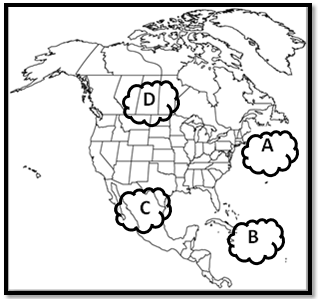
Which type of air would you find at air mass D?
a)
cold, dry
b)
warm, humid
c)
warm, dry
d)
cold, humid
48.
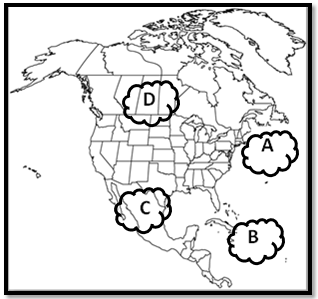
Which type of air would you find at air mass C?
a)
cold, dry
b)
warm, humid
c)
warm, dry
d)
cold, humid
49.
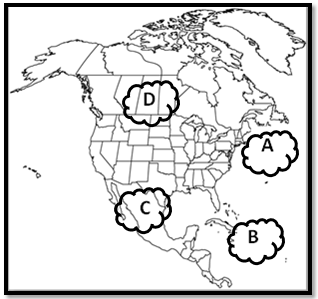
Which type of air would you find at air mass B?
a)
cold, dry
b)
warm, humid
c)
warm, dry
d)
cold, humid
50.
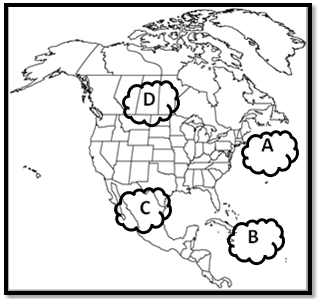
Which type of air would you find at air mass A?
a)
cold, dry
b)
warm, humid
c)
warm, dry
d)
cold, humid
51.
What is the jet stream?
a)
Precipitation in North Carolina
b)
Weather over a long period of time
c)
Strong winds above the Earth's surface
d)
Football flying over the Earth
52.
What is the instrument called that measures air pressure?
a)
thermometer
b)
ruler
c)
yard stick
d)
barometer
53.
When air is heated, it will MOST likely
a)
expand and fall
b)
expand and rise
c)
condense and fall
d)
condense and rise
54.
How does the jet stream affect the weather?
a)
The jet stream transports weather systems that affect us.
b)
The jet stream does not affect the weather.
c)
The jet stream releases oxygen so we can breathe.
d)
The jet stream brings only bad weather.
55.
This type of front results in the same weather for several days
a)
warm
b)
cold
c)
stationary
d)
occluded
56.
This type of front can bring strong storms
a)
cold
b)
warm
c)
stationary
d)
occluded
57.
Our ________ for fossil fuels such as oil and natural gas is growing.
a)
reduce
b)
demand
c)
impact
d)
increase
58.
This growing need for ________ cause us to burn more and more fossil fuels.
a)
demand
b)
energy
c)
reduce
d)
carbon
59.
Burning fossil fuels such as coal puts _________ into the air.
a)
energy
b)
atmosphere
c)
efficient
d)
carbon
60.
Carbon dioxide, or CO2, and other gases ________ the amount of heat goes out into space.
a)
reduce
b)
increase
c)
impact
d)
demand
61.
Which of the following is NOT a greenhouse gas?
a)
carbon dioxide
b)
water vapor
c)
carbon monoxide
d)
methane
62.

The greenhouse gas having the greatest role in human-caused global warming is
a)
methane
b)
carbon dioxide
c)
CFCs (chlorofluorocarbons)
d)
ozone
63.
Some greenhouse gases are naturally present in the Earth's atmosphere
a)
True
b)
False
64.
Which of the following activities contributes the most to carbon emissions globally?
a)
Deforestation
b)
Agriculture
c)
Burning fossil fuels
d)
Respiration
65.
This layer is the closest to the earth which is often called the "lower atmosphere."
a)
exosphere
b)
troposphere
c)
ozone layer
66.
The majority of the atmosphere contains which gas?
a)
oxygen
b)
carbon dioxide
c)
nitrogen
67.
Where is the ozone layer located?
a)
Stratosphere
b)
Troposphere
c)
Mesophere
d)
Exosphere
68.
What layer of the atmosphere does weather occur?
a)
Exosphere
b)
Troposphere
c)
Stratosphere
d)
Thermosphere
69.

Which of the following is the correct composition of Earth's atmosphere?
a)
78% oxygen, 21% nitrogen, 1% other
b)
78% nitrogen, 21% oxygen, 1% other
c)
50 % oxygen, 50% nitrogen
d)
75% oxygen, 25% nitrogen
70.

The ozone is important because it
a)
Protects the Earth from asteroids
b)
Makes the oxygen leave Earth
c)
Protects us from the ultraviolet rays
d)
Keeps the oxygen trapped on Earth
71.

As altitude increases, what happens to air pressure?
a)
increases
b)
remains constant
c)
decreases
d)
stays the same
72.

Low-pressure systems are characterized by all of the following EXCEPT
a)
counterclockwise movement
b)
rising air
c)
warm, moist air and precipitation
d)
cool, dry air and sunny days
73.

What causes wind?
a)
differences in gravity
b)
differences in oxygen
c)
differences in density
d)
differences in air pressure
100 %

