
 Worksheets
2018 Exam Review
Total questions: 65
Worksheet time: 1hrs 1mins
Name
Class
Date
1.
The top layer of the Earth.
a)
Mantle
b)
Crust
c)
Core
d)
Asthenosphere
2.
Which layer is the thinnest, least dense and most brittle?
a)
Mantle
b)
Inner Core
c)
Crust
d)
Outer Core
3.
Which type of rock results from melting and cooling of magma?
a)
Igneous
b)
Metamorphic
c)
Sedimentary
d)
Extrusive
4.
Which type of rock forms from extreme heat and pressure?
a)
Igneous
b)
Sedimentary
c)
Organic
d)
Metamorphic
5.
Which type of igneous rock forms above ground?
a)
Intrusive
b)
Organic
c)
Extrusive
d)
Foliated
6.
Magma cooling and hardening below Earth's surface forms an
a)
Intrusive igneous rock
b)
Extrusive igneous rock
c)
Foliated metamorphic rock
d)
Organic sedimentary rock
7.
What is the MAIN way rocks are classified?
a)
Their color and shapes
b)
How they form
c)
Mineral bands
d)
Where they form
8.
The color of a mineral in powder form is called the mineral's
a)
hardness
b)
specific gravity
c)
luster
d)
streak
9.
Minerals that are mined because they contain useful metals or nonmetals are called
a)
rocks
b)
fossil fuels
c)
chemicals
d)
ores
10.
What is Hardness?
a)
The tendency of a mineral to split easily along flat surfaces.
b)
A measure of how easily a mineral can be scratched.
c)
The way a mineral shines, or reflects light.
11.
Which of the following statements is false?
a)
Oceanic crust is made of basalt
b)
Oceanic crust is thinner than continental crust
c)
Oceanic crust is less dense than continental crust
d)
Oceanic crust is younger than continental crust
12.
A subduction zone is formed...
a)
when one tectonic plate sinks below another
b)
at every type of convergent plate boundary
c)
at every type of divergent plate boundary
d)
at transform boundaries
13.
What happens to pressure as we move from the crust to the inner core?
a)
Pressure Decreases
b)
Pressure Increases
c)
Nothing
14.
Where do convection currents happen in the model we are studying?
a)
the Crust
b)
the Mantle
c)
the Core
15.
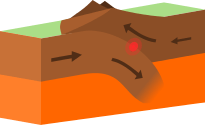
What type of plate boundary is this?
a)
Plate
b)
Divergent
c)
Convergent
d)
Transform
16.
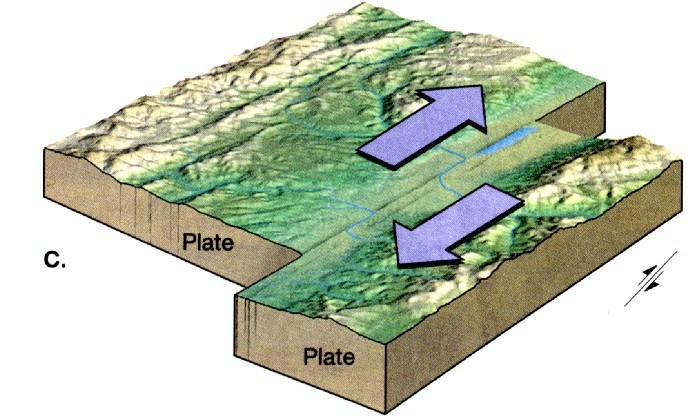
What type of plate boundary is this?
a)
Transform
b)
Convergent
c)
Divergent
d)
Plate
17.

Name this plate boundary.
a)
divergent
b)
convergent
c)
transform
d)
insurgent
18.
The area around the pacific plate where boundaries form is called...
a)
death ring
b)
fire zone
c)
ring of fire
d)
zone of fire
19.
1. What is a fault?
a)
A type of earthquake.
b)
A break in a tectonic plate.
c)
A type of wave
20.
Most earthquakes happen along the _________________.
a)
coast
b)
faults
c)
desert
d)
directions
21.
What happens when a group of animals become extinct?
a)
All of its members have died.
b)
Only a few of its members are still living.
c)
The animals can no longer lay eggs.
d)
All of its members move to another place.
22.
Principle that states in a sequence of undisturbed rocks, the oldest rocks are on the bottom and the rocks become progressively younger toward the top
a)
superposition
b)
uniformitarianism
c)
half-life
23.

These are dinosaur footprints. What is this a example of?
a)
All of the below!!!!!
b)
index fossil
c)
permineralized remains
d)
trace fossil
24.

What type of fossil is this?
a)
Mold
b)
Carbon flim
c)
Cast
d)
Original Remains
25.
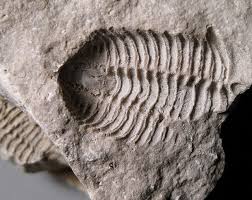
Which fossil is an impression left by the original organism?
a)
cast
b)
mold
c)
trace
d)
preserved remains
26.
A mineral which contains a useful substance is call a/an?
a)
gem
b)
quarry
c)
ore
d)
rock
27.
Occurs when a mineral breaks along a smooth, flat surface
a)
cleavage
b)
fracture
c)
streak
d)
luster
28.
A mineral's resistance to being scratched is called?
a)
streak
b)
luster
c)
hardness
d)
heft
29.
How do you test the hardness of a mineral?
a)
Throw it against a wall
b)
Step on it
c)
Scratch Test
d)
Kick it until it breaks
30.
A naturally formed, inorganic solid with a crystalline structure
a)
density
b)
streak
c)
mineral
d)
non silicate mineral
31.

Using this scale, which mineral can scratch fluorite?
a)
Talc
b)
Gypsum
c)
Apatite
d)
Calcite
32.
Which part of the eye contracts and dilates based on the environment?
a)
Pupil
b)
Cornea
c)
Sclera
d)
Iris
33.

What is letter B
a)
Optic nerve
b)
Lens
c)
Cornea
d)
Retina
34.

What is letter E?
a)
Vitreous humor
b)
Retina
c)
Cornea
d)
Optic nerve
35.

What is letter F?
a)
Retina
b)
Pupil
c)
Vitreous humor
d)
Iris
36.

What is letter I?
a)
Cornea
b)
Lens
c)
Vitreous humor
d)
Optic nerve
37.
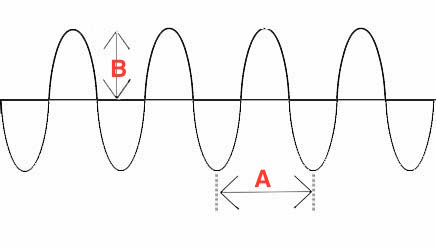
What property of this wave is represented by the letter "A"
a)
amplitude
b)
crest
c)
trough
d)
wavelength
38.
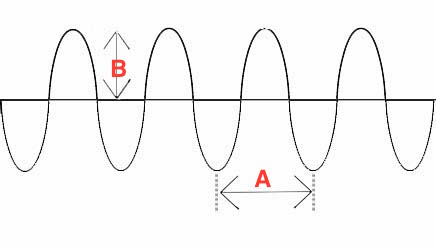
What property of the wave is represented by the letter "B"?
a)
amplitude
b)
crest
c)
trough
d)
wavelength
39.
The highest point on a wave is:
a)
the crest
b)
the trough
c)
the top
d)
the coast
40.
The lowest point on a wave is the:
a)
Amplitude
b)
Crest
c)
Trough
d)
Wavelength
41.
The number of wavelengths that pass a point each per second is:
a)
frequency
b)
period
c)
longitudinal
d)
transverse wave
42.
The type of waves that require medium to pass:
a)
Mechanical Waves
b)
Electromagnetic Waves
43.

Which vocabulary term is used to identify the distance between points C & G?
a)
Amplitude
b)
Crest
c)
Frequency
d)
Wavelength
44.
When the frequency of a wave increases, what happens to the wavelength?
a)
The wavelength is not directly affected by the frequency of a wave.
b)
The wavelength increases.
c)
The wavelength decreases.
d)
More specific information is needed to form a conclusion about the wavelength.
45.
A mechanical wave cannot travel through...
a)
a vacuum(empty space).
b)
water.
c)
air.
d)
glass.
46.
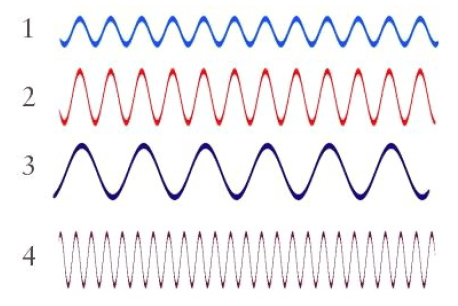
Which wave in the diagram has the greatest frequency?
a)
1
b)
2
c)
3
d)
4
47.
Which of the following can sound travel through?
a)
solid
b)
liquid
c)
gas
d)
all of the above
48.
When a wave strikes and object and bounces off. (example echo)
a)
medium
b)
refraction
c)
reflection
d)
interference
49.
When a wave bends as it passes through at an angle from one medium to another.(example: pencil in a glass of water-)
a)
medium
b)
refraction
c)
reflection
d)
interference
50.
What do we call the part of a compressional wave that is spread a part?
a)
compression
b)
rarefaction
c)
crest
d)
trough
51.
A wave carries...?
a)
energy only
b)
matter only
c)
energy and matter
d)
neither
52.

What kind of waves can travel through space?
a)
electromagnetic waves
b)
compressional waves
c)
longitudinal waves
d)
sound waves
53.

Of the following, ________ have the greatest frequency of the electromagnetic spectrum.
a)
ultraviolet rays
b)
gamma rays
c)
radio
d)
visible waves
54.
If a material absorbs all frequencies of light waves EXCEPT green, what color will be perceived by the observer?
a)
Green
b)
White
c)
Black
d)
Yellow
55.
If all light waves are absorbed by a medium, then what color will be perceived?
a)
White
b)
Black
c)
Red
d)
Green
56.
What part of the visible spectrum has the highest energy?
a)
Red
b)
Orange
c)
Green
d)
Violet
57.
A shirt reflects all light, what color is the shirt
a)
Black
b)
Blue
c)
Magenta
d)
White
58.

Which of these objects is "Opaque"?
a)
A Brick Wall
b)
Eye Glass Lenses
c)
Stained Glass Windows
59.

Which of these objects is "translucent"?
a)
A Brick Wall
b)
Sunglasses
c)
Mirror
60.

Which of these objects is "transparent"?
a)
Stained Glass Window
b)
Wooden Table
c)
Clear Glass Window
61.

Which term explains the path of the light ray in this diagram?
a)
Convection
b)
Scattering
c)
Absorption
d)
Refraction
62.
Behavioral changes of individuals of a species that allow for better survival. (Acquired traits)
a)
Variation
b)
Adaptation
c)
Behavior
d)
Environment
63.
Where the better adapted organisms survive to pass traits along to offspring.
a)
Evolution
b)
Natural Selection
c)
Extinction
d)
Artifical Selection
64.
What is the advantage of having different shaped beaks?
a)
To look different from other species.
b)
To be able to eat the food readily available in the environment.
c)
To protect itself against predators.
d)
To protect itself against prey.
65.
Why are advantageous traits more likely to be passed onto offspring?
a)
Because they are more likely to survive and reproduce.
b)
Because they come from dominant alleles.
c)
Because they come from recessive alleles.
d)
Because the trait is an acquired phenotype.
100 %

