wayground logo

Free Printable Worksheets

Font size

S
M
L
XL
Worksheets

Properties of Waves

Total questions: 90

Worksheet time: 2hrs 35mins
Name
Class
Date
1.

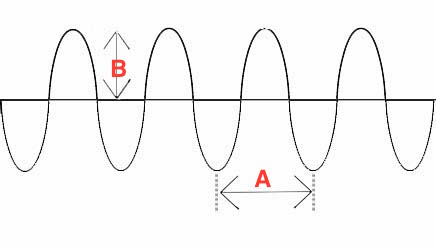
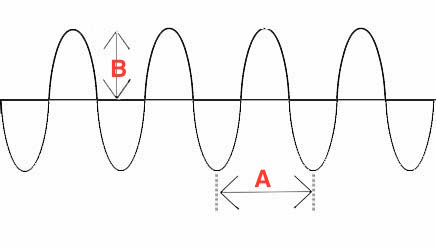
What property of this wave is represented by the letter "A"

a)

amplitude

b)

crest

c)

trough

d)

wavelength

2.
What property of the wave is represented by the letter "B"?
a)
amplitude
b)
crest
c)
trough
d)
wavelength
3.
The number of wavelengths that pass a point each per second is:
a)
frequency
b)
period
c)
longitudinal 
d)
transverse wave 
4.
The type of waves that require medium to pass:
a)
Mechanical Waves
b)
Electromagnetic Waves
5.
Which vocabulary term is used to identify the distance between points C & G?
a)
Amplitude
b)
Crest
c)
Frequency
d)
Wavelength
6.
When the frequency of a wave increases, what happens to the wavelength?
a)
The wavelength is not directly affected by the frequency of a wave.
b)
The wavelength increases.
c)
The wavelength decreases.
d)
More specific information is needed to form a conclusion about the wavelength.
7.
A mechanical wave cannot travel through...
a)
a vacuum(empty space).
b)
water.
c)
air. 
d)
glass.
8.
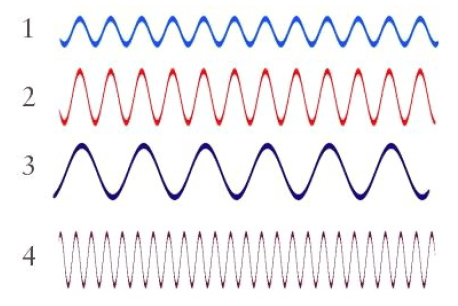
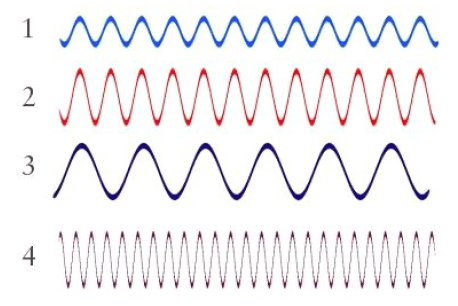
Which wave in the diagram has the greatest frequency?
a)
1
b)
2
c)
3
d)
4
9.
Which wave in the diagram has the greatest wavelength?
a)
1
b)
2
c)
3
d)
4
10.
Which of the following can sound travel through?
a)
solid
b)
liquid
c)
gas
d)
all of the above
11.
regular disturbances that carry energy through matter or space
a)
crest
b)
energy
c)
wave
d)
trough
12.
which material does sound travel the fastest?
a)
solid 
b)
liquid 
c)
gases
13.
When a wave strikes and object and bounces off. (example echo)
a)
medium
b)
refraction
c)
reflection
d)
interference
14.
When a wave bends as it passes through at an angle from one medium to another.(example: pencil in a glass of water-)
a)
medium
b)
refraction
c)
reflection
d)
interference
15.

What type of wave is pictured?

a)

Transverse wave

b)

Longitudinal wave

c)

Waving goodbye

d)

Stadium wave

16.

What type of wave is pictured?

a)

Transverse wave

b)

Longitudinal wave

c)

Wave, what wave?

d)

Slinky wave

17.

Material some waves travel through, such as the type of solid, liquid, or gas.

a)

Trough

b)

Peak

c)

Wavelength

d)

Medium

18.

Unit used to measure the frequency of wavelengths.

a)

Amplitude

b)

Hertz

c)

Joule

d)

Engergy

19.

All waves carry ______________.

a)

Sound

b)

Light

c)

Water

d)

Energy

20.

Sound travels in which kind of wave?

a)

Longitudinal waves

b)

Transverse waves

21.

Light waves and water waves travel in what type of waves?

a)

Transverse waves

b)

Longitudinal waves

22.

This is an example of ______________________.

a)

Transverse waves

b)

Longitudinal waves

23.

What type of waves are these?

a)

Transverse waves

b)

Longitudinal waves

24.
Which statement best explains the difference between longitudinal and transverse waves?
a)
Longitudinal waves have troughs, while transverse waves have crests.
b)
Longitudinal waves produce energy, while transverse waves consume energy.
c)
Particles in longitudinal waves travel towards a force, while particles in transverse waves travel away from a force.
d)
Particles in longitudinal waves vibrate in the direction the wave is moving, while particles in transverse waves vibrate perpendicular to the direction the wave is moving.
25.
Term
A region of space that doesn't contain any matter is called a...
a)
medium
b)
crest
c)
vacuum
26.
Term
A disturbance in space where the disturbance moves perpendicular to the way it transfers energy from one place to another is classified as being...
a)
impulsive
b)
longitudinal
c)
transverse
27.
Term
A regular repeating collection of disturbances that transfer energy from one place to another is called a...
a)
pulse
b)
wave
c)
impulse
28.
Term
The most compressed portion of a longitudinal wave is called the wave's ...
a)
crest
b)
trough
c)
compression
29.

Term

The least compressed portion of a longitudinal wave is called the wave's ...

a)

rarefaction

b)

trough

c)

compression

30.
More compression in a longitudinal wave means it has more amplitude and the crest would be higher.
a)
True
b)
False
31.
The speed of the wave is measure by the amplitude.
a)
True
b)
False
32.
Sound waves travel faster than light waves.
a)
True
b)
False
33.
Speed is measured as...
a)
wavelength x amplitude
b)
amplitude x frequency
c)
wavelength x frequency
d)
frequency x amplitude
34.
What best describes the doppler effect?
a)
An apparent change in frequency of a wave due to the relative motion between a wave source and an observer
b)
When sound changes pitch
c)
When light changes color
d)
An apparent change in the amplitude of a wave due to the relative motion between a wave source and an observer.
35.
If a star is being observed from Earth and it's light has shifted towards the blue side of the electromagnetic spectrum it would be...
a)
Moving towards the Earth
b)
Moving away from the Earth
c)
This is a trick question that cannot be answered
d)
It isn't a star, it is a very large blueberry.
36.
If a star is being observed from Earth and it's light has shifted towards the red side of the electromagnetic spectrum it would be...
a)
Moving towards the Earth
b)
Moving away from the Earth
c)
This is a trick question that cannot be answered
d)
It isn't a star, it is a very large blueberry.
37.
The vast majority of galaxies in our universe are moving away from us.  We know this because we observe __________ in the galaxies absorption spectra.
a)
Redshift
b)
Blueshift
c)
Turbulance
d)
Superposition
38.
An object that is moving VERY fast away from Earth would have ________ than an object that is moving very slow away from Earth.
a)
More Redshift
b)
More Blueshift
c)
Less Redshift
d)
Less Blueshift
39.
An object that is moving VERY fast towards the Earth would have ________ than an object that is moving very slow towards the Earth.
a)
More Redshift
b)
More Blueshift
c)
Less Redshift
d)
Less Blueshift
40.
When redshift occurs, the perceived frequency of the wave would...
a)
Increase
b)
Decrease
c)
Stay the same
d)
Make bird sounds
41.
When redshift occurs, the perceived WAVELENGTH of the wave would...
a)
Increase
b)
Decrease
c)
Stay the same
d)
Make squirrell sounds
42.
When blueshift occurs, the perceived frequency of the wave would...
a)
Increase
b)
Decrease
c)
Stay the same
d)
Make duck sounds
43.
When blueshift occurs, the perceived WAVELENGTH of the wave would...
a)
Increase
b)
Decrease
c)
Stay the same
d)
Make frog sounds
44.
When a car coming toward you, the honk getting_________
a)
higher
b)
lower
45.
When someone is playing music by the road and you drive pass him, the music will _______
a)
become higher and then lower
b)
become lower and then higher
c)
become lower
d)
become higher
46.

Long sound waves are...

a)

high pitched

b)

low pitched

c)

loud

d)

soft

47.

Short sound waves are...

a)

high pitched

b)

low pitched

c)

loud

d)

soft

48.
What can you tell about this object's motion?
a)
Moving to the North (up).
b)
Moving to the South (down). 
c)
Moving to the West (left). 
d)
Moving to the East (right). 
49.
What direction is this object moving?
a)
left
b)
right
c)
up
d)
down
50.
What can you tell about the motion of this object?
a)
Moving left.
b)
Moving right quickly.
c)
Standing still. 
d)
Moving up slowly. 
51.

In the Doppler Effect Lab, we mostly observed changes in what?

a)

Velocity

b)

Wavelength

c)

Shape

d)

Amplitude

52.
What do the light waves of a galaxy that is moving TOWARD us look like?
a)
red shifted
b)
blue shifted
c)
green shifted
d)
yellow shifted
53.
travels through solids fastest because the molecules are closer together
a)
speed of sound
b)
wavelength
c)
frequency
d)
amplitude
54.
A wave in which the vibration is in the same direction as that in which the wave is traveling; sound waves
a)
longitudinal wave
b)
ocean wave
c)
transverse wave
d)
mechanical wave
55.
Which medium will transmit sound the fastest?
a)
ocean water
b)
solid iron
c)
perfumed air
d)
a sponge
56.
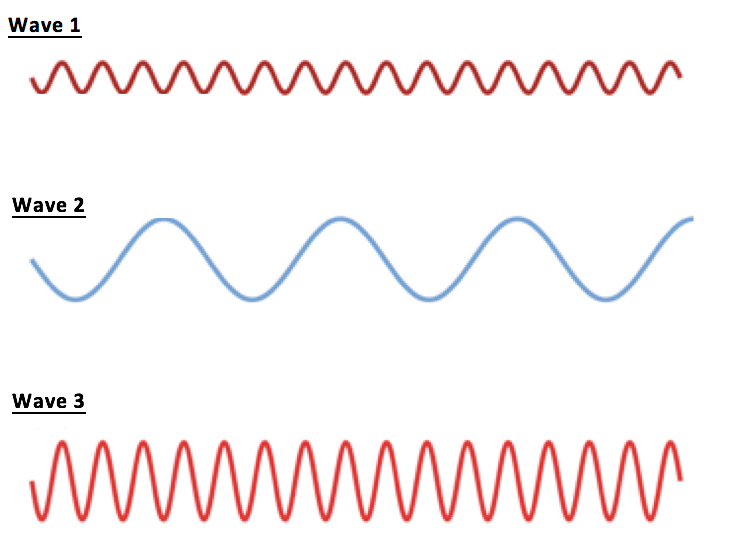
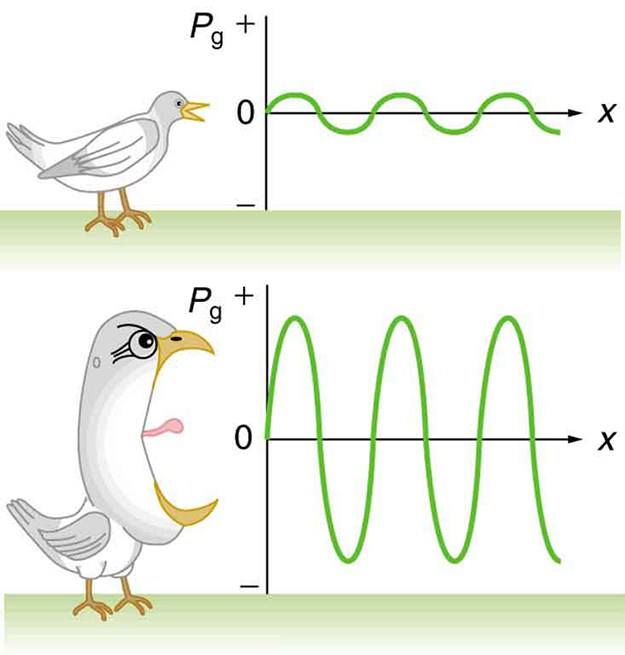
Which of the following sound waves represents an angry dog's low pitched and loud growl (Grrrrr-ruff)? 
a)
Wave 1
b)
Wave 2
c)
Wave 3 
57.
Which of the following sound waves represents a dolphin's loud and high pitched whistle. 
a)
Wave 1
b)
Wave 2
c)
Wave 3 
58.
Bending of waves around an object (such as through a doorway)
a)
sound
b)
diffract
c)
pitch
d)
volume
59.
A part in a longitudinal wave where the particles are spread apart
a)
compression
b)
rarefaction
c)
crest
d)
trough
60.
A reflected sound wave
a)
frequency
b)
pitch
c)
echo
d)
rarefaction
61.
When a sound is louder what measurement gets bigger?
a)
Frequency 
b)
Amplitude 
c)
Wavelength 
d)
Crest
62.
What does pitch depend on?
a)
amplitude 
b)
frequency
c)
intensity 
d)
volume of sound
63.

If two sound waves differ in intensity (as in volume), the wave that is more intense sounds________

a)

softer

b)

louder

c)

higher pitch

d)

lower pitch

64.
The amplitude of a sound wave determines how __________ the sound appears 
a)
loud
b)
high pitch
c)
deep
65.
If the distance represented by the letter A were increased, how would it change the way the sound was heard?
a)
The sound would be higher. 
b)
The sound would be lower. 
c)
The sound would be softer. 
d)
The sound would be louder. 
66.
Loudness, or the intensity of sound, is measured in _________
a)
hertz
b)
decibels
c)
watts
d)
amps
67.
Two different sound waves interact and make a louder sound.  This is an example of
a)
sound effect.
b)
constructive interference.
c)
destructive interference.
d)
refraction.
68.
Waves that have a short wavelength also have this...
a)
loud sound
b)
soft sound
c)
high frequency
d)
low frequency
69.
The high or low pitch of a sound is related to the ___________ of the wave
a)
decibel
b)
amplitude
c)
frequency
d)
rest position
70.
What is a pitch?
a)
highness or lowness of a sound
b)
the intensity of a vibration
c)
the amplitude of the sound wave
d)
volume of sound
71.
A note is played on a guitar.  Next, a lower note is played on the guitar.  Which of these statements describes the lower pitch note?
a)
Both notes vibrated at the same speed.
b)
The second note vibrated slower.
c)
The second note vibrates at a higher frequency.
d)
The second note vibrated faster.
72.
The Doppler effect can cause an apparent change in...
a)
loudness
b)
intensity
c)
pitch
d)
reasonance
73.
As a sound source approaches and then moves past a stationary observer, the observer will hear
a)
a steady rise in pitch
b)
a sudden drop in pitch
c)
a drop in pitch, then a rise in pitch
d)
a rise in pitch, then a drop in pitch
74.
According to the Doppler Effect, a police officer driving a car with the siren on would hear...
a)
sound interference.
b)
low pitch.
c)
no change in pitch.
d)
no pitch.
75.
Noise cancelling headphones work by means of...
a)
constructive interference
b)
destructive interference
c)
non-interference
d)
spatial interference
76.
Transverse waves require no medium.  What is an example of this?
a)
Sound waves.
b)
Pressure waves.
c)
Light waves.
d)
Audio waves.
77.
The time required for a pendulum to make one to-and-fro swing is known as the:
a)
period
b)
crest
c)
frequency
78.
Constructive interference is:
a)
when two waves affect one another in a positive way
b)
produce a single wave of greater amplitude
c)
both
79.
Destructive interference is:
a)
when the two waves affect each other in a negative way
b)
the two waves add together and produce a single wave of greater amplitude
c)
are in phase
80.
In-phase is:
a)
constructive interference
b)
destructive interference
c)
longitudinal
81.
Out-of-phase is:
a)
destructive interference
b)
constructive interference
c)
transverse
82.
The non-moving part of the wave (where the standing wave cancels each other out) is:
a)
node
b)
anti-node
c)
standing wave
83.

Which wave has the highest pitch?

a)

A

b)

B

c)

C

d)

D

84.

Which wave has the loudest?

a)

A

b)

B

c)

C

d)

D

85.

Which wave has the quietest?

a)

A

b)

B

c)

C

d)

D

86.

Which wave has the lowest pitch?

a)

A

b)

B

c)

C

d)

D

87.

Which wave has the most energy?

a)

A

b)

B

c)

C

d)

D

88.

What is the wave's amplitude?

a)

1.14 cm

b)

2 cm

c)

3.5 cm

d)

0.4 cm

89.

What is the wave's wavelenght?

a)

0.17 cm

b)

6 cm

c)

5.5 cm

d)

21 cm

90.

What is the wave's frequency?

a)

2 Hz

b)

6 Hz

c)

7 Hz

d)

21 Hz