
 Worksheets
Waves in the string
Total questions: 92
Worksheet time: 2hrs 34mins
How are standing waves formed in a stretched string?
By the interference of two waves traveling in the same direction
By the interference of two waves traveling in opposite directions
By a single wave reflecting off a boundary
By the superposition of multiple waves of different frequencies
What is a node in the context of standing waves on a string?
A point where the wave has maximum amplitude
A point where the wave has zero amplitude
A point where the wave changes direction
A point where the wave speed is maximum
Which of the following describes an antinode in a standing wave?
A point of zero displacement
A point of maximum displacement
A point of minimum energy
A point of constant phase
What is the fundamental frequency of a string fixed at both ends?
The frequency of the first harmonic
The frequency of the second harmonic
The frequency of the third harmonic
The frequency of the fourth harmonic
How is the wave speed v in a stretched string related to its tension T and linear mass density μ ?
v=μT
v=μT
v=T⋅μ
v=Tμ
What happens to the frequency of a standing wave if the tension in the string is increased?
The frequency decreases
The frequency remains the same
The frequency increases
The frequency becomes zero
Which harmonic corresponds to the second overtone in a string fixed at both ends?
First harmonic
Second harmonic
Third harmonic
Fourth harmonic
What is the relationship between the energy of a standing wave and its amplitude?
Energy is directly proportional to the amplitude
Energy is inversely proportional to the amplitude
Energy is proportional to the square of the amplitude
Energy is independent of the amplitude
In a standing wave pattern on a string, how many nodes are present in the second harmonic?
1
2
3
4
If the length of a string is L , what is the wavelength of the fundamental frequency?
L
2L
2L
32L

The vibration directions of the throws are given.
Which throw moves in the direction of 1 accordingly?
I,II and III
III
I
II and III

The speed of X and Y shots moving in the directions given in the figure is Q = 1 br / s. How many seconds after the pulses pass from the given position completely extinguish each other?
6
5
10
8

Q1> Q3> Q2 is the relationship between the velocities of pulses generated when objects of mass m1, m2 and m3 are suspended at the ends of identical arcs. Accordingly, in which option is the relationship between masses given correctly?
m1 = m3 = m2
m3 > m1 > m2
m1 > m2 > m3
m1 > m3 > m2

The pulses X and Y are connected at point K. As the reflected and transmitted of a pulse is as in the figure;
The first pulse was created in X post.
II. The first pulse was created in the Y post.
III. The movement direction of the first roll is to the left.
which of his judgments could be correct?
II
I
II and III
I,II and III
A given about a wave created on a homogeneous pulses;
I. It is a transverse wave.
II. It is longitudinal wave.
III. When its frequency is increased, its speed increases.
which of his judgments could be correct?
I, II
II
I
II, III

The appearance of the waves created in identical pulses is as in the figure.
Since the forces stretching the springs are equal, in which option is the relationship between the frequencies of the waves given?
f2 > f3 > f1
f2 > f1 > f3
f2 = f1 = f3
f1 > f2 > f3

A violin string of length 0.54 m and wave speed of 565 m/s along it. Calculate the frequency of the 5th harmonic.
1046.3 HZ
282.5 Hz
3138.89 Hz
1546 Hz


Sketch A shows two identical pulses traveling in opposite directions along a string, each with a speed of 1.0 cm/s. After 4.0 s, the string will look like which of the other sketches?
1
2
3
4
5

The figure represents a string of length L, fixed at both ends, vibrating in several harmonics. Which string shows the 4th harmonic?
A
B
C
D
E

The figure shows several modes of vibration of a string fixed at both ends. The mode of vibration that represents the fifth harmonic is
1
2
3
4
None of these is correct.
A 1.00 m string fixed at both ends vibrates in its fundamental mode at 440 Hz. What is the speed of the waves on this string?
220 m/s
440 m/s
660 m/s
880 m/s
1.10 km/s


What is the wavelength of this standing wave?
2.15 m
4.30 m
6.45 m
8.60 m
A 1.00 m string fixed at both ends vibrates with 4
anti-nodes at 440 Hz. What is the speed of the waves on this string?
220 m/s
440 m/s
660 m/s
880 m/s
1.10 km/s

A standing wave is formed on a string of length l. Which of the following statements is/are true?
∎ Progressive waves are travelling along the string in both directions.
∎ The standing wave is an example of superposition.
∎ The wavelength of the standing wave is l.

Which one of these statements is true?


The string is 3.5m long. The time period is 0.4s and hence calculate the speed of the underlying travelling waves.

Standing waves are created by
Two identical waves reflecting off each other
Two identical waves being diffracted together
Two identical waves move through each other in opposite directions
Two identical waves are diffracted from two identical sources
In the diagram which letters represent the nodes
A B C
A C E
B D
B D E
A C D
A violin string of length 0.54 m and wave speed of 565 m/s along it. Calculate the frequency of the 5th harmonic.
1046.3 HZ
282.5 Hz
2615.74 Hz
1546 Hz
What is the fundamental frequency of a standing wave with fixed ends?
Always 440 Hz
Has no relation to the length of the string
Depends on the length of the string and the speed of the wave
Depends on the tension of the string and the amplitude of the wave
How is the fundamental frequency related to the length of the string?
The fundamental frequency is only related to the tension in the string.
The fundamental frequency is directly proportional to the length of the string.
The fundamental frequency is not affected by the length of the string.
The fundamental frequency is inversely proportional to the length of the string.
Explain the concept of nodes and antinodes in standing waves.
Nodes are points with minimum amplitude, while antinodes are points with maximum amplitude.
Nodes are points with zero amplitude, while antinodes are points with maximum amplitude.
Nodes and antinodes are the same thing.
Nodes are points with maximum amplitude, while antinodes are points with zero amplitude.
How many nodes are there in a standing wave with 3 segments?
8
6
2
4
What is the relationship between the number of nodes and the wavelength of a standing wave?
Inversely proportional
Depends on the tension of the string
No relationship
Directly proportional
Calculate the wavelength of a standing wave with a frequency of 50 Hz and a speed of 340 m/s.
6.8 m
3.4 m
10.2 m
5.5 m
If the length of a string is 2m and the speed of the wave is 300 m/s, what is the frequency of the standing wave?
150 Hz
500 Hz
200 Hz
75 Hz
Determine the frequency of a standing wave with a wavelength of 0.6m and a speed of 360 m/s.
0.2 Hz
600 Hz
1200 Hz
0.1 Hz
Explain how to calculate the frequency of a standing wave in a string with fixed ends.
f = (n/2L) / v
f = (n/2L) + v
f = (n/2L) * v
f = (n/2L) - v
In a wave, the distance traveled by a wave during one period is called
amplitude
frequency
wavelength
displacement
The frequency of a wave is doubled when the speed stays the same. Which of the following is true about the wavelength?
Doubles
Quadruples
Halved
Decreased to one-forth
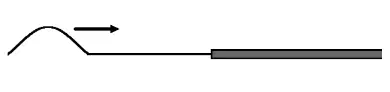
A wave pulse travels to the right along a thin string. The string is connected to a thick rope. Which of the following is true about the direction of the reflected and transmitted pulses?
They are both upright
They are both inverted
The reflected is upright and transmitted is inverted
The reflected is inverted and transmitted is upright

Two pulses of equal positive amplitude travel toward each other on a string. Which of the following is true about an oscillating point where the pulses pass through each other?


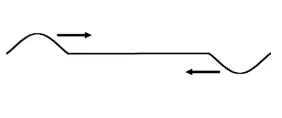
Two pulses of equal and opposite amplitude travel toward each other on a string. Which of the following is true about an oscillating point where the pulses pass through each other?


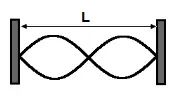
A string of length L oscillates at a frequency at which a standing wave is produced. What is the wavelength of the wave in the string?
L
L/2
L/3
2L/3
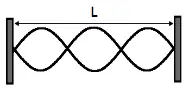
A string of length L oscillates at a frequency at which a standing wave is produced. What is the wavelength of the wave in the string?
L
L/2
L/3
2L/3
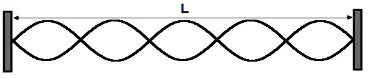
A string of length L oscillates at a frequency at which a standing wave is produced. What is the wavelength of the wave in the string?
L
L/5
2L/3
2L/5
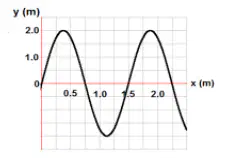
A “snapshot” of a wave is given on the graph. What is the amplitude of oscillations?
0.5 m
1 m
1.5 m
2 m
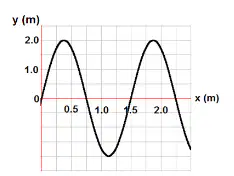
A “snapshot” of a wave is given on the graph. What is the wavelength?
1 m
1.5 m
2 m
2.5 m

A “snapshot” of a wave is given on the graph. What is the speed of the wave if the frequency of oscillation is 16 Hz?
8 m/s
16 m/s
24 m/s
36 m/s

A string with a length of 3 m oscillates at a frequency 6 Hz. What is the speed of the wave in the string?
9 m/s
12 m/s
15 m/s
18 m/s

Mechanical wave is defined as the waves produced by a disturbance in a
medium causes the vibration of particles in the medium to ________________________________
transfer the electromagnetic
transfer the energy.
transfer the heat

Which part of the wave is this?
Crest
Trough
Compression
Rarefaction
Water waves and waves on a string is a type of...
Transverse wave
Longitudinal wave
Both of the waves
The ____________________________ are produced by
the superposition of two progressive waves of
equal in amplitude and frequency, traveling in
opposite direction.
stationary wave
progressive wave
sound wave
heat
What is Node?
Zero displacement
Back and forth displacement
Maximum displacement
Linear displacement
What is the wavelength?
length between crest to crest or trough to trough
the height of a wave
how fast the wave goes
the amount of times a wave passes through a certain point
Transverse wave Is defined as a wave in which the direction of vibrations of the particle is (a) to the direction of the wave propagation (wave speed)
What is two factors that influence sound intensity?
node and antinode
amplitude and distance
(a) refers to the change in
observed frequency during the relative
motion between a wave source and its
observer.
Waves transfer _______.
particles
matter
energy
_____ waves have vibrations that run parallel to the direction the wave travels, and _____ waves have vibrations that run perpendicular to the direction the wave travels.
transverse, longitudinal
longitudinal, transverse
Examples of this type of waves include water waves, waves on a string/jump rope, and light waves.
transverse
longitudinal
Examples of _____ waves include sound waves and earthquake P-waves.
transverse
longitudinal
_______ is the distance between waves, measured from one crest to the next crest.
Wavelength
Frequency
Amplitude
The _______ is the highest point on a transverse wave, and the ____ is the lowest point.
Trough, Crest
Crest, Trough
Compression, Rarefaction
Rarefaction, Compression
The _______ is the size or height of a wave, measured from the equilibrium to the crest or trough.
Amplitude
Wavelength
Frequency

The _______ of a wave is how many waves pass a given point every second.
Frequency
Wavelength
Amplitude
Frequency is measured in _______.
Hertz (Hz)
Meters per second
Meters
Newtons
Frequency is how many waves pass a point in 1 second. If 100 waves pass a given point in 4 seconds, what is the wave's frequency?
25 Hz
100 Hz
4 Hz
400 Hz

In a longitudinal wave, a ____ is an area where the particles are spread apart and a ____ is an area where the particles are close together.
crest, trough
compression, rarefaction
rarefaction, compression
trough, crest

Examples of ________ waves include visible light, xrays, ultraviolet, and radio waves.
transverse
longitudinal
Waves that can travel through empty space are called _____ waves. Waves that require a medium to travel, such as air or water, are called _____ waves.
mechanical, electromagnetic
electromagnetic, mechanical
crest, trough
compressional, rarefactional

In the diagram of a compressional wave, A is showing a ___ while B is showing a ___.
compression, rarefaction
trough, crest
rarefaction, compression
crest, trough

In this diagram of a transverse wave, A is showing the wave's _____ and B is showing the wave's _____.
amplitude, trough
amplitude, crest
wavelength, trough
wavelength, crest

In this diagram of a transverse wave, C is showing the wave's _____ and D is showing the wave's _____.
crest, amplitude
trough, amplitude
crest, wavelength
trough, wavelength

