
 Worksheets
Fossil test review
Total questions: 60
Worksheet time: 2hrs 38mins
Name
Class
Date
1.
An organism that no longer exists on Earth is called
a)
Decayed
b)
Evolved
c)
Extinct
d)
Preserved
2.
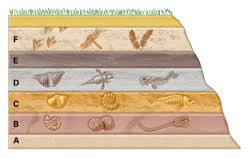
Which rock layer contains the newest fossils?
a)
F
b)
E
c)
B
d)
C
3.
The best index fossils have which two traits?
a)
widespread geographically, long lifespan
b)
widespread geographically, short lifespan
c)
specific place, long lifespan
d)
specific place, short lifespan
4.
Index fossils help determine relative age through correlating rock layers.
a)
True
b)
False
5.
One of the oldest organisms discovered is called a(n) _________.
a)
dinosaur
b)
micro-organism
c)
trilobite
d)
cast and mold fossil
6.

According to the law of superposition, which layer is the youngest?
a)
A
b)
B
c)
C
7.

Which rock layer in the diagram seems to be the oldest?
a)
F
b)
E
c)
B
d)
A
8.
Which statement is true about the fossil record?
a)
It is a record of all living things
b)
It shows how our climate has remained the same over time
c)
It provides evidence for history of life on Earth
d)
It does not support the theory of evolution
9.
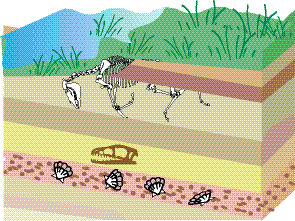
According to the law of superposition, the oldest fossils are found
a)
At the top of the rock layers
b)
Near the bottom of the rock layers
c)
In the middle of the rock layers
d)
Somewhat near the surface
10.
The Law of Superposition helps scientists to determine what?
a)
The absolute age of rock layers
b)
The age of fossils
c)
The relative age of rock layers
d)
the super powers of rocks
11.

Which rock layer most likely contains fossils of the most recently evolved organisms?
a)
1
b)
2
c)
3
d)
4
12.

Index fossils CAN tell us the age of a rock layer.
a)
True
b)
False
13.
What is any evidence of ancient life called?
a)
Half-life
b)
Fossil
c)
Unconformity
d)
Uniformitarianism
14.

Which of the following organisms formed last on Earth?
a)
Jellyfish
b)
Shark
c)
Lizards
d)
Horses
15.

Scientists chose where units of geologic time began and ended based on major changes in life forms at certain times.
a)
True
b)
False
16.

To be considered an index fossil, it had to have lived for a relatively short period of time.
a)
True
b)
False
17.

Which of the following is the youngest rock layer in the "Index Fossil Correlation?"
a)
Hermit Shale
b)
Z4
c)
Z6
d)
B6
18.

What type of fossil is this?
a)
Mold
b)
Cast
c)
Preserved remains
d)
Trace fossil
19.

In which kind of rock do we usually find a fossil?
a)
sedimentary rock
b)
rock candy
c)
hard rock
20.
Which is an example of a trace fossil?
a)
animal tracks
b)
coprolite
c)
burrows
d)
all of the answers given here
21.

What is a fossil?
a)
the remains or physical evidence of an organism preserved by geologic processes
b)
fossils can be preserved in rock, amber, asphalt, or ice
c)
any naturally preserved evidence of animal activity
d)
fossil of an organism that lived during a relatively short period of time
22.
Fossilized tracks or other evidence of activity of an organism.
a)
trail
b)
trace
c)
index
d)
absolute
23.
Which of the following would NOT help an organism become fossilized?
a)
shell
b)
skeleton
c)
buried quickly with sediment
d)
soft body parts
24.
According to the law of superposition, the oldest fossils are found
a)
At the top of the rock layers
b)
Near the bottom of the rock layers
c)
In the middle of the rock layers
d)
Somewhat near the surface
25.
Fossils provide evidence for all of the following EXCEPT
a)
when organisms lived
b)
where organisms lived
c)
what year the organism was born
d)
how they lived
26.
What organism typically eats remains before they can be fossilized?
a)
producers
b)
secondary consumers
c)
primary consumers
d)
scavengers
27.
Fossils used to determine the age of a rock layer.
a)
trace
b)
index
c)
cast
d)
trail
28.
Rock produces a copy of the original organism.
a)
coal
b)
cast
c)
mold
d)
trace
29.
Fossils can be all of the following except..
a)
remains
b)
igneous rocks
c)
traces
d)
imprints
30.
Minerals move into the tiny spaces of hard body parts.
a)
carbon film
b)
permineralized remains
c)
cast
d)
mold
31.
The age of something compared to the age of other things. (Not an exact age)
a)
relative age
b)
absolute age
c)
superposition
d)
index
32.
Coal is made from
a)
igneous rock
b)
metamorphic rock
c)
remains of organisms
d)
magma
33.
A cavity or imprint of an organism
a)
cast
b)
mold
c)
coal
d)
trace fossil
34.
All of the following have preserved the original remains of an organism EXCEPT
a)
tar
b)
ice
c)
amber
d)
water
35.
In undisturbed rock layers, the oldest rocks are on bottom and the youngest rocks are on top.
a)
absolute age
b)
relative age
c)
principle of superposition
d)
index fossils
36.
The age of something in years
a)
relative age
b)
absolute age
c)
superposition
d)
index
37.

Rock or Mineral Copy of the original organism
a)
True
b)
Cast
c)
Mold
d)
Trace
38.

A dinosaur footprint
a)
True
b)
Cast
c)
Mold
d)
Trace
39.

Hollow space left when a plant or animal decays
a)
True
b)
Cast
c)
Mold
d)
Trace
40.

Preserved dinosaur claw
a)
True
b)
Cast
c)
Mold
d)
Trace
41.

Fossilized dinosaur tooth marks
a)
True
b)
Cast
c)
Mold
d)
Trace
42.
Fossilized dinosaur tooth marks
a)
True
b)
Cast
c)
Mold
d)
Trace
43.

Wooly mammoth skull
a)
True
b)
Mold
c)
Cast
d)
Trace
44.

Impression of an ancient shell
a)
True
b)
Mold
c)
Cast
d)
Trace
45.

Which of the following does NOT lead to a quick burial to create a fossil?
a)
Ocean floor
b)
Tree sap
c)
Tar pit
d)
The desert
46.

Type of fossil
a)
Trace
b)
Cast
c)
Mold
d)
True
47.

What type of fossil is on the left?
a)
Cast
b)
Mold
c)
Trace
d)
Carbon Film
48.

Type of fossil?
a)
Cast
b)
Mold
c)
True
d)
Carbon Film
49.

Type of fossil?
a)
True
b)
Mold
c)
Cast
d)
Carbon Film
50.

Type of fossil?
a)
True
b)
Mold
c)
Trace
d)
Carbon Film
51.

Gives an exact age in years
a)
Relative Dating
b)
Absolute Dating
52.

Determines age by rock strata
a)
Relative Dating
b)
Absolute Dating
53.

Name the law which tells why layer "D" is older than layer "A."
a)
Superposition
b)
Relativity
c)
Fossil
d)
Urban's
54.

Which of the following happened most recently?
a)
A. Deposition of Unit C
b)
B. Deposition of Unit B
c)
C. Deposition of Unit F
d)
D. Tilting of C, D, E, and F
55.

George Geologist finds that unit F contains eroded pieces of unit G. Which of the following statement is TRUE?
a)
A. The granite is younger than unit B.
b)
B. Unit B is younger than the granite.
c)
Unit B and granite are the same age.
d)
D. The relative ages of the granite and unit B cannot be determined from the information given.
56.
The Law of Superposition helps scientists to determine what?
a)
The absolute age of rock layers
b)
The age of fossils
c)
The relative age of rock layers
d)
the super powers of rocks
57.

This rock was formed by smaller pieces of rock that settled at the bottom of a lake millions of years ago. What type of rock is this?
a)
Sedimentary
b)
Igneous
c)
Metamorphic
58.

Relative age of a rock is the number of years that have passed since the rock formed?
a)
true
b)
false
59.

Look at the diagram, what layer did animal E first show up in?
a)
Layers #4
b)
Layers #5
c)
Layers #6
d)
Layers #7
60.

What type of fossil is this?
a)
Trace fossil
b)
Mold
c)
Cast
d)
Carbon film
100 %

