wayground logo

Free Printable Worksheets

NEW

Font size

S
M
L
XL
Worksheets

Bacteria, Archaea, Viruses

Total questions: 69

Worksheet time: 48mins

Name
Class
Date
1.
Prokaryotes are unlike all other organisms in that their cells 
a)
do not have a nucleus
b)
have organelles
c)
have cell walls
2.
Bacteria that contain chlorophyll and perform photosynthesis like a plant belong in the group
a)
archaebacteria
b)
cyanobacteria
c)
chemoautographs
d)
pathogens
3.
Name the three cell shapes of prokaryotes
a)
rod, circle spiral
b)
cocci, bacilli, spirilli
c)
crystal, tube, spaghetti
4.
Name this bacteria shape
a)
coccus
b)
spirillum
c)
bacillus
5.
Name this bacteria shape
a)
bacillus
b)
coccus
c)
spirillum
6.
Name this bacteria shape
a)
coccus
b)
bacillus
c)
spirillum
7.
 Bacteria that help break down dead material in the environment are called 
a)
vaccines
b)
decomposers
c)
oats
8.
True or False: Some types of bacteria eat and clean up oil spills
a)
True
b)
False
9.
Bacteria cells are exactly like animal cells
a)
True
b)
False
10.
How do bacteria move?
a)
flagella
b)
cilia
c)
they don't
11.
All bacteria are harmful to humans
a)
True
b)
False
12.
Bacteria are unicellular
a)
True
b)
False
13.
Most bacteria are...
a)
Autotrophs
b)
Heterotrophs
14.
Archaebacteria live in extreme environments
a)
True
b)
False
15.
The first living organism probably belonged to which kingdom?
a)
Archaebacteria
b)
Fungus
c)
Plant
d)
Animal
16.
Which disease is not caused by bacteria?
a)
Strep throat
b)
Pneumonia
c)
Food poisoning
d)
Influenza (the Flu)
17.
Bacteria help you digest food.
a)
True
b)
False
18.

_____________ live in extreme environments.

a)

Archaea

b)

Bacteria

19.

Bacteria contain a nucleus and membrane-bound organelles.

a)

True

b)

False

20.

Bacteria contain circular chromosomes called

a)

Ribosomes

b)

Coccus

c)

Plasmids

d)

Nucleus

21.

The two types of appendages for movement are called..

a)

Coccus and bacillus

b)

Flagella and pili

c)

Spirillum and pili

d)

Flagella and bacillus

22.

Spirillum shaped bacteria are

a)

rod-shaped

b)

spherical

c)

spiral

23.

Bacillus shaped bacteria are

a)

Rod-shaped

b)

Spherical

c)

Spiral

24.

Coccus shaped bacteria are

a)

rod-shaped

b)

spherical

c)

spiral

25.

Diplo- grouped bacteria are

a)

2 bacteria

b)

a chain of bacteria

c)

a cluster of bacteria

26.

Strepto- grouped bacteria are

a)

2 bacteria

b)

a chain of bacteria

c)

a cluster of bacteria

27.

A _______________________ lives in an anaerobic environment like swamps, sewage treatment plants, and the digestive tracts of animals.

a)

Methanogens

b)

Halophiles

c)

Thermoacidophiles

28.

_________________ live in extremely salty environments.

a)

Methanogens

b)

Halophiles

c)

Thermoacidophiles

29.

____________________________ live in extremely hot environments.

a)

Methanogens

b)

Halophiles

c)

Thermophiles

30.

A ________________________ uses sunlight to make food.

a)

Saprotroph

b)

Photoautotroph

c)

Chemoautotroph

31.

A _________________________ uses inorganic matter for food.

a)

Saprotroph

b)

Photoautotroph

c)

Chemoautotroph

32.

This kind of reproduction results in identical cells.

a)

Binary Fission (asexual)

b)

Conjugation (sexual)

33.

During conjugation, 2 bacteria are held together by their

a)

Flaglla

b)

Pili

34.

Endospores are really easy to destroy.

a)

True

b)

False

35.
Endospores form during
a)
binary fission.
b)
sunlight hours.
c)
respiration.
d)
harsh environmental conditions
36.
What important role do bacteria called decomposers play?
a)
They return basic chemicals to the environment.
b)
 They produce vitamins
c)
They slow down food spoilage.
d)
They kill harmful bacteria.
37.
Binary fission occurs when a bacterium transfers some of its genetic material to another _____________
a)
cell
b)
virus
c)
eukaryote
d)
bacterium
38.
Some bacteria move by using a long, whip-like structure called a(n) ____________________
a)
tail
b)
cillia
c)
organs
d)
flagellum
39.
A bacterial infection can be cured with an antibiotic because ____________
a)
a virus can be killed with an antibiotic
b)
bacteria are living organisms
c)
bacteria do not cause bad infections
d)
bacterial infections only occur in infants
40.
What is found in the cytoplasm of bacteria cells?
a)
The DNA
b)
The Nucleus
c)
the protein coat
d)
the flagellum
41.
Describe the three ways bacteria reproduce.
a)
binary fission, conjugation, forming endospores
b)
binary fission, budding, forming endospores
c)
conjugation, sexual and forming endospores
d)
they cannot reproduce
42.
Explain how bacteria act as decomposers for our environment.
a)
They rot and become stinky so they go out with the trash
b)
They break down dead or decaying matter into needed nutrients
c)
They help bugs to survive the winter
d)
They turn glass into sand 
43.
Bacteria help you digest food.
a)
True
b)
False
44.
Bacteria are only found in dirty places
a)
True
b)
False
45.
What are these images?
a)
Shapes of viruses
b)
Shapes of bacteria
c)
Shapes of protists
d)
Shapes of fungi
46.
Penicillin is called a/an ________________?
a)
antibody
b)
antibiotic
c)
vaccine
d)
enzyme
47.
Bacteria are smaller then viruses.
a)
True
b)
False
48.
In order to avoid harmful bacteria,
a)
Exercise and get plenty of rest
b)
Wash with warm water and soap
c)
Avoid contact with others who may be sick
d)
All of the above
49.
Microorganisms are found everywhere.
a)
True
b)
False
50.
A bacterial infection may be treated with antibiotics, but a virus cannot
a)
True
b)
False
51.
A ___ is made by using pieces of deactivated viruses or dead pathogens.
a)
Flagella
b)
Vaccine
c)
Spore
d)
Antibodies
52.
Reasons that viruses are considered to be nonliving is because
a)
They are not cellular
b)
They cannot reproduce on their own
c)
They cannot make proteins
d)
all of the above
53.
What do viruses need to reproduce?
a)
they need genetic material
b)
They need a host cell
c)
They need  bacteria
d)
They need insulin
54.
When a virus invades a living cell, its _______
takes over the cell's functions.
a)
outer coat
b)
genetic material
c)
core
d)
cytoplasm
55.
What do viruses have in common with living cells? They both...
a)
store genetic information
b)
have chloroplasts
c)
use glucose for cellular respiration
d)
have endoplasmic reticulum
56.
A tiny non-living particle that invades and then multiplies inside of a living cell is called a:
a)
vaccine
b)
virus
c)
bacteriophage
57.
Antibiotics kill viruses
a)
True
b)
False
58.
Viruses are cells. 
a)
True 
b)
False
59.
How could you describe the size of a virus?
a)
Smaller than bacteria
b)
Larger than a parasite
c)
About the size of a dime
d)
Smaller than a proton
60.
Viruses are...
a)
prokaryotic
b)
eukaryotic
c)
non-living
d)
endospores
61.
What is a pathogen?
a)
Bacteria
b)
Virus
c)
Type of disease infection
d)
Protist
62.
Viruses are _______.
a)
producers
b)
consumers
c)
parasites
d)
decomposers
63.
How does a virus cause a person to develop the common cold?
a)
invades the host cell to reproduce
b)
removes energy from the host cell
c)
produces toxins in the host cell
d)
protects the host cell from bacteria
64.
One reason that viruses are considered to be nonliving is that they are not made of ______.
a)
protein
b)
viruses
c)
bacteria
d)
cells
65.
Communicable diseases are
a)
not contagious
b)
conditions that people are born with
c)
passed from one person to another
d)
caused through hereditary factors
66.
Antibiotics kill viruses
a)
True
b)
False
67.
Which viral life cycle kills its host cell by lysing?
a)
lytic
b)
mitosis
c)
lysogenic
d)
S phase
68.
How many basic parts does a virus have ?
a)
1
b)
2
c)
3
d)
4
69.
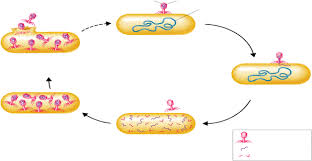
What is shown here?
a)
Lysogenic Cycle
b)
Lytic Cycle
c)
Binary Fission
d)
Conjugation