
 Worksheets
Disease Unit- 2026
Total questions: 64
Worksheet time: 2hrs 7mins
Programmed cell death is known as
Mitosis
Division
Apoptosis
Controlosis
True or False: Cancer cells are assigned a specific task, but do not function properly due to a mutation or damage to DNA.
True
False
True or False: Normal cells have tumor or growth suppressors that control cell growth so that cells stop dividing when they need to.
True
False
When enough cells have been made and are contacted on all sides by other cells around it, they stop dividing. This is known as...
Mitosis
Contact inhibition
Oncogenesis
Carcinogens
True or False: Normal cells will self destruct if they have a disease or mutation so that the mutation doesn't spread.
True
False
The process that cells use to make more cells for growth and repair is known as...
Oncogenesis
Apoptosis
Mitosis
Slimotosis
What are the reasons a cell might undergo mitosis?
If an organism is getting bigger or growing
If old cells die
If cells get damaged
All of the above
When a cell has a mutation, what is SUPPOSED to happen?
Cell continues to divide anyway
Cell undergoes apoptosis
Cell divides until it reaches a high density
Cell creates more mutations to fix the old mutation
A gene is...
A cancer cell
Melanoma
a section of DNA that codes for specific thing in a cell
a whole chromosome

Based on the image, what are the two types of vessels that can attach to a tumor? Check all that apply.
Blood vessel
Lung vessel
Lymph vessel
Neuron vessel

95% of the cells life cycle
Stage where DNA is copied
Interphase
Metaphase
Telophase
Prophase

Nuclear membrane disappears
Chromosomes can now be seen
Centrioles move to opposite sides
Metaphase
Interphase
Telophase
Prophase

Chromosomes line up at the equator of the cell
Spindle fibers extend from the centrioles to the middle of the chromosomes
Prophase
Metaphase
Anaphase
Interphase

Chromatids separate
Anaphase
Metaphase
Prophase
Telophase

Nuclear membrane reforms around the new daughter cells.
Cytoplasm begins to "pinch" in.
Anaphase
Metaphase
Telophase
Interphase

During what phase of the cell cycle is DNA replicated?
G1 phase
G2 phase
S phase
M phase
Put the following stages of the cell cycle in order: G2, S, G1, M.
S, G1, G2, M
G1, S, G2, M
G1, M, G2, S
M, G1, S, G2

Genes whose protein prevent cell division or lead to cell death.
Proto-Oncogenes
Oncogenes
Tumor Suppressor Genes
A disease caused by uncontrolled division of abnormal cells
Cancer
Osteoporosis
Sickle Cell Anemia
Arthritis
Random errors in gene replication that lead to a change in the sequence of DNA
Mutations
Cell Cycle Checkpoints
Mitosis
What is the purpose of the cell cycle checkpoints?
To make sure the cell isn't duplicating too fast
They were there by chance and happen to help reduce the chances of cancer
To make sure that all parts of the cell are healthy to avoid mutations
A ________________is a critical point where stop and go signals can regulate the cycle
tumor
checkpoint
growth factor
oncogene
Select all of the cell cycle checkpoints
Cell growth checkpoint
DNA synthesis checkpoint
Cancer checkpoint
Mitosis checkpoints
When is apoptosis initiated?
When DNA damage is repaired.
When cells are removed from the cell cycle.
When DNA damage cannot be repaired.
This is the cell cycle checkpoint that makes sure the correct number of chromosomes are present and attached to the spindle fibers
G1 Checkpoint
G2 Checkpoint
M Checkpoint
I Checkpoint
This is the cell cycle checkpoint that makes sure all DNA has been replicated correctly.
G1 Checkpoint
S Checkpoint
M Checkpoint
I Checkpoint
During which stage of the cell cycle does the nucleus divide?
interphase
mitosis
endocytosis
cytokinesis

What can cancer cells do that normal cells cannot?
they do everything the same
they regenerate their telomeres, preventing them from aging
they go through cellular division
they grow
What gene is often mutated to become inactive which can lead to cancers?
p57
EVR 1
p53
telomerase
The scientist who said that cells lose DNA with each cell division and therefore will only divide a finite number of times is
James Watson
Leonard Hayflick
Albert Einstein
Rachel Carson
Suppose someone has more telomerase activity than normal, what would this indicate about that person's cells? (select all answers that apply)
they could be cancerous
their cells could be immortal
their cells would die quickly
they may have long telomeres
The Hayflick limit involves
the size a cell can reach before dividing
a cell dividing about 50 times before it reaches senescence
telomeres lengthening with each cell division
None of the choices

What process is being represented in this diagram?
asexual reproduction
mitosis
meiosis
DNA replication

What process is being represented in this diagram?
sexual reproduction
mitosis
meiosis
DNA replication
If an egg cell of an organism contains 12 chromosomes, how many chromosomes should be present in a heart cell of the same organism?
12
24
6
48
What is a gamete?
a body cell (ex. skin or heart cell)
an autosome
a sex cell (ex. sperm or egg)
a somatic cell
How many chromosomes does a sex cell have compared to a body cell?
twice as many
the same amount
the same, but replicated
half as many
Somatic cells are formed during what process?
meiosis
mitosis
DNA replication
interphase

During which phase are sister chromatids lined up in a single file along the center of the cell?
Metaphase I
Metaphase II
Telophase I
Telophase II

Name this phase of Meiosis:
Prophase II
Metaphase I
Metaphase II
Anaphase II
In Anaphase II, the _________ separate.
Homologues
Sister Chromatids
Tetrads
Centrioles


Name this phase of Meiosis
Anaphase II
Anaphase I
Metaphase I
Metaphase II

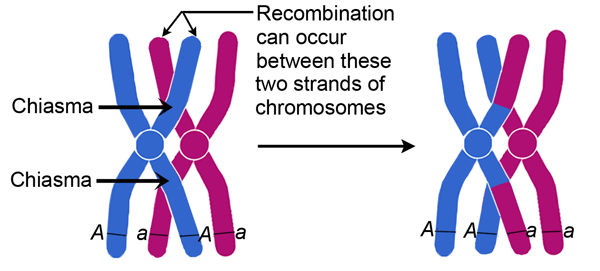
In which stage of MEIOSIS does crossing over occur? (The exchange of genetic material between chromosomes in a tetrad.)
Anaphase I
Metaphase I
Prophase I
Telophase I
Which of the following is the best definition for MEIOSIS?
the process of two haploid cells uniting
the counting of chromosomes within a diploid cell
a two-step process that reduces the number of chromosomes in half such that there is only one copy of all the chromosomes
the equational division of a cell into two identical copies

Which phase of meiosis is shown in the picture?
Prophase I
Metaphase I
Anaphase I
Telophase I

Which phase of meiosis is shown in the picture?
prophase I
metaphase I
anaphase I
telophase I
Involves crossing over
Mitosis
Meiosis
Both
Ends with diploid number of chromosomes
Mitosis
Meiosis
Both
involves 1 division of nucleus
Mitosis
Meiosis
Both
produces identical daughter cells
Mitosis
Meiosis
Both
forms gametes
Mitosis
Meiosis
Both
produces haploid cells
Mitosis
Meiosis
Both

