wayground logo

Free Printable Worksheets

NEW

Font size

S
M
L
XL
Worksheets

Plate Tectonics, quizizz 2

Total questions: 53

Worksheet time: 41mins

Name
Class
Date
1.
What did Wegener think happened during continental drift?
a)
continents froze over
b)
continents moved
c)
the mantle warmed
d)
convection stopped
2.
The area around the pacific plate where boundaries form is called...
a)
death ring
b)
fire zone
c)
ring of fire
d)
zone of fire
3.
Associated with transform boundaries.
a)
Volcanoes
b)
mountains
c)
trenches
d)
earthquakes
4.
What happens to temperature as you go deeper in the Earth?
a)
decreases
b)
increases
c)
fluctuates
d)
remains the same
5.
The vibration and shaking of the Earth...
a)
volcanism
b)
plateau
c)
earthquake
d)
richter scale
6.
Younger sea floor crust is located...
a)
farther from the mid-ocean ridges
b)
at the mid ocean ridges
c)
at the subduction zone
d)
near the continents
7.
This land formation occurs at a divergent continental/ continental boundary.
a)
mid ocean ridge
b)
deep ocean trench
c)
pacific hot spot
d)
rift valley
8.
Which ocean is expanding due to a mid-ocean ridge?
a)
Indian
b)
Dead Sea
c)
Atlantic
d)
Artic
9.
This fault occurs when crust slides past each other with little up or down movement.
a)
normal
b)
compression
c)
reverse
d)
strike-slip
10.
Which of the following is where one plate slides under another plate and old crust is recycled?
a)
submarine zone
b)
divergence zone
c)
subduction zone
d)
lower zone
11.
Created by a divergent boundary.
a)
Rocky Mountains
b)
Mariana Trench
c)
Mid Atlantic ridge
12.
This area contains over 70 percent of volcanoes and 90 percent of earthquakes in the world.
a)
North American plate
b)
ring of fire
c)
fiery rings 
d)
African plate
13.
Which of the following is the softer moving area of the mantle that contains convection currents?
a)
asthenosphere
b)
lithosphere
c)
oceanic crust
d)
outer core
14.
The hanging wall slides up and over the footwall is what kind of fault?
a)
strike-slip
b)
normal
c)
reverse
15.
What fault has little up or down motion?
a)
strike-slip
b)
normal
c)
reverse
16.
When the hanging wall slips downward below the footwall, what kind of fault is it?
a)
strike-slip
b)
normal
c)
reverse
17.
The surface along which rock break and slide past each other is called a:
a)
fracture
b)
fault
c)
joint
18.
A type of fault where rocks on either side move past each other sideways is called:
a)
normal fault
b)
reverse fault
c)
strike-slip fault
19.
a)
normal fault
b)
reverse fault
c)
strike-slip fault
20.
a)
normal fault
b)
reverse fault
c)
strike-slip fault
21.
a)
normal fault
b)
reverse fault
c)
strike-slip fault
22.
The cat is standing on the...
a)
foot wall
b)
hanging wall
c)
left
d)
weirdest elevator ever
23.

A _____ is a break in Earth's crust where rocks can slide past each other.

a)

fault

b)

lithosphere

c)

plate tectonic

d)

rift

24.
The crust and the rigid upper part of the mantle form the part of Earth called the ______________.
a)
lithosphere
b)
mid-ocean ridge
c)
rift
d)
core
25.
The lithosphere plates are constantly on the move.
a)
true
b)
false
26.
Earth's lithosphere sits on top of the asthenosphere.
a)
true
b)
false
27.
____________ is the theory that the lithosphere is divided into plates that are always moving.
a)
Plate tectonics
b)
Mid-Ocean ridge
c)
Divergent
d)
Fault
28.
The lithosphere moves only a few _______ a year.
a)
centimeters
b)
feet
c)
yards
d)
miles
29.
_______________ is a chain of mountains that runs about 41,600 miles through the world's oceans.
a)
Rift
b)
Mid-Ocean Ridge
c)
Valley
d)
Rocky Mountains
30.

_____________ is the process which takes place along the mid-ocean ridge in which liquid rock rises and becomes solid as two tectonic plates move farther apart.

a)

sea-floor spreading

b)

mid-ocean ridge

c)

rift

d)

transform fault

31.
The San Andreas Fault is located in what state?
a)
Calfiornia
b)
Arizona
c)
Ohio
d)
Alaska
32.
The San Andreas Fault in California is an example of a ___________ fault.
a)
transform
b)
divergent
c)
convergent
d)
rift
33.
Scientists call the single super continent that once existed on Earth _________.
a)
Pangea
b)
Panda
c)
Pan
d)
Super Big Continent
34.
Many ________ form along convergent boundaries.
a)
volcanoes
b)
oceans
c)
continents
d)
plateaus
35.
Name the one fault boundary where crust is neither formed nor destroyed.
a)
transform 
b)
divergent
c)
convergent
36.
What is one clue/evidence that scientists have used to conclude that the continents once were together?
a)
fossils
b)
water levels
c)
elevation above sea level
37.
What type of plate is thicker?  Continental or Oceanic
a)
continental
b)
oceanic
38.
What is "solid earth" called?
a)
Atmosphere
b)

Hydrosphere

c)
Lithosphere
d)
Biosphere
39.
What is the outermost layer of Earth called?
a)
Mantle
b)
Crust
c)
Inner Core
d)
Outer Core
40.
The theory that says Earth's continents once made up an ancient supercontinent, and have been drifting apart ever since, is called the theory of...
a)
Pangea
b)
Plate Tectonics
c)
Natural Selection
d)
Gravity
41.

Islands can form from magma which is pushed up at a __________ plate boundary

a)

Divergent

b)

Convergent

c)

Transform

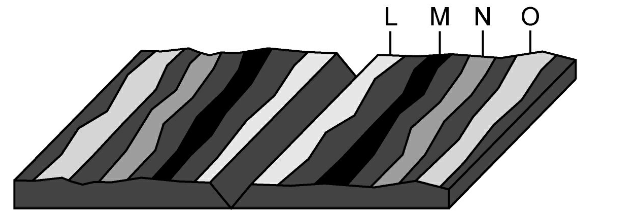
42.
Where would the oldest rock be found?
a)
L
b)
M
c)
N
d)
O
43.
How is it possible for new crust to be formed without increasing the surface area of the Earth?
a)
Crust is destroyed at the same time it is created
b)
New crust is underwater where it sinks
c)
New crust breaks more easily than old crust
44.
Mountains are created when....
a)
Two continental plates collide
b)
Two oceanic plates pull apart
c)
An Oceanic plate subducts under a Continental Plate
d)
Two continental plates pull apart
45.

Meteorologist who discovered that the continents were 'drifting'

a)

Alfred Wegener

b)

Harry Hess

46.

Geologist and Navy Admiral who mapped the seafloor in WWII discovering the Mid Atlantic Ridge and ocean trenches which led to his theory of 'seafloor spreading'

a)

Alfred Wegener

b)

Harry Hess

47.

Wegener said the continents seemed to ...

a)

fit together like puzzle pieces

b)

have never moved

c)

be made of coal

d)

sinking into the mantle

48.

Glossopteris was a...

a)

reptile that could not have swam across the Atlantic ocean

b)

tropical fern that could not survive in cold climates

c)

matching mountain range

d)

coal bed found in Antarctica

49.

_____________ only form in tropical environments near the equator but they are found even in Antarctica.

a)

Mountains

b)

Coal Beds

c)

Glaciers

d)

Fossils

50.

Deep trenches in the ocean are where old seafloor or crust is recycled are called __________.

a)

subduction zones

b)

mid ocean ridges

c)

fault lines

d)

hot spots

51.

The theories of Continental Drift and Seafloor Spreading led to the modern theory of ________________.

a)

fault lines

b)

plate drift

c)

plate tectonics

d)

lithospheric shift

52.

People did not believe Wegener's theory because he...

a)

could not explain how it was happening.

b)

was not very well liked by his peers.

c)

was a Geologist.

d)

was not as smart as Harry Hess.

53.

The mechanism to explain how the continents drifted that Harry Hess contributed is called ___________________.

a)

plate tectonic theory

b)

continental drift

c)

seafloor spreading

d)

hot spot formation